



How do economic factors affect pensions?
Most pensions these days are defined contribution schemes. Generally speaking, that means what you pay in - including personal, third party, and employer contributions, investment returns, and tax relief - is what you have at retirement.
With these types of pension, you have some control over how much you contribute, what you invest in, and the size of your withdrawals in retirement (from age 55 rising to 57 from 2028).
Your pension is usually invested in a range of assets, such as company shares and bonds, on your behalf by your provider. This gives your money the opportunity to grow over time.
However, that also means your savings are exposed to some economic factors outside of your control. These can make managing your pension a bit trickier.
While there’s not a lot you can do about things like inflation or interest rates, knowing about them can help. You can use this knowledge to inform the decisions you make with your pension. It might stop you from acting impulsively to unexpected events when they happen, too.
Read about a few economic factors that can affect your pension, and how you can manage your savings around them.
What external factors can affect my pension?
Many different elements could affect your savings. That includes changes to pension rules like allowances and thresholds, broader economic policy, or events that impact investment markets.
Inflation
Inflation measures the speed at which prices are rising.
Some inflation is healthy for an economy. However, over time, it can eat into your money’s spending power if inflation is higher than the return on your savings.
Inflation can impact your pension in a couple of ways.
- Influencing your investment strategy - your returns need to beat or at least be in line with inflation. Otherwise, your pension savings are losing value in real terms.
- Maintaining spending power throughout retirement - prices will most likely continue rising in retirement. You need enough in your pot so that you can continue to afford the same lifestyle in the future as costs rise.
You can use the PensionBee Inflation Calculator to see how inflation can affect your pension savings. You can also adjust the size of your fund and contributions, and your expected retirement age, showing you how increasing prices could affect your pot’s spending power over time.
Interest rates
Inflation leads on to another key factor: interest rates.
Interest rates are one of the main tools policymakers have to control inflation. Generally, central banks (like the Bank of England) will:
- Raise interest rates when inflation is high - making borrowing more expensive and saving more attractive, slowing consumer spending.
- Cut interest rates when inflation is low - encouraging spending and stimulating economic growth through low savings rates and cheaper borrowing.
Interest rates can directly affect some investments within your pensions. For example, bonds are closely linked to interest rates, with prices usually moving in the opposite direction. So, your pension balance could be impacted by changing rates.
They can also affect consumer spending on the whole. For example, cutting rates can drive economic growth, which could help investments to grow too.
On the other hand, raising rates can slow growth, potentially having a knock-on impact on investments in turn.
Conflict and geopolitical uncertainty
Markets often respond to conflict and geopolitical uncertainty. Especially when there’s a knock-on effect to supply and demand of a key resource.
For example, the conflict in the Middle East in early 2026 created concerns over the global oil and gas supply.
Markets fell in response, with the S&P 500 (an index of 500 of the largest US companies) falling between the start of the year and 30 March.
You might’ve seen this drop reflected in your pension balance, with your pot’s value dipping.
But while conflict can be ongoing and last years, such market uncertainty can be short-lived and investments can recover. In fact, shortly after that drop, the S&P 500 had risen back up and even hit a new all-time high.
Past performance doesn’t necessarily indicate future performance. But this shows how markets can recover, pulling investments back up with them.
Employment and work opportunities
The job market could affect the amount you’re able to save into your pension. You could face a period of unemployment, or find it difficult to find jobs in your field if you’re self-employed.
You might have to dial down your contributions or stop paying into your pension during this time. Even small pauses can impact how much you’ll have at retirement because, as well as stopping your own personal contributions, you’ll miss out on:
- any available tax relief;
- employer contributions, if you’re eligible; and
- potential investment returns.
Government changes
The government often changes pension rules. This is typically announced at the Budget in spring or autumn, during which the Chancellor lays out the government’s spending plans and financial priorities for the next year.
Between 2023 and 2026 alone, the government announced:
- the removal of the pension lifetime allowance (LTA) and its charge;
- three new allowances to control pension lump sums;
- an increase in the pension annual allowance, rising from £40,000 to £60,000;
- that pensions would be subject to Inheritance Tax (IHT) from 2027; and
- a £2,000 cap on salary sacrifice pension contributions that are free from National Insurance contributions, coming into effect in 2029.
All these changes could affect how you’re able to manage your savings, some positively and some negatively.
It’s sensible to keep up with them so you can make decisions with your pension with the latest rules in mind.
Mitigating the effects of external factors on your pension
These events are entirely out of your control. Fortunately, there’s still plenty you can do to manage your savings.
- Stay invested for the long term - while it can be difficult, it’s important to stay invested if you can, especially in savings products like your pension, which is designed for the long term. You may even be able to benefit by contributing when markets are down.
- Choose investments or a plan that’s suitable at different life stages - your needs will change as your life does. For example, when you’re younger, you have more time for your investments to recover if they fall in value. Then, as you get older, you might want to de-risk. While that means lower returns, it can also limit the chance of your savings falling in value while you’re drawing from them.
- Have an emergency fund in retirement - this gives you access to money to use for your day-to-day living costs while you leave your pension investments to potentially recover if they’ve dipped. A good rule of thumb is to have between one and two years’ expenses in an easily accessible account, just in case you need it.
With this in mind, you might be suited to one of PensionBee's default plans and their investment approach.
Our default plan for under 50s, the Global Leaders Plan, invests in some of the world’s largest and most recognised companies. An entirely equity-based plan, it aims for growth over time, taking on a higher amount of risk.
It could be suitable if you’re seeking to grow your pension in the years and decades before you retire. You can’t access your pension in most cases until 55 (rising to 57 from 2028). So, the younger you are, the longer you have to stay invested and ride out periods of market volatility.
Meanwhile, our default plan for customers aged 50 and over is the 4Plus Plan. This actively managed plan aims to provide returns of 4% a year above the BoE base rate. It also takes less risk so your balance isn't as exposed to market dips. That can offer greater stability as you approach retirement.
Focus on what you can control
With so many factors at play, it can be confusing to try and manage your savings with them in mind.
The key is to try and focus on what you can control. That means:
- thinking about the kind of retirement you want;
- making regular contributions to build a pot that will help you achieve it; and
- choosing investments or a pension plan that helps your savings grow to what you need.
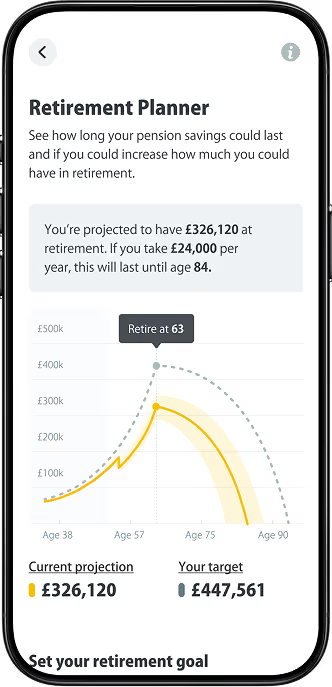
Doing the maths can help, and the PensionBee Pension Calculator is a good place to start. You can input details such as how much you and your employer currently pay in, and your desired retirement income.
From there, you can work out how much you’d need to save to reach your retirement goals.
Risk warning
As always with investments, your capital is at risk. The value of your investment can go down as well as up, and you may get back less than you invest. This information should not be regarded as financial advice.
Last edited: 22-05-2026
.webp)