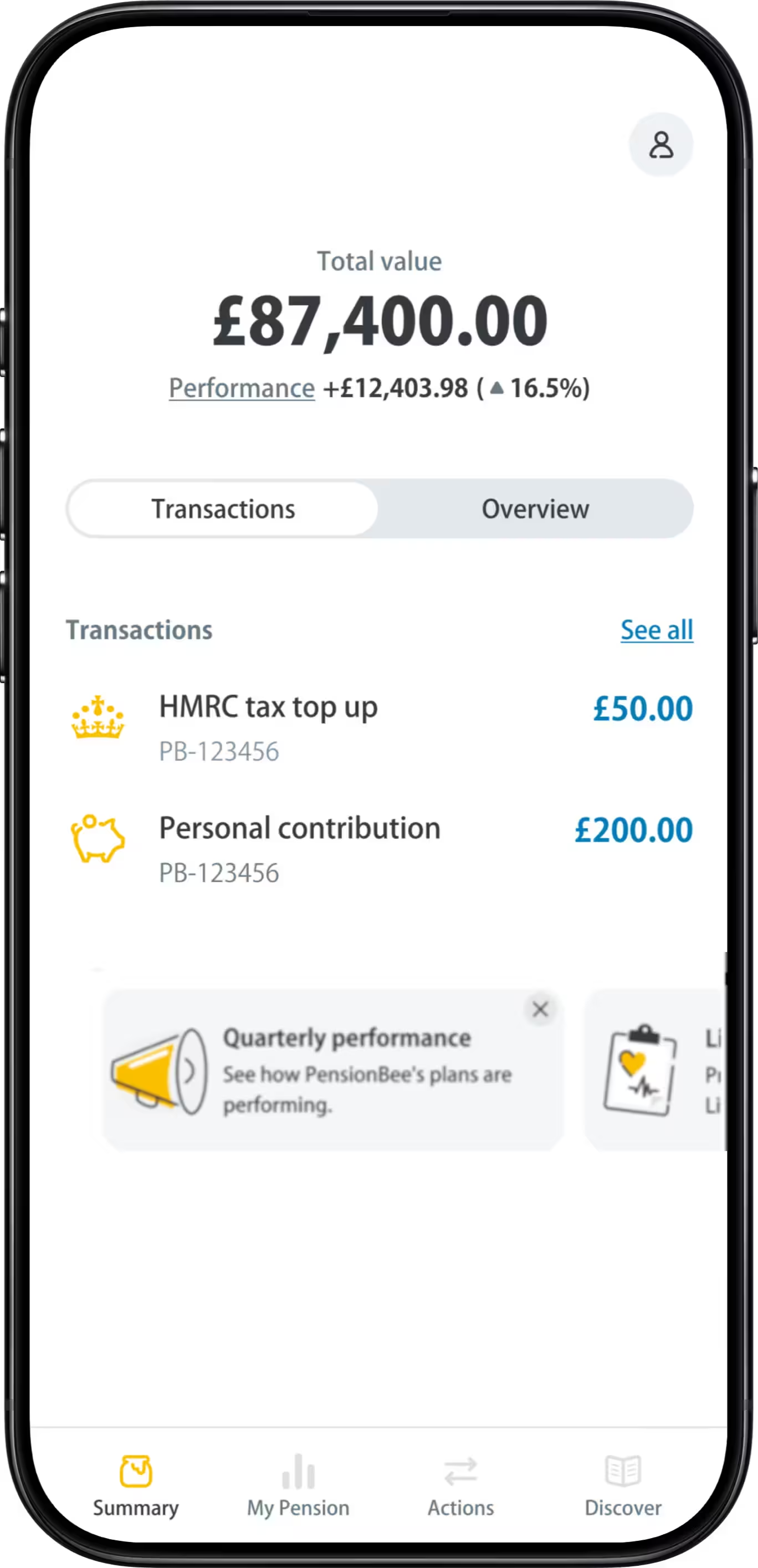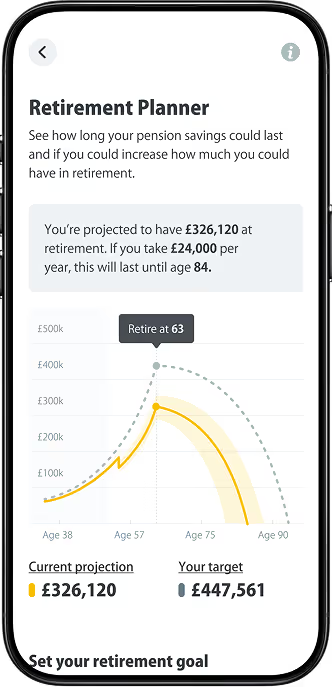




Sign up to our flexible pension plan for the self-employed and contribute as much or as little as you like, as often as you like.
SIPP contribution limits and tax relief
In _current_tax_year_yyyy_yy, you can usually tax-efficiently pay up to _annual_allowance into a Self-Invested Personal Pension (SIPP).
You can also typically claim tax relief on up to 100% of your salary, capped at _annual_allowance.
However, this could differ depending on your circumstances.
In this guide, find out how SIPP tax relief and contribution limits work.
Tax relief on SIPP contributions
A SIPP’s a form of personal pension where you have more control over how your money’s invested.
With most personal pensions, you pick an investment plan or fund, or stick with your provider’s default. But with a SIPP, you can choose individual investments.
That gives you greater flexibility in how your retirement savings are invested. However, it also means you need the knowledge to make sensible investment decisions. Otherwise, you could have less at retirement than you expect.
Like all defined contribution pensions, you can receive tax relief on eligible personal contributions to a SIPP.
Pension tax relief means the government tops up your pot based on your marginal rate of Income Tax.
There are two main ways this is usually applied:
- Net pay - you pay into your pot directly from your salary before tax.
- Relief at source - you pay into your pension and receive tax relief as a top up on your contributions.
SIPPs typically use relief at source.
In this case, your pension provider claims the basic rate (_basic_rate) tax relief from HMRC and adds it to your pot.
So, if you pay £800 into your SIPP, the government adds £200, making the total contribution £1,000. That’s a 25% tax top up on your contribution.
Higher and additional rate taxpayers can claim further relief, too. That’s usually via Self-Assessment, or a change to your tax code.
Higher rate (_higher_rate) taxpayers get an extra 20% relief. So, a £1,000 contribution effectively costs you £600.
Meanwhile, additional rate (_additional_rate) taxpayers get a further 25% relief. That makes the cost of a £1,000 contribution just £550.
Tax relief is one of the biggest benefits of saving into a SIPP. It gives your contributions a boost while cutting your tax bill.
{{dark-cta}}
SIPP contribution and tax relief limits
SIPPs also have the same contribution and tax relief limits as other pensions.
There are a couple of contribution allowances to be aware of.
Annual allowance
First, there’s the annual allowance. That’s the limit on the gross amount that can be saved into a pension each tax year without incurring tax charges.
In _current_tax_year_yyyy_yy, the standard annual allowance for pension contributions is _annual_allowance - this includes personal, employer and any third party contributions.
You can save up to _annual_allowance per year into a pension while still receiving tax relief on personal and third party contributions. Tax relief isn’t applied to employer contributions.
Low and non-earners can usually pay up to _low_earner_annual_allowance_gross into a pension (_current_tax_year_yyyy_yy), and can benefit from basic rate tax relief. So, a _low_earner_allowance_annual_net contribution would be topped up to _low_earner_annual_allowance_gross.
If you make contributions above your annual allowance, you’ll usually be subject to an annual allowance tax charge. That removes the tax benefit of saving into your SIPP.
You may have a higher annual allowance
You may be able to carry forward unused annual allowance from the previous three tax years.
In _current_tax_year_yyyy_yy, that means you can go back to _tax_year_minus_three. You must use your allowance in the current tax year first, before then going back to the earliest year with unused allowance.
For example, imagine that you’ve contributed _annual_allowance to your pension this year already. However, you contributed £40,000 last tax year (2025/26).
In that case, you could carry forward £20,000 of your allowance from last year.
To use carry forward, you must have been a member of a registered pension scheme in the years you're carrying forward from.
You may have a reduced annual allowance
Your annual allowance may also be reduced. Here’s how.
- If you have high earnings - if both your adjusted income exceeds _adjusted_income and your threshold income exceeds _threshold_income, you may be subject to the tapered annual allowance. This sees your annual allowance reduced by £2 for every £1 your adjusted income’s above _adjusted_income, down to a minimum of _min_tapered_annual_allowance. That’ll happen if your adjusted income is _max_adjusted_income or more, and your threshold income’s above £200,000.
- If you’ve already flexibly accessed your pension - if you flexibly access the taxable part of your pension (from 55, rising to 57 from 2028), you could be subject to the money purchase annual allowance (MPAA). This reduces your annual allowance to _money_purchase_annual_allowance a year (_current_tax_year_yyyy_yy). Once triggered, it can’t be reversed.
Tax relief limit
Alongside the annual allowance, there’s a separate limit on tax relief. You can receive tax relief on personal and third party contributions up to 100% of your salary, capped at _annual_allowance per year (_current_tax_year_yyyy_yy).
You won’t receive tax relief on contributions you make above this threshold.
If you’ve triggered the MPAA, your reduced annual allowance of _money_purchase_annual_allowance is inclusive of tax relief.
SIPP tax-efficient withdrawal limits
There are also limits to be aware of when accessing your SIPP (from 55, rising to 57 from 2028).
Previously, there was a pension lifetime allowance (LTA). The LTA used to limit the total amount you could have in your pension before you’d pay an additional tax charge when accessing your savings.
However, it was abolished in 2024 replaced with three new thresholds:
- Lump sum allowance (LSA) - from 55 (57 from 2028), you can take up to 25% of your total pension savings (across all pots) tax-free. This is capped by the LSA. In _current_tax_year_yyyy_yy, this is _lump_sum_allowance.
- Lump sum and death benefit allowance (LSDBA) - this limits the number of tax-free lump sum benefits you and your beneficiaries can receive from your pensions. In _current_tax_year_yyyy_yy, this is _lump_sum_death_benefits_allowance.
- Overseas transfer allowance (OTA) - this limits the tax-free amount you can transfer into an overseas pension scheme. In _current_tax_year_yyyy_yy, this is _overseas_transfer_allowance.
SIPP: balancing flexibility and investment risk
SIPPs are different to other pensions as you choose your investments. That gives you more control over how your pension’s invested.
However, you’ll need to be comfortable doing so. Any mistakes you make with your pension investments could result in a lower balance than you expect or need for retirement.
That usually makes SIPPs more suitable for confident and experienced investors.
If you’re unsure which type of pension’s right for you, consider speaking to an Independent Financial Adviser (IFA).
Risk warning
As always with investments, your capital is at risk. Past performance is not an indicator of future performance. The value of your investment can go down as well as up, and you may get back less than you invest. This information should not be regarded as financial advice.
Last edited: 20-07-2026
Choose a self-employed pension that puts you in the driving seat
When investing, your capital is at risk