











If you’re 40 and haven’t started saving into a pension yet, you’re not alone.
Data from the Department for Work and Pensions (DWP) shows that more than a third of adults aged between 40 and 75 have no savings at all.
That puts potentially millions at risk of approaching or arriving at later life with no money stored away.
Fortunately, there’s still plenty of time to put money away for a comfortable retirement when you stop working.
Can I start a pension at 40?
Yes, you can start a pension at 40. In fact, you can pretty much start a pension at any age. But the earlier you do it, the longer you have to build a nest egg for retirement.
There’s no set retirement age in the UK. Some people see the State Pension age as a benchmark. In 2026/27, this is 66 (rising to 67 from 2028), though many people choose to work beyond this age. That means if you start a pension at 40, you could still have around 30 years to build a pension pot.
{{main-cta}}
Do I have a pension already?
You may already have a pension and not know about it. It’s estimated that there’s over £50 billion in forgotten pension pots - where the owner has changed their contact details and the pension provider isn’t able to find them.
This could’ve happened for various reasons. For example, that might be from moving house to simply not knowing you had a pension with a previous employer.
Auto-Enrolment legislation introduced in 2012 means employers must automatically enrol eligible full-time and part-time employees in the workplace pension scheme if they:
- work in the UK;
- are at least 22 years old, and haven’t reached State Pension age;
- earn more than £10,000 a year; and
- aren’t already a member of a suitable workplace pension scheme.
You’ll usually be auto-enrolled every time you move to a new job, unless you opt out. That can result in lots of pension pots if you work for more than one employer.
The more pots you have, the easier it can be to misplace them. In turn, you might forget about some of your savings. Or, it may lead you to holding a pension that isn’t performing as well as it could because you aren’t reviewing it regularly.
It’s free to check for previous pensions you may have using the government’s Pension Tracing Service.
It could be worth combining (also called ‘consolidating’) these into one pension. That might help you keep track of your retirement savings and make it easier to manage. You could also potentially save on fees.
There are a few things to think about before you consolidate, including:
- keeping pension scams in mind, especially if someone contacts you out of the blue;
- checking for exit fees with your current provider, as these could eat into the value of your pot; and
- considering special or safeguarded benefits, such as an enhanced annuity or early pension access before the standard age (55, rising to 57 from 2028).
What are the benefits of starting a pension?
There are many benefits of saving into a pension.
Firstly, you may get tax relief. For most UK taxpayers, eligible personal contributions will be topped up by the government. That means you could get:
- 20% tax relief if you’re a basic rate taxpayer;
- 40% tax relief if you’re a higher rate taxpayer; or,
- 45% tax relief if you’re an additional rate taxpayer.
You can receive tax relief on personal and third party contributions up to 100% of your salary, capped at £60,000 per year (2026/27). Tax relief isn’t applied to employer contributions.
Basic rate relief is usually claimed by your pension provider and applied automatically. For higher and additional rate relief, you can claim this via Self-Assessment.
Over time, this extra money can make a big impact on your overall pension pot. Any returns you make on your pension investments can also earn interest, a process called ‘compounding’. These snowballing returns can help your pension grow over time.
If you’re employed and eligible for Auto-Enrolment, you’ll also benefit from employer contributions.
Under Auto-Enrolment, 8% of qualifying earnings must be paid into your pension. Of this, your employer must contribute at least 3%. Usually the remaining 5% comes from you (4% from your salary, 1% from tax relief).
Some employers also pay higher amounts or match the amount you put in.
Making the most of employer contributions to your pension can also help you boost your retirement savings.
Note that you can usually tax-efficiently contribute to your pension up to the annual allowance. This is the limit on the gross amount that can be saved into a pension each tax year without incurring tax charges.
The current standard annual allowance for pension contributions is £60,000 (2026/27) - this includes personal, employer and any third party contributions.
What income do I need in retirement?
The question to ask yourself is how much money you’d like when you stop working. Or rather, what income would you ideally like every year when you retire?
To give you a rough idea, the Retirement Living Standards from Pensions UK give examples of what kind of lifestyle you can expect with different income levels.
The table below shows what you’d need for different standards of living, and whether you’re single or a couple (2026/27):
Of course, these are just estimates. Your actual income needs will be personal to you, based on your goals and ideal lifestyle.
You can think about this based on the current amount of money you live on, with a few changes.
When you retire, some of your outgoings may go down. For example, if you’ve paid off your mortgage or if you’re no longer having to commute, you’ll no longer have these expenses.
On the other hand, you might spend more in early retirement as you start doing the things you really want. That might be travelling or buying expensive items.
You’ll also no longer be earning your salary once you retire, and depending more on your pension savings. So, working out your ideal income can help guide how much you need to have in your pot.
Remember to factor in the State Pension. If you’re eligible for the full new State Pension, it pays £241.30 a week, while the basic State Pension pays £184.90 a week (2026/27). You can check how much you’re set to receive on GOV.UK.
You may also have other savings or investments you plan to use in retirement, which you can put towards your overall budget.
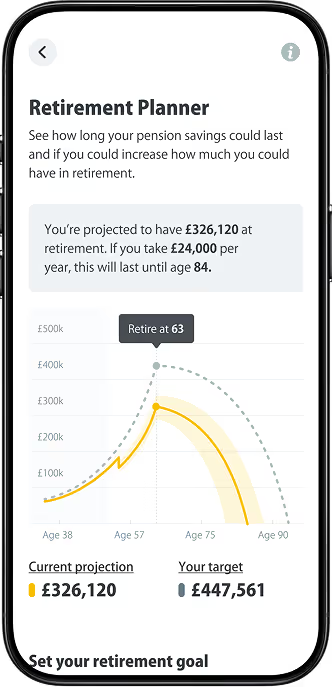
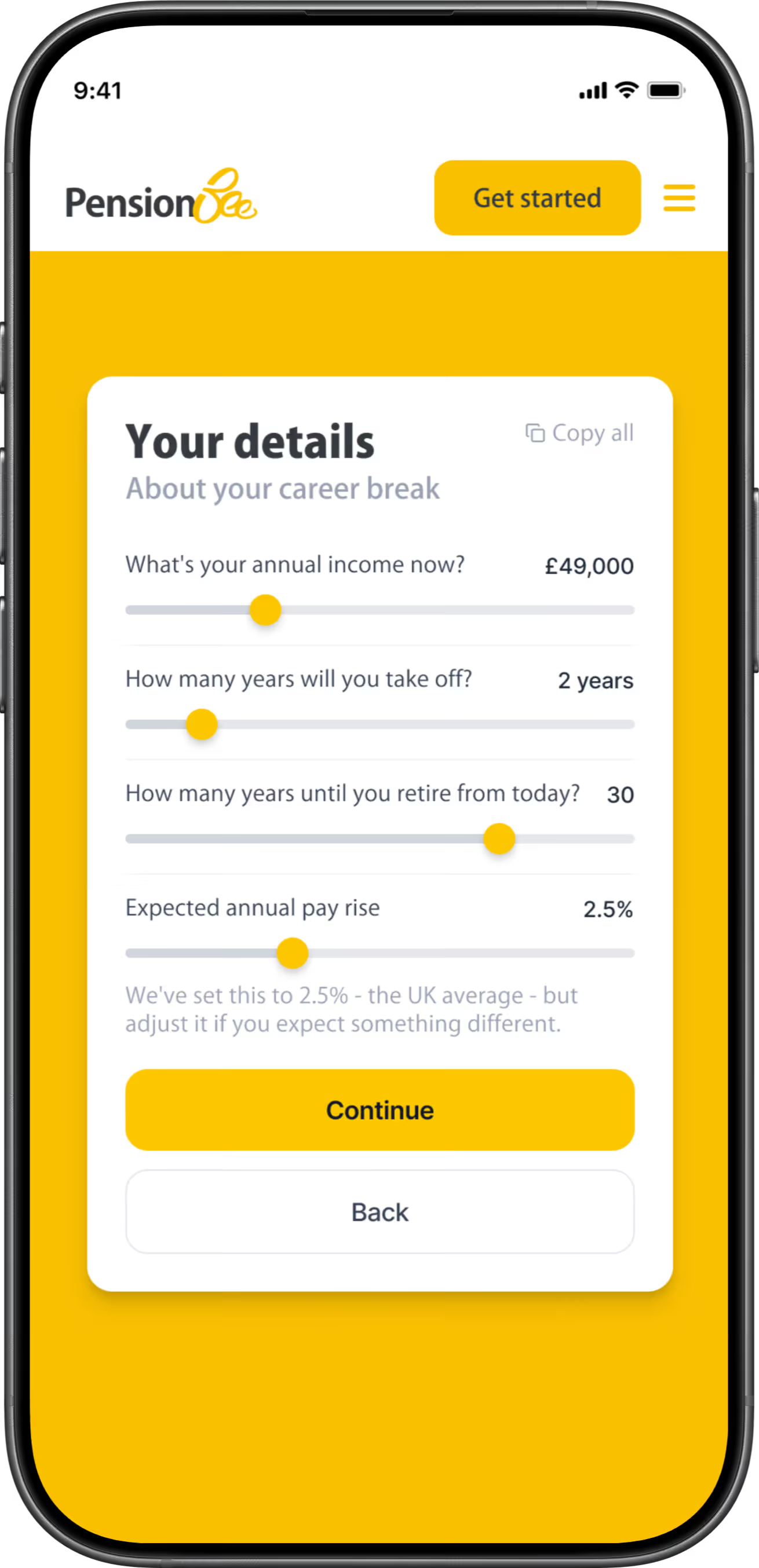
Use PensionBee’s Pension Calculator to see how much you might need to save to afford your desired retirement lifestyle.
How much do I need to save if I start a pension at 40?
If you’re starting a pension at 40, you’ll have to put more money away than someone starting at an earlier stage.
That’s because there’s less time to go until you stop working. Simply, you have a smaller window to save and benefit from any potential investment growth.
That said, it’s still possible to build a pot that could support you and your desired lifestyle in retirement.
For example, imagine that you want to retire at 66 with enough in your pot to draw an income of £20,000 a year.
In that case, to build a pension that would last until you turn 85, each month you’d need to save around:
- £270 from 30 years old;
- £410 from 40 years old; and
- £710 from 50 years old.
These figures are calculated using the PensionBee Pension Calculator. They assume no employer contributions, that you receive the full new State Pension (£12,547 in 2026/27), and that you don’t take the first 25% of your pension tax-free from 55 (rising to 57 from 2028).
While you’d need to pay in less from 30, your contributions at 40 are far lower than they’d need to be at 50. So, the sooner you start paying into a pension, the more time you’ll have for it to grow.
How to boost your pension pot
If you think the amount you’ll have to live on when you retire isn’t the amount you’re predicted to save, don’t panic.
There are lots of ways to boost your overall pot and to make up the shortfall.
- Making the most of your contributions - consider increasing the amount you’re paying in if you can. Even 1% or 2% can make a big difference over time and your employer may also match your contributions.
- Catching up on missed years - if you haven’t used your full annual allowance in the past, you might be able to make tax-efficient pension contributions going back to the previous three tax years, as long as you were signed up to a pension scheme during those years.
- Looking for forgotten pensions - use the government’s Pension Tracing Service to see if you have any savings from previous jobs. You can leave these where they are if you’re happy with that provider. Or you can combine them into a new pension.
- Earning an extra income - there are lots of ways to earn money, on top of your job. That might be renting out a room or driveway, selling your old stuff, or taking on a new career such as teaching online classes or tutoring.
- Working for longer - this might not be the number one option. But if you can work for longer, you’ll have more time to earn money and contribute to your pension. That gives your pension more time invested, benefiting from compound returns before you start taking it, too.
Summary
If you’ve reached 40 with no pension savings, it isn’t too late to start.
The best time to start is as early as possible. The second-best time is today.
If you’re considering starting a pension, or want to combine old pots into one, PensionBee could help.
With a range of investment plans and tools to help you plan, you can get back on track towards the retirement you want.
Rebecca Goodman is a freelance Personal Finance Journalist. She regularly writes for several national newspapers including the Independent, the Mail on Sunday, the Sun, and the Guardian along with a number of specialist publications.
Risk warning
As always with investments, your capital is at risk. The value of your investment can go down as well as up, and you may get back less than you invest. This information should not be regarded as financial advice.
Period | Market Event | FTSE World TR GBP (%) | 4Plus Plan (%) |
|---|---|---|---|
4Plus Plan’s inception – 6 Sept 2013 | QE Tapering, China Interbank Crisis and its aftermath | -5.44 | -2.41 |
3 Oct 2014 – 15 May 2015 | Oil price drop, Eurozone deflation fears & Greek election outcome | -5.87 | -1.77 |
7 Jan 2016 – 14 Mar 2016 | China’s currency policy turmoil, collapse in oil prices and weak US activity | -7.26 | -1.54 |
15 June 2016 – 30 June 2016 | BREXIT referendum | -2.05 | -1.07 |











%201.png)