The Buzz.

Read the latest pension news and retirement planning tips, from our team of personal finance journalists, investment professionals and money bloggers.

E12: Financial jargon - what does it all mean? With Vix Leyton and Jasper Martens
From interest rates and income tax to dividends and bonds, find out what all that financial jargon actually means, with Vix Leyton and Jasper Martens.

The following’s a transcript of our monthly podcast, The Pension Confident Podcast. Listen to episode 12 here, watch on YouTube, or scroll on to read the conversation.

PHILIPPA: Welcome to the last episode of Series One of the Pension Confident Podcast. But no need to worry, because I’m happy to tell you we’ll be back with a whole new series in January 2023. I’m Philippa Lamb, and to wrap up this year, we’re going to demystify a subject that’s confused all of us at one time or another - financial jargon. Whether it’s stagflation, inflation, Auto-Enrolment, or all those acronyms - what do they mean?

From interest rates and income tax to dividends and bonds, sometimes it feels like the language of personal finance is specifically designed to confuse us. So, today we’re going to push back with jargon busting help from two expert guests.

PHILIPPA: Welcome to the last episode of Series One of the Pension Confident Podcast. But no need to worry, because I’m happy to tell you we’ll be back with a whole new series in January 2023. I’m Philippa Lamb, and to wrap up this year, we’re going to demystify a subject that’s confused all of us at one time or another - financial jargon. Whether it’s stagflation, inflation, Auto-Enrolment, or all those acronyms - what do they mean?

Vix Leyton‘s right here with me. By day, she’s a Personal Finance Expert and off-duty, she’s a Stand-Up Comedian and Host of the False Economy Podcast. Welcome Vix.

VIX: Thank you so much for having me.

PHILIPPA: Also with us is PensionBee’s very own CMO, Jasper Martens. Great to have you with us.

JASPER: Thank you. And no, I don’t have a podcast like Vix.

VIX: Not yet, but eventually we all will!

Why it’s important to understand financial jargon

PHILIPPA: Before we start, as always, I’m going to remind you that anything discussed on this podcast should not be regarded as financial advice and when investing your capital is at risk.

Now, Vix, financial jargon, I know you’re an expert and I’ve worked in that field myself, but it’s confusing for everyone. You were telling me before we came in, there’s still stuff that trips you up. Is there a particular word?

VIX: It’s a funny one because I’m technically a finance expert, but my job is to be the person that asks the questions so people don’t have to. Because I think everybody’s so embarrassed that they don’t seek advice on these things. So you just kind of style it out and I’m good at that.

But I like the more exciting terms like bull and bear. They sound like sexy fashion brands to me, but I think they’re a lot drier than that.

PHILIPPA: Jasper, have you got a least favourite bit of jargon?

JASPER: In the pensions industry, we’ve got lots of jargon and the one that I’ve brought to the show today is an UFPLS.

PHILIPPA: What’s that?

JASPER: That’s an Uncrystallised Funds Pension Lump Sum, which only applies to a defined contribution scheme. And even after all of these years at PensionBee, I’ve failed to explain that in simple terms to anyone.

PHILIPPA: I’m not sure I want you to do that even now!

VIX: It’s like when someone explains the rules of a card game, I really want to understand and I’m listening, I’m giving you my eye contact, but I can hear the music from Smart in the back of my head.

PHILIPPA: Which brings us to the big problem here! Jargon’s off-putting, and every line of work has its own. The difference with financial jargon is, it’s really in our own interest to understand it.

JASPER: Yes, if you don’t understand your finances then you’ll fail to plan a happy retirement but also to have a good financial outlook. And sometimes you do need to go into the books and learn. Fortunately we’ve got the internet now to help.

Financial jargon in the news lately

PHILIPPA: But personal finance is particularly jargon filled, isn’t it?

JASPER: It is and I think the industry’s made it deliberately complicated. Sometimes I hear things like, ‘Well we’ve got these difficult words and acronyms because otherwise we have to write them out and it takes a long time.’ And I feel that if we keep the population clueless, then people won’t take action. And then those companies can earn money off of you. So, you better start finding out what those words actually mean.

PHILIPPA: I’m a cynic about that too. I think there’s a bit of a barrier being put up there. But listening to the news lately, it’s been filled with financial jargon and economic stories. I was thinking we might kick off with some of the terms we’ve been hearing regularly in the news. Some of the real basics, and the first one I have for you is income tax.

JASPER: We all love to pay some tax, don’t we Philippa?! So I think, with income tax, people generally understand what that means. You’re paying tax on the income you earn. And we have tax bands in the UK, so on the first £12,570 that you earn, you don’t pay any income tax at all.

And anything you earn over £12,571 and up to £50,270, you pay _basic_rate basic rate income tax. Then, if you earn between £50,271 to £150,000, you pay _higher_rate higher rate income tax. If you earn over £151,000, you pay _additional_rate additional rate income tax.

However, it was announced in the Autumn Statement on 17 November, that the higher and additional tax thresholds are changing in 2023/24. So, from April 2023, if you earn between £50,271 and _lower_earnings_limit,140, you’ll pay _higher_rate higher rate income tax in 2023/24. And if you earn over _lower_earnings_limit,140, you’ll pay _additional_rate additional rate income tax in 2023/24.

So those are the UK tax bands and usually, you won’t really see the tax being taken off. Because what’s given to you in your take-home pay, is different to your income as the tax will, in most cases, already have been taken off. So I think that’s where sometimes the confusion kicks in. But most people will be paying tax within those tax bands.

PHILIPPA: And inflation?

JASPER: Inflation’s basically the price of things you buy in shops increasing in value.

VIX: I knew that one!

JASPER: Oh, you knew that one? Great! Do you know the difference between RPI and CPI?

VIX: Oh, no. I didn’t realise that I had to revise for this podcast. Is that the Retail Price Index?

JASPER: Yeah, so I’m going to pretend I already knew everything about it and I didn’t look it up whatsoever.

PHILIPPA: Yeah, he did. I saw him doing it. RPI?

JASPER: Retail Price Index and Consumer Price Index.

PHILIPPA: What’s the difference?

JASPER: The simplest way to explain it, it’s the way you measure inflation. And with the Retail Price Index, we include things like the cost of living and housing, so your mortgages are included. And usually that one is higher than the Consumer Price Index. And to make things more complicated, for example, the government or a company might use the RPI and another will use the CPI.

PHILIPPA: So you need to know which is which?

JASPER: You need to know. But normally, I’d say, roughly they’re quite similar. One tends to be a bit higher than the other.

VIX: So, I’m speculating here but does which one is used depend on which one is higher? Because I’ve only ever seen RPI on bills, when they’re explaining why my bills are going up.

PHILIPPA: Interesting.

VIX: And again, like you say, it’s this willful ignorance. It looks legit, so I just huff and puff about it and just shrug and move on.

PHILIPPA: Yeah, well what else are you going to do about it?

VIX: Then I shred it and feel sad.

PHILIPPA: Okay, interest rates. I know it sounds basic, but let’s talk about interest rates.

JASPER: Well where do you start? Because it’s such a broad topic. But interest rates, I think for most people, it’s either the money you earn on your savings. So, the bank pays you an interest rate because you’ve given them some money in their bank and therefore they give you a percentage in return.

But interest rates can also cost you. So if you’ve got a mortgage, an interest rate’s the money you pay to borrow money from a bank or another organisation. And interest rates are usually set by a central bank.

PHILIPPA: Central bank being, in this case, Bank of England?

JASPER: Exactly. So for example, recently the interest rate has gone up from 2._corporation_tax to 3%. And that’s the rate that the banks pay to borrow money off the Bank of England.

PHILIPPA: And that’s what’s called the base rate?

JASPER: The base rate, exactly. And the banks who borrow that money can then lend that money to you, as a consumer. And they’ll probably put a margin on top of that. So what you pay is definitely not the base rate. You’ll usually pay a bit more.

PHILIPPA: So everything hangs off the base rate. So when we hear on the news about the Monetary Policy Committee at the Bank of England changing the base rate, it does matter because it impacts the amount of interest we might get in our savings account or the amount of money we might have to pay for a mortgage.

JASPER: Yes. So the amount of interest you pay when you borrow money to buy a house gets more expensive if the base rate goes up, but you might also get more interest on your savings. Usually, the Bank of England and other central banks will change that base rate to curb inflation. Because if it gets more expensive to borrow money, consumers hold back and don’t spend as much.

PHILIPPA: We spend less?

JASPER: Exactly. And that’s why the bank has that tool. And sometimes it’s nice for us, as we get more savings in our bank account, but in many cases it’s not so nice. And the cost of living really is now the issue here, where that rate has gone up and therefore our mortgage payments are going up.

PHILIPPA: As I said Vix, you work in this industry so I have to say, you’re a part of the problem! But you’ve talked about bull markets, there’s gilts, there’s stagflation, there’s asset management. I mean it’s just bamboozling. Does the industry really design itself in such a way that it’s building that wall between it and us?

VIX: It’s impossible to know, isn’t it? But I think the big issue for me is that this isn’t taught in schools.

PHILIPPA: Oh yes. We’ve talked about that on the podcast before - you’re not taught any of this stuff at school, are you?

VIX: Yeah, I can tell you that I’ve lost my watermelon or my umbrella in French - I’ve never used that. But I wouldn’t be able to give you a concise understanding of how interest and inflation would affect literally every element of my life, in terms of borrowing and saving.

There are so many terms that are confusing. Who’s coming up with these? What’s stagflation? It sounds like when I said yes to going to Becky’s hen in a local pub, and then six weeks later, somehow I’m in a WhatsApp group with somebody called Laura who’s asking for _basic_rate_personal_savings_allowance for an Airbnb that I don’t remember saying yes to. Oh and also I’ve got to dress up as a unicorn. That’s not what it is, but there are no clues as to what it is?

PHILIPPA: Yeah. And that’s an old one. I’ve no idea where the word stagflation came from. It’s crazy, isn’t it?

Now look, acronyms are my personal least favourite. Jasper, again, I want to start with a common one, and I want to start with FTSE. You hear about the FTSE all the time. We might know it’s something to do with the stock market, but what exactly is the FTSE?

JASPER: Well, the FTSE is the Financial Times Stock Exchange, which is basically an index of companies that are listed on the stock exchange. And so, if we talk about the FTSE 100, we’re talking about the 100 biggest companies on the FTSE, the Financial Times Stock Exchange. That’s basically what it means. It’s just an index of companies that are listed there.

PHILIPPA: Another stock market acronym - IPO.

JASPER: Well I know that one because PensionBee did one in April 2021. It’s an Initial Public Offering. And that’s when your company is going to the market, and before you do so -

PHILIPPA: I’m going to stop you there. Going to the market? Let’s go further back to the basics.

VIX: This little piggy?

PHILIPPA: So you’re a company -

JASPER: Ok, I’m rolling up my sleeves!

PHILIPPA: So, you’re a company and you’ve grown to a certain size and now you’d like some investors to lend you some cash?

JASPER: What you’re trying to do is get people buying your shares, so that you can raise money. When a company goes on the stock market, they’re trying to sell shares. And if your company is good, and it has good unit economics and has a good future, investors will say ‘I want some of those!’ and they’ll buy those shares off you.

PHILIPPA: So the public offering is, you offering your shares for sale?

JASPER: Yeah. To anybody who wants to buy them.

PHILIPPA: Got it. Savings is a big area for acronyms isn’t it? Again, we hear a lot of them but knowing precisely what they are is something else. Here’s a nice one for you. What’s the difference between an ISA and a LISA?

JASPER: Well first of all, can I just say that I feel like I’m doing a test here?

PHILIPPA: That’s exactly what’s happening.

JASPER: I should’ve known!

VIX: We both know the answers. We’re just checking that you do.

PHILIPPA: I’ve got them on a piece of paper here.

JASPER: Well, an ISA is an Individual Savings Account and a LISA is a Lifetime Individual Savings Account.

PHILIPPA: And what are they?

JASPER: So basically, they’re both tax efficient ways to save for later. In the case of a LISA, you can save that towards your first house purchase.

The Lifetime ISA, like all ISAs, is a tax-free savings account. You won’t be taxed on what you put in, and you receive a _corporation_tax bonus on your savings. You’ll get a £1 bonus for every £4 you put in. You can put up to £4,000 into a LISA every year, so the maximum bonus you can receive each year is _basic_rate_personal_savings_allowance. In addition to this limit, you can’t pay more than _isa_allowance per year across all your ISAs.

LISAs are tax-free and the government provides a bonus of _corporation_tax on the money you put in. So, for every £4,000 you put into your LISA, you receive a _basic_rate_personal_savings_allowance bonus.

JASPER: And ISAs are just savings, but they’re tax efficient. So, every year you can save around _isa_allowance into that Individual Savings Account and you wouldn’t pay any tax on that amount.

ISAs are popular ways for people in the UK to save or invest their money tax-free. There are four types of ISA:

  • Cash ISAs
  • Stocks and Shares ISAs
  • Innovative Finance ISAs
  • Lifetime ISAs (LISAs).

The government puts a limit on how much individuals can save or invest in them in a single tax year. This limit is known as the ‘ISA allowance‘.

This ISA limit is the maximum an individual can save across the range of ISAs. So for example, if you saved _starting_rates_for_savings_income in one ISA and £3,000 in another in one tax year, you’d have used up £8,000 of your total allowance.

In the 2021/22 tax year, the total allowance stands at _isa_allowance. This limit resets at the start of each tax year on 6 April 2023. If you don’t make use of your entire allowance before then, you’ll lose any remaining amount.

JASPER: Does that answer the question?

PHILIPPA: Are we happy with that?

VIX: I think so.

Pensions industry jargon

PHILIPPA: So Jasper, the moment you’ve been waiting for, let’s talk about pensions! Because, as we know, the pensions industry is big on confusing acronyms. There are a lot of very confusing terms. Which ones do you think listeners really need to have their heads around?

JASPER: I think, especially at the moment because it’s been in the news a lot, it’s the triple lock on the State Pension.

PHILIPPA: And what’s that?

JASPER: It’s basically indexing your pension. That means that the UK Government is legally binded to make sure that your State Pension rises in line with one of three locks. Lock one is the rate of inflation, which was at 10.1% in September 2022. This is the rate in which the Chancellor confirmed that the State Pension will rise in April 2023. Lock two is the increase in average earnings. And lock three is a fixed amount of 2.5%. The highest of those three is the one in which the State Pension will grow.

PHILIPPA: Okay. Vix is looking confused!

VIX: Does that mean that the State Pension only ever increases and never decreases?

PHILIPPA: That’s a very good point. Can the State Pension go down?

JASPER: No, the minimum it will go up is 2.5%. But if inflation, or average earnings are higher than 2.5%, then the State Pension will increase in line with those instead. The highest one will win.

PHILIPPA: And it really matters right now because we’ve got very high inflation all of a sudden. If you’re dependent on the State Pension, then it’s really significant isn’t it? Because everything you’re spending, you’re getting 1_personal_allowance_rate less for.

VIX: And everything’s costing 1_personal_allowance_rate more.

JASPER: It sounds really great, right? And it’s really beneficial for people who’re taking their State Pension because they’ll get that increase. But what about everybody else in this country that aren’t getting the State Pension because they’re still working and earning? What about them? And that’s what’s often criticised in the media - that pensioners are getting the best deal. So, I would say, the jury’s still out.

PHILIPPA: Jasper, what’s risk?

JASPER: This isn’t being a risk devil or a risk taker.

VIX: Or a skydiver! I’m not going to go on this rollercoaster because the harness looks a bit loose? No! That’s not what risk is.

My mum got divorced about 10 years ago and she didn’t take care of any of the household finances, she ran our home and brought me up and did a brilliant job of it. But I think my mum’s perception of pensions was, it was kind of a benefit that work gave to you and it was a flat rate like a savings pot.

I remember, we went to the bank and sat down with a bank manager because I didn’t understand enough to help her. Even though she was like ‘You work in finance, you can help me make these decisions’, I was like ‘Oh, no thank you!’

They sat her down and they said, ‘Right, we want to understand what your interest in risk is.’ Like, how much of a risk taker are you? My mum was scrambling around, and she sort of fancied the bank manager as well, which didn’t help. So she wanted to seem a bit sexier and a bit riskier, and I could see the cogs turning in my mum’s head. And she was like, ‘Hmm, you know, occasionally I like a scratch card.’

JASPER: Risk is about how you want to invest your money. Other than the State Pension and defined benefit pensions, every other pension in the UK’s actually an investment, whether you like it or not.

It can be cash, it can be bonds, it can be stocks, it can be anything really. But the typical cocktail is a mix between shares and bonds, and then maybe a little bit of cash and property, and all of those come with a risk. Now, if you’re young and you’re growing your pension savings, you might actually want to take a little bit of risk as share prices can go up and down, as we are seeing right now.

PHILIPPA: But you might get potentially better returns?

JASPER: Yes, especially in the long run. And when you get a little bit closer to retirement, you might want to take less risk and therefore, you might be looking at investing in property, bonds or cash.

Now most pension plans that are out there will be a mixed cocktail. So, you might have a very strong cocktail when you’re young and maybe an alcohol-free cocktail as you get nearer to retirement. But most pension providers will start you off with a very ambitious cocktail when you’re younger and all you need to do is contribute. And then what they’ll do over time, is they’ll change the cocktail. So they’ll add more water to it.

PHILIPPA: So you’ll end up with mineral water at the end of it?

JASPER: Exactly. You want less risk when you’re two years away from taking your pension. And that’s what risk is all about.

PHILIPPA: Okay, I’m happy with that. I’ve got more pension related terms for you - what’s an annuity?

JASPER: So, let’s say you’re getting to an age where you want to retire and you’ve saved a pot of money. You can give that to a pension company or a life insurance company and in return they’ll say, ‘Oh thank you Jasper, thank you for your pension. And for that, I’ll give you a fixed amount until you die.’

And an annuity rate, let’s take 5% for example, basically means that you get 5% of your pot every year until you die. Now that’s usually linked to interest rates. So this is where the base rate comes in.

So if interest rates are really low, annuity rates will be low too. And annuity rates have been historically very low. Now, with the interest rates rising from 2._corporation_tax to 3%, even though it might not sound like a lot, it’s a huge change.

PHILIPPA: What about drawdown? We hear about this all the time - but what’s drawing down your pension?

JASPER: So, with an annuity, you give away your pension pot and in return, you get an income every month. In the case of a drawdown pension keeps your money invested for longer. At the same time, you can take your pension flexibly, withdrawing money whenever you need it. Up to _corporation_tax of your savings can be taken tax-free, with the remaining 75% subject to income tax. The amount you pay depends on your total income for the year and your tax rate.

VIX: Is that subject to the same income tax rules as your salary?

JASPER: Yes.

PHILIPPA: Like we were talking about earlier.

JASPER: So for example, people who are emptying their pension pots when they’re 55, that’s drawdown. Basically, you draw down your whole pot until it reaches zero. So, let’s say you have _high_income_child_benefit in your pension and you take that in one go: suddenly, your income in that year is _high_income_child_benefit and you’re going to have to pay a lot of income tax.

VIX: That’s an expensive boat!

JASPER: But if you take small chunks every year as income and leave the rest invested, it has a chance to grow over time.

You can take up to _corporation_tax as a tax-free lump sum or take _corporation_tax of each withdrawal tax-free. Your tax-free amount doesn’t use up any of your personal allowance, but once your withdrawals exceed this threshold you’ll be required to pay income tax. It’s important to consider how much you withdraw from your drawdown pension, and when you do so, to ensure you don’t move into a higher tax bracket.

If you’ve a small pension with a value of _annual_allowance you can take _corporation_tax as a tax-free lump sum, leaving £45,000 in drawdown. Once you exceed your personal allowance, each withdrawal will be subject to income tax. However, if this is your sole income you’ll only be charged the basic rate of income tax, as your total pot falls within the lowest tax band.

If you’ve a larger pension with a value of £400,000 you can take _high_income_child_benefit as a tax-free lump sum. You’ll then have £300,000 to invest via drawdown. The amount you choose to withdraw in any given tax year will determine how much tax you pay and you could easily be required to pay higher rate or additional rate tax if you withdraw too much too soon or have other earnings. If, for example, you choose to withdraw a further _high_income_child_benefit in a single year you’ll have to pay higher rate tax at _higher_rate.

So it might be better if you take small chunks every year as income, and you leave the rest invested so it has the chance to keep growing over time.

PHILIPPA: Pension policy documents, they’re full of jargon, aren’t they? What are the common benefits and acronyms that we might find in pension policies?

JASPER: So you might find things like a Guaranteed Annuity Rate, a Guaranteed Minimum Pension, Protected Tax-Free Cash, Protected Pension Age. Basically these are guarantees that were given to customers in the past.

So just to give you an example: a Guaranteed Annuity Rate. If you were with pension company A and you wanted to buy an annuity, you’d get a really good rate from pension company A, because they didn’t want you to go to pension company B, C, or D. Nowadays, websites like Money Helper actually help you to shop around because there might be better deals out there.

PHILIPPA: Like we do with utilities?

JASPER: Exactly.

How and where can we learn about finance?

PHILIPPA: It’s all about better education around money and finance, isn’t it? And it always seems to me that basic finance skills, and I know you feel the same way about this Vix, is something that we should be teaching kids in school?

VIX: It absolutely is, because just in this session I’ve understood more than I’ve ever known. It can be scary, you’ll read the first couple of paragraphs of something and if you don’t engage with it straight away, I’ll just move on.

PHILIPPA: It’s bewildering isn’t it?

VIX: I sit down and I try but it’s confusing and I think people are embarrassed to ask questions. I was with my mum in that session, and she’s not a stupid woman, she’s a very intelligent woman, but she’s just had no exposure to this whatsoever so she didn’t know what to ask. And her view was that she just wanted somebody to tell her what to do and they weren’t able to do that.

That’s the one thing that a pensions advisor cannot do, you have to opt in. But she didn’t have the financial skills to opt in. And that dragged on for much longer than that session, because we came away from it and it manifested on the route home. She hadn’t really taken in what was said enough. So it took us a long time to get there.

PHILIPPA: I’m hoping there might be people who’re listening to this, who might not know anything about pensions actually, because we do talk about the basics. And we’re not frightened to talk about the basics because, as you say, no one really wants to admit they don’t know what drawdown is. And with the situation that we’re all in, economically, this stuff matters more than ever.

JASPER: Yes and I think as an industry, we’ve got to do much better than what we’re doing right now. At PensionBee, we want to make pensions simple so you can look forward to a happy retirement. That’s our mission statement. But every week there will be moments where it’s almost like someone presses a button and we’ll realise something is too jargony. So every piece of content we produce has a proper tone of voice check because we have to avoid these things creeping in.

PHILIPPA: Are you surprised just how low the level of understanding is in the finance industry? Because I always feel that, even in myself, as well as in others, who’ve worked in this field. There’s always stuff that, if you’re really honest, you just don’t properly understand?

JASPER: Yeah. Half of the time people don’t know that a pension’s actually invested, or that it costs you money.

PHILIPPA: And there’s no shame in not knowing that, is there?

JASPER: There’s no shame. I didn’t know that a pension costs you money when I joined PensionBee in 2015. I thought my company was paying for it but no, I was paying for it.

VIX: I found out today!

PHILIPPA: Have you got a favourite way of educating yourself more about this? We’ve got this podcast, there are other podcasts. But have you got any favourites, Vix?

VIX: I’m approaching 40 years old and I’m a Peter Pan. In my mind, this is something to worry about later. I’m astonished that there are 21 year olds walking around now that didn’t exist when I was a teenager. But I think we all want to believe that we’re still young enough that we could change the game. So I think it’s brilliant that all these resources exist, but particularly now, with the cost of living crisis, where people are trying to work out how they can budget until the end of the month, budgeting for even 10 or 15 years feels like a problem for another day.

So I think the press and financial experts need to do more to highlight the difference between tackling it now versus leaving it a few years - five years, 10 years, 15 years - because there’s a penalty for that. I’m already paying a penalty for that now I’m approaching middle-age. That hurts to say out loud!

PHILIPPA: If we’re talking to young Vix, Jasper, where would you send her? Is there a book, are there some websites you can go to, to look up financial terms?

JASPER: There are a couple of handy websites I would check out. Money To The Masses explains finance in a really easy way. And secondly, Boring Money is a really good website too.

VIX: I mean they’re really under-selling this!

JASPER: They’re looking at how to turn something boring into something actually really exciting and hopeful. So that’s what they do. They’ve also launched a really good community hub especially aimed at women and their savings, because they tend to be behind in terms of their pension savings, for example. So I think that’s really good. And of course, Money Helper‘s also definitely a really good one to go to.

PHILIPPA: That’s all really helpful. I’m gonna wrap it up there. Thank you both very much.

VIX: Yeah, it’s been a brilliant educational day for me, so thank you.

JASPER: Yeah, thank you both!

PHILIPPA: That’s it for this episode and Series One. A final reminder that everything you’ve heard on this podcast should not be regarded as financial advice and wherever you invest your capital is at risk. We’ll be back with you in January 2023 with Series Two and we’ll be kicking off with financial personalities - what’s yours and can you harness it to help you reach your savings goals?

If you’ve got a moment, we’d love it if you could rate and review us on your podcast app, or you can share your feedback and suggestions for future episodes by emailing podcast@pension.com. Thanks for being with us this year. Have a great Christmas break and join us again in January.

Catch up on episode 11 and listen, watch on YouTube or read the transcript.

Risk warning

As always with investments, your capital is at risk. The value of your investment can go down as well as up, and you may get back less than you invest. This information should not be regarded as financial advice.

Bonus episode: Tips for the end of the tax year
Read the transcript from our bonus podcast episode on tips for the end of the tax year.

The following is a transcript of a bonus episode of The Pension Confident Podcast - Tips for the end of the tax year. You can listen to this bonus episode or scroll on to read the conversation.

PHILIPPA: Hi, welcome to another bonus episode and as the end of the tax year is coming up fast we’re going to be talking pensions, ISAs and tax!

From tax relief to ISA limits, we’ve gathered some top tips and insights from our guests to help you get your finances in order. And before we get going, remember, anything discussed on the podcast shouldn’t be regarded as financial or legal advice, and when investing, your capital is at risk.

OK, first up, you’ve probably heard people talk about tax relief but what is it and how does it work? Here’s Financial Journalist and Founder of Much More With Less, Faith Archer from episode 32 with a great little explainer.

FAITH: One of the good things about pensions is the government wants to bribe us into saving for retirement. You get free money on top of your pension contributions. You automatically get basic rate tax relief. Every pound you pay into a pension, the tax relief added is 25p as a basic rate taxpayer, and you can claim back further tax relief if you’re a higher or additional rate taxpayer. And also, if you’re paying into a workplace pension, then by law, your employer has to contribute to that pension fund as well. There’s certain minimum amounts they’re set to do, but different employers can be more generous. It might be that they’re willing, if you pay in more, they’re willing to match those contributions and put even more money towards your retirement.

PHILIPPA: So much for pensions, what about other savings? Here’s Founder of Boring Money Holly Mackay from episode 29 talking about Individual Savings Accounts - or ISAs, and another way to save your money tax-free that you may not know about.

HOLLY: I love ISAs. They’re like Tupperware pots. You stick your money in, and the taxman can’t get his hands on what’s inside that pot. This is really important because the tax take for all of us is going up and up and up - and is just going to keep going up. So, ISAs are awesome. But, spoiler alert, we also get a certain amount of money every year we can earn in interest and not pay tax on, whether it’s in an ISA or not.

PHILIPPA: And that’s currently?

HOLLY: That’s the Personal Savings Allowance. It depends on how much tax you pay. If you’re a higher rate taxpayer, you can earn _higher_rate_personal_savings_allowance a year in interest before you pay any tax on it. If you’re a basic rate taxpayer -

PHILIPPA: Which is most of us.

HOLLY: Yeah, you can earn _basic_rate_personal_savings_allowance a year in interest. For me, the smart move, I think, is to look at your first lump sum of money, any cash savings, and go for the good rates. And quite often, those aren’t in Cash ISAs. But just make sure that the interest you earn on that every year isn’t going to go above that Personal Savings Allowance. So, _higher_rate_personal_savings_allowance if you’re a higher rate taxpayer or _basic_rate_personal_savings_allowance if you’re a basic rate taxpayer.

PHILIPPA: That’s a lot of interest, isn’t it? Most people aren’t going to be getting that much interest on their savings. So, they’re not going to be paying any tax regardless.

HOLLY: And with current interest rates as they are, to give you an idea, if you’re a basic rate taxpayer, that’d be about _isa_allowance in a savings account. That’d generate about _basic_rate_personal_savings_allowance a year. So, it’s quite generous.

PHILIPPA: There’s another type of ISA well worth knowing about and that’s called the LISA. Here’s Holly again.

HOLLY: But I think for people, particularly people in their 20s, 30s who’re thinking about buying a property, you’re cautious about locking your money away into a pension. And this is where I think for people under 40, an alternative is the Lifetime ISA. This is a vehicle where you can pay in up to £4,000 a year if you’re under 40, and the government will match that with up to _basic_rate_personal_savings_allowance every year. So that’s a total of _starting_rates_for_savings_income you could save there. There are catches with that. You have to spend that money either on buying a first property, or if you change your mind and decide not to, you can then use that for retirement. If you change your mind and take the money out sooner, you get clobbered with punitive rates. So, you have to be pretty damn sure that you’re either going to buy a property or use it for retirement. But that’s a vehicle that does give people who’re saving for a property a bit of flex. It’s an alternative to a pension. There are pros and cons to both. But particularly, I think for self-employed people who don’t have those workplace contributions it’s an interesting tax wrapper to have a look at.

PHILIPPA: And talking about those pros and cons, let’s hear from PensionBee’s VP Public Affairs Becky O’Connor in episode 17 when she talked about how you can use ISAs and pensions together.

BECKY: My investments are like a wild flower garden. I’ve got bits of money saved everywhere. There’s a bit in a Lifetime ISA, a bit in a Stocks and Shares ISA, some in Junior ISAs for my kids. They’re not all doing well and I’m not contributing to all of them, all the time either, they’re all there - but they’re not pension substitutes. Although with the Lifetime ISA, I do quite like the idea of getting this bit of cash at 60. With a pension you can access it at 55, although that’s going up to 57 from 2028. I just quite like the idea of having this little extra bit [saved], because my boys will then be a certain age, where they might be getting married or buying a house, or something. So that’ll be quite nice.

PHILIPPA: Becky, when we were talking about this podcast a couple of days ago, you raised this point didn’t you - about the Lifetime ISA being closest to a pension. If you’ve already got a home and you have a pension, is there any point in having a Lifetime ISA?

BECKY: Yeah, I think it’s something people come up against as a bit of a dilemma. For the reason I previously gave, it might be quite nice to have a pot that’s coming your way at 60. Obviously with the Lifetime ISA, you have the bonus and with pensions, you have the tax relief. However much you get in tax relief depends on whether you’re a basic, high rate or additional rate taxpayer. So, it depends on your taxpayer status, for one thing, as to which works out better.

There’s an annual allowance on pension contributions. And there’s another kind of loophole, which means you can use a previous year’s allowances on your pension as well, which is worth knowing about, if for some reason you’ve quite a bit of cash coming your way.

CLAER: If you come into an inheritance?

BECKY: Exactly. And that can be quite handy at that point.

PHILIPPA: Let’s wrap this episode up with Financial Expert and Author Peter Komolafe. In episode 17 he shares something to keep in mind if you’re thinking about opening more than one ISA.

PETER: Right, the ISA rules can be very, very confusing sometimes. So if you have a Stocks and Shares ISA, you can have that and you can also have a Lifetime ISA invested in Stocks and Shares as well. That’s completely fine. What you can’t do, is have a Lifetime Stocks and Shares ISA open with X provider and then go open another one with Y provider in the same tax year. So you’ve gotta be sure in terms of who you’re choosing to allocate. You can have a Stocks and Shares ISA, just a normal one, and a Lifetime ISA that’s invested in Stocks and Shares as well. That’s completely fine and within the rules.

PHILIPPA: And that’s a wrap. For more information around pensions and tax, head to the PensionBee website and search for “Pensions Explained“.

Just a last reminder before we go that anything discussed on the podcast shouldn’t be regarded as financial or legal advice. When investing, your capital is at risk.

You can listen back to all those episodes in full wherever you get your podcasts. We’re also on YouTube and in the PensionBee app too! If you subscribe right now you’ll never miss an episode and while you’re doing that, please do leave us a rating and a review. It’ll only take a moment and you know we love to know what you think!

Thanks for listening.

Risk warning

As always with investments, your capital is at risk. The value of your investment can go down as well as up, and you may get back less than you invest. This information should not be regarded as financial advice.

E37: The easiest way to retire with more money with Neil Bage, Bola Sol, and Laura Dunn-Sims
We're revealing the easiest way to retire with more money - and it’s not about trying to chase down a six-figure salary or taking huge investment risks.

The following is a transcript of our monthly podcast, The Pension Confident Podcast. Listen to episode 37, watch on YouTube or scroll on to read the conversation.

Takeaways from this episode

  • Financial engagement is essential - staying engaged with your finances can significantly impact your retirement savings, potentially saving you up to _higher_rate_personal_savings_allowance,000 over your lifetime.
  • Visualising the ‘future self’ - imagining yourself as retired can be tricky, but using tools that help visualise your future can help you make better financial decisions today.
  • Simple actions matter - small, consistent actions, such as reviewing pension contributions and fees, can lead to significant improvements in retirement savings.
  • Automation helps - automating savings can simplify the process and encourage consistent saving without the need for constant decision-making.
  • Setting realistic goals - establishing achievable financial goals rather than overly ambitious ones can help maintain motivation with retirement planning.
  • Education and resources - using available resources, such as PensionBee’s Pension Calculator, can empower individuals to make informed decisions about their pensions.

PHILIPPA: Hi, welcome back. Today, we’re exploring a simple question: the most effective way to max out your chances of retiring comfortably. It might not be what you’re thinking because it’s not about trying to chase down a six-figure salary or taking huge investment risks - it’s actually just about always paying attention to your finances.

Ignoring what’s going on with your money, it can cost you. New research from PensionBee shows that ‘financial disengagement‘, as it’s known, that can cost savers as much as _higher_rate_personal_savings_allowance,000 over their lifetime. So, serious money.

But when did you last check on your savings? Do you actually know how much you got set aside for retirement? Small decisions made today could transform your future because they give your money time to grow. And here’s the good news: staying engaged isn’t that hard.

In this episode, we’re going to show you how to do it. I’m Philippa Lamb. Just before we begin, if you haven’t subscribed to The Pension Confident Podcast yet, why not click right now so you never miss an episode.

We’re talking about how to be ‘financially engaged’. Here with me, I have Bola Sol, she’s a Financial Adviser, Money Columnist and Author. Neil Bage is a Behavioural Expert and Co-Founder of Shaping Wealth. And from PensionBee, Head of Consumer PR, Laura Dunn-Sims. Hi, everyone.

ALL: Hi.

PHILIPPA: Here’s the usual disclaimer before we start. Please do remember, anything discussed on the podcast shouldn’t be regarded as financial advice or legal advice. When investing, your capital is at risk.

Common financial pitfalls

Now look, everyone, before we start telling people they need to pay more attention to their finances, I’m going to freely admit I haven’t always done this. I’ve definitely buried my head in the sand about money - more than once! How about you? Have you always been good?

NEIL: No.

PHILIPPA: I’m glad. I’m feeling better already.

NEIL: It’s difficult. We have a gazillion competing priorities in life - money is one of them. Unfortunately, it’s the one that often falls by the wayside because, let’s face it, it’s a bit difficult, it’s a bit complex.

PHILIPPA: It feels that way, doesn’t it?

NEIL: Yeah, that’s right.

PHILIPPA: Laura, you do this stuff for a living. Have you always been a good girl about it?

LAURA: No, I’ve not. When I first left university, my first job, I actually opted out of my workplace pension because -

PHILIPPA: - I did this, too.

LAURA: Yeah, I wanted the extra money and I had no idea of the benefits of saving into a pension. I wouldn’t do it now, but yeah, lesson learned.

PHILIPPA: Yeah, I didn’t even bother to respond. I got an email, and “would like to be?”, and I didn’t. And so, of course, it never happened. Bola?

BOLA: No. [In my] mid-20s, I took a contracting job, which means I didn’t get permanent benefits as a permanent employee. I just didn’t think about my pension. I was all thinking “oh yeah” getting all the cash for a few years. Not once did I think about my pension - but I do think about it more now.

PHILIPPA: Well, yeah, as time goes on, I think we all think about a bit more. But I mean, this is the trick, isn’t it? Starting early. It’s like you say, we’ve all got our reasons for not keeping a closer eye on our money: life is busy, pensions can feel confusing, I mean can you even remember your login details?

Laura, we do need to do this, though, don’t we? Because you’ve got this new research from PensionBee talking about this _higher_rate_personal_savings_allowance,000 potential loss of being disengaged from your pension. Where does that number come from? How does that work?

LAURA: So, our research found that savers who consistently engage with their pension throughout their working life typically have better retirement outcomes. That’s because small early actions, such as assessing how much you’re contributing or how much you’re paying in fees, that can really make a difference in later life. Basically, the more you know about the pension, the more tangible it becomes, and then you can make more informed decisions from there.

PHILIPPA: And the trick here, I’m going to keep saying this in this podcast, is starting early. Because as we mostly admitted around the table at the beginning, when you start out in work, you’re just not thinking about this, are you? So, just getting your head around the fact that it’s a thing that matters to you, might not matter now, but it’s going to matter later.

Visualising our ‘future selves’

PHILIPPA: Neil, we’re not great at doing that, are we? It feels so far away that you don’t feel you need to keep on it?

NEIL: Yeah. As humans, we have a really interesting challenge with our ‘present self’ and our ‘future self’. And the future self (so, the Neil Bage in the future, right?) it’s a stranger to me. And in order for me to engage with my future self, I need to use my imagination and think “OK, who do I want that Neil to be when I reach 60 or 65”. Or whatever the date is, whatever the age is.

But the challenge in that isn’t only am I relying on my imagination, I’m also trying to weigh up the day-to-day challenges of living life. The bills and the holidays and all of the other things that are competing for my cognitive attention. And so, we’ve always as a species had a really difficult time to put ourselves into a future state and make decisions today that will ultimately benefit me in the future. It’s a notoriously difficult thing for us to do.

PHILIPPA: Yeah, that visualisation. Particularly when you’re in your 20s, visualising yourself in your 60s or your 70s - I mean, it feels almost impossible, doesn’t it?

NEIL: It’s incredibly difficult, and I’d say impossible. There’s a great piece of research by Hal Hirschfield, a Professor in the US, who is one of the world’s leading authorities on ‘future self‘. He created this app where it would age you and then say, “I now need you to make some decisions”. And what they found is people who looked at an aged version of themselves typically invested more money into their pension than someone who didn’t. And it’s not just picturing it, it’s planning for who you want to be.

The other challenge is there’s an amazing psychological phenomenon called the ‘End of History Illusion‘, whereby if you ask people, “are you different to how you were 10 years ago?”, people go, “yeah, I am”. “What about 20 years ago?”, “very different”. “30?” “Oh, I don’t recognise that person.” “Great. How much do you reckon you’re going to change going forward in the next 10 years?”, people will typically say, “not a lot”.

PHILIPPA: Really?

NEIL: It’s called the End of History Illusion because we believe that we’re the finished article today. That’s playing out at the same time. Then when somebody says, “can I talk to you about a pension?”, which is about saving for your future. You’ve got these unconscious conflicts going on all the time.

Overcoming complacency with pensions

PHILIPPA: It’s interesting, isn’t it? The other thing I’m thinking [about], Bola, is if you’ve got a pension, if you’ve been auto-enrolled into a workplace pension, whatever it is, there’s that temptation [to think], “well, job done”, right? And complacency sets in, and you never think about it again.

BOLA: Oh, absolutely, because you tell yourself “it’s being taken care of, so I can’t be asked to look at it”. I have conversations with people and ask [them], “do you know what it’s invested in?”, and they say “I have no idea”, because it takes away, as you said, the stress of competing with everyday life priorities and stuff. So, you think, “look, I’ve got some money in there, not sure how much it is, but it’s doing something”.

The _higher_rate_personal_savings_allowance,000 ‘cost of disengagement’

PHILIPPA: Laura, this is the thing, isn’t it? This is where the _higher_rate_personal_savings_allowance,000 comes in, that if you do think about it early, you can make a real difference to it. Can you talk us through the missed opportunities that people have to engage with this?

LAURA: Yeah, definitely. I think engaging with a pension doesn’t have to be as overwhelming as sometimes we think it can be. It’s really simple steps like understanding what your pension is invested in.

Simple things like moving from a poor performing fund, which might typically be giving you about a 3% annual return a year, to finding a better performing fund, for example, maybe giving you a 7% annual return. Over your lifetime of saving, that can add almost _higher_rate_personal_savings_allowance,000 to your pension.

It’s those simple things like perhaps you’ve changed jobs. You have an old pot that you haven’t thought about for a few years, you find it, you consolidate it into one pot if that makes sense to do so. And then you’re only paying one set of fees instead of two. Then from there, you can start planning and making those decisions in the future that helps retirement feel so much more tangible.

How can we make the numbers feel real?

PHILIPPA: In terms of ‘the how’ you do all this, thinking that most people are definitely not experts on pensions. You’re thinking, “OK, I should be - I don’t even know how good my fund is. Is this a good thing? What I’ve got now? Should I be somewhere else?”. How do you make those decisions? Where do you start with that?

LAURA: So, your pension provider should be able to help provide a ‘fund sheet‘, which would give you an overview of performance. There’s also the government’s MoneyHelper website, they give free, impartial advice. So, they can help you navigate that a bit more.

There’s lots of great educational tools like pension calculators, where you can play around with your contribution amounts, change the age you want to retire at, and then that can really help you give a personalised view of what saving for retirement could look like for you.

PHILIPPA: They’re quite fun, aren’t they? In that whole thing of being, “if I could save a bit more now, I could have a yacht when I’m 70!”. But I think as part of the visualisation process that you were talking about, I think they’re pretty good for that, don’t you?

NEIL: Anything that I can look at, anything I can engage with, that allows me to put a piece in the jigsaw puzzle (if you like) is helpful. And the more it feels real, the more it feels achievable, the more likely I am to then engage with it. The more I see something and I go, “I’ll never, ever do that, I’ll never reach that figure” - it becomes a barrier to entry for any of us. That’s no different to other walks of life.

You don’t really need to go to the gym and pay £50 a month for gym membership if you’ve never been to the gym. Because the likelihood is you’re not going to stick it out. Because you’ll go to the gym, you’ll forget how difficult it is. You’ll see all these other people around you pumping weights and doing all the things, and you go, “oh, I’m not like them”. And so, you retreat from that.

That’s the same as our money life. It’s no different. If you see something that you go, “but that’s not me”, it makes it notoriously difficult to engage with it. It needs to feel real.

PHILIPPA: So, this is setting realistic goals then, not setting some crazy aspirational thing and then thinking, “I’m going to fail before I’ve even started”. I mean the gym is a great analogy, I think. That whole thing, you walk in, and think “this is just never going to be me. These people are so fit and gorgeous”.

NEIL: That’s why I’ve never joined a gym. It’s never me.

PHILIPPA: You see, I go all the time.

BOLA: I go. I just stare at people in the corner like, “wow! Maybe one day I’ll be there, but I’m just going to stay over here for now”.

PHILIPPA: Yeah, at least you’re going, Bola, right? I mean, you can be one of those people, I think.

Transitioning from an ‘immediate return’ to ‘delayed return’ environment

PHILIPPA: I wonder as well, with pensions, I mean, old age, no one’s looking forward to it, right? We push it away. Why would you want to think about it? Isn’t that another barrier? You’re talking about financing a time of your life that you don’t really ever want to get to.

NEIL: Look, inertia is a really powerful issue - or challenge - for all of us. But deep rooted behind this is a bigger challenge that we never address. It’s the elephant in the room, right? So, let’s talk about it.

Human beings have been around for five and a half million years. We’ve been evolving for five and a half million years, and we have a fine-tuned sense of how to engage with the world around us. We’ve developed the most amazing skills to communicate with each other, to spot danger, to spot threats, to lean in when people need help, to lean back when you feel that you’re in danger - all that type of thing.

But during this period that we’ve evolved, things have been invented that we as a species have had to try and adapt to. And one of them is money - money is an invention. And the thing is, we’ve been around for five and a half million years. Money has been around for 2,000 years. So, it’s a relatively new thing for the human brain to navigate. So, pensions [are] a nuanced element of our money story.

Borrowing, investing, saving, giving, earning - all of these dimensions of our money life bring with it challenges. And when you say “save”, that in and of itself is a difficult thing. When you then go, “oh, by the way, I’m talking about a pension”, it becomes nuanced in a way where people go, “I can’t even save £5 a month to do this, and what you’re asking me to do something, and by the way, I’m not going to see it again for 35 years”.

So, the elephant in the room is we need to get better at addressing people’s money life first before we go down to a deeper level, which is talking about a specific solution, almost in a specific vertical. And if we can lift ourselves up and engage people at that level, I see this time and time again with our clients around the world. It completely transforms the conversation.

PHILIPPA: That’s really interesting. I mean, in the same way, even the concept of saving for the future in terms of human existence is quite a new idea, isn’t it?

NEIL: Of course.

PHILIPPA: Because we were lucky just to get through the day for human existence. So, the idea of “I’m saving for years ahead”, it’s quite a fresh thought, isn’t it? I mean, if we think of ourselves as animals, as you say.

NEIL: It really is. But it is right. If you go back to the five and a half million year timeline, we’ve probably spent 99% of that time in what’s known as an ‘immediate return’ environment. If I was hungry, I ate. If I needed food, I’d hunt. We now live in a ‘delayed return’ environment, where the benefits of what I do aren’t beneficial to me up until some future state. That messes with a brain that has just spent five million years in a world that screams “now”.

PHILIPPA: Get through the day.

NEIL: Now we’re saying, “later”.

PHILIPPA: Yeah!

How to retire with more money

PHILIPPA: Yes. See, I think we’re getting at something here. Now, Bola, tell me, if we’re thinking we’ve understood our difficulties here, the barriers, getting started on this, your tips for this. I mean, how do people - If people are thinking, “yeah, this kind of is me and I know I need to do something” - where do they start?

BOLA: First of all, looking at where you’ve worked before and asking, “did I have a pension there? And do I know where it is now?”. Because I think so many people - we know that there are billions in lost pensions. And instead of feeling like, “oh, I don’t have much to start with”, have you looked into where you’ve worked before and what pensions you have there? I think that’s incredibly important.

It can give people a bit of hope because that’s what I did. It gave me hope to just feel like, “OK, well, there’s a pot of money, and then there’s another lot of money there”. As opposed to before, there [were] maybe five different pots, and I was just like, “this feels quite overwhelming”. That’s what the government website is there for. You can check there.

PHILIPPA: Yes, they can find your lost pensions.

BOLA: Yeah, they can find your lost pensions. Second of all, look into what you’re investing in. Choose a type according to the attitude to risk that you have. I think that’s incredibly important because you may have a higher level of risk at particular stages of your life. I wouldn’t say age, but stages of your life, because you get to a point where you’re like, “OK, I can afford the risk right now”. Then you get to other points where you’re like, “absolutely not. Now is not really the time to be making those big decisions with my pension”. Maybe I’m getting closer to my pension age, I don’t really want to play with that money.
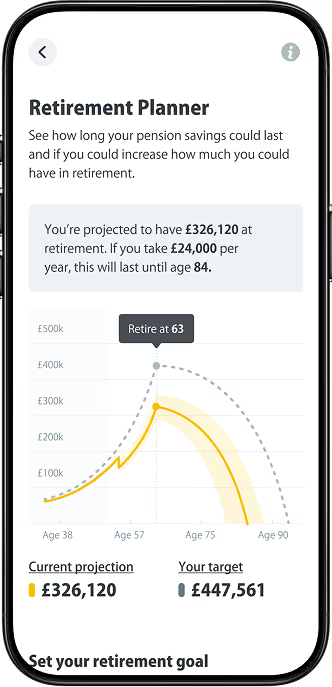

PHILIPPA: Yeah, I want to talk about risk, an appetite for risk a bit later on. The other thing that’s in my mind is contributions - because contributions are contributions, right? They just tick over, we don’t think about it. But there’s that thought as well, isn’t there? That if we’re talking about long-term savings growing with the power of compound interest, that marvellous thing, compound interest over time, even a small rise in how much more you put in your pot can make a huge difference. So, it’s about finding a little bit each month if you can. Those savings, I think, can be helpful, can’t they?

BOLA: Exactly. I speak to people about that a lot. I say, “can you put a bit more in?”. And sometimes I get, “oh, I don’t want to”. I’m like, “you’ll be happier in the future”. It’s so funny because you’re trying to make them see their future self. And funnily enough, what you said earlier, I can’t wait to be older.

PHILIPPA: Really?

BOLA: I know that you can become more unfiltered with age. And I’m just like, “oh my gosh, 70 plus, I’m going to run amok! Just be saying anything I want to”.

PHILIPPA: OK, we’re all back around the table when Bola’s that age and we’ll see what she says. I think, Laura, it’s important to understand, is it? We’re talking about upping our contributions. People think, “well, I just can’t. I just can’t”. We’re all strapped for cash. But it doesn’t need to be a lot, does it? I mean, say you could manage £50 a month more. What’s that going to look like, say, 30 years?

LAURA: Yeah. If you made a £50 contribution every month for 30 years, that could give you about £27,000 extra in your pot in retirement. It’s a very small action, but it’s the - Because it’s been done over a long period, it’s as we mentioned, compound interest. It allows your money more time to grow and you start almost earning interest on the interest you’re earning.

Yeah, I think it can be really powerful. One thing we sometimes say is sometimes it’s easier to think about it as a percentage rather than, I’m going to add £50 more. If you think I’m going to increase my contribution by 1%, 2%, then you can do that in line with if you have a salary increase or perhaps you have a bonus, and it helps you think about your overall financial position instead of maybe just plucking a number out of thin air because you think £50 sounds good, sort of thing.

NEIL: Laura, you raise a really valid point here. If I use this phrase, “human beings are born as storytellers, we’re not born as calculators“. That phrase is important. In some regards, as you say, OK, then I’m not going to baffle them with numbers. Great. But we can use it to our advantage, because if we say, just increase it by 1%, People go, “oh, that’s a small number. Oh, I could do that”.

So, we’re using it to our advantage to get them to take action. It’s not nefarious in any way. It’s playing on the fact that if you said, “oh, increase it by £50”, they can model £50 in their head. They know what £50 buys. They don’t know what 1% buys because they can’t do the maths. Sometimes we need to be clever in how we communicate with people.

Automate your way to compound interest

PHILIPPA: You can use technology as well, can’t you? To do this stuff for you because I love tech. This whole idea that you can set up all sorts of triggers with your banking. But when your savings get to a certain level, automatically ‘X’ amount goes into your pension or ‘X’ amount goes into some other form of savings. So, that you don’t even have to have that conversation with yourself, and it just does it for you. Do you use those? I think they’re really helpful.

BOLA: Yeah, I do. I know that there’s some apps where there’s things like, “oh, when it rains, put money away”.

PHILIPPA: Oh, that sounds great to me.

BOLA: I didn’t do that. Living in the UK, my friend does that. Living in the UK, I’m like, that is a very risky game because it rains a lot.

PHILIPPA: You say that, but it’s really beneficial, isn’t it?

BOLA: Yeah, exactly. Literally saving for a rainy day. But yeah, I do use some of those.

PHILIPPA: Yeah, I think that’s the thing, isn’t it? Then you don’t run that risk of a year later thinking, “oh, I got that rise, but actually, I’m so used to it now that it doesn’t feel like a rise. I haven’t done anything with that money, and I could have had a year of compound interest on that if I’d done it”. Technology can really help take some of the muscle out of it for you, can’t it?

NEIL: I use an app and I invested a small amount of money in it. I’ve kept it and I use it, and I’ve used it for now for three years. Basically, all it does is it goes into my bank account every week and it does an analysis of what my income is and my expenditure, and it just takes a tiny amount and takes it away from me and puts it into a savings account. And I never see it. I don’t miss it.

I get an email off them saying, “oh, we’ve just taken £43.62”. And you go, “amazing, OK, thanks”. And then I move on with my life. But when you go into the app and you look at how much money you’ve saved, it really is a “oh my word. That’s unbelievable”. And that’s both of them: it’s automating, but it’s also the power compounding - because it’s sitting there now and it’s doing something.

PHILIPPA: I think sometimes we talk about this like, “you should be doing this, you must do this, it’s important to do it”. But I’m not sure we talk enough about how nice it feels when you do. Because it gives you a real - Well, maybe it’s just me.

BOLA: Oh, I get it too.

PHILIPPA: But you stash a little bit of money or you look at your balance. And with apps, obviously, you can check your pension balance whenever you want to. And you do get that little, “oh, that’s nice”.

BOLA: I literally, what you said, I had an app doing that for two years, but I completely forgot about it. One time I was strapped for money and I was like [sliding out] the front door. I felt like I’d won the lottery. Although it was my money.

PHILIPPA: You did it, but it feels like a gift, doesn’t it?

BOLA: It felt great. Yeah, it does.

Understanding ‘risk’ in an investment context

PHILIPPA: The other barrier to all this is investing. We talk about this a lot on the podcast: saving versus investing. Because [with] saving, you feel good about saving, but you can always get your hands on your money. Investing, tying it up, it’s daunting. I mean, it’s an uncertain world. Stuff happens. We know this, job loss, whatever it might be, things that we’re not expecting. Good things, like unexpectedly having all sorts of nice things come to your life. It can be expensive.

That whole idea of, “do I really want my money where I can never get at it?”. I wonder whether we can talk a bit about how to get past that feeling of that being an overwhelmingly permanent final thing to do, particularly women. I think at PensionBee, you’ve got data on this, haven’t they? We’ve talked about it before that women, we like to save, but we like to be able to get our hands on it. How do we do this, Neil? You’re the one who’s going to tell us the psychology behind this. How does that not feel overwhelmingly risky to us?

NEIL: It doesn’t, and we have to accept that it’s overwhelming and risky. Two words. It’s overwhelming because every fibre of your brain is saying, “live today”. I can put my money into a savings account and the bank will say to me, “oh, you’re going to get 1% interest” and I can go, “OK, fine. Will I lose my capital?” “absolutely not”. That gives me a safety barrier. I know that if I put _money_purchase_annual_allowance in, I’m going to get at least _money_purchase_annual_allowance back. Whereas if I put _money_purchase_annual_allowance into a stock market or investment, there’s a risk that I might get none back.

Now, there’s an interesting thing that we can help people with here, and that’s understanding the difference between ‘possibility’ and ‘probability’. We often confuse those two things [interchangeably]. “Is there a possibility that I could lose money in a stock market investment?” “of course”. But it’s highly improbable. In other words, the chance of that happening, statistically, is incredibly slim, almost virtually zero, if you choose the right investment, right?

PHILIPPA: And it’s a long-term investment.

NEIL: And it’s a long-term investment. The only way you’re going to realise its value is if you stick the course. If you allow it to do what it needs to do. And that’s difficult because the roof breaks, the car’s broken down, and whatever, whatever - life happens. But the evidence is crystal clear, the sooner you can start investing in a pension, the sooner you can put your money to work, the more you will get back at the point in life when you need it. Your future self will turn around and say, “thank you so much for doing this for me”.

PHILIPPA: I mean, Laura, that’s the point that we should mention because we’ve talked about keeping an eye across your finances. That’s what the whole episode is about. But if you check your pension balance all the time, for years and years, you’re going to be looking at it at some point, it’s going to go down in value because it’s dependent on global financial situations you have no control over, your pension provider has no control over. So, one day, and it’s probably going to happen more than once, you’re going to look at the number and think, “oh, wow, that’s less than I thought”. Tell us, just reinforce the message, why we shouldn’t worry about that?

LAURA: Yeah, absolutely. I think it’s important to remember that pensions are long-term investments. And particularly if you’ve got a long investment horizon, so you’re not expecting to retire anytime soon, then you have a long time for the market [to] recover and you can weather that market volatility quite well. Typically, as you get older, you can move to a pension that ‘de-risks’. If you’re retiring very imminently, you wouldn’t have big nasty shocks, sort of thing.

PHILIPPA: Yes.

Balancing greed and fear

PHILIPPA: We’re balancing greed and fear, aren’t we? We want great returns on the money, we’re frightened of losing it - and they’re perfectly natural emotions. Thinking about how we make objective decisions, Neil, and we’re back to the whole ‘tell us how to do it’ thing. We’re aware you can feel the fear. When you - Money worries really get you like nothing else. You can really feel the anxiety in your heart, can’t you? When you think, “oh, that’s not as much as I thought it would be”. That’s bad news. And then the temptation to [make] a knee-jerk decision is really there, like a rush to action. How do we train ourselves to be less emotional about this and more rational?

NEIL: Man, that’s the million dollar question, right?

PHILIPPA: It is!

NEIL: It really is, because money is an emotional lightning rod. The second you say “money”, the brain goes into a place of, “oh, we’re going to have a difficult conversation. Do I want to really do this?”.

PHILIPPA: “It’s going to be complex”.

NEIL: “It’s going to be complicated. I’m going to hear jargon. I’m not going to understand. I’m going to look stupid”. All of those things. And risk is an important part of the story here. We need to learn more about money from a personal perspective. What I mean by that is we all have ‘money stories’. We all grow up and hear things about money. “We live our lives hand to mouth” or “oh no, we save because we’re a family of savers”. All of these stories we hear as kids -

PHILIPPA: You get an identity, don’t you?

NEIL: We get an identity, and it’s a ‘money identity‘, and it becomes part of who I am. And the more we can be objective about the decisions we make, the more we can make them based on fact and evidence, the better the decision will ultimately be. We shouldn’t really be making decisions about our long-term financial futures based on our gut or “it feels right”.

PHILIPPA: “I’ve got a friend who’s doing it”.

NEIL: Yeah, exactly. That’s completely subjective. Congratulations. Buy your friend a bottle of champagne and say, “well done”. But the reality is their life is their life and your life is your life.

PHILIPPA: So, countering that fear, that anxiety, I mean, there are rational things you can do. We haven’t talked about ‘diversification’. If you’re worried about risk, if you’re worried about a ‘bad number’ that you’re suddenly seeing on a screen - how do people do that? So they can balance out those risks.

BOLA: Yeah, I think it’s key to invest in different types of assets and ask yourself, “what are you comfortable investing in?”. Maybe also, ask yourself, “what don’t you know?”. Being British, we know about property quite well. But then you want to look at, OK, stocks and shares or bonds, for example, in different ways that you can invest.

And also, different markets. If you invest in funds, maybe you don’t know much about markets in Asia, for example, or America. But this is where you come in, you learn, you ask questions. Then just remember, you can take different percentages. If there’s something that you deem to be safer and you have a better understanding of, you maybe say, “I’m comfortable to put _higher_rate of asset allocation into this one thing and then maybe _basic_rate in another”, and just realise that how that number and what you put in can change over time.

How to make (and keep) good habits

PHILIPPA: Well, we need to wrap this up really now. But before we do that, I’d like to get back to that whole idea of how do we embed these good habits that we’re trying to form because Neil, you talked about the gym. We can think about diets all of us have been on. That whole sense of how do you make saving and investing feel fresh and worth doing for life. Bola, what have you got?

BOLA: Well, automation is important. So, wherever you can automate money and contributions to your pension. Yeah, I’d say that’s key. And potentially, if you can add more in manually yourself, maybe set quarterly reminders on top of the automation, that way you have two different sets of reminders. One that’s happening automatically and one where you can say, “oh, I wonder, do I have a bit more money at the moment to put in?”.

PHILIPPA: I do that. Calendar reminders, that simple. It’s a nice idea, isn’t it? Set them for weekends, though, because if you set them in the week, you don’t do it. I speak from experience here because life gets busy. Then before you know it, you’ve forgotten about that calendar reminder. Laura?

LAURA: When it comes to my pension, I’m going to have a ‘home pot‘ sort of approach. I’m going to have one pot that I keep throughout my career. Then as I go through all my old pots, I’m just going to move into the home pot. The idea is I should hopefully always have only one to two pensions.

PHILIPPA: Yeah, simplification. I guess there’s a lot to be said for that, isn’t there? How many more passwords do we need to remember?

BOLA: Honestly.

PHILIPPA: Yeah, I know. Thank you all very much indeed.

ALL: Thank you.

PHILIPPA: And thanks everyone for listening. It seems to me this is all about looking after the pennies and watching them turn into pounds - eventually.

If you’re enjoying the series, do give us a rate and a review. It really helps us reach more listeners like you. And if you’ve missed an episode, don’t worry. You can catch up anytime on your favourite podcast app, YouTube, or if you’re a PensionBee customer - in the PensionBee app.

Next month, we’re going to be looking at how to stay on top of your finances if you’re shifting careers. You might be reskilling into a whole new line of work, becoming self-employed, maybe in later life, or even starting a business. We’re all having to be more agile in our working lives, and we’ll have plenty of tips and inspiration to help guide you through your next step.

Just a final reminder, anything discussed on the podcast shouldn’t be regarded as financial advice or legal advice, and when investing in capital is at risk. Thank you for joining. We’ll see you next time.

Risk warning

As always with investments, your capital is at risk. The value of your investment can go down as well as up, and you may get back less than you invest. This information should not be regarded as financial advice.

Bonus episode: What does the 2025/26 tax year mean for your finances?
Read the transcript from our bonus podcast episode on the new tax year.

The following is a transcript of a bonus podcast episode of The Pension Confident Podcast. Listen to the episode or scroll on to read the conversation.

Takeaways from this episode

  • Understanding the new tax year - the new tax year started on 6 April 2025, which resets your annual tax allowances. This is an opportunity to set financial goals, such as utilising savings accounts like ISAs.
  • Incomes and income tax - the National Living Wage for those aged 21 and over will rise from £11.44 to £12.21 per hour.
  • Frozen tax thresholds - the freezing of income tax and personal tax-free allowances means that more people may be pushed into higher tax brackets as their salaries increase.
  • State Pension adjustments - the State Pension will rise by 4.1%, benefiting from the triple lock. But some pensioners may feel worse off due to the withdrawal of the Winter Fuel Payment.
  • Changes to statutory sick pay - Statutory Sick Pay will increase from £116.75 to £118.75 per week, though this remains a minimal change.
  • Increased parental pay and childcare benefits - Statutory Parental Pay will see a nominal increase, while free childcare hours will expand significantly from September 2025, although potential costs remain a concern for parents.

PHILIPPA: Hi there. Welcome to a bonus episode all about the new tax year and what it could mean for your finances. Now, last November, we had Chancellor Rachel Reeve’s first budget. We’ve just had her first Spring Statement. So what’s changing? Well, plenty! From the minimum wage to tax bands, sick pay, and the State Pension - a bunch of announcements came into effect on 6 April. So now’s the perfect moment to get your head around them.

I’m Philippa Lamb, and if you’re not already subscribed to the podcast, why not click to sign up right now? Faith Archer has just walked into the studio. If you’re a regular listener, you already know she’s an old friend of the podcast. She’s a Financial Journalist and Founder of the personal finance platform, Much More With Less - which helps people make the most of their money. Welcome back to the podcast, Faith.

FAITH: Great to be here.

PHILIPPA: It’s nice to see you again. Here’s the usual quick disclaimer before we start, please remember, anything discussed on the podcast shouldn’t be regarded as financial advice or legal advice. And importantly, when investing, your capital is at risk.

The start of a new tax year

PHILIPPA: So, Faith, should we start with the basics? As I said, the new tax year, it started on Sunday 6 April. What exactly is the tax year?

FAITH: Well, it’s the year from 6 April one year to the 5 April the next, and it’s the period over which income tax and other taxes are calculated. So rather than running for the calendar year, from the beginning of January to the end of December.

PHILIPPA: It’s quite a useful reset point in the year, isn’t it, for everyone?

FAITH: Yeah, I think so. You can almost have your ‘tax year resolutions’ and think about the different things you’re going to do now that all your tax allowances have restarted.

PHILIPPA: I’m guessing you do this every year. What sort of things are on your list?

FAITH: Well, from an income perspective, you’re allowed to earn a certain amount of money every year before you start paying income tax. For most people, that’s £12,570 a year. But there’s also some little extra allowances. The £1,000 a year property allowance, the £1,000 a year trading allowance. If you make a bit of money, say selling stuff on Vinted or Depop -

PHILIPPA: OK.

FAITH: - those allowances restart. You can earn extra cash without having to pay income tax. Also, if you’ve got any spare cash that you can sort away, you have allowances, £20,000 is the overall Individual Savings Account allowance -

PHILIPPA: ISA?

FAITH: - the ISA, yes. Then once you put money inside an ISA, it’s protected from the taxman. The taxman can’t touch it for tax, and they’re also not interested if you take any money out of it. There are many flavours of ISAs nowadays. There’s also the Lifetime ISA. That’s a £4,000 allowance with the bonus that the government will add an extra £1,000. It’s meant to be an incentive for younger people to save for [their] first property or for retirement. There’s Junior ISAs for the under 18s, so you can put £9,000 each tax year in those for your kids. And pensions, your pension allowance resets, so you can put a larger sum into your pension.

PHILIPPA: Yeah, and as you say, I’ve been talking about the ISA allowances. They always sound like such a lot of money, £20,000 here, £9,000 there. But you can put in whatever you can afford, but it’s well worth putting in what you can, right?

FAITH: Absolutely. I think the tax year can be a really good trigger just to rethink, are there ways that you can top-up the allowances that are slightly less painful.

PHILIPPA: Yeah.

FAITH: Setting up that Direct Debit for an affordable amount, so it just goes out without you having to lift a finger. If you’re one of the lucky people that’s had a pay rise, for example, then now might be a good time to think, “have you got some spare cash that perhaps you could divert into savings or pension? Can you up a Direct Debit? Could you up, if you’re lucky enough to have an employer who might even match pension contributions, could you up those contributions?” It’s going out straight after payday before you’ve noticed it, before you’ve got used to living on a higher income.

PHILIPPA: What you’re essentially saying is, it’s a spring clean for your finances, isn’t it?

FAITH: Yeah.

PHILIPPA: The beginning of the tax year. Every year, just take a look at what’s going on, make some changes, see where you’re at?

FAITH: Yeah.

Increased pay for employees and costs for employers

PHILIPPA: Should we take a look at what’s actually changed from the Chancellor’s point of view? Because as I said, we had the Budget last Autumn. Some of the things she announced then are only coming into effect now. Then we’ve had the Spring Statement as well. I mentioned the National Living Wage. What’s changing there?

FAITH: Well, I think this is positive. It’s going up. For those aged 21 and over, it’s going to go up from £11.44 an hour to £12.21 an hour. That’s if you’re working 35 hours a week, that’s a reasonably decent increase. Where it’s really going to hit, perhaps, is more on the employer side of it -

PHILIPPA: Yeah.

FAITH: - than the employee. Because for employers, they’re not just having to find the money for increases in the National Living Wage, if that affects some of their staff. But also we’re finally seeing the changes to employee National Insurance contributions (NICs) kicking in. The ones that were announced in the Autumn Statement. That’s quite a tough pill because employers are seeing both the rate at which National Insurance contributions by employers are paid, that’s going up - 13.8% to 15%. And also the point at which they have to start paying it is going down. All of a sudden, they have to start paying employer NICs at £5,000 rather than £9,100. I think that triple whammy: more employer NICs, starting at a lower point and higher salaries if you’re sticking with the National Living Wage. That’s quite an expensive bill on the payroll.

PHILIPPA: Employers will see their payroll cost go up. It depends what business they’re in, [by] how much. There’s going to be a knock-on for jobs, I’m guessing, and maybe a knock-on for how likely you are to get a pay rise this year.

FAITH: Yeah. Fundamentally, if costs have gone up, that money is going to come from somewhere. So either it’s being passed on in higher costs for goods and services, or fewer pay rises, or are they going to be more reluctant to take on additional staff if the cost is going to be higher? If the business is struggling, are they actually going to have to let staff go? We have yet to see how that’s going to roll out, what impact that is going to have on people’s wages and employment prospects.

PHILIPPA: There’s been a lot of speculation in the press, isn’t there?

FAITH: Yeah.

Frozen income tax and personal tax-free allowance thresholds

Now, tax again. Explain this to me because I think it’s often very confusing. Income tax and personal tax-free allowances, they’re frozen again this year. What does that mean?

FAITH: I mentioned that you could earn a certain amount of money before you start paying income tax. At the moment, that’s £12,570. Now, what used to happen was each year that allowance went up with inflation. By freezing them, what it means is if the allowance is the same but your salary increases, you’ve got more income being taxed.

PHILIPPA: At the higher level?

FAITH: Well, just being taxed at all! It means more people start paying tax and more people get pushed up into higher tax brackets. It just means a higher tax take. The fact that it has been frozen, I think it was maybe even April 2022, it’s forecast to be frozen until at least April 2028. This is one way of bringing in a significantly higher tax take for the government rather than just, say, slapping up the rate of income tax.

PHILIPPA: It’s worth being aware of, because it sounds like one of those things you think, “well, if it’s frozen, so what? I don’t need to think about it”. But actually, it’s significant, isn’t it? There’s a term for it, isn’t there? ‘Fiscal drag’.

FAITH: Yeah. It’s a really big intake. I’ve seen figures from the Office for Budget Responsibility (OBR) suggesting that the freeze since 2022 means there’ll be 9% more taxpayers in all, but 47% more higher rate taxpayers, and again, 47% more additional rate taxpayers. Because of people getting pushed up into these higher rates of income tax.

PHILIPPA: It’s really, really significant.

FAITH: Yeah.

The State Pension and Winter Fuel Payment

PHILIPPA: [The] State Pension, that’s going up.

FAITH: It is! Income tax thresholds may be frozen, but the State Pension, it benefits from the ‘triple lock‘, the full new State Pension. The triple lock, it means that the State Pension increases each year by the highest of either: inflation, earnings growth, or 2.5%.

PHILIPPA: This year?

FAITH: It’s going up 4.1% in line with the Consumer Price Index (CPI) - inflation.

PHILIPPA: OK, which sounds like good news.

FAITH: Well, it is good news, and I think there are a lot of pensioners that’ll be glad of the increase in their State Pension. Especially because they saw the Winter Fuel Payment withdrawn by the government. That’s something that used to be a universal benefit that pensioners got either £200 or £300 to help pay their heating bills. The change that Labour brought in was that you’d only get the Winter Fuel Payment if you were on certain means-tested benefits, such as Pension Credit.

PHILIPPA: Yeah, this was a change that happened very rapidly, didn’t it? As soon as the new government came into power -

FAITH: Very quickly.

PHILIPPA: - pretty much this happened. I guess for those people, even though the State Pension is going up, it’s going to be offset by the fact that they won’t be able to claim, they won’t get the Winter Fuel Allowance.

FAITH: I think the real kicker, I’ve heard this month referred to as ‘awful April’ because for all of us, not just if you’re a pensioner, but virtually every utility bill you can think of is going up. Now, I’ve seen forecasts that on average, people expect their bills to go up by [around] £400 a year.

PHILIPPA: That’s a lot.

FAITH: And the State Pension is going up by £471 (a year).

PHILIPPA: So when it comes down to it, most people aren’t going to be that much better off?

FAITH: No. If you used to get the Winter Fuel Payment and you no longer do -

PHILIPPA: You’re worse off.

FAITH: You’re worse off. If you look at food prices, there’s been a lot of food inflation. Things aren’t looking rosy.

PHILIPPA: No. I mean, being a bit less doomy, at least, inflation does now seem to be coming more under control, certainly more than it was last year.

FAITH: Yes, not as sky high, no.

PHILIPPA: Before we leave pensions, there’s this issue now, isn’t there? With the State Pension getting close to the level of the personal allowance you were talking about a minute ago. This is the point at which we have to start paying tax. What could that mean for pensioners then? If their pension takes them to the point where they need to start paying tax?

FAITH: Well, it’s the government effectively giving with one hand and taking away with the other. I think it just means that more pensioners will have to pay income tax if they have the smallest amount of other income. Perhaps from a private pension, savings, investments, whatever it is, workplace pensions.

PHILIPPA: They might have been just below the limit where they had to start paying tax, but now they might tip over.

FAITH: Yeah, it’s so clear. I think the full new State Pension from 6 April, I think is like £11,973 a year versus the £12,570 personal allowance. What’s that? Like a £600 difference.

PHILIPPA: Really, really close.

FAITH: Yeah, you don’t need to be bringing in much extra income, and suddenly you’re a taxpayer.

Changes to Statutory Sick Pay, alongside overhaul of benefits systems

PHILIPPA: Sick pay. Statutory Sick Pay (or SSP), that’s changing too, isn’t it?

FAITH: It is. It’s increasing up from £116.75 to £118.75 per week.

PHILIPPA: Not a huge change.

FAITH: Yeah, it’s not a massive change. It’s a little bit up. I mean, that’s the minimum. You’ll find some employers are more generous, but I don’t think many of us would actually like to be trying to fund all of our living costs on that amount per week.

PHILIPPA: No, absolutely. Now, the other issue that cropped up in the run up to the Spring Statement was [the] changes to the benefits system. We now know what they’re going to be. It’s complicated. It affects quite a range of benefits. Do you want to just remind us which ones it is - so that people can check for their own situation?

FAITH: I think the government is very keen to get more people into work and bring down the size of the benefits bill. The main levers it’s using to pull are on Universal Credit, and the Personal Independence Payments (PIP), that are made to people who have disabilities, illnesses that make it more difficult for them to work. They’re effectively making it, I think, more difficult to get Personal Independence Payments to try and make people incentivised to go out, find jobs in some way, and increase their income that way.

Increased Statutory Parental Pay and free nursery hours

PHILIPPA: Family-friendly changes. Now, we’ve seen rises, haven’t we? To statutory maternity, paternity, adoption, and Shared Parental Pay. They’re all going up?

FAITH: They are. They’ll go up nominally from £184.03 to £187.18. But in practice, the amount is either 90% of average weekly earnings or the statutory rate (whichever is lower). The earnings threshold is also going up a tad, just ticking up £123 to £125 a week. Maternity Allowance, though, [the] threshold stays at £30 a week.

PHILIPPA: OK. I mean, something to think about if you’re planning for a new baby, I guess, just to factor those numbers in?

FAITH: Make the budget beforehand so that if you do need to make cuts, you do them as soon as possible, rather than after -

PHILIPPA: Yeah.

FIATH: - you spend the money and suddenly thinking, “oh my goodness, I can’t afford that!”.

PHILIPPA: First step, understand what your employers’ policies are.

FAITH: Yeah, because some employers are way more generous than the statutory minimums.

PHILIPPA: Yes, because if you only get the statutory minimum, that might be way, way less than you would tend to earn normally (or not). But so get on the company website, ask your line manager, whatever it is - find out. Because there’s no standard policy here. It goes company by company, employer by employer.

FAITH: Company by company. It’ll be limited to how much time you take for your maternity leave. There may be reasons why you need to return to work at certain points rather than go on to lower levels of maternity/paternity pay.

PHILIPPA: Thinking about older kids, then childcare, this is a huge cost for millions of parents. I mean, it’s something that’s talked about by everyone with children. What’s happening with free childcare hours? Because they’re going up, aren’t they?

FAITH: They are. It’s not something that’s changing straight away. It’s more from September 2025. The situation at the moment is that eligible working parents can get 15 hours free childcare for children aged nine months to three years [old]. But that then doubles to 30 hours for three and four year olds. The big change from September 2025 is that 30 hours a week should be available for all the kids from nine months up to school age. There’s widening the access to 30 hours a week [of] free childcare.

PHILIPPA: I’m slightly wondering how helpful this will be for everyone. Because there’s already talk of nursery fees going up and swallowing that benefit from the point of view of parents and also the lack of provision nationally. It’s patchy, isn’t it?

FAITH: It’s patchy. It depends what childcare provision is available in your area. Part of the reason it’s patchy is because historically, the amount the government reimburses nurseries for these free hours isn’t actually enough. It doesn’t cover the genuine cost of caring for the children. We’ve seen, I mean, some nurseries have closed. Other nurseries, they get around it by charging top-up fees.

PHILIPPA: Yeah.

FAITH: So your free hours do come with a bill attached, where that’s justified as being for, say, nappies or meals, sunscreen, trips. So there could be some cost. I think one of the other restrictions is that it’s not necessarily 30 hours week in, week out. It’s during term-time rather than all year round.

PHILIPPA: Yeah, that’s a really key thing to understand if you’re working full-time. Time, isn’t it? This doesn’t cover you all year.

FAITH: Yeah. While the free hours of childcare, if it brings down your childcare bill, that’s amazing.

PHILIPPA: Great.

FAITH: Just remember, it’s more like a reduction than potentially completely free.

PHILIPPA: It’ll depend on what nursery you’re using.

FAITH: Yes.

PHILIPPA: Faith, thank you so much. That was a really useful rundown. Sorry to have so many questions. There was a lot to talk about, wasn’t there?

FAITH: There was.

PHILIPPA: If you’re enjoying this series, please do give us a rating and a review. It really helps us reach more listeners like you. Now, if you’ve missed an episode, don’t worry. You can catch up anytime on your favourite podcast app, YouTube, or if you’re a PensionBee customer in the PensionBee app, of course.

Now, next month, we’ll be exploring how to stay on top of your finances if you’re thinking about making a career change. Maybe you’re thinking about reskilling into a whole new line of work. Maybe it’s self-employment or starting your own business that you’re thinking about. Whatever age and stage you’re at, we’ll have plenty of practical tips and inspiration to help you take that next step.

Just a final reminder, anything discussed on the podcast shouldn’t be regarded as financial advice or legal advice. When investing, your capital is at risk. Thanks for being with us.

Risk warning

As always with investments, your capital is at risk. The value of your investment can go down as well as up, and you may get back less than you invest. This information should not be regarded as financial advice.

What's new at PensionBee in January 2019
Find out what we're doing to bring the new year in with a bang.

2019 looks set to be a big year for PensionBee, and we’ve kicked off the new year with some exciting new updates. We’re always working to bring you an innovative, modern pension experience, so read on to find out what we’ve been up to this month.

We’ve launched a Shariah compliant plan...

Shariah Plan

This month sees the addition of three new PensionBee plans, including our Shariah Plan. This plan invests your money only into Shariah-compliant companies, which could make it a good choice for anyone who’d like to invest responsibly. All investments are approved by an independent Shariah committee, and the fund is managed by HSBC and State Street Global Advisors, so you know your money is in safe hands. Find out more on our plans page.

The low-risk Preserve Plan...

Preserve Plan

We’re also excited to announce the launch of our Preserve Plan, a lower-risk plan that is designed to shelter your pension from stock market volatility. Instead of investing in the markets, it makes short-term investments into creditworthy companies – reducing your risk with the intention of preserving your money. Take a closer look over on our plans page.

...and our actively-managed 4Plus Plan

4Plus Plan

The 4Plus Plan could be ideal for people looking to de-risk before retirement. The long-term growth target of 4% can indicate what you’ll expect to receive, so you can start planning your retirement to a degree of certainty.

Our 4Plus Plan aims to achieve long-term growth of 4% per year, by managing your money actively across a range of global investments. The fund manager, State Street Global Advisors, responds to market developments where necessary, always seeking a balance between growth and stability. Find out more about how it works on our plans page.

Check out our redesigned homepage

New homepage

We’ve given our homepage a makeover to showcase our entire offering – helping customers combine their pensions, increase contributions and make withdrawals, in just a few clicks. It’s these key features of our product that make us a leading online pension provider. Visit our shiny new homepage here.

Keep an eye out for our next update on our blog. We’re always working on new features to make our customers happy, so if you have any ideas or suggestions, please let us know in the comments section or over on social media, and we’ll feed it back to the team.

What happened at PensionBee in February 2019
Our team were busy bees throughout February! Find out what we got up to last month!

It may have been the shortest month of the year but our team were busy bees throughout February. We introduced some important new product updates last month, so read on to find out what we got up to.

We’ve made it even easier to make contributions via bank transfer

Contribution blanket

We’ve improved our process for customers making contributions via bank transfer to make it simpler to save for retirement. Now, you only need to set up a bank transfer once and we’ll be able to invest any amount you contribute, regardless of the amount you set up the bank transfer with. This means you won’t need to set up a new transfer for different contribution amounts, which may suit customers with a fluctuating income, and it’s even easier to make weekly contributions.

Our improved process applies across recurring and one-off contributions made by bank transfer. We’ve updated our terms and conditions to reflect this change, which applies to existing customers as well. If you’re contributing via bank transfer, make sure to keep track of your payments so you don’t exceed your annual allowance.

Remember, contributions can also be made using Direct Debit. You can learn more about making contributions to your PensionBee pension in our FAQs.

We’ve launched dynamic performance charts in your BeeHive

Dynamic charts

Customers can now compare their plan performance to the FTSE 100, straight from their BeeHive. This new feature will allow you to track market volatility over time, and gain greater insight into the past performance of our longest running plans. It may also provide context when considering the impact recent stock market fluctuations could have on longer-term investments.

For now, this is only available to members of the Tracker, Tailored, Future World and Match plans, when you log into your online dashboard. Simply navigate to your Account using the tabs, and select ‘My plan’ from the dropdown menu.

If you’ve chosen one of our newer Shariah, Preserve, or 4Plus plans, rest assured we’ll be launching dynamic performance graphs for these too. And soon this exciting new feature will also be available to view in our mobile app.

Our CEO Romi Savova became a PensionBee BeeKeeper for a week!

Romi BeeKeeping

PensionBee CEO Romi Savova spent a week this month on the front line as a BeeKeeper, solving problems and helping our customers. At PensionBee, our customers are our priority and getting back to basics is a great way to feel good about the work we’re doing to create a modern pension experience, and to identify ways to improve and simplify our services. Romi loved speaking to and learning from our customers. Read about her experience on our blog.

Keep an eye out for our next update on our blog. We’re always working on new features to make our customers happy, so if you have any ideas or suggestions, please let us know in the comments section or over on social media, and we’ll feed it back to the team.

What happened at PensionBee in March 2019
We've been busy rolling out some exciting new updates this March. Find out what we've been up to!

It’s been another busy month in the PensionBee office as we continue working on updates and improvements, in line with our mission to create an innovative pension product for our customers. Here are some of our highlights from March.

We’re rolling out My Plan updates for our mobile app

My Plan app updates

We’re always looking to provide our customers with greater insight into their savings, from our easy pensions explainers to helping customers understand their pension performance. We’ve recently made some shiny improvements to your plan page, which you can find under the ‘Account’ tab when you log into your online dashboard. You’ll find information about your plan and its performance, as well as additional resources to help you get into the nitty gritty of your pension plan.

We’re now rolling out these updates to our mobile app, to make it even easier to learn about your plan and how it’s performing. Currently, Android users will find a new ‘Plan information’ link on their ‘Account’ tab, under the ‘My Plan’ heading. Here, you’ll be able to find details about your plan, performance charts, and other useful information. We’ll be rolling out the new update to iOS users in the next couple of weeks, alongside additional resource documents for both platforms.

Guest blogger Faith Archer wrote about the gender pension gap

Guest post

For International Women’s Day this year, finance journalist and money blogger Faith Archer wrote an insightful guest post for PensionBee, highlighting the gender pension gap and steps we can all take to close it. Faith builds on our research which shows that, on average, men in the UK have 31% more in their pots than women, with the gap increasing to _scot_higher_rate for men and women in their 50s. Yikes!

Faith addresses the cause of this gap, including its links to the gender pay gap, and offers some helpful suggestions for women to close the gap and make the most of their pension savings. You can read Faith’s full post on our blog.

PensionBee is shortlisted for three UK Pensions Awards

We’re thrilled to announce that we’ve been shortlisted for a whopping THREE UK Pensions Awards! PensionBee has been shortlisted in three categories: DC Pension Provider of the Year, DC Innovation of the Year, and Retirement Innovation of the Year. Congratulations to all of this year’s finalists!

Keep an eye out for our next update on our blog. We’re always working on new features to make our customers happy, so if you have any ideas or suggestions, please let us know in the comments section or over on social media, and we’ll feed it back to the team.

How PensionBee helped Fiona take control of her retirement
Our customer, Fiona, tells us how PensionBee has helped her plan for retirement.

As Fiona approached 40, she wanted to start building a nest egg for the future. She had several pensions from previous jobs and her main concern was to bring them together, so she could start building a clearer picture and put a saving plan in place.

Fiona fixes her pension mess

After finding out about PensionBee online, Fiona decided to consolidate three of her past pensions with us. There was no need for her to send us reams of paperwork, or spend hours on the phone to old providers. All we needed to combine her pensions were some basic details, like her provider name and her policy number.

PensionBee deal with it all. I just put my name in and my policy number, and then they’ve done everything else. I didn’t have to do anything, it was just... done!

Fiona found the process quick and simple from start to finish, and she now uses our app to keep track of her pension from her smartphone.

{{main-cta}}

Pension peace of mind

With her pensions all in one place, Fiona’s now a lot more relaxed about retirement. She loves the transparency her BeeHive provides and doesn’t worry about her finances like she used to.

Being with PensionBee makes me really relaxed about my finances. It’s all in one place, I can see everything on my app, and I just don’t have to worry about it any more.

In fact she’s inspired her partner Dave to sort his own pension, after he heard about Fiona’s experience with PensionBee!

Fiona’s talked to me about PensionBee from the second she signed up. It’s prompted me to sort myself out and maybe it’s something I’ll be looking at!

Find out what other PensionBee customers have to say over on our YouTube channel, or take a look at customer reviews on Trustpilot.

How PensionBee made saving simple for Lucille
Take a look at what our customer Lucille thinks of PensionBee.

After a year of waiting on financial advisers to consolidate her pensions, Lucille was getting weary.

She had a number of dormant pensions from previous companies and was concerned about losing track of them, as well as losing their value to costly fees.

Lucille decided it was time to make matters into her own hands, and after a recommendation from a friend she decided to sign up to PensionBee.

Pensions made simple

Lucille found it easy to bring her old pots into one PensionBee plan. She just gave us some basic information and we took care of rest, with her personal BeeKeeper updating her throughout the process.

You’ve got a point of contact. It’s nice to know that if I do want to contact PensionBee I can email my BeeKeeper and get a response from a person!

Lucille uses PensionBee’s pension calculator to work out how much she needs to be contributing to meet her goals and retire earlier. Now, she’s excited to save into her pot and fund her big retirement travel plans.

A transparent pension for the 21st century

Lucille loves the extra transparency she gets with PensionBee. Her online balance helps her follow all her fund’s activity, while her Analytics charts help her track the performance of her money.

PensionBee allows me to see how my pension’s performing. I’ll be able to work out whether I need to ramp up my contributions, which will help me get to retirement. And then I won’t have to work any more!

Find out what other PensionBee customers have to say over on our YouTube channel, or take a look at customer reviews on Trustpilot.

How PensionBee gave Rebecca a self-employed pension
Self-employed Rebecca shares her PensionBee story.

Ever since becoming self-employed Rebecca’s pension had been on her mind. But between running her own business and being a mum for her two young children, she didn’t have a lot of time.

She had five old pensions from previous jobs but thought consolidating them would be too much hassle. Until she stumbled across PensionBee...

A quick way to consolidate

Rebecca was able to quickly and easily consolidate her previous pensions, with the sign up process - including the time spent tracking down her dusty old paperwork - taking no more than an hour and a half. The simplicity involved definetely appealed with her time being so precious, a policy number and a provider name all that was required.

PensionBee helps me from the point of view of being self employed specifically because it’s very simple, very quick, very easy.

Rebecca likes the flexibility that PensionBee offers her as a self-employed saver. There are no minimum contribution amounts and she can make one-off contributions instead of a set amount each month.

Re-engaged to save

Now, Rebecca feels more engaged with her pension and uses the app regularly to pay in and watch her pot grow.

I think I look at the app every two or three days! I’m quite enjoying seeing it grow on my phone.

She didn’t realise how much there was until she brought her old pots together, and the increased transparency that comes with PensionBee has inspired her to save even further.

Find out what other PensionBee customers have to say over on our YouTube channel, take a look at customer reviews on Trustpilot or look at our self employed pension.

What happened at PensionBee in April and May 2019
We’re excited to announce some new and improved features at PensionBee. Here’s what we’ve been working on in April and May!

We’ve got some exciting updates to share with you, including a fresh look on our website and our rollout of new Simpler Annual Statements, which makes us the first pension provider to offer customers an easy to understand snapshot of their pension. Read on to learn what’s new at PensionBee and how we’re improving your pension experience.

We’ve adopted Simpler Annual Statements to make it even easier to manage your pension

Simpler Annual Statements

We want to give our customers complete transparency and control over their savings. Whether that’s by giving you full visibility of how your pension’s performing, or making our annual statements easier to understand – we’re on a mission to make pensions simple!

Our Simpler Annual Statements are designed to provide a short and clear overview of your pension. They’ll show you the total balance, how much you’ve contributed to your pension, the tax top ups you’ve received from HMRC and how much your employer has paid in, if applicable.

We’re pleased to be the first pension provider to adopt the new format, since it was announced by the government back in October. Minister for Pensions and Financial Inclusion, Guy Opperman said: “I am 11_personal_allowance_rate committed to simpler statements and am pleased to see PensionBee adopting the Simpler Annual Statement. I look forward to the rest of the industry doing the same thing in 2019.”

If you have a live balance and transferred your old pensions to PensionBee before the end of the 2018/19 tax year, (and haven’t transferred out or started withdrawing from your pension), you’ll be able to view your Simpler Annual Statement in your BeeHive.

We’ve refreshed our website to show you how PensionBee works, from consolidating to withdrawing your pension

How It Works update

We’re always working to bust jargon and demystify pensions, whether that’s through the articles in our Pensions Explained centre, our Pensions 101 videos over on YouTube, or explaining how pensions work right here on our website. We’ve recently updated our How It Works page to give you a simple and concise walkthrough of our service - our website is as easy and straightforward as it is to manage your pension with PensionBee!

Plus we’ve added new sections on combining your old pensions with PensionBee and making contributions to your new PensionBee plan, which sit alongside our page on how to withdraw your pension when it’s time to retire. Our site covers everything you need to know, from transferring your existing pensions over to us, to receiving tax top ups from HMRC, and even planning your retirement with our drawdown calculator.

We’ve been nominated… again!

We’re thrilled to announce that we’ve been nominated for Diversity and Inclusion Champion in the Computing Tech Marketing and Innovation Awards 2019! We’re incredibly proud of our diverse team, whose dedication, commitment, and insight make PensionBee such a wonderful and inclusive place to work.

We’ve also been nominated for Tech Company of the Year in the Evening Standard Business Awards 2019 - alongside Twitter, no less!

🏅We’re pleased to announce that PensionBee has been shortlisted for ‘Diversity and Inclusion Champion’ in the Computing Tech Marketing and Innovation Awards 2019 🏅 #pensions #fintech #awards #diversityandinclusion https://t.co/T7vKbLtNoB pic.twitter.com/lPCt83TdI5
— PensionBee (@pensionbee)

And that’s not all - PensionBee has also been nominated in the Investment Marketing and Innovation Awards 2019. We’re shortlisted for three awards: the Corporate Social Responsibility Award, Most Innovative Direct Consumer Proposition, and the Open Innovation Award. We’re proud to be bringing our company values of innovation and love to the pensions industry.

Plus, our CEO, Romi, has been nominated for no less than six accolades at the Women in Pensions Awards 2019, including Pensions Woman of the Year and Role Model of the Year. Congratulations to everyone who was nominated.

Keep an eye out for our next update on our blog. We’re always working on new features to make our customers happy, so if you have any ideas or suggestions, please let us know in the comments section or over on social media, and we’ll feed it back to the team.

What happened at PensionBee in June 2019
We were busy bees last month, working hard to bring exciting new features to your pension. Here’s what we were working on in June.

Summer is finally here and there’s a buzz in the air - and in our BeeHive! We were busy bees last month, working to bring exciting new features to your account as well as stacking up those award wins. Here’s what we got up to in June.

We’ve automated your tax top ups from HMRC

Automated tax top ups

We’ve recently made improvements to the way your tax top ups from HMRC are added to your account. Now, whenever you make a personal contribution to your pension, we’ll automatically add your _corporation_tax tax top ups from HMRC so you can see the funds in your account straightaway.

This means you’ll no longer need to wait eight weeks for these to credit your account, and will be able to see a more accurate view of your balance whenever you log into your BeeHive. Don’t forget, most savers can contribute £100 to their pension from a personal bank account, and get a £25 top up from HMRC, to a maximum of £40,000 in the current tax year.

We’re keeping your pension safe

New safety page

Keeping your savings safe is paramount to us at PensionBee, so we’ve updated our website to highlight the security procedures we use to protect your money. PensionBee is directly authorised and regulated by the Financial Conduct Authority, and we’re also a member of the Association of British Insurers, working on better standards in the pensions industry.

Plus, our pensions are managed by the world’s largest money managers – State Street Global Advisors, HSBC and BlackRock – so you know your money’s in experienced hands. They invest your money and your pension is kept completely separate from our own funds.

If our money managers fail, your pension will be protected by the Financial Services Compensation Scheme up to 10_personal_allowance_rate. We’ll also pursue any compensation on your behalf. Should PensionBee fail, your money manager will continue to invest your pension. We don’t manage your money, so your savings would be safe.

We protect your data with full encryption, secure data protection practices, and we will never share your personal information without your permission. You can find out more about our security policies on our website and our FAQs, or get in touch with your BeeKeeper if you have any questions.

The awards keep coming…

The awards keep coming

We’re pleased to announce that PensionBee was named ‘Diversity and Inclusion Champion’ at the Computing Tech Marketing & Innovation Awards, in recognition of our work campaigning for diversity and representation in the pensions industry.

We’re immensely proud that half of our team consists of women and we have around _higher_rate BME representation at PensionBee – an achievement that’s unheard of in our sector. We’re working hard to prove that pensions can be a good career for anyone looking to be on the cutting-edge of product development and innovation, while challenging the perceptions of what people in pensions should be.

We also won two awards at the Investment Marketing and Innovation Awards: ‘Most Innovative Direct Consumer Proposition’ and ‘Open Innovation’. The first accolade acknowledges our simple online user journey which has transformed pension transfer processes to give you complete control and clarity over your pension.

The second award recognises our innovative use of Open Banking in an industry that hasn’t changed or adapted with advances in technology in decades. We plan to share our APIs with even more banking marketplaces and aggregators in the near-future to put pensions back where they belong – at the forefront of your finances.

Keep an eye out for our next update on our blog. We’re always working on new features to make our customers happy, so if you have any ideas or suggestions, please let us know in the comments section or over on social media, and we’ll feed it back to the team.

How PensionBee revived Lynn’s pension savings
PensionBee customer and personal finance blogger, Mrs Mummypenny, describes how PensionBee helped her to get her pension savings back on track.

Personal finance blogger and mum of three Lynn was keen to start saving into her pension again after taking some time off work to set up her business. Lynn needed an easy, flexible self-employed pension as she entered her 40s.

PensionBee’s self-employed solution

Lynn consolidated her old pensions with PensionBee, finding our transfer process simple and painless. We just needed some basic details about her old pensions, like her provider name and policy number, and then we did all the work - no paperwork, no fuss.

One of the things I really love about PensionBee and being self-employed is that I’ve got flexibility to put whatever I choose into my pension each month.

Now, Lynn can make contributions into her pension straight through our app, with no minimum or fixed contribution amount. With a fluctuating self-employed income, this means that Lynn can save an amount that works for her each month, whether it’s £1000 or £100.

Achieving long-term financial goals

In previous jobs, Lynn didn’t opt in to her workplace pension scheme, a financial decision she regrets as she gets closer to retirement. Now that she’s saving into her PensionBee plan, Lynn feels reassured as she tracks the performance of her savings on the app.

It feels incredible to have that visibility. It gives me a sense of reassurance that I know exactly what’s going on with my money.

It’s always better to start saving for retirement early, but since transferring to PensionBee, Lynn finally feels in control of her pension savings. She’s reaching her financial goals and getting back on track for a comfortable retirement.

Find out what other PensionBee customers have to say over on our YouTube channel, or take a look at customer reviews on Trustpilot.

What happened at PensionBee in July 2019?
Summer is finally here! This month, we’ve been working to make managing your pension a sunny experience. Find out what we’ve been up to this July.

Whether you’re loving or loathing the heat, it’s safe to say that the ‘Great British Summer’ is finally here. In between the awards ceremonies and the sunshine, our team has been working hard to make managing your pension even easier. Here’s what we’ve been up to this July.

We’ve made it even easier to see your pension balance grow

      New_balance_tab2_dyugr9

We’ve made a few changes to the ‘Balance’ tab in the BeeHive so it’s now even easier for you to understand your transactions. As part of this we’ve changed how your tax top ups are displayed so it’s more straightforward to see which tax top up relates to which contribution.

You’ll also be able to see more information on your rewards, from the name of the person you successfully referred to the corresponding tax top up. Remember, you can recommend PensionBee to your friends, and as soon as they successfully transfer a pension, we’ll automatically add £50 to your pension and £50 to theirs too (£40, plus a £10 tax top up). Full terms and conditions can be found on our website.

We’ve invested over half a billion pounds on your behalf

AUM_banner_soy8pa

We’re proud to announce that we have now surpassed _higher_rate_personal_savings_allowancem in pension money, with a further £400m on its way. That means you’ve trusted us with almost a billion pounds of your retirement savings!

Thanks to you, PensionBee has become a key challenger and disruptor in one of the oldest industries – in just a few years. We don’t take the trust you’ve placed in us lightly and will keep campaigning for change and listening to your feedback, so we can continue to bring you a leading pension product.

Our app’s just turned 1

App-y anniversary

Can you believe it’s already been a year since we launched our mobile app? The app was designed to help you to manage your pension with ease, with 24/7 access to your balance and the ability to view past performance and make contributions – all from the palm of your hand.

We’ve got lots of exciting updates planned over the next few months so watch this space. If you haven’t already, download the PensionBee app from the Apple App and Google Play Stores.

Don’t forget you can also see your PensionBee balance in some other leading money management apps including Starling, Yolt, Moneyhub, Money Dashboard and Emma.

Keep an eye out for our next update on our blog. We’re always working on new features to make our customers happy, so if you have any ideas or suggestions, please let us know in the comments section or over on social media, and we’ll feed it back to the team.

What happened at PensionBee in August 2019
We were busy throughout August, working on new features to enhance your pensions experience. Here’s what we got up to

Summer might be winding down, but we’re as busy as ever! We’ve been working hard on more new features and continue to stack up those award nominations. Read on to find out what we got up to in August.

We’re enhancing our Analytics tab to make retirement planning better

We’re working on some updates to the Analytics tab in your BeeHive to to help our customers better plan for retirement. We’re building a new retirement planning tool to make it simpler to see how much money you’re likely to receive at retirement and how long your pension could last, based on your current contributions. The new calculator will let you know whether you’re on track or whether you’ll need to boost your savings to reach your long-term goals.

It can be tricky to figure out how much you need to save for retirement, which is where our handy tools come in to help make planning for your future straightforward and easy to understand. And remember, it’s never too late to start saving! If you’re in your 40s or your 50s, there’s still time to build a decent pension pot for a comfortable retirement.

PensionBee shortlisted for two Technology Product Awards 2019

We’re proud to announce that we’ve been shortlisted for two Technology Product Awards in 2019: ‘Most Innovative Use of AI / Automation - SMEs’ and ‘Technology Hero of the Year’, for our CTO, Jonathan Lister Parsons.

Innovation is one of our PensionBee values and we’re incredibly passionate about making use of exciting technology to create a seamless, modern pension service that serves our customers any time, any place. Our CTO Jonathan works tirelessly alongside the rest of our tech team to make your pensions experience simple and convenient.

We’ve also been shortlisted for a Schroders UK Platform Award in the ‘Leading Digital Platform’ category, an accolade we’re immensely proud to have won back in 2018.

Keep an eye out for our next update on our blog. We’re always working on new features to make our customers happy, so if you have any ideas or suggestions, please let us know in the comments section or over on social media, and we’ll feed it back to the team.

What happened at PensionBee in September 2019
September is always a busy month for PensionBee. Read on to learn about the new features and updates that we’ve been working on this month.

We’ve been working hard this September to bring you some exciting new features, including a new retirement planning tool and improved withdrawals for over-55s. Read on to find out what we’ve been up to this month.

We’ve enhanced our ‘Analytics’ tab to give you a clearer picture of your pension situation, now and in the future

Analytics update

If you’ve logged into your BeeHive in the last few days you may have noticed the improvements we’ve made to the ‘Analytics’ tab. We’ve replaced your old performance chart with an interactive retirement planning tool, to help you better visualise the level of savings you might need for retirement.

Instead of focussing on past performance, your new retirement planning tool is forward looking, and helps you see how much you have now, compared to your target, at a glance. The new tool will let you know whether you’re on track for a comfortable retirement or whether you’ll need to boost your savings to reach your long-term goals.

There are three key elements to the new ‘Analytics’ tab:

  • Retirement Planner - a brand new tool that lets you see the level of savings you might need based on your long-term goals
  • Transfer and Contribution breakdown - a new snapshot of what’s in your pension pot, based on how much you’ve transferred, contributed and received from HMRC in the form of tax top ups
  • Past performance - a refresh of the old analytics chart that now simply shows the growth of your pension pot over time

We’ve increased the efficiency of withdrawals for over-55s

Withdrawals for over 55s

A few months ago we announced that whenever you make a contribution to your pension we will automatically add your _corporation_tax tax top ups from HMRC, so that you can see the funds reflected in your pension balance straightaway. We’ve now introduced the same improvement for withdrawals so instead of your money taking several weeks to reach your bank account, it will soon take a matter of days.

On average it will take around 10 working days for you to receive your money, as long as there are no issues verifying your bank details. Plus, if you’re making repeat withdrawals to the same bank account(s), you’ll now be able to select your bank details from a drop down menu without needing to input the same information each time.

Remember, you can only start withdrawing your pension after your 55th birthday, and therefore won’t be able to benefit from these new features until then.

Our CEO, Romi, is to help establish the government’s Pensions Dashboards

Pensions Dashboards

The way we manage our pensions is changing, with the government planning to introduce an online dashboard that lets you see all of your pensions together – from your old workplace pensions to the State Pension – in the next few years.

While the project is still in its infancy, last week it was announced that our CEO, Romi, would be joining the Pensions Dashboards IDG Steering Group alongside nine others from a diverse range of companies including Which? and Moneyhub. The group has been chosen to represent the interests of consumers, fintechs and the pensions sector, and will be working on the practicalities of establishing pensions dashboards services and making them available to the general public.

As you know, PensionBee is already successfully using technology to help customers like yourselves find and combine their pensions, giving Romi valuable insight into the process. Romi’s appointment will help ensure that consumers have a louder voice in the creation of pensions dashboards and that the end product delivers a service that’s fit for purpose.

Keep an eye out for our next update on our blog. We’re always working on new features to make our customers happy, so if you have any ideas or suggestions, please let us know in the comments section or over on social media, and we’ll feed it back to the team.

How to set a good retirement goal in three easy steps
Find out how to take control of your retirement savings and set yourself a realistic goal in three easy steps.

Setting yourself a retirement goal is a great way to take control of your retirement planning. A realistic and achievable goal could help you see whether you’re on track to achieve the kind of retirement you want, and to encourage you to stay on track! Here are three easy steps to setting a good retirement goal.

1. Budget

Before you can start planning for your retirement, you’ll need to know what your finances look like in general. You’ll want to start with a budget, which will help you to see where you’re spending and where you can save. Begin by listing your essential monthly expenses, including rent or mortgage payments, bills, food, transport costs, and any other regular payments. You should also list any existing contributions you make into your savings accounts, pension, and other investments.

Next, make a record of all your non-essential purchases each month, like eating out and takeaways, new gadgets, subscriptions, and drinks at the weekend. You can find the cost of these expenses by checking your bank statements. Many modern banking accounts, like Monzo and Starling Bank, automatically categorise your payments, so it’s even easier to identify where you’re spending.

Once you’ve listed all of your expenses, it’s time to calculate your income. Subtract the cost of your monthly expenses from your monthly income to see what you have left at the end of the month. You might need to make some changes to your spending habits in order to save more into your pension. Consider which non-essential purchases you can cut back on or stop entirely; maybe you’re still paying for a subscription service you haven’t used in six months! Working out a healthy budget that works for you and your lifestyle will enable you to set a realistic retirement goal because you’ll be able to see what’s achievable for a comfortable retirement.

2. Think about the future you

Once you’ve set up a good budget, it’s time to start planning for the kind of retirement you want. Have a think about what sort of lifestyle you would like to have in your 60s, 70s, and 80s, and how much this is likely to cost you. In 2016/17, the average UK couple had an annual retirement income of £29,952, which covers all the essentials like a home and bills, as well as small luxuries like the occasional holiday.

It can sometimes be difficult to envision our lives in retirement, so start with the basics and think practically. Think about where you’ll live and what your day-to-day expenses are likely to be. Take a look at your budget to see how much you’re currently spending on food and transport, and consider how these habits might change in the future. For example, the cost of your weekly shop may reduce once your kids have moved out and you’re no longer preparing meals for a large family. Plus, you’re likely to be commuting less once you’ve retired! Remember to factor in the increasing cost of living, and think about your income streams. You might receive an income from your pension alongside other investments or a part-time job.

Once you’ve got a rough idea of your ideal retirement income, you can use our pension calculator to see how much you need to be saving in order to meet your goal. Our calculator will tell you whether you’re on track or whether you need to be saving more. You can adjust your retirement age and how much you’re contributing to land on a realistic target that you can work towards.

{{main-cta}}

3. Get on top of your pensions

After you’ve worked out how much you need to save in order to meet your retirement goals, you’ll need to start fortifying your savings. First, it’s a good idea to track down any old or lost pensions to see if you can boost your savings. Consider combining your old pensions as bringing all your pension savings together could make it easier to manage them. Plus, you might be able to save on fees which, left unchecked, might eat away at your old pots.

Check to make sure you’re enrolled on your workplace pension scheme, which is an easy way to top up your retirement savings. Contributions will be taken straight from your paycheck so you don’t have to worry about forgetting to save, plus employer contributions can boost your pot with free money!

Finally, consider saving any extra cash into your pension, for example after a bonus or inheritance. You can use our pension calculator to see how this can help your progress towards your retirement goal. Remember, most people are eligible for a _corporation_tax tax top up from HMRC on pension contributions, which can really help to build a solid pension pot.

We want to help you to make sense of pensions so we’ve put together our Pensions 101 series over on our YouTube channel to explain how pensions work and how to get on top of your retirement savings. Take a look and let us know your thoughts in the comments section.

What happened at PensionBee in October 2019?
This month, we’ve been actioning customer feedback to continue delivering a leading pension product. Here’s what we’ve been up to in October.

This month we’ve been reflecting on the feedback you give us, and how we can incorporate your ideas to continue delivering a leading pension product. Read on to find out what we’ve been up to in October and the changes we’ve made in response to our customers’ feedback.

Our approach to sustainability

Sustainability

Reducing our impact on the environment and investing responsibly are subjects that are close to all of our hearts and you can read more about sustainable investing in our blog. As our customers, we feel it’s important that you know what our approach to the environment is, and how we plan to campaign for the issues that matter to you most.

We believe pension providers have a key role to play in the transition from the carbon economy to one based on 100% renewable energy sources, and should promote positive climate change activities in the companies that your pension funds are invested in.

We’d love to hear your thoughts on this topic, and if you’ve got a question on the sustainability of your pension plan, we’ll put it directly to your money manager when we film your next plan update. Get in touch by emailing: engagement@pensionbee.com.

Your analytics chart is back

Analytics feedback

Following the launch of our new retirement planning tool, you asked us to bring back the old analytics chart, and we listened! To see the past performance and growth of your pension pot over time, simply log in to your BeeHive and click on the ‘Analytics’ tab, where you’ll find it below the new retirement planner and transfer and contribution breakdown chart.

We’re speaking out about slow pension transfer times

Slow pension transfers

Last week the Telegraph and the Sun published our analysis of more than 50,000 pension transfers, looking at the fastest and slowest providers. There was a huge variation between firms, with some taking just 12 days to transfer a pension, and the worst taking an unbelievable 404 days.

Outdated legislation from 1993 allows pension providers to hold your savings hostage for up to six months before honouring your wishes and completing a pension transfer. We know this can be incredibly frustrating for our customers, which is why we’re renewing our campaign for a pension switch guarantee.

Thankfully lots of things have changed in the past 26 years, and it’s time for pensions to be brought into the 21st century. We’re calling on the government to create new legislation that will allow savers to easily and safely change their pension provider, in the same way we can change our bank or energy provider in a set number of days.

Keep an eye out for our next update on our blog. We’re always working on new features to make our customers happy, so if you have any ideas or suggestions, please let us know in the comments section or over on social media, and we’ll feed it back to the team.

What happened at PensionBee in November 2019
As things start to wind down for the festive season, there’s been no let-up at PensionBee. Here’s what we’ve been up to in November.

As things start to wind down for the festive season, there’s been no let-up at PensionBee. From hosting our first ever hackathon event, to putting the hard questions to your money managers on your behalf, read on to find out what we got up to in November…

How we’re engaging your money managers on sustainability

Sustainability

Last month, we discussed our approach to sustainability and why we believe pension providers have a key role to play in the transition from the carbon economy to one based on 10_personal_allowance_rate renewable energy sources. In the weeks since, we’ve continued to put pressure on your money managers to answer your questions about the inclusion of certain companies, both in your quarterly plan update videos and also in writing.

Our CEO, Romi, recently wrote an open letter to Sacha Sadan, Director of Corporate Governance at Legal & General, querying Shell’s inclusion in the Future World Plan. While Legal & General are yet to publicly respond in full, they told the Guardian that they believe the oil company could do more and they were pushing for greater transparency on how Shell’s production plans aligned with the Paris agreement. We’ll let you know once we hear more, but in the meantime you can read Romi’s letter in full and stay up to date with the latest news in on sustainability.

Introducing Scam Man & Robbin’

Scam Man and Robbin

At the end of November we held our eagerly anticipated Pension Scams Hackathon event which brought together some of the most innovative “pentech” (pension technology) companies in the UK, and challenged them to work together to create a concept for an online game that increases awareness of pension scams.

Cross-company teams from PensionBee, Nutmeg, AgeWage and Smart Pension had just six hours to deliver the concept for a game which met three assessment criteria: virality, engagement and relevance. At the end of the day, concepts were judged by three pensions industry experts: Michelle Cracknell CBE, Non-Executive Director at PensionBee and former CEO of the Pensions Advisory Service; Margaret Snowdon OBE, President of the Pensions Administration Standards Association and Chairman of the Pension Scams Industry Group; and Stephanie Baxter, Deputy Personal Finance Editor at The Telegraph.

The winning concept, ingeniously called Scam Man & Robbin’, casts the player in the role of vigilante ‘Scam Man’, who’s main objective is to protect people’s pensions, blowing the whistle on anything he thinks could be a scam.

Inspired by one of the world’s most-loved superheroes, Scam Man & Robbin’ aims to challenge common misconceptions which may initially seem positive about a pension scheme, such as guaranteed high returns or a friend’s recommendation, but may in fact be the hallmarks of a scam.

We’re excited to start working on the game, and you can expect to see Scam Man & Robbin’ sometime in early 2020.

We’re ending the year on a high

Award winners

Last week PensionBee was named ‘Online Business of the Year’ at the Growing Business Awards, which celebrated the strength, vision and resilience of fast-growing SMEs and entrepreneurs.

The judges praised us for being ‘ahead of the curve’ and highly aware of our ‘social responsibility to grow sustainably and maintain a high level of service and innovation’.

We’re also thrilled to announce that our CEO, Romi, was named ‘Entrepreneur of the Year’ at the 2019 City AM Awards earlier in November, seeing off stiff competition from business leaders in industries as diverse as fintech and medical services to energy and manufacturing.

Keep an eye out for our next update on our blog. We’re always working on new features to make our customers happy, so if you have any ideas or suggestions, please let us know in the comments section or over on social media, and we’ll feed it back to the team.

What happened at PensionBee in 2019
2019 was a big year for us at PensionBee, filled with innovation, improvements, and lots of award wins! Here’s what we achieved last year - bring on 2020!

This article was last updated on 13/12/2022

2019 was a big year for PensionBee: we launched a bunch of new features, made some important product improvements, and celebrated a ton of award and industry wins! Here are some of our highlights from last year.

We launched some new features

Product features

Back in January, we launched three new pension plans: our Shariah, Preserve, and 4Plus plans. These plans offer specific investment approaches that could be suitable for different investment goals. For instance, our Shariah Plan invests your money in accordance with Islamic principles on finance, which may make it suitable for anyone looking to invest more responsibly. Our Preserve Plan reduces risk in order to preserve your savings as you approach retirement age.

In December 2022, we launched our new-look “Refer a Friend scheme“ which makes it even easier to refer your friends via our web and mobile apps. Remember, you’ll get a £100 (£80 from PensionBee and £20 tax relief from HMRC) added to your pot for each friend that opens an account with us and adds £100 or more to it. And with up to 50 friends you can refer, you could earn up to _starting_rates_for_savings_income in pension contributions!

And we improved some existing ones

Improvements

This past year, we’ve also made some significant product improvements, including introducing a new retirement planner that lets you see the level of savings you might need based on your long-term goals. We also made it easier for you to see how much you’ve transferred and contributed to your pension pot, and how much you’ve received from HMRC in the form of tax top ups, and how your pot has grown over time.

We also became the first pension provider to adopt the new Simpler Annual Statement. The Simpler Annual Statement is designed to help consumers understand and compare their pension pots with different providers more easily, including clear and simple information on pension charges.

We’ve been celebrating our wins

2019 saw us win a slew of awards alongside a heap of nominations recognising our product innovation, dedication to customer service, and commitment to an inclusive and diverse workplace.

It’s not just trophies that we’ve been celebrating, though. We’re so grateful to all the support and feedback that we’ve received from our customers this past year, which has enabled us to consistently improve our product, expand our team and office, and continue to push the pensions industry into the 21st century (and a new decade!) Halfway through 2019, we reached _higher_rate_personal_savings_allowance million in assets under administration and received our 1,000th Trustpilot review! As always, a huge thank you to our wonderful customers for trusting us to make pensions simple and engaging.

2020 has been no less busy so far, as our team has been hard at work pushing out a new look and getting stuck into a new year of pensions innovation, love, and hard work. Keep an eye out for our billboards that have just been unveiled across the country and let us know what you think on social media! We can’t wait to see what this next year will bring.

Keep an eye out for our next update on our blog. We’re always working on new features to make our customers happy, so if you have any ideas or suggestions, please let us know in the comments section or over on social media, and we’ll feed it back to the team.

Thank you! Your submission has been received!
Oops! Something went wrong while submitting the form.

Recent articles

Put your pension
in the palm of
your hand

Combine your old pension pots into one new online plan. It takes just a few minutes to sign up.

Be pension confident!

Be pension confident!

Combine your old pension pots into one new online plan. It takes just a few minutes to sign up.
Combine your old pensions into one simple plan
Invest with one of the world’s largest money managers
Make paper-free online withdrawals from the age of 55
Pay just one simple annual fee
  • Sign up in minutes
  • Transfer your old pensions into one new online plan
  • Invest with one of the world’s largest money managers
  • Pay just one simple annual fee
Capital at risk
Button with Google Play logo and text 'Get it on Google Play' on a black background.