The Buzz.

Read the latest pension news and retirement planning tips, from our team of personal finance journalists, investment professionals and money bloggers.

E36: Is my pension funding climate change? With Rotimi Merriman-Johnson, Jesse Griffiths and Giorgia Antonacci
Have you ever wondered if your pension is funding climate change? Find out in this episode as we dig into the detail.

The following is a transcript of our monthly podcast, The Pension Confident Podcast. Listen to episode 36 or scroll on to read the conversation.

PHILIPPA: Hi, welcome. Here’s a question for you. Have you ever wondered if your pension is funding climate change? We all know about the damage greenhouse gases do to the world, so it’s not a comfortable thought. And according to Make My Money Matter, by greening our pensions, we could cut our carbon footprint 21 times more than by going veggie, or giving up flying or switching energy providers.

But with the new US President favouring oil exploration and our own government talking about more runways at major airports, would investing in a more sustainable pension really make any difference at all to climate change?

These are big questions and with sustainable investing being a quite fresh idea, it’s been met with some scepticism over the years. So today, we’re going to dig into the detail to help you make confident choices about your own pension. Talking of which, if you haven’t subscribed to the podcast yet, why not click right now so you never miss an episode.

I’m Philippa Lamb, and here to shed light on sustainable pensions, I’ve got three guests with me. Rotimi Merriman-Johnson, he’s a qualified Financial Adviser and Founder of Mr MoneyJar, his financial education company. Jesse Griffiths is CEO of the Finance Innovation Lab. They’re working to build a financial system which serves both people and the planet. And from PensionBee this time, we’re joined by Giorgia Antonacci. She’s Senior ESG Manager, and she knows all there is to know about sustainable pensions. Hello, everyone.

GIORGIA: Hello.

ROTIMI: Good morning.

JESSE: Hi, good to be here.

PHILIPPA:The usual disclaimer before we start, please do remember anything discussed on the podcast shouldn’t be regarded as financial advice or legal advice, and when investing, your capital is at risk.

The link between pensions and climate change

PHILIPPA: Now, I thought we might start with the real basics, Giorgia. What’s my pension got to do with climate change?

GIORGIA: When we think about climate change, there are a few things that come to our minds quite immediately, and I’m quite sure that pensions aren’t one of those. But actually, our finances, and in particular, our pensions, are the very first thing we should be looking at if we want to understand, to begin with, and then try and address the negative impact that we can have on the environment.

PHILIPPA: This is because our pension funds invest in companies that are involved in climate change. Is that right?

GIORGIA: Yes, exactly. Our pension funds obviously hold stocks in oil, gas companies, and these investments help fossil fuel companies to expand their operations, extract more resources, and ultimately delay the transition to renewable energy.

PHILIPPA: I saw some data from Greenpeace saying 3_personal_allowance_rate of fossil fuel industry shares are held by pension funds. That’s globally. It’s a big number, isn’t it?

GIORGIA:There’s something like £88 billion invested in fossil fuel companies just in the UK pension funds.

PHILIPPA: OK, so the link is there. It’s a big link. Rotimi, is it true - here’s another piece of data that I heard - every £10 you put in your pension, £2 is linked to deforestation?

ROTIMI: Yeah, so Make My Money Matter, the campaigning group that you mentioned in the introduction, they found that over £300 billion of UK pension fund investments are invested into companies with deforestation risk. That breaks down as £2 in every £10 you save being exposed to deforestation risk or about 31% of companies.

PHILIPPA: Jesse, it’s important to understand, isn’t it, that it’s not just about what we might think of as ‘dirty’ industries that are associated with climate change?

JESSE: No, and I think there’s two points. One is that almost everything we do has a carbon emission associated with it. Obviously, fossil fuels are the main driver of climate change, but that’s also linked to agriculture, the food we eat, it’s linked to the clothes we wear, the way we get around. But it’s also true that it’s linked to a lot of other environmental problems which are as damaging or potentially even more damaging than climate change, of which deforestation and destruction of nature - the destruction of our seas, the destruction of our soils.

The fossil fuel industry

PHILIPPA: OK, so I think we’ve established the link between pension investing and potentially climate change. Jesse, why do pension funds keep investing in these stocks? We know they’re damaging.

JESSE: Well, I think there’s probably two reasons. One is that you can make money from investing in fossil fuels still.

PHILIPPA: It’s profitable.

JESSE: Historically, it’s been very profitable. There’s one study that estimates that the fossil fuel industry has, over 30 years, made about a trillion dollars a year in profit. So it’s historically been very profitable, although that’s changing. But the second is that I think pension funds and the economics profession in general are not really understanding climate change well enough. There’s a recent study from Carbon Tracker that shows that many pension funds are using economic models that assume there will be no risk, no economic or financial risk from climate change, which is completely against what the climate scientists are telling us. We’ve got a real problem about understanding how climate change impacts our financial sector and our economy.

PHILIPPA: Is the financial services industry just willfully burying its head in the sand there? I’m surprised to hear you say that.

JESSE: I think there’s some of that, but I think there’s also just a lot more education that’s needed, and in particular, I think the government needs to act to help the industry move much quicker than it is at the moment.

Does investing sustainably mean lower returns?

PHILIPPA: In the past, we’ve tended to think, “yeah, I can do that, but the returns I’m going to get, they’re going to be much lower. When it comes to pensions, my pension pot, which is obviously incredibly important as an investment asset, is going to be smaller. Really, do I want to do that?” Is it still true?

GIORGIA: I was waiting for this question. I’m very passionate about it, and I’ve got notes!

PHILIPPA: Great, go for it.

GIORGIA: I think this is actually a false myth, and there’s actually research evidence showing that ESG funds, or sustainable funds, actually outperform traditional funds. There’s this very interesting report from the Morgan Stanley Institute for Sustainable Investing that they publish every year, and it’s called The Sustainable Reality Report. In 2023, sustainable funds outperformed their traditional peers across all major asset classes.

PHILIPPA: How are they managing to do that?

GIORGIA: There’s a very strict correlation between companies that are sustainable and that have sustainable business practices and their financial performance. The overall performance in general of sustainable funds in 2023 was 12.6%. Traditional funds, 8.6%, so we can see a 4% difference.

PHILIPPA: Do we know why?

JESSE: Well, because there’s a very strong correlation between how well your investments perform and how well the economy does. In the UK, for example, in the last year for which we’ve got data, the net zero economy, the green economy, grew by 9%, whilst the overall economy grew by a bit less than 1%. The green economy is where the growth is happening and where the growth will happen in the future. I think if I could add to that, for me, the main reason why we should care about climate change, if we think about our pensions, is because the current trajectory of climate change is very bleak for our futures because of climate change.

The Institute of Actuaries just did a study this month, and their estimates is that if we carry on in the best case scenario, where we get to about three degrees of global warming, then our economy will shrink by 50-7_personal_allowance_rate in the next 40 years, which will be absolutely catastrophic for all of our retirement savings, for all of our retirements. We’ve got to do something about climate change if we want to save enough money to have a decent retirement.

PHILIPPA: OK, so the general view around the table is that a sustainable pension isn’t going to be a bad investment compared to a traditional pension. I guess there’s an argument that polluter stocks, they’re the ones that are going to be more vulnerable in the future.

ROTIMI: Hopefully.

PHILIPPA: If you just look at it in a hard-headed financial way, that’s a reasonable argument, I’m guessing. You’d expect that sustainable assets would gain in popularity and value?

JESSE: I think it links to your volatility point. At some point, as governments do ratchet up their response to climate change, those stocks will look less and less attractive, and at some point could lose their value quite quickly. That’s one reason why the Financial Stability Board, the global institution, had a study out this month saying that we can expect a lot more financial crises in the future if we don’t do something about climate change. Both because climate change creates economic problems and because of the change that we’re going through, shifting the value of fossil fuel stocks and other climate-destroying stocks, which could lose their value very quickly. If your pension fund happens to be invested heavily in them, you could lose a lot of money.

The rising cost of living

PHILIPPA: Presumably also climate change, I think we know don’t we, that it contributes to the rising cost of living. Investing in that arena, you’re buying into the idea that life will be more expensive in the future anyway. So even potentially, if you had a bigger pension pot, it wouldn’t go as far. Does that argument stand up?

GIORGIA: Yes. Extreme weather events are becoming more and more frequent, and we see that around us everywhere. But sometimes a major extreme weather event happens somewhere in the world, on the other side of the globe, and we think it’s so far away from us that it doesn’t really affect us. But that’s not true. There are a few examples. For instance, in 2022, if I’m not wrong, there was a heat wave in India that affected the wheat yields, and that caused the wheat price all over the globe to spike. It’s like that butterfly effect. Electricity bills are going to become more expensive. Food is going to become more expensive because crop yields are going to be impacted and transportation of goods will become more expensive. That’s something we don’t think about, I think.

PHILIPPA: Well, particularly in Europe, because we’re quite insulated, aren’t we, at the moment from the more dramatic effects of climate change.

JESSE: But I think we also shouldn’t forget quite how much vulnerability and uncertainty dependence on fossil fuels has caused in the past as well as what it’ll cause in the future. We know the war in Ukraine has been fueled by fossil fuels. We’re very dependent on regimes that aren’t our friends for the supply of those fossil fuels. Prices have been highly volatile - they’ve caused major economic problems many times. So a fossil fuel economy isn’t a safe, stable, lovely economy either. Actually, if we can transition rapidly to a green economy where we own electricity production through renewables, for example, we can have a much safer world and also one where prices should be more stable.

Can individuals make a difference?

PHILIPPA: Yeah, in an ideal world. But as you say, thinking about politics right now, we’re not a political podcast, but we really can’t avoid them right now. We have the new US President backing more oil and gas exploration. Our own UK government is talking about new runways at major airports. It’s hard, I think, for people to understand they can make a difference with their own investing decisions when they see governments sticking to the old ways. It’s quite a disincentive, isn’t it?

JESSE: Well, I think that’s why we have to see ourselves as investors and as citizens. So yes, we should be making the most of our power as investors, because if we can persuade our pension funds and other places we invest to change their attitudes, that has an impact. And it also creates momentum for change towards the government. It’s ultimately the government that’ll need to make sure that the incentives and penalties are there to drive us fast enough. Because it’s not just, the pensions industry is obviously a major part of the financial and economic system, but it’s only part, there’s also other investors who maybe won’t be so minded to go as fast as our pension funds, which should have our best interests at heart. That’ll require regulation and government policy to push those investors where we need to go.

PHILIPPA: Thinking about individual customers, most people don’t use sustainable pensions right now. How many of us would it take to really make a difference?

ROTIMI: The literature I’ve seen has suggested that if between 1_personal_allowance_rate to _basic_rate of pension investors were to green their pensions and invest sustainably in their pensions, that could go a long way to making a difference. Because what a lot of people don’t realise is when we look at total household wealth in the UK, which is about £14 or £15 trillion, _scot_higher_rate of all of that is in pensions.

PHILIPPA: It’s not just about the money, is it? It’s not actually just about the number, it’s about the message we send to the industry?

JESSE: The key point is acting to change the way we all think about climate change, which includes the industries, but also includes society as a whole. So speaking to your friends and everybody doing their part is very important. But we mustn’t lose sight of the fact that ultimately the only act that can push us fast enough will be the government changing the incentives and penalties for the industry. That’s partly true because of the issues we’ve talked about before, where some people can still make money from destroying nature and the climate. But also because the pension system in the UK is very unequal. The bottom 5_personal_allowance_rate of the population has 1% of total pension wealth, and the top 1_personal_allowance_rate has almost two-thirds. Whilst that top 1_personal_allowance_rate can have an influence with the way that they invest, most people will have very little influence through the money they have.

PHILIPPA: That they actually save.

JESSE: But they can have a big influence as citizens in terms of who they vote for, the campaigns they support, supporting the work of organisations that are trying to get the pensions and financial industry to change.

PHILIPPA: That’s an interesting point, isn’t it? Even if you don’t have much money to invest in your pension each month, even if you don’t think of yourself as a significant part of the financial sector, you can make a difference.

GIORGIA: Yes. I think we can’t think of our pension as like an individual pot just sitting there and being invested in some random stocks because usually pension funds are pooled funds, so they’re invested in big funds and the asset managers take money from all of the members and invest them together. If we put pressure on the asset managers, then we can have a positive influence.

PHILIPPA: I’m thinking that if people are going to make these choices, they’re really going to want to feel confident that the pension fund they’re going for is genuinely sustainable because I think we can all agree there’s been quite a lot of misinformation, mislabeling, in the green arena, right from things like supermarket products, which perhaps aren’t as eco friendly as we’ve been led to believe in some instances. All that sort of thing, I think, plays into an understandable level of scepticism amongst consumers. Giorgia, this is you. How do you create a genuinely sustainable pension fund? What goes into it? How does it work?

What makes a sustainable pension fund?

GIORGIA: At PensionBee we have a vision where everyone can enjoy a happy retirement. We believe that a happy retirement needs sustainable long-term returns, but also a fair, healthy, safe world to retire into, because otherwise, what’s the point of saving for retirement? That’s why we incorporate ESG factors, environmental, social, and governance, into our investment approach. We do that through ESG exclusionary screens and Active Ownership.

PHILIPPA: OK, explanation?

GIORGIA: You basically just exclude certain sectors or industries from the investment universe, from the investment portfolio, based on specific sustainability criteria.

PHILIPPA: You’re not investing your customers’ money in things that you consider don’t match those ESG aspirations?

GIORGIA: Obviously, it’s not that easy because you can’t just take an industry and remove it from a fund.

PHILIPPA: Well, that’s my question, really. How ‘green’ are they?

GIORGIA: There are funds that follow specific criteria. If you’re investing in a fund that says it excludes fossil fuel there has to be transparency. You know that your fund won’t be investing in that industry.

Greenwashing, labelling and timescales

PHILIPPA: ‘Sustainable funds’ is a broad term, isn’t it, Jessie? This idea of what exactly will they be investing in, it’s not quite as simple as it sounds, is it?

JESSE: It’s not. Unfortunately, it’s an industry where there’s a lot of what’s called greenwashing, where funds claim to be sustainable but aren’t if you dig a little bit deeper. It really is quite important that you invest through [funds] that have been in some way verified to be properly sustainable. That’s quite difficult for each individual person to do, and even sometimes for pension funds and others to do. But the government is about to launch a review of ESG standards in the UK. Hopefully, we can get to a better government or regulator set of minimum standards that you might have to meet if you’re going to claim some of these sustainability criteria that you do.

PHILIPPA: OK, so that there would be across the piece standards. Rotimi’s nodding here, and people would actually understand the labelling system as it were.

ROTIMI: Yes. There are a few things that I’d recommend to people to check out. The first thing is MSCI’s ESG rating scale. MSCI stands for Morgan Stanley Capital international, and they rate companies and funds on the scale from AAA to CCC based on their ESG standards. Here in the UK, the Financial Conduct Authority (FCA) has launched four sustainability labels. But then there’s also in terms of the Active Ownership that Giorgia mentioned, if there are businesses or companies that you believe in, you can also choose to own those directly. You might already be aware of the company, or you could look at the constituents of a sustainable fund and look at the companies that that fund is made up of. You can do it through doing your own research as well.

PHILIPPA: OK. Jesse, this is exactly what your organisation argues for more sustainable finance. Is this system that Rotimi has just described, is that what you’re after?

JESSE: I think what we need to get to is a system where the FCA and other regulators give the gold standard to anything that claims to be sustainable. And it has rigorous, as Giorgia said, rigorous ways of proving that. There are proper exclusions, for example, investment in fossil fuels and a proper assessment of what they’re actually investing in. So it’s not left to individual funds to define that, but it’s something that’s standardised across the whole industry.

PHILIPPA: Just to be clear, that doesn’t happen right now. Individual funds make their claims based on their own idea of what ESG and sustainable means. So comparing one fund to another, if you’re trying to choose one, it’s not that straightforward for ordinary customers, is it?

JESSE: It’s not. It’s partly because at the moment a lot of sustainable funds are basically saying, “we’re not doing any of the worst things that you could imagine”, but they’re not actively doing very much to shift the economy in the way which we need to do it.

PHILIPPA: So they’re gesturing towards being more sustainable but not really putting their backs into it.

JESSE: Yeah. For example, one way in which you can create an index that’s more sustainable is you take your money out of energy stocks and you put them into tech stocks. But tech stocks have a large carbon impact as well.

PHILIPPA: Yes

JESSE: It’s not as simple as just saying, “OK, we just get out of these little bits and we move to these bits”. You actually have to actively be trying to invest, I’d argue, into the green economy of the future if you want to claim to be a truly sustainable fund.

PHILIPPA: From what you’re all saying, this is the tipping point, isn’t it? There needs to be confidence. There needs to be a labelling system that people can believe in. There’s a lot of smoke and mirrors right now, isn’t there? It’s hard for people to feel confident. We’re not quite there yet, are we?

JESSE: We’re not, but there’s a large programme of reform, the government’s undertaking, the regulator’s undertaking, that could get us there. For example, they’re developing a green taxonomy, which would be a proper way of saying this investment is actually green and this one isn’t. They’re developing standards for transition plans. Those are the plans that each individual company has to say how they’ll meet net zero, and those need to be rigorously enforced. They’re doing improvements to ESG ratings as well. There’s a lot that’s going on, and the question is, can we persuade our government to go fast enough?

PHILIPPA: What’s the time frame on this? When would you hope that we might see this new framework, this more transparent framework actually in place?

JESSE: Well, it’s happening now. They just closed the green taxonomy consultation last week, so that’s ongoing now. They’re about to open transition plans. It’s all happening right now. This year/next year will be absolutely crucial. Perhaps actually the biggest thing is the government has promised the largest reform of the pensions industry for 20 years, which has already started and which will carry on for the next two years or so. So there’s this huge opportunity for those of us who care about our futures to put pressure on the government, to say “you’ve got to green that pensions review. We can’t be living in a world where we have looked after our financial interests, but actually we’ve destroyed the planet”.

What action can pension savers take?

PHILIPPA: It’s a big challenge, isn’t it? Thinking, as you say, about what individuals can do. You can find out what your own pension is invested in, can’t you? I think a lot of people don’t understand this. How do you do it?

GIORGIA: I guess to begin with, you can ask your pension provider. You can definitely access the top 10 or top 20 holdings in your pension. That’s very important because probably the top 20 holdings will make up the most of your pension.

PHILIPPA: The vast majority of it. OK. Yeah, sounds like a plan.

ROTIMI: Looking at the fund that your pension is invested in, you can look at the top 20. If the pension platform that you’re using doesn’t disclose that, then you can always do an internet search of the fund name and see if the fund management company itself has published the constituents.

PHILIPPA: OK, and do they tend to do that?

ROTIMI: In my experience, yeah, they tend to. Sometimes you might just get a broad breakdown of a certain percentage of equities and bonds and cash. But actually, most of the time, I’ve been able to see what the constituents are.

JESSE: I’d also say that you don’t need to put quite as much pressure on yourself to do all the research. Why can’t you just write to your pension [provider]? Send them an email, ask them what they’re doing. Ask them to justify how their investments will meet your needs to have a safe climate in the future.

Influencing change

PHILIPPA: Yeah, because as individuals, obviously, we don’t have voting rights on any of this. We give them our money and we trust them to invest it appropriately. The big institutional investors, on the other hand, they do have muscle, don’t they? How do they play into all this? They have voting rights. They can actually make things change. Presumably, we can influence them?

GIORGIA: We can. We could say that pension investors, pension savers, have shares in the companies their pensions are invested in. These shares come with voting rights. But obviously, we can’t exercise these voting rights directly because of how the pension funds are structured as pooled funds where all of the money is pooled and invested in the same fund. But our asset managers can vote at the AGM, the Annual General Meetings of these companies, and can either put pressure on how these companies behave or they can just support management and keep the status quo as it is.

PHILIPPA: Are we seeing asset managers becoming more inclined to pressure companies in this way?

GIORGIA: I think so. There are a few large asset managers who are doing a lot in this space, which is very encouraging. But for instance, at PensionBee, historically, because we’re an institutional client, so we weren’t allowed to vote directly at the AGMs. But after years of discussion with our asset managers, we were finally granted voting choice. We can now vote at the AGMs of those companies on behalf of our customers. For instance, last year we surveyed our customers and we presented them a few real-life scenarios of shareholder resolutions that happened. We asked our customers how they would’ve wanted to vote at those AGMs.

PHILIPPA: Right, and what did they say?

GIORGIA: We chose as our voting policy, the socially responsible investment policy. From the survey results, we understood that our customers are happy with that voting policy because it reflects their expectations and their views.

PHILIPPA: This feels like it’s moving more to where it should be in the sense that the individual people who are handing over their cash to be invested in a pension fund can tell their pension provider what they want their money invested in. It’s feeling a bit better, isn’t it?

JESSE: Yes, and it’s worth highlighting the work of ShareAction, a brilliant organisation that’s really pioneered this approach. You can check out their website and find out more about them. I think it’s important, but there’s obviously limitations to that approach. I think one limitation we’ve discovered in the last few years is fossil fuel companies have proven that they don’t really have any intention to transition. They’ve actually been cutting back their investments in renewable alternatives and increasing their investments in fossil fuels. There comes a point at which you have to say, “well, actually any investment in that company isn’t compatible with a sustainable future. Yes, we should use that shareholder pressure, but we need to be careful about which companies we’re trying to push”.

GIORGIA: That’s why we developed our Climate Plan, because we surveyed our customers in our fossil fuel free investing plan last year. We asked them their views about the plan, and they told us that they wanted to go further in the exclusion, and that links with what you said because there are some industries that you just can’t engage with. They told us they wanted to go further with the exclusions, but that they also wanted to invest more in green revenues.

PHILIPPA: OK, so you developed the new plan off the back of what your customers said they wanted?

GIORGIA: Yes.

Final thoughts

ROTIMI: I think it’s tricky for customers as well. If I could invoke Maslow’s hierarchy of needs. If you aren’t able to feed and clothe yourself comfortably, you’re not making as much money as you’d like. If the economy isn’t stable, then you’re not necessarily going to have the headspace to be thinking about things like climate change and how green your investments are, like a privilege that you have when you have time.

PHILIPPA: Absolutely. It’s not top of the list, is it, for most people?

ROTIMI: No, like survival is.

PHILIPPA: Feeding the family, holding on to a job.

ROTIMI: This is why I think we’re asking so much of our government, but I think it’s really important that we get a handle of the cost of living. I think a lot of people would want to do something about what we’re discussing today, but they simply don’t have the time or the bandwidth.

PHILIPPA: It feels too far in the future, doesn’t it?

ROTIMI: Yeah.

PHILIPPA: It doesn’t feel like it’s immediately impacting us. So people put it down, perfectly understandably, I think, to the bottom of the list.

ROTIMI: But what I’d say to that is we shouldn’t ignore it because the one advantage that we have is that - we can all remember the pandemic, right? It was like -

PHILIPPA: We can.

ROTIMI: We were aware of the risks posed by an airborne respiratory virus, and we didn’t do anything about it. Then one day we were allowed to go outside, and then the next day we weren’t. We’re aware of how a challenge can brew under the surface, and then once it’s here, it’s here now. So climate change is a very similar problem in that regard.

JESSE: The cost of living point is really important, but there’s hope as well as problems here, aren’t there? The first point to make is, of course, that we’ve experienced really high and volatile energy prices recently -

PHILIPPA: Yes.

JESSE: - caused by the price of gas. If the government can get to its clean power by 2030, everything will be renewable [in the] electricity system, then we should have much more stable, much lower prices locked in for a long period of time. Actually, from a cost of living perspective, we need to make this transition quickly. But also there’s one study that estimates that by 2030, solar power will be the cheapest form of electricity in every single country in the world because the costs of solar power are coming down so quickly. The economy is changing, and if we don’t get on board with that as a country, as investors, as citizens, then we’re going to miss out.

PHILIPPA: Right. I’m going to draw that to a close. I know we can keep on talking about this all day, but I think it’s been really fascinating so far. I have learned a lot, so thank you all very much indeed.

Interesting, wasn’t it? Good to understand more about what sustainable pensions actually are. Thanks for being with us. If you found this episode helpful, please do rate and review us. We really appreciate it.

Before we go, the usual disclaimer just one more time. Please remember, anything discussed on the podcast shouldn’t be regarded as financial advice or legal advice, and when investing, your capital is at risk. See you next time.

Risk warning

As always with investments, your capital is at risk. The value of your investment can go down as well as up, and you may get back less than you invest. This information should not be regarded as financial advice.

Pension decumulation aka planning how to spend my pension savings
Read more about how planning to transform a pension pot into retirement income involves balancing a whole load of different factors.

After a lifetime of pension saving, I need to get to grips with spending it. Now I’ve sailed into my fifties, suddenly the point when I can tap into my pension, from 55, doesn’t seem so far away.

It turns out building a pension pot is the easy part, thanks to the Direct Debits that divert money into my pension plan every month. As I’m self-employed, I also chuck in random sums from time to time, if I’m feeling particularly flush, or particularly panicked about retirement.

So pension accumulation - tick.

But pension decumulation, the process of spending it? That’s looking a whole lot trickier.

Moving from saving to spending

Nowadays, only a lucky few have the luxury of defined benefit or ‘final salary’ pensions, where your pension income’s based on your salary and the number of years you’ve worked for your employer, rather than the amount of money you’ve contributed to the pension.

The rest of us with defined contribution pensions have to decide what to withdraw when. Spend too much, and we risk running out of money. Spend too little, and we face a less enjoyable retirement.

Planning how to transform a pension pot into retirement income involves balancing a whole load of different factors. Just to make things more difficult, several of the factors, such as life expectancy, stock market performance and inflation, are beyond my control. I can plan how to cope with them, but I can’t avoid them entirely. Plus, after all these years of stashing cash in my pension pot, it’s a big mindset shift to start spending those precious pounds.

Back in 2014 when the government ripped up the pension rules, the Pensions Minister at the time, Sir Steve Webb, made a crack about giving people the freedom to spend their retirement savings on a Lamborghini. But surprise, surprise, dedicated savers, after decades building their pension funds, didn’t suddenly change their personalities and blow their retirement cash on a luxury car.

If I want to overcome my fear of running out of money and enjoy the results of my saving, I need to come up with a decumulation plan.

Decumulation: where to get started

Here are some of the main factors to consider - and some suggestions about where to seek further information.

1. Money for retirement

I’ve started by working out how much money I have saved towards retirement. For my husband and I, that means totting up a hotchpotch of workplace pensions, private pensions and State Pensions, which kick in at different ages. Check what you’ll get as a State Pension and when on gov.uk.

We’re also lucky enough to have some money outside pensions, in savings and Individual Savings Accounts (ISAs) invested in the stock market, plus the rent from a buy-to-let property. As we own our house, we could potentially either downsize or use equity release to tap into some of the value of our home.

2. Retirement date

The earlier you start retirement, the longer you’ll need to stretch your retirement savings. Right now, I’m happily self-employed, and don’t see myself quitting at 55. However, I’m not sure I want to work full tilt until my State Pension starts at _pension_age_from_2028. Hopefully, if I build a big enough pension pot, I can afford to retire somewhere in between, potentially after working part-time for a while.

{{main-cta}}

3. Life expectancy

Do you know when you’re going to die? No, me neither.

It’s hard planning decumulation, when you can only guess how long your pension money needs to last. Luckily, the Office for National Statistics (ONS) has a life expectancy calculator. Pop in your age and gender, and it will let you know your average life expectancy, and the chances of reaching older ages. So for example, I’m expected to live until 87, with a one in four chance of reaching 97, a one in 10 chance of hitting 99, and a seven in 100 chance of passing 100. Even though it looks like a limited chance I’ll reach triple figures, I’m still intending to plan on lasting that long.

4. Desired income

The general rule of thumb is to aim for a retirement income that’s two thirds of your current salary, but with my erratic freelance income I find it hard to imagine exactly how much I’ll need in retirement.

Fortunately, the Retirement Living Standards created by the Pensions and Lifetime Savings Association (PLSA), estimate what a minimum, moderate and comfortable retirement might cost. Check out my post about the Retirement Living Standards and how they can help.

If you want to put together a budget based on your own bills, MoneyHelper also has a useful budget planner.

5. Potential income

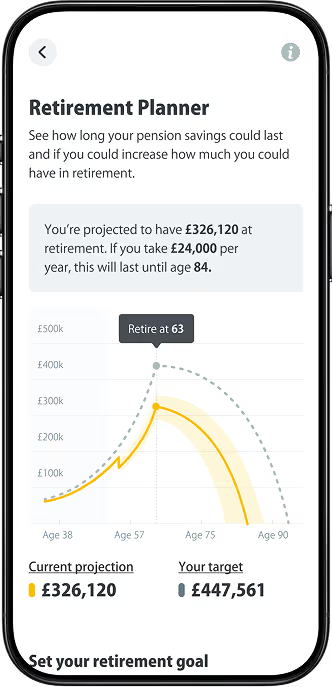
Whatever income I’d like to live on in my dream retirement, the reality will be driven by how much money I’ve saved, and how long it needs to last, between my retirement and popping my clogs. Luckily I can use the PensionBee Pension Calculator to plug in my current pension pot and contributions, and then toggle between different retirement ages and income, to see if my savings are likely to run out before the age of 100.

Decumulation: practicalities

In practice, how you tap into your pension cash can have big implications for the future. It therefore pays to consider your options for accessing pension cash, tax, inheritance and any further pension contributions.

1. Income tax

Klaxon alert: withdrawing money from a pension isn’t the same as whipping cash out of a savings account. Only _corporation_tax of a pension can be withdrawn tax free – and the rest gets taxed as income. I really don’t want to whip out a large sum and see the tax man take _additional_rate.

If I spread withdrawals over several years instead, I’m likely to pay less income tax. Funding retirement from different accounts can also help cut tax. In contrast to pensions, withdrawals from ISAs are completely tax-free.This means I could potentially take some income from my pensions, and top it up with money from my ISAs, to stay in a lower tax bracket.

2. Accessing pension cash

I face six different options for taking money out of my defined contributions pensions, once I hit 55 (rising to the age of 57 from 2028):

  • Delay taking my pension pot and leave it invested.
  • Withdraw the whole lot, of which _corporation_tax is tax-free. As explained above, that could land me with a large tax bill. Plus if I just stick the remainder in a savings account, the value will be eaten away by inflation.
  • Use the money to buy an annuity, which pays a guaranteed income for as long as I live or for a fixed term, with the option of taking _corporation_tax of my pension pot tax-free. Annuity rates have been of poor value for ages, but they have risen recently and can provide peace of mind for some pension savers when they think about living out their retirement.
  • Leave the money invested, via pension drawdown, and take a flexible income, also with the option of taking _corporation_tax of my pension pot tax-free. On the plus side, this dangles the potential for higher growth, and the chance to leave anything left over to my kids. On the downside, I risk running out of money if I spend too much, too fast.
  • Leave the money invested and take it as a number of lump sums, where _corporation_tax of each amount is tax-free and the rest is taxable. These have the snappy title of Uncrystallized Funds Pension Lump Sums (UFPLS), and involve the same risks as pension drawdown. If you don’t need to release a chunk of money when starting your retirement, this can be a good way to reduce tax on your income.
  • A mix of the above. So I could, for example, withdraw my _corporation_tax tax-free lump sum to keep as cash savings, use part of my remaining pension pot to buy an annuity to cover essential bills, then move the rest into a drawdown to use when needed.

3. Future pension contributions

If I decide to go part-time before retiring completely, I need to take care before touching my pension cash. Withdraw too much, and it will restrict the amount I can pay into pensions in future.

Anyone who takes any income from their pension, apart from the _corporation_tax tax free chunk, will see the amount they can put in a pension each year slashed from a maximum of _annual_allowance to just _money_purchase_annual_allowance. This is known as the Money Purchase Annual Allowance, or MPAA.

If you want to keep snapping up free money in tax relief and employer pension payments, plan your decumulation carefully.

4. Inheritance

Spare a thought for your children. If you’re lucky enough to have any money left in your pension pot when you die, it won’t be counted when calculating Inheritance Tax (IHT), unlike other assets such as property and savings. Even ISAs get hit by IHT, if they aren’t left to spouses or civil partners.

So if IHT is likely to be an issue, it’s worth spending down savings and ISAs before using up pension cash.

Decumulation: potential problems

As part of my decumulation plan, I also need to allow for the gremlins that can throw a spanner in the works. Just to make things fun, these are mostly factors that I can’t control.

1. Inflation

As we’ve all discovered recently, prices and bills can soar. So I need to allow for rising income, if I want to continue covering my costs in the years ahead. The PensionBee pension calculator is based on 2.5% inflation each year, and is the rate used by the Financial Conduct Authority (FCA). But if prices rise far more, I’ll be forced to make larger withdrawals to cover the higher costs.

2. Spending patterns

Income needs can change a lot during retirement. With all that free time, I’d love to spend more on hobbies and holidays while I still can. I’m expecting that spending to drop when health problems start, and also fear I might need loads more money in later life, for care costs or nursing home fees.

So I need a plan that allows for more disposable income in the early years, with a back up plan for long-term care later on.

3. Market movements

I’m intending to use drawdown to fund my retirement, where I leave a big chunk of my pension pot invested in the stock market. This dangles the tempting prospect of higher growth over the long term. However, the stock market doesn’t grow in a straight line, but can go up, down and sideways.

I can try to allow for the vagaries of stock market slumps by moving some of my investments into less risky assets and assuming moderate rather than super high growth. The PensionBee pension calculator shows an income line after inflation based on investment growth of 5% a year, but also shows the range of income on either side, based on low growth of 3% a year right up to high growth of 8% a year.

I’m also intending to keep a chunk of money in cash, so I can still pay essential bills when markets drop, and am not forced to sell investments when prices are low.

Where to get help

Personally, the sheer range of factors to consider with decumulation makes my head hurt. Luckily, there are places to get help.

If you’re over 50 and want more guidance on your pension options, you can book a free appointment with Pension Wise. The FCA is so keen on this impartial government service that it wants pension companies to ‘nudge’ their customers more strongly into making appointments, before digging into their pensions. I’ve previously written about how useful I found a Pension Wise appointment.

Your pension company will also normally provide a pensions toolkit, with materials about how to access your pension cash. However, if you want specific suggestions based on your own situation, you’ll need to pay for independent financial advice. You can search sites such as Unbiased.co.uk or VouchedFor.co.uk to find qualified local advisers. It could well be the best money you ever spend, to avoid expensive mistakes with your pension savings.

Faith Archer is a Personal Finance Journalist and Money Blogger at Much More With Less.

Risk warning

As always with investments, your capital is at risk. The value of your investment can go down as well as up, and you may get back less than you invest. This information should not be regarded as financial advice.

How we can use our pensions to drive positive change whilst saving for retirement
If you have a pension, you're already an investor, and that gives you more power than you might think.

This article was last updated on 06/04/2025

You might think your pension is just about making sure your retirement is comfortable - a pot that you save into until you’re ready to stop working and start withdrawing. But something many people may not realise is that pensions are investments that are shaping our world right now. If you have a pension, you’re already an investor, and that gives you more power than you might think.

The hidden power in your pension

When you check your pension statement, you see numbers, percentages, and projections. What you don’t see is that your money is actively working - invested in companies, projects, and initiatives around the world. Your pension fund might be supporting renewable energy projects or backing healthcare innovations. It could even be funding industries that don’t align with your values.

Depending on where your pension is held, you can direct that power. Just as you make conscious choices about the products you buy and the causes you support, you can align your pension with your values. It’s not just about avoiding harmful investments; it can also be about actively supporting positive change.

{{main-cta}}

Understanding your investor voice

Your pension provider acts on your behalf as a shareholder in numerous companies. The fund managers vote on important decisions on your behalf and in alignment with your values. Collectively, pension funds own portions of the world’s largest and most recognised companies. When enough people speak up about gender equality, fair wages, or climate action, companies listen. Your voice, combined with others, can influence corporate behaviour.

Making your money match your values

The rise of Environmental, Social, and Governance (ESG) investing has opened up more possibilities for those who are conscious of these issues.

Innovative providers like PensionBee are leading the way with specialised investment options. Their Climate Plan is an example of this, taking an approach that isn’t just about avoiding fossil fuels but also:

  • actively reduces investment in carbon-heavy companies;
  • targets a minimum 1_personal_allowance_rate reduction in greenhouse gas emissions each year;
  • aligns with the Paris Agreement‘s goals;
  • excludes businesses with fossil fuel reserves; and
  • screens out businesses heavily dependent on fossil fuel operations.

For women concerned about climate change, this represents a tangible way to contribute to environmental solutions while building retirement savings.

Here’s how you can take action:

  1. First, understand where your money is currently invested. Request an investment breakdown from your pension provider. Many are surprisingly transparent about their holdings. Some even have online portals where you can view this information. If you’re a PensionBee customer, you can view the top 10 holdings of your plan on their blog.
  2. Next, research your options. Most major pension providers now offer ethical or sustainable fund choices. These might focus on companies leading in environmental protection or social justice. Some funds specifically support women-led businesses or companies with strong female representation in leadership.
  3. If your current pension provider doesn’t offer suitable options, consider switching. There might be other options on the market that better align with your values. The process is usually straightforward and many providers only need a few details such as a provider and policy number to get started.

Impact without sacrifice

A common concern is that ethical investing might mean lower returns. However, research increasingly shows that companies with strong ESG practices often perform as well as - or better - than their conventional counterparts. They tend to be better managed, more innovative, and better prepared for future challenges.

Think about climate change, for instance. Companies that are already adapting their business models and reducing their carbon footprint are likely to be more resilient in the long term. While companies with diverse leadership often make better decisions and show stronger performance.

The ripple effect

When you align your pension with your values, you’re not just planning for your own future - you’re helping shape the world you’ll retire into. Your investment choices can support companies working to address climate change, promote gender equality, or improve healthcare access.

As more women take control of their pension investments, we send a powerful message to the financial industry. We show that we care about more than returns - we want our money to make a positive difference.

Your next steps for taking action

  1. Review your current pension investments. Contact your provider to see a detailed breakdown of where your money’s invested.
  2. Research ethical options. Ask your provider about their sustainable or ethical fund choices. If they don’t have any, consider whether this aligns with your values.
  3. If you have previous pension pots, consider consolidating them into one place that aligns with your values.

Philly Ponniah is a Chartered Wealth Manager and Financial Coach who helps women build confidence around their money. Having worked in the wealth industry for almost 13 years, she now helps high-achieving women get financial clarity, so they can live well today while building wealth sustainably for the future.

Risk warning

As always with investments, your capital is at risk. The value of your investment can go down as well as up, and you may get back less than you invest. Past performance does not guarantee future results. This information should not be regarded as financial advice.

How can I make my money Shariah-compliant?
Learn more about how Shariah compliant investments and savings are the approved way of accumulating wealth within Islamic teachings.

With more than 3.9 million Muslims living in the UK there’s keen interest in creating inclusive financial products for this community. In fact recent data from Reuters estimated that the global market for Shariah funds has ballooned by more than 30_personal_allowance_rate in the last decade.

But what do we mean when we say Shariah-compliant? Shariah-compliant investing is an approach that aims to achieve financial returns while only investing in companies that comply with Islamic finance principles.

How do I know if my money is Shariah-compliant?

First let’s cover the basics: what is Islamic finance? What are halal and haram investments? And what is meant by Shariah compliance?

1. What is Islamic finance?

Islamic finance spans a broad range of products that keep within the moral principles of Islamic teachings as explored in the Quran. The most important Islamic practices are known as the Five Pillars of Islam:

  • Hajj (Pilgrimage to holy site of Mecca)
  • Salah (Praying fives times a day)
  • Sawm (Fasting during holy month of Ramadan)
  • Shahada (Faith in Allah and His message)
  • Zakat (Giving a portion of wealth to charity)

The pillars that are most applicable to Islamic finance are: shahada and zakat. In practice, this means that financial products (such as investments and savings accounts) should donate to charity and shouldn’t fund haram activities or industries.

2. What are halal and haram investments?

Islamic teachings have do’s and don’ts for their followers. Everything that’s permitted is called halal and prohibited is haram. This outlines how Muslims can live in line with their faith without ambiguity over what actions to take.

Examples of halal industries: cosmetics, fashion, halal food, islamic finance, logistics, media, pharmaceuticals, research, tourism.

Examples of haram industries: alcohol, drugs, gambling, haram food such as pork, non-Islamic finance, pornography, tobacco, weapons.

3. What is Shariah compliance?

Investing in halal industries and excluding haram industries is only part of Shariah compliance, there are other aspects which need adhering to. As mentioned earlier the Five Pillars of Islam play a huge part in what you can’t invest in:

❌ Gharar (Investing or participating in short-selling)

❌ Haram (Funding of haram industries)

❌ Maisir (Gambling or speculative investments)

❌ Riba (Interest payments or investments with interest element)

All of these practices are prohibited in Islam and aren’t available to Shariah-compliant funds. For example, bonds are banned because they’re effectively loans that investors grant customers in exchange for interest on the initial amount. It is this interest that makes them riba and therefore haram. However an Islamic bond (sukuk) avoids haram practices. Instead of lending money to the borrower, the investor owns part of the assets - meaning there’s no profiting from debt. And the investor doesn’t receive any interest but may profit from an increase in the value of assets.

{{main-cta}}

How can I make my money Shariah-compliant?

If you’re keen to keep your money halal then switching to a Shariah-compliant bank, mortgage, or pension is a good place to start. Although consumer options are limited, they are available and the Islamic finance sector is constantly expanding. Here’s three switches you could make to ensure your money is Shariah-compliant:

1. Shariah banking

In the UK there are currently five Shariah-compliant banks which are fully aligned to Islamic principles while being authorised by the Financial Conduct Authority: Abu Dhabi Islamic Bank, Al Rayan Bank, Bank of London & The Middle East, Gatehouse Bank, and Qatar Islamic Bank UK.

Shariah banks offer current accounts and sometimes other services: asset management, buy-to-let products, corporate banking, home finance, private equity. This means there’s no uncertainty whether your money is halal. And being protected up to £85,000 per person (per bank) by the Financial Service Compensation Scheme (FSCS).

2. Shariah-compliant mortgages

Islamic Finance Guru’s guide to Islamic Home Finance Providers in the UK breaks down the best Shariah-compliant, interest-free alternatives to traditional haram mortgage lenders. Making it easier for Muslims to become homeowners without compromising on beliefs.

3. Shariah pension funds

PensionBee’s Shariah plan is 10_personal_allowance_rate equity based, which means it’s invested in halal stocks. Decisions about which stocks to include or exclude are made by an independent Shariah committee.

There are Shariah pensions available, including at PensionBee. You can find out more in the Pension Confident Podcast. Listen to Shariah investments: what are they? or watch it on YouTube.

Risk warning

As always with investments, your capital is at risk. The value of your investment can go down as well as up, and you may get back less than you invest. This information should not be regarded as financial advice.

3 reasons a sustainable pension can make financial sense
Is your pension prepared for the future? Discover why fossil fuel investments could put your retirement savings at risk.

More people than ever are choosing to invest sustainably. This means selecting a plan that not only helps you save for retirement, but drives meaningful change and shapes a better world.

With an incredible £41 trillion invested globally, pensions have the collective power to drive positive change. Sustainable investing isn’t just about doing good, it can be a smart long-term financial strategy too.

Here’s three key reasons why choosing a sustainable pension could be a win for both your wallet and the world.

1. You can avoid ‘climate risk’

Climate change isn’t only a growing risk to the environment and our society, it also poses a significant risk to your pension returns.

Fossil fuels, responsible for 75% of global greenhouse gas emissions, are by far the biggest contributor to climate change. Yet around 1_personal_allowance_rate of global pension funds are still tied to them. You’ll find oil and gas companies like BP and Shell in almost all major ‘default’ pension schemes.

If you’ve been auto-enrolled into a workplace pension, it’s likely that your retirement savings are in a default pension scheme. This means many people are unknowingly funding industries that contribute to climate change through their retirement savings, despite the growing availability of sustainable investment options that align with environmental and social values.

This isn’t because fund managers enjoy destroying the planet. It’s because fossil fuels have historically given, despite the odd shock, quite steady and dependable returns. They’ve been the engine of the global economy for a long time, with ever-increasing demand pushing up prices.

However, all this is changing. As the world shifts to renewable energy sources to hit net zero targets, fossil fuel investments - from oil wells to petrol and diesel cars - are predicted to plummet in value.

If this happens quickly, fossil fuels could become what’s known as ‘stranded assets‘. This could lead to significant losses for pension investors and even trigger a global financial crisis.

So, while returns on fossil fuels might look attractive for now, over the long term they’re increasingly seen as risky and unreliable investments. A sustainable pension, meanwhile, avoids investing in environmentally harmful industries like fossil fuels.

PensionBee’s new Climate Plan goes even further by excluding any companies with ties to fossil fuels based on revenues, power generation and reserves. It also actively invests in companies that are reducing their carbon emissions and driving the transition to a low carbon economy.

{{main-cta}}

2. ‘Good’ businesses are good business

Sustainable pensions aim to invest in companies with strong Environmental, Social, and Governance (ESG) practices. These businesses strive to treat their customers, employees, and the planet responsibly and disclose their efforts transparently.

As well as being ‘morally right’, this strategy can be financially beneficial. Responsible companies are less likely to face scandals, lawsuits or regulatory fines. All of which can damage their reputation, share price and your pension returns.

American Investor and Philanthropist, Warren Buffet, famously said: “It takes 20 years to build a reputation and five minutes to ruin it.”

Take car manufacturer Volkswagen’s emissions scandal in 2015, known as ‘dieselgate‘. The company’s share price plunged by 3_personal_allowance_rate almost instantly. It ended up paying €31.3 billion (£26.17 billion) in fines and settlements.

Similarly, fashion brand Boohoo’s share price fell _basic_rate over the previous year and almost 9_personal_allowance_rate over three years after it was revealed some UK workers were paid as little as £3.50 per hour.

Research backs this up. The United Nations’ Sustainable Development Goals (UNSDGs) have a globally agreed set of goals to end poverty and protect the planet. A study by the University of Zurich and Robeco found that companies aligned with the UNSDGs are less likely to become embroiled in scandals on ESG issues.

It revealed just a 1% increase in a business’s alignment with a single UNSDG led to an 11% decrease in the number of scandals it faced within a year. The decrease was even more pronounced (17%) for severe scandals.

Investing in companies with strong ESG practices can reduce risk with potential for better returns. Research shows that ESG investments can match or even outperform traditional investments in the long run.

According to the latest Sustainable Reality report from the Morgan Stanley Institute for Sustainable Investing, sustainable funds outperformed their traditional peers across all major asset classes and regions in 2023.

3. Investor demand is growing

Sustainable investments aren’t just a ‘nice to have’; they’re what the world needs if we’re going to have a future we can live in. Where we put our money will likely decide whether we can avoid escalating climate disasters and the irreparable loss of biodiversity - or not.

More and more savers are realising this. A Financial Lives Survey by the Financial Conduct Authority last year found that 81% of adults want their investments to do good as well as provide a financial return.

Businesses are catching on too. A Sustainability Report by Deloitte surveyed over 2,000 top executives and found that 85% of companies have increased their spending on sustainability in the past year.

Many business leaders now view sustainability as a way to generate long-term profits. In a recent survey, 92% said they’re confident they can expand their businesses while reducing emissions to address climate change. This is promising for investors backing companies committed to achieving net zero.

Consumer demand is driving much of this change. Over half of the executives surveyed said they’ve shifted their strategies because people’s buying habits and preferences are changing. For example, due to consumer feedback PensionBee launched their Climate Plan to help customers align their pensions with the Paris Agreement.

This shift needs to happen. Moving your investments away from polluting companies and towards those solving climate problems is key to the green transition. As demand for these solutions grows, naturally the value of investments in these companies is likely to grow too. In fact, US companies tackling climate change have seen an 18% higher return on investment - and _pension_age_from_2028% higher than those hiding their emissions.

Being on the right side of this positive change now - rather than investing in companies pushing against it - means you’re well positioned to benefit financially over the long term.

Lori Campbell is a Freelance Journalist specialising in sustainable finance and investing. She’s the Editor of ethical personal finance website, Good With Money. Lori was previously a Senior News Reporter at the Sunday Mirror.

Risk warning

As always with investments, your capital is at risk. The value of your investment can go down as well as up, and you may get back less than you invest. This information should not be regarded as financial advice.

Top 10 holdings in your pension
Find out more about the top 10 holdings in your pension, companies which are carefully selected by the world’s biggest money managers.

The ‘top holdings’ in your pension are simply the companies you have the largest investments in. When your pension’s invested through PensionBee, these companies are carefully selected by some of the world’s biggest money managers.

Putting your pension under a microscope, you’ll see that you probably own a miniscule percentage of a multitude of companies. This may include the big players in the technology sector, known as the ‘Magnificent Seven‘.

How does your pension grow?

Pensions are designed to grow over decades by investing in a mix of assets types, such as ‘bonds’ and ‘equities’. This mix, called diversification, helps balance the risk and reward of each asset type.

The main asset classes are:

  • Bonds - essentially loans to companies or governments, where you earn a fixed interest rate over an agreed period.
  • Cash - money held for stability, offering low risk but typically very low returns compared to other assets.
  • Equities - shares in companies, where the share price reflects the company’s value divided by the number of shares available.

Does your age impact how you should invest?

When you’re younger, you can usually take more risks with your pension because there’s plenty of time to recover from market ups and downs. Investing heavily in equities, sometimes even 10_personal_allowance_rate, can help maximise growth through compounding - where your returns generate even more returns over time.

As retirement approaches, usually from around 50 years old, it’s wise to gradually reduce risk by shifting into safer assets like bonds or cash. This process, called de-risking, helps protect your savings from market fluctuations, ensuring they’re ready when you need them.

Keep reading to find out the top 10 holdings of your PensionBee plan.

The following represents the equity holdings only and portfolio weights are normalised. Please note that holdings can change at any time and are provided for informational purposes only.

PensionBee’s default plans

Global Leaders Plan

PensionBee’s Global Leaders Plan aims to grow your pension savings by investing in approximately 1,000 of the world’s largest and most recognised public companies. This is our default plan for savers under 50 years old.

Top 10 holdings % of equity portion
1 NVIDIA 5.9%
2 Apple 5.3%
3 Microsoft 4.5%
4 Amazon 2.9%
5 Alphabet Class A 2.4%
6 Broadcom 2.0%
7 Alphabet 2.0%
8 Meta 1.9%
9 Tesla 1.7%
10 Taiwan Semiconductor Manufacturing 1.6%

Holdings as of 31 December 2025.

With this plan you’ll benefit from:

  • one simple annual fee of 0.70%; and
  • fund management by BlackRock.

4Plus Plan

PensionBee’s 4Plus Plan invests your money in a range of assets that are adjusted on a weekly basis depending on market conditions by experts at State Street. This is our default plan for savers aged 50 years old and over.

Top 10 holdings % of equity portion
1 NVIDIA 2.0%
2 Apple 1.7%
3 Microsoft 1.5%
4 Amazon 1%
5 Alphabet Class A 0.9%
6 Taiwan Semiconductor Manufacturing 0.9%
7 Broadcom 0.7%
8 Meta 0.7%
9 Alphabet Class C 0.7%
10 Tesla 0.5%

Holdings as of 31 January 2026.

With this plan you’ll benefit from:

  • one simple annual fee of 0.85%; and
  • fund management by State Street.

PensionBee’s sustainable plans

Climate Plan

PensionBee’s Climate Plan aims for the total carbon emissions produced by the plan’s companies to be reduced by at least 1_personal_allowance_rate each year.

Top 10 holdings % of equity portion
1 NVIDIA 6.1%
2 Apple 4.4%
3 Microsoft 3.6%
4 Amazon 2.5%
5 Alphabet Class C 2.5%
6 Tesla 1.9%
7 Meta 1.8%
8 Broadcom 1.7%
9 Alphabet Class A 1.7%
10 Taiwan Semiconductor Manufacturing 1.5%

Holdings as of 31 January 2026.

With this plan you’ll benefit from:

  • one simple annual fee of 0.75%; and
  • fund management by State Street.

Shariah Plan

PensionBee’s Shariah Plan invests your money only into Shariah-compliant companies. The plan tracks the Dow Jones Islamic Market Titans 100 Index, an index of the 100 largest global stocks that comply with Islamic investment guidelines as approved by an independent Shariah committee.

Top 10 holdings % of equity portion
1 NVIDIA 8.4%
2 Apple 7.5%
3 Microsoft 7.3%
4 Amazon 6.3%
5 Alphabet Class A 4.7%
6 Meta 4.2%
7 Broadcom 4.2%
8 Alphabet Class C 3.8%
9 Tesla 3.3%
10 Eli Lilly and Co 2.2%

Holdings as of 17 February 2026.

With this plan you’ll benefit from:

  • one simple annual fee of 0.95%; and
  • fund management by HSBC Global Asset Management and State Street.

PensionBee’s other plans

Tracker Plan

PensionBee’s Tracker Plan invests your money in global shares and bonds, with investments that follow the world’s markets as they move.

Top 10 holdings % of equity portion
1 NVIDIA 3.9%
2 Apple 3.3%
3 Microsoft 2.8%
4 Amazon 2%
5 Alphabet Class A 1.7%
6 AstraZeneca 1.4%
7 Alphabet Class C 1.4%
8 Meta 1.4%
9 Broadcom 1.3%
10 Taiwan Semiconductor Manufacturing 1.2%

Holdings as of 31 January 2026.

With this plan you’ll benefit from:

  • one simple annual fee of 0.50%; and
  • fund management by State Street.

Preserve Plan

PensionBee’s Preserve Plan is a money market fund that makes short-term investments into creditworthy companies. This reduces risk and preserves your money.

There’s no equity component to this plan, so there’s no top 10 company holdings.

With this plan you’ll benefit from:

  • one simple annual fee of 0.50%; and
  • fund management by State Street.

Will my top 10 holdings change?

Yes, your holdings are constantly changing, as the financial fates of the world’s biggest companies play out each day. Currently we’re living in a time where the technology sector is highly lucrative for investors. ‘Big tech’ like Apple and Microsoft have held the top spot of the world’s most valuable companies for over a decade, but this hasn’t always been the case.

We know from historical data that the companies of today may not be the companies of tomorrow. Before that oil and gas giant, ExxonMobil, was the biggest company. And even further back the multi-industry company, General Electric Company, held the top spot. Your money is in experienced hands as our money managers are some of the biggest in the world and make informed decisions based on global appetite and change your holdings accordingly.

Have a question? Get in touch!

Do you want to know more about your pension plan with PensionBee? You can check out our Plans page to learn how your money is invested in different assets and locations, or log in to your BeeHive to see your specific plan. You can always send comments and questions to our team via engagement@pensionbee.com.

Risk warning

As always with investments, your capital is at risk. The value of your investment can go down as well as up, and you may get back less than you invest. This information should not be regarded as financial advice.

What happened to pensions in March 2025?
How did the stock market perform in March 2025 and how does that impact your pension plan? Find out all this and more.

This is part of our monthly pension update series. Catch up on last month’s summary here: What happened to pensions in February 2025?

​In March 2025, US President Donald Trump escalated his trade policies. This included sweeping tariffs on key US trading partners like Canada, Mexico, and China. Effective from 4 March, these measures introduced a _corporation_tax tariff on imports from Canada and Mexico, and _basic_rate on Chinese goods.

His administration justified these actions by citing concerns over illegal immigration and drug trafficking. In particular the influx of fentanyl into the United States.

This has caused global stock markets volatility, which is why you may see your pension balance fluctuating more than normal.

Keep reading to find out what these tariffs mean for your pension savings.

What happened to stock markets?

In the UK, the FTSE 250 Index fell by 4% in March. This brings the 2025 performance close to -6%.

FTSE 250 Index

Source: Google Market Data

In Europe (excluding the UK), the EuroStoxx 50 Index fell by 4% in March. This brings the 2025 performance close to +7%.

EuroStoxx 50 Index

Source: Google Market Data

In North America, the S&P 500 Index fell by 6% in March. This brings the 2025 performance close to -5%.

S&P 500 Index

Source: Google Market Data

In Japan, the Nikkei 225 Index fell by 4% in March. This brings the 2025 performance close to -11%.

Nikkei 225 Index

Source: Google Market Data

In the Asia Pacific (excluding Japan), the Hang Seng Index rose by 1% in March. This brings the 2025 performance close to +_ni_rate.

Hang Seng Index

Source: Google Market Data

Market reactions and global impact

The announcement of these tariffs led to immediate volatility in global financial markets. This is because stock markets don’t like the uncertainty that these tariffs bring. Major US stock indices experienced significant declines; for instance, the S&P 500 fell by 1.75% on the day of the announcement.

In response to US tariffs, China introduced additional tariffs ranging from 1_personal_allowance_rate to _ni_rate on American imports, including agricultural products such as soybeans, pork, and beef. China also implemented export controls and added 12 American companies to its ‘unreliable entities‘ list. This is a list of organisations that are thought to harm China’s national security and interests. Canada announced plans for _corporation_tax tariffs on $155 billion worth of US goods, while Mexico considered its own set of retaliatory measures.

European markets, however, showed resilience in March. The EuroStoxx 50 Index, representing leading blue-chip companies in the Eurozone, recorded gains. This reflects investor optimism about the region’s economic prospects despite global trade tensions.

How US politics is affecting UK pensions

For UK pension savers, these developments highlight the importance of understanding where pension funds are invested. Whilst many pensions have exposure to US company shares (also known as equities), most are globally diversified. This means your investments are spread across different asset classes and regions. Volatility in American markets has meant a downturn in the S&P 500 during March, and this may have a short-term impact on pension valuations. However, diversification can help mitigate these effects. Notably, European and Asian markets have shown relative stability, which may offset some of the negative impacts from US market fluctuations.​

While the long-term consequences of these trade policies are uncertain, it’s essential for pension holders to maintain a long-term perspective. Historically, pension investments have demonstrated resilience, recovering from short-term market disruptions over time. However, past performance isn’t an indicator of future results.

This is part of our monthly pension update series. Check out the next month’s summary here: What happened to pensions in April 2025?

Have a question? Get in touch!

Do you want to know more about your pension plan with PensionBee? You can check out our Plans page to learn how your money is invested in different assets and locations, or log in to your BeeHive to see your specific plan. You can always send comments and questions to our team via engagement@pensionbee.com.

Risk warning

As always with investments, your capital is at risk. The value of your investment can go down as well as up, and you may get back less than you invest. This information should not be regarded as financial advice.

7 ways to spring clean your finances
Spring is the perfect time to declutter - and that includes your finances. Here are seven simple things you can do to spring clean your finances.

Spring is the perfect time to declutter - and that includes your finances. From cutting back on unnecessary spending to maximising your savings, here are seven simple things you can do to spring clean your finances.

1. Review your budget

You may have set a few financial resolutions back in January to improve your budgeting or cut your spending. Spring is a great time to take a look and see how you’re doing. Did you stick to your monthly budget? Are there any areas where you’re overspending? Are you keeping up with your savings goals? As time goes on, priorities change so don’t be afraid to make adjustments to your budget if you need to. If you need a refresher, read our eight steps to setting a budget.

2. Give your savings a boost

Now you’ve got your budget back on track - you might find you have some spare cash to stick into savings. With summer round the corner, now’s a good time to top up your holiday fund. Or why not give your emergency fund a boost? Keeping on top of this is a great way to ensure you have a financial safety net for any unexpected costs that might arise. Spring also marks the start of a new tax year, so why not get a headstart on making the most of your Individual Savings Account (ISA) allowance?

3. Consolidate your pensions

If you’ve had multiple jobs, it’s likely you have multiple pensions floating around. Combining any old pensions you have into one easy-to-manage pot can be a really effective way to tidy up your finances. You could save on the fees you’re paying across multiple providers plus, it’ll give you better control over your retirement savings. It’s well worth looking into consolidating and with PensionBee, the process is kept as straightforward as possible.

{{main-cta}}

4. Cancel unused subscriptions

Another brilliant way to take control of your finances is to check your monthly (or yearly) subscriptions. Make sure you’re still getting good use out of everything you’re paying for and crucially, cancel any that you no longer use! In 2024, Citizen’s Advice reported that £688 million was spent on unused subscriptions in the UK. So whether it’s a gym membership, streaming service or a recurring payment to a newspaper - if you aren’t going to miss it then it’s time to cancel it.

5. Check your credit score

A healthy credit score is one of the keys for financial success. It’ll impact whether you get approved for a loan, a mortgage and can even play a part when you’re simply setting up a mobile phone contract. You can check your credit score for free with websites like ClearScore in just a few minutes. Just remember, a low score isn’t the end of the world and there are lots of things you can do to improve it if needed. Read our blog or listen to episode 31 of The Pension Confident Podcast to find out more.

6. Switch and save

Another quick win when it comes to sorting your finances is thinking about switching providers. Have you considered moving your current account to a new bank? You might find that other banks and building societies are offering cash bonuses to new customers. Plus, there’s a Current Account Switch Service which can help make the process simple and stress-free. It could also be worth considering new providers when renewing your insurance or broadband contract. If you’ve been with one company for a few years, you might find that better deals are available now. Not sure where to start? There are lots of comparison websites that can do a lot of the leg work for you, including Money Supermarket and Compare the Market.

7. Set new financial goals

And finally, have a think about setting some financial goals for the next few months or rest of the year. Having clear goals can be a huge motivation whether you want to improve your spending behaviour or save for the future. Just make sure your goals are realistic so you have the best chance at sticking to them.

Risk warning

As always with investments, your capital is at risk. The value of your investment can go down as well as up, and you may get back less than you invest. This information should not be regarded as financial advice.

Saving for the future as a self-employed worker
Learn about the challenges faced by self-employed workers, what their pension options are and what they should they think about when contributing and withdrawing.

This article was last updated on 24/07/2025

Self-employed people make up _ni_rate of the total workforce in the UK - that’s around 4.8 million people. However, only 16% of self-employed people pay into a pension. When we look at the participation rate for workplace pensions in the UK, we see quite the opposite. In 2023, 88% of eligible employees - or 20.8 million workers - contributed to a workplace pension, in part due to the introduction of Auto-Enrolment in 2012.

So what are the challenges faced by self-employed workers, what are their pension options and what should they think about when contributing and withdrawing?

The challenge for self-employed workers

Self-employment can bring flexibility, independence, and ownership. However, you might find that you lack much of the support that comes with paid employment. The reality is, if you work for yourself, you have to open a pension for yourself. This is something that all too often gets overlooked by the day-to-day demands of being a business owner.

When you work for yourself, you might find these three common challenges that work against you when you’re saving towards retirement:

  • An irregular income - fluctuating earnings can make consistent pension contributions challenging.
  • A lack of time - much of your efforts are going towards running the business, rather than building your wealth outside of work.
  • No employer support - unlike employees, you won’t benefit from employer contributions to boost your pension savings.

Saving for retirement as a self-employed person may seem overwhelming, but despite these challenges there are several options available to help you save towards your future as you build your business.

Self-employed pensions

There are two options for self-employed workers - a self-employed pension or a Self-Invested Personal Pension (SIPP). Both are defined contribution pensions that you need to open yourself, but a SIPP allows you to choose your own investments. Whereas with a self-employed pension - like the one with PensionBee - you choose a plan and the investments are made on your behalf.

All pensions (including PensionBee’s self-employed pension) are subject to an annual allowance which limits the amount you can contribute each year without paying tax. This is currently _annual_allowance (_current_tax_year_yyyy_yy). However, the annual allowance can be reduced for higher earners through a process called ‘tapering’ or for those who’ve started to access their pension. Personal contributions are also limited to 10_personal_allowance_rate of your earnings (whichever is lower).

There’s no limit on the number of self-employed pensions you can have open at any one time. Although, if you have a few, you may prefer to consolidate them into one easy-to-manage plan and potentially save on fees. This may also make things easier for you in retirement as all your savings will be in one place.

If you haven’t used the full annual allowance mentioned above in previous years, you may be able to take advantage of any unused allowances from up to three prior tax years thanks to the carry forward rule.

The age of access for a personal or workplace pension is also earlier than the State Pension age, it’s currently 55, although it’s due to rise to 57 by 2028. So for many retirees, the reality is that they’ll first be able to access their personal or workplace pension savings from their mid 50s, and then their income will be supplemented by their State Pension (if they’re eligible) in their mid 60s.

When you make personal contributions to your self-employed pension, you get what’s called tax relief. This is where the government adds in extra money on top of your contributions. In England, most basic rate taxpayers usually get tax relief on their personal contributions, so for every £100 you contribute, the government adds an extra £25, making it _lower_earnings_limit. If you’re a higher or additional rate taxpayer, you can claim back even more of your pension contributions via a Self-Assessment tax return. The rules are slightly different for taxpayers in Scotland.

If your business is a limited company, you may be able to make employer contributions into your self-employed pension (alongside personal contributions), which can be treated as a business expense. So if you make employer contributions from your limited company to your pension of £30,000, you still have £30,000 left of your annual allowance to make in personal contributions. Just keep in mind that you can’t receive tax relief on personal contributions above what you earn. So if you only earn _isa_allowance, the maximum amount your personal contributions can be is _isa_allowance gross. This works out at £16,000 net income and £4,000 tax relief.

One of the best things about paying into a self-employed pension? The contributions you make either from your limited company or in your personal name reduce the amounts of capital gains tax (CGT) or income tax you have to pay. This is a powerful tax incentive to start saving towards your retirement!

{{main-cta}}

How often should you pay into your self-employed pension?

You can pay into a self-employed pension via lump sums or monthly deposits, much as you would a monthly subscription. With PensionBee’s self-employed pension, you can contribute flexibly and add as much or as little as you like as often as you like.

While there’s no set amount you ‘should’ pay into a self-employed pension, the general principle when investing - the money is invested remember - is that the earlier you start contributing the more you’ll be able to benefit from compound interest. This is where not only do your contributions grow over time, but the ‘growth’ you receive grows as well, creating a powerful snowball effect!

You also need a retirement savings goal to understand not only how much you could have in retirement, but if you’re on track to achieve it too. Handily, Pensions UK have developed their Retirement Living Standards which show retirement lifestyles at three different income levels. These can give you a good idea of what you might need in retirement whether you’re single or in a couple. The table below shows the figures for _current_tax_year_yyyy_yy.

Minimum lifestyle
Moderate lifestyle
Comfortable lifestyle
Single
£13,400 per year
£31,700 per year
£43,900 per year
Couple
£21,600 per year
£43,900 per year
£60,600 per year

To achieve the following, pension savers could be looking at the following *pension pot sizes to be able to achieve the above levels of income:

For example:

  • if you take £4,000 a year out of your _high_income_child_benefit pension pot and you receive the full new State Pension (_state_pension_annually, _current_tax_year_yyyy_yy), you could achieve just over the PLSA’s minimum lifestyle with a yearly retirement income of just under £16,000. This would last you beyond your 100th birthday.
  • if you take around £19,500 a year out of your _threshold_income pension pot and you receive the full new State Pension (_state_pension_annually, _current_tax_year_yyyy_yy), you could achieve around the same as the PLSA’s moderate lifestyle with a yearly income of just over £31,300. This would last you around 20 years.
  • if you take around £32,000 a year out of your £395,000 pension pot and you receive the full new State Pension (_state_pension_annually, _current_tax_year_yyyy_yy), you could achieve the PLSA’s comfortable lifestyle with a yearly retirement income of just under £43,000. This would last you around 20 years.

*These calculations assume your current and desired retirement age is 65 years old, you have a defined contribution pension pot and you don’t take _corporation_tax of your pot as tax-free cash. Source: PensionBee’s Pension Calculator.

How can you access the money in a self-employed pension?

When you come to access your pension pot, which you can currently do from age 55 (rising to 57 from 2028), you can take _corporation_tax of the money as a tax-free lump sum. You’ll then pay income tax on the rest. This is called pension drawdown. You can also buy an insurance product called an annuity, which pays you a fixed income for a term or for the rest of your life.

To work out the best options for you, and to see whether you’re on track to reach your projected retirement savings goal, you can:

Getting the State Pension when you’re self-employed

Finally, let’s talk about the State Pension. All self-employed individuals are entitled to the State Pension, you just need to have a sufficient National Insurance (NI) record.

You need a minimum 10 qualifying years on your NI record to get any State Pension at all, and 35 qualifying years to receive the full new State Pension amount.

For the _current_tax_year_yyyy_yy tax year, the full new State Pension is _state_pension_annually or _state_pension_weekly a week in the _current_tax_year_yyyy_yy tax year thanks to the ‘triple lock’.

The age of accessing the State Pension is currently _state_pension_age for both men and women, but it’s scheduled to increase to _pension_age_from_2028 between 2026 and 2028. To find out when you’re eligible to receive the State Pension, use PensionBee’s State Pension Age Calculator.

However, while the State Pension provides a foundation for retirement income, it’s unlikely to be sufficient for a comfortable retirement. The age of access will almost certainly be higher than it is today by the time many reading this reach their mid-sixties. That’s why self-employed individuals must build additional savings to maintain their desired lifestyle in later years.

Saving for retirement as a self-employed can seem daunting, and requires a lot of dedication and planning. But thanks to modern technology, the opening and management of a self-employed pension itself is something you can do from the palm of your hand. And the ability to make small contributions as and when means you can get started even with small sums, making it ideal for business owners. If you’re interested in opening a self-employed pension, then sign up to PensionBee and start saving towards your retirement today.

Rotimi Merriman-Johnson - also known as ‘Mr MoneyJar‘ - is an award-winning Content Creator, Qualified Financial Advisor and Founder of Mr MoneyJar Limited, a UK-based financial education company. He offers accessible, practical financial education, through digital content, events and one-to-one coaching. Rotimi covers topics such as personal finance, investing, getting on the property ladder and regularly comments on financial and political news events and has been featured on the BBC, The Financial Times, ITV News and Sky News.

Risk warning

As always with investments, your capital is at risk. The value of your investment can go down as well as up, and you may get back less than you invest. This information should not be regarded as financial advice.

Pensions and tariffs: what you need to know
Pensions have experienced some ups and downs lately. The main driver of these changes has been fast-moving news around President Trump, tariffs and trade.

This article was last updated 30/04/2025

Pensions have experienced some ups and downs lately, with balances rising and falling on a daily basis. The main driver of these changes has been fast-moving news around President Trump, tariffs and trade, and knock-on implications for inflation, interest rates and the economy. Here’s a recap of what’s happened this month:

  • 2 April - President Trump begins introducing a number of tariffs (taxes on imported goods) on almost all countries, including key US trading partners like Canada, Mexico, China and the UK. This caused global stock markets to experience a sharp downturn.
  • 9 April - a 90-day pause is announced with tariffs for most countries reduced to a baseline 1_personal_allowance_rate - other than for China, where a rate of up to 1_additional_rate remains on Chinese-made goods.
  • 10 April - stock markets respond positively to the tariff pause announcement.
  • 12 April - China responds with a 1_corporation_tax tariff on US goods, but says that it’ll not respond to any further US increases.
  • 21 April - countries including Japan and South Korea continue to try to negotiate on tariffs while China warns them against making trade deals with the US that would be at the expense of China’s interests.
  • 22 April - President Trump indicates that the 1_additional_rate tariffs on Chinese goods “won’t be that high” and will “come down substantially”, expressing hope that the Chinese President, Xi Jinping, would come to the negotiation table.
  • 29 April - stock markets show signs of recovery, with the S&P 500 posting its best weekly gains since early April.

The most recent market rally appears to be primarily driven by optimism that the worst of the tariff escalation may be over. Investors have responded positively to signals that President Trump may be willing to negotiate and reduce tariffs, particularly with China. However, trade deals are yet to be agreed, and uncertainty remains about the long-term trade policy direction and its economic impact.

The clash between President Trump and the Federal Reserve also continues to cause concern about the central bank’s ability to run monetary policy independently:

  • 21 April - President Trump calls on the Federal Reserve (the US central bank) to lower interest rates. His ongoing criticism of the Federal Reserve - and in particular its Chair Jerome Powell - causes further market instability.
  • 22 April - President Trump doubles-down on his criticism of the Federal Reserve, but states that he has “no intention of firing” Jerome Powell.

The Federal Reserve is in charge of setting the nation’s interest rates - but it hasn’t lowered rates yet this year. President Trump called for lower interest rates in an attempt to offset the impact his tariffs are having on the likelihood of a recession. Lower interest rates make borrowing cheaper, stimulating demand and economic activity, but potentially pushing prices up. The Federal Reserve remains cautious about lowering interest rates as it risks causing a rise in prices (inflation), at a time where tariffs are already having an inflationary impact. The US interest rate range has remained unchanged at 4.25-4.5_personal_allowance_rate since December 2024. The Federal Reserve’s next board meeting takes place on 6-7 May.

The impact of Trump’s tariffs

Tariffs impact all countries as they make it harder to trade. That means companies could experience less growth and lower profits. When initial tariffs were announced, there was a sharp downturn across global stock markets due to many companies experiencing a decline in share price.

Seven leading US tech companies - also known as the Magnificent Seven - were particularly vulnerable to tariffs as a large number of their suppliers are based overseas. For example, Apple and Amazon both heavily rely on manufacturing and supply chains in China.

The Trump administration has since temporarily exempted smartphones, computers and certain other electronic devices from ‘reciprocal tariffs’, but has said that exemptions for technology from China could be short-lived.

While a partial stock market recovery occurred after the 90-day pause was announced, markets remain volatile. Financial markets don’t like uncertainty and can often react to news quickly, meaning sharp swings in the prices of company shares and bonds, which all pensions are invested in.

The table below shows recent performance data for the Magnificent Seven alongside their five-year performance. You can read more about Apple, Amazon, Meta, Microsoft and NVIDIA’s share prices in our new blog series to see how they might be affecting your pension balance.

Mag 7 performance over time

Source: IBD data as of 31 March 2025 and MarketWatch 31 March 2020, 31 March 2025

So what does this mean for your pension?

We understand it can be worrying to see your balance fall, but history shows that markets do recover. It’s important to remember that pensions are designed for long-term growth. The Financial Conduct Authority (FCA) encourages pension savers to avoid making hasty decisions during periods of market turbulence. Staying invested and focused on the long term is usually the best course of action.

It’s important to remember that this kind of market volatility is normal during uncertain times, and it’s not unusual to see fluctuations day-to-day. When looking through history, we’ve seen many periods of fluctuation that look similar to this one. The exhibit below shows the maximum decline seen in historical years:

S&P 500 declines over time

Source: Carson Investment Research, S&P 500 year-to-date move through April 8

Whilst past performance isn’t an indicator of future results, historical data shows that every decline in stock markets has been followed by a subsequent recovery and new historical highs. The chart below shows S&P 500 performance over the last 30 years.

S&P 500 performance over 20 years

Source: marcotrends

Why hasn’t my pension balance recovered yet?

The recovery of pension balances depends on how quickly global markets stabilise. This should start to happen once there’s more certainty around the economic changes proposed by President Trump. It’s also important to remember that your balance isn’t shown in real-time as it often takes several days to reflect market movements.

It might feel like there’s been a lot more volatility than usual over the last few years with the pandemic, the invasion of Ukraine, and now the uncertainty caused by tariffs. But historically, markets have always recovered from even bigger declines than we’re seeing now. That’s why the length of time that you’re invested in the market is so important. Staying invested means you’re in the best position to benefit and be part of the market recovery, when it comes. Keeping a cool head and thinking long term is key.

It may surprise you to learn that some investors would argue that downturns can provide a great opportunity to grow their investments, particularly if they increase their pension contributions during this time. That’s because the underlying value of each investment is lower, meaning investments go further and more units can be bought, leading to greater returns during market recovery.

Where to find pension information and support

Do you want to know more about your pension plan with PensionBee? You can check out our Plans page to learn how your money is invested in different assets and locations, or log in to your BeeHive to see your specific plan. You can always send comments and questions to our team via engagement@pensionbee.com.

Our default plans are designed to support you depending on your age.

If you’re under 50, our default is the Global Leaders Plan - a predominantly equity based plan that focuses on growth in your accumulation (or growth) years. The plan invests in around 1,000 of the world’s largest and most recognised public companies to offer a greater opportunity to grow pension savings before retirement.

If you’re over 50, our default is the 4Plus Plan which is designed for the decumulation (or withdrawal) years. This plan aims to achieve long-term growth of over 4% by investing your money into a mix of assets, including equities, bonds, cash and other asset classes. This plan is actively managed, meaning that the holdings may be adjusted weekly depending on market developments, as it seeks to balance growth and stability.

If you’re not sure where other pensions you may have are invested, you can usually find information online via your provider’s website or portal. Or, you can contact your provider and ask for a breakdown.

It could also be worth looking at resources like MoneyHelper. If you’re over 50, you can book an appointment with Pension Wise for free and impartial guidance.

Risk warning

As always with investments, your capital is at risk. The value of your investment can go down as well as up, and you may get back less than you invest. This information should not be regarded as financial advice.

Your guide to Lifetime ISAs and pensions
Both pensions and Lifetime ISAs are long-term savings solutions for retirement, but how do they compare?

The Lifetime ISA (LISA) was introduced in April 2017 as a long-term savings option for two big life events; buying your first home or retirement. If you’re wondering how LISAs work and how they stack up against pension funds, you’re in the right place.

1. What’s a Lifetime ISA?

A Lifetime ISA is a type of Individual Savings Account (ISA). ISAs allow you to save money without having to pay tax on your contributions and interest earned.

Like other ISAs, LISAs are also tax-free, but differ in the fact that they give further incentives. When you put money into a LISA, the government will provide a bonus of _corporation_tax. So, for every £4,000 you put in, you’ll receive an extra _basic_rate_personal_savings_allowance.

You’ll be able to open a LISA if you’re aged between 18 and 39. They’re designed specifically to fund these long-term life goals, so you won’t pay any fees if you withdraw your money to buy your first home or if you’re retiring after age 60.

However, if you withdraw for any other reason, you’ll accrue a penalty of _corporation_tax. Effectively taking away any bonus that you earned from the government.

2. How do LISAs compare to pensions?

Pension funds are still the most popular long-term savings product for retirement, offering tax relief and the room for growth.

One of the key differences between LISAs and pensions is that pensions can only be used for retirement whilst LISAs can also be used for buying a first home.

There are also different annual contribution limits. With a LISA, you’re limited to contributing a maximum of £4,000 per year. And this counts towards your annual ISA limit of _isa_allowance (_current_tax_year_yyyy_yy). With a pension there isn’t a limit. However, if you exceed your annual allowance of _annual_allowance (_current_tax_year_yyyy_yy), you won’t get tax relief on contributions over that amount.

3. What tax relief do I get?

LISAs are tax-free savings accounts. You won’t be taxed on what you put in, and you receive a _corporation_tax bonus on your savings. So for every £4 you put in, you’ll receive a £1 bonus.

With pensions, most taxpayers usually receive tax relief on pension contributions up to _annual_allowance each year (_current_tax_year_yyyy_yy). For higher earners, there’s a tapered limit. The highest earners receive tax relief on pension pots up to _money_purchase_annual_allowance (_current_tax_year_yyyy_yy).

{{main-cta}}

4. Will I pay tax on withdrawals?

From the age of 55 (rising to 57 from 2028) you can take up to _corporation_tax of your pension as a tax-free lump sum. If you take out more than this you’ll have to pay income tax. Alternatively, if you make withdrawals via income drawdown, where your money remains invested, you can take taxable income from it as and when you want. If you do this without taking the _corporation_tax tax-free lump sum first, you can get _corporation_tax of each withdrawal tax-free.

Money in your LISA will remain tax-free no matter what, but you can only make withdrawals in specific circumstances. You’ll have to pay a _corporation_tax fee every time you withdraw outside of these criteria.

5. So when can I withdraw money?

If you’re using the savings in your LISA to buy a home, it must be your first home and you must be buying a mortgage. The funds also need to go through a solicitor.

If you want to open a LISA for retirement, you’ll only be able to access your money after age 60. In comparison, you can access your pension once you reach age 55 (rising to 57 from 2028).

With LISAs, you can only withdraw outside of these criteria without a charge in exceptional circumstances, such as if you become terminally ill.

6. What if I need to access my money?

ISAs generally allow for early access to funds which makes them popular options for mid-term saving. The LISA is no different; you can access your money at any time, but there’ll be a _corporation_tax charge if you’re not using your money for your first home or retirement.

It’s important to think about your long and short term goals when it comes to deciding what savings option works best for you. In an emergency, it can help to be able to withdraw your money. On the other hand, restricting access until retirement means that your money stays safe until you need it. The longer you leave your money invested, the more chance it has to benefit from compound interest.

7. What about my workplace contributions?

One advantage of workplace pensions is that your employer will make contributions alongside your own. Your employer is required to pay at least 3% of your qualifying earnings into your pension. Although some will go above and beyond and offer matched pension contributions.

8. Does Inheritance Tax apply to LISAs and pensions?

LISAs are subject to Inheritance Tax (IHT) rules whilst pensions are exempt. This means that when you die, money held in your LISA can only be passed onto a spouse or civil partner tax-free. Other beneficiaries will have to pay IHT.

Beneficiaries of your pension will only have to pay IHT on your savings if you die after age 75. However, it’s important to note that when you die, your pensions don’t form part of your estate. You can choose to mention your pension in your will if you want to eliminate any doubt over your wishes, but it’s recommended that you fill out an ‘expression of wish‘ form with your pension provider. This states who you’d like to receive your remaining pension.

Should I open a LISA or a pension?

Ultimately, there are a lot of personal factors that will affect your decision to either open a LISA or invest in a pension. Your individual circumstances will determine which option is best for your long-term savings.

A key consideration might be whether you want to prioritise your first home or your retirement. If you’re already a homeowner, then you’d only be able to use a LISA for retirement. If this is the case, you might perhaps consider saving into a LISA alongside your pension, acting as a top-up to your income when you reach age 60.

Other financial products can impact your decision-making process. For instance, you may already have other ISA products. Although you can save into a LISA alongside other types of ISA, each individual has a savings limit of _isa_allowance each year (_current_tax_year_yyyy_yy) across all of their ISAs. This includes the maximum of £4,000 per year that you can pay into your LISA.

If you’re finding it hard to keep track of all of your savings and you have a couple of pensions, it might be more beneficial for you to consolidate them into one plan.

Learn more about the differences between ISAs and pensions with this special episode of The Pension Confident Podcast. You can also read the transcript or watch the episode on YouTube.

Risk warning

As always with investments, your capital is at risk. The value of your investment can go down as well as up, and you may get back less than you invest. Anything discussed on the podcast should not be regarded as financial advice.

Company spotlight - how does NVIDIA’s performance affect my pension?
Current geopolitical events are affecting NVIDIA’s performance, which in turn could affect your pension. Keep reading to find out more.

Your pension is likely invested in some of the largest companies in the world - including NVIDIA, a key global player in the graphics processing unit (GPU) and artificial intelligence (AI) sectors. Current geopolitical events are influencing NVIDIA’s performance, which in turn affects your pension. Let’s take a look at why this is.

How does NVIDIA’s performance affect my pension?

Shares represent a unit of ownership in a company. When you buy shares, you become a part owner of that company, and your ownership is proportional to the number of shares you hold.

The value of a share is worked out by taking the company’s value and dividing it by the number of shares in issue. This then forms the individual share price. It’s this share price that goes up and down in value over time. The price can move according to current market conditions, historic performance and potential growth opportunities.

If you were to look at your own pension closely, you’ll see that you probably own a small percentage of many of the world’s largest and most successful companies. The top holdings in your pension refer to the companies you have the largest investment in. For most pension savers, NVIDIA will likely be one of the top 10 holdings in your pension fund.

What is NVIDIA?

NVIDIA was founded in 1993 by Jen-Hsun Huang, Chris Malachowsky, and Curtis Priem in California. With a vision to revolutionise computing, they initially focused on GPUs (these are computer chips that render images and videos) for the gaming market. Its first product, the NV1, was released in 1995, marking the beginning of its journey in high-performance graphics.

Today, NVIDIA is the third largest company in the world with a market capitalisation (total value) of $2.7 trillion. ‘Market capitalisation’ is calculated using the present share price multiplied by the total number of shares.

NVIDIA is also one of the seven leading technology companies in the US (also known as the ‘Magnificent Seven‘) recognised for its innovation and strong performance.

How much of a typical UK pension is invested in NVIDIA?

Pensions typically put a large portion of your funds into company shares (equities) through the stock market. This strategy aims to grow your wealth over the long term, as company shares are typically one of the best performing asset types.

As NVIDIA is currently one of the largest companies in the world, it’s a common holding in many investments.

While the exact percentage of NVIDIA in a typical UK pension fund varies, NVIDIA makes up around 4% of the MSCI World Index, a widely followed global stock market index which tracks the performance of many established companies across 23 developed countries worldwide.

As such NVIDIA could represent a small percentage of the typical UK pension plan. Current geopolitical events are influencing NVIDIA’s share price performance, which in turn could affect your pension balance.

How is NVIDIA affected by President Trump’s tariffs in 2025?

The return of US President Donald Trump has brought renewed attention on tariffs - which are taxes on imported goods. His administration has escalated the trade war with China, announcing a steep 1_additional_rate tariff on Chinese-made products.

These tariffs harmed NVIDIA’s supply chain as it relies heavily on Chinese factories for manufacturing semiconductor and GPUs for computers. In the table below you can see how short-term uncertainty from US tariffs have shaken the value of NVIDIA shares. However, the long-term trajectory shows strong growth.

Company 3-month performance 1-year performance 5-year performance
NVIDIA -_corporation_tax_small_profits +_basic_rate +1,5_additional_rate

Source: Market Watch. Data as of 31 March 2025.

Fortunately, the Trump Administration later removed ‘reciprocal tariffs’ for smartphones, computers and other electronic devices - although these exemptions could be temporary.

However, NVIDIA now faces additional challenges as the US government tightened export rules. The rules require licenses to export one of its most popular products - its H20 AI chip - to China. This new restriction is expected to cost NVIDIA $5.5 billion due to inventory commitments.

These tariffs are part of Trump’s wider strategy designed to reduce the trade deficit and boost domestic manufacturing. Founder and CEO, Jensen Huang, has committed several billion dollars to make products in the US over the next four years.

What could make the NVIDIA share price go up and positively impact your pension balance?

Over the next three months, the share price could rise if:

  • NVIDIA exceeds expectations in its next quarterly earnings report (this looks at the profits and losses for the prior three months). This could lead to a short-term spike in the share price;
  • NVIDIA announces new product launches or partnerships in the AI or gaming sectors, which could excite investors and signal future growth opportunities; and/or
  • the Federal Reserve, the Central Bank in the US, decreases interest rates. This could boost consumer spending power and encourage businesses to borrow at a lower interest rate and allow them to consume more goods.

Over the next year, the share price could rise if:

  • NVIDIA continues to dominate the AI hardware market with its GPUs, boosting its profitability;
  • NVIDIA expands into emerging markets, such as India, where demand for gaming and AI technologies is growing; and/or
  • NVIDIA boosts its profitability by increasing its software and subscription-based offerings.

Over the next five years, the share price could rise if:

  • NVIDIA achieves breakthroughs in new industries, such as autonomous vehicles or edge computing, where its GPUs and AI expertise could play a critical role;
  • there’s sustained demand for NVIDIA’s products and it maintains its leadership in AI and gaming technologies; and/or
  • strong cash flow allows NVIDIA to reinvest in innovation, buy back shares, or pay dividends, which could support long-term stock price appreciation.

What could make the NVIDIA share price go down and negatively impact your pension balance?

Over the next three months, the share price could fall if:

  • NVIDIA misses revenue or profit targets in its quarterly earnings report. This could lead to a ‘short-term sell-off’, as investors react quickly by selling its shares, leading to a short-term decline in the share price;
  • supply chain disruptions occur, such as delays in manufacturing or shipping due to geopolitical tensions or reliance on Taiwan for computer chip production; and/or
  • rising interest rates or fears of a global economic slowdown negatively impact tech stocks, including NVIDIA.

Over the next year, the share price could fall if:

  • NVIDIA faces increased competition from other chipmakers, such as AMD or Intel, which could harm its market share in AI and gaming industries;
  • regulatory challenges arise, such as antitrust scrutiny or export restrictions on advanced chips, which could limit NVIDIA’s growth potential; and/or
  • an economic downturn weakens demand for high-end GPUs, particularly in gaming and data centres, which are significant revenue drivers for NVIDIA.

Over the next five years, the share price could fall if:

  • NVIDIA faces increased competition in AI and GPU technologies;
  • geopolitical tensions disrupt NVIDIA’s supply chain with Taiwan, or limit access to key markets like China; and/or
  • the AI market experiences slower-than-expected growth, reducing demand for NVIDIA’s products and impacting its long-term growth trajectory.

Conclusion

  • Your pension likely has a small investment in NVIDIA - most pensions invest a portion of your retirement money in NVIDIA because it’s one of the largest and most successful companies in the world.
  • When you invest, you own a portion of the company - the value of these company shares will fluctuate based on market conditions, affecting the value of your pension on a given day.
  • Current events can impact your investments - geopolitical events, such as tariffs imposed by the Trump Administration, can affect NVIDIA’s costs and share price. This in turn impacts your pension balance.
  • Politics is short-term and investing is long-term - while current events can cause short-term volatility in share prices, successful investing typically focuses on long-term growth.

Staying informed about current events, and their impact on your pension, can help you invest with confidence - even in a changing market.

Have a question? Get in touch!

Do you want to know more about your pension plan with PensionBee? You can check out our Plans page to learn how your money is invested in different assets and locations, or log in to your BeeHive to see your specific plan. You can always send comments and questions to our team via engagement@pensionbee.com.

Risk warning

As always with investments, your capital is at risk. The value of your investment can go down as well as up, and you may get back less than you invest. This information should not be regarded as financial advice.

Company spotlight - how does Microsoft’s performance affect my pension?
Current geopolitical events are affecting Microsoft’s performance, which in turn could affect your pension. Keep reading to find out more.

Your pension is likely invested in some of the largest companies in the world - including Microsoft, a key global player in the technology and software industries. Current geopolitical events are influencing Microsoft’s performance, which in turn affects your pension. Let’s take a look at why this is.

How does Microsoft’s performance affect my pension?

Shares represent a unit of ownership in a company. When you buy shares, you become a part owner of that company, and your ownership is proportional to the number of shares you hold.

The value of a share is worked out by taking the company’s value and dividing it by the number of shares in issue. This then forms the individual share price. It’s this share price that goes up and down in value over time. The price can move according to current market conditions, historic performance and potential growth opportunities.

If you were to look closely at your own pension, you’ll see that you probably own a small percentage of many of the world’s largest and most successful companies. The top holdings in your pension refer to the companies you have the largest investment in. For most pension savers, Microsoft will likely be one of the top 10 holdings in your pension fund.

What is Microsoft?

Microsoft was founded in 1975 by Bill Gates and Paul Allen in Albuquerque. The pair recognised an opportunity to create software for the Altair 8800, one of the first personal computers. Their initial product, a version of the BASIC programming language, laid the foundation for the software industry as we know it today.

Today, Microsoft is the second largest company in the world with a market capitalisation (total value) of $2.9 trillion. ‘Market capitalisation’ is calculated using the present share price multiplied by the total number of shares.

Microsoft is also one of the seven leading technology companies in the US (also known as the ‘Magnificent Seven‘) recognised for their innovation and strong performance.

How much of a typical UK pension is invested in Microsoft?

Pensions typically put a large portion of your funds into company shares (equities) through the stock market. This strategy aims to grow your wealth over the long term, as company shares are typically one of the best performing asset types.

As Microsoft is currently one of the largest companies in the world, it’s a common holding in many investments.

While the exact percentage of Microsoft in a typical UK pension fund varies, Microsoft makes up around 4% of the MSCI World Index, a widely followed global stock market index which tracks the performance of many established companies across 23 developed countries worldwide.

As such Microsoft can represent a small percentage of the typical UK pension plan. Current geopolitical events are influencing Microsoft’s share price performance, which in turn could affect your pension balance.

How is Microsoft affected by President Trump’s tariffs in 2025?

The return of US President Donald Trump has brought renewed attention on tariffs - which are taxes on imported goods. Tariffs on imported materials like aluminum and steel increase hardware costs for companies like Microsoft. These hardware supply chains are concentrated in Asia - where many countries have been hit with tariffs.

Microsoft relies on these materials for its cloud and artificial intelligence (AI) infrastructure - the latter of which is a critical area of investment for the company. The tariffs and rising costs have directly impacted its plans to build AI data centres in Ohio - a project reported to be worth $1 billion.

In the table below you can see how short-term uncertainty from US tariffs have shaken the value of Microsoft’s shares. However, the long-term trajectory shows strong growth.

Company 3-month performance 1-year performance 5-year performance
Microsoft -11% -11% +138%

Source: Market Watch. Data as of 31 March 2025.

The Trump Administration later exempted smartphones, computers, and certain other electronic devices from ‘reciprocal tariffs’ - although these exemptions could be temporary. These tariffs are part of Trump’s broader strategy designed to reduce the trade deficit and boost domestic manufacturing.

What could make the Microsoft share price go up and positively impact your pension balance?

Over the next three months, the share price could rise if:

  • Microsoft exceeds expectations in its next quarterly earnings report (this looks at the profits and losses for the prior three months). This could lead to a short-term spike in the share price;
  • Microsoft continues to innovate and announce new products in the AI space, attracting investors and increasing the share price; and/or
  • the Federal Reserve, the Central Bank in the US, decreases interest rates. This could boost consumer spending power and encourage businesses to borrow at a lower interest rate and allow them to consume more goods.

Over the next year, the share price could rise if:

  • Microsoft announces company acquisitions (like its recent purchase of Activision Blizzard) enhancing its growth and attracting investors; and/or
  • Microsoft sees continued growth in AI, particularly through its partnership with OpenAI.

Over the next five years, the share price could rise if:

  • Microsoft continues to integrate AI into core products such as Microsoft 365 and Azure. This would drive substantial revenue growth, increasing the share price;
  • Microsoft remains at the forefront of technological innovation by investing in research and development; and/or
  • strong cash flow means Microsoft can buy back its own shares and pay dividends, which could help its stock price go up over time.

What could make the Microsoft share price go down and negatively impact your pension balance?

Over the next three months, the share price could fall if:

  • Microsoft misses revenue or profit targets in its quarterly earnings report. This could lead to a ‘short-term sell-off’, as investors react quickly by selling their shares, leading to a short-term decline in the share price;
  • supply chain disruptions continue to occur impacting manufacturing or shipping; and/or
  • rising interest rates or fears of a global economic slowdown negatively impact tech stocks.

Over the next year, the share price could fall if:

  • the costs associated with scaling AI continue to rise. This could weigh on profitability for Microsoft in the short term;
  • increased or new regulations limit Microsoft’s ability to expand or innovate; and/or
  • an economic downturn reduces consumer demand for products and services like enterprise software and cloud computing.

Over the next five years, the share price could fall if:

  • Microsoft fails to execute AI integrations and expansions in cloud services risking its reputation as an industry leader;
  • challenges in the gaming market (particularly with Microsoft’s acquisition of Activision Blizzard) impact its overall revenue; and/or
  • increased competition in cloud computing from Amazon Web Services and Google Cloud harm Microsoft’s market share.

Conclusion

  • Your pension likely has a small investment in Microsoft - most pensions invest a portion of your retirement money in Microsoft because it’s one of the largest and most successful companies in the world.
  • When you invest, you own a portion of the company - the value of these company shares will fluctuate based on market conditions, affecting the value of your pension on a given day.
  • Current events can impact your investments - geopolitical events, such as tariffs imposed by the Trump Administration, can affect Microsoft’s costs and share price. This in turn impacts your pension balance.
  • Politics is short-term and investing is long-term - while current events can cause short-term volatility in share prices, successful investing typically focuses on long-term growth.

Staying informed about current events, and their impact on your pension, can help you invest with confidence - even in a changing market.

Have a question? Get in touch!

Do you want to know more about your pension plan with PensionBee? You can check out our Plans page to learn how your money is invested in different assets and locations, or log in to your BeeHive to see your specific plan. You can always send comments and questions to our team via engagement@pensionbee.com.

Risk warning

As always with investments, your capital is at risk. The value of your investment can go down as well as up, and you may get back less than you invest. This information should not be regarded as financial advice.

Company spotlight - how does Meta’s performance affect my pension?
Current geopolitical events are affecting Meta’s performance, which in turn could affect your pension. Keep reading to find out more.

Your pension is likely invested in some of the largest companies in the world - including Meta, a key player in the social media and tech sectors. Current geopolitical events are influencing Meta’s performance, which in turn affects your pension. Let’s take a look at why this is.

How does Meta’s performance affect my pension?

Shares represent a unit of ownership in a company. When you buy shares, you become a part owner of that company, and your ownership is proportional to the number of shares you hold.

The value of a share is worked out by taking the company’s value and dividing it by the number of shares in issue. This then forms the individual share price. It’s this share price that goes up and down in value over time. The price can move according to current market conditions, historic performance and potential growth opportunities.

If you were to look at your own pension closely, you’ll see that you probably own a small percentage of many of the world’s largest and most successful companies. The top holdings in your pension refer to the companies you have the largest investment in. For most pension savers, Meta will likely be one of the top 10 holdings in your pension fund.

What is Meta?

Meta (formerly Facebook), was founded in 2004 by Mark Zuckerberg, along with his college roommates. Initially launched as a social networking site for college students, it quickly expanded, transforming the way people connect and communicate online. Meta now owns and operates Facebook, Instagram and Whatsapp among other products and services.

Today, Meta is the sixth largest company in the world with a market capitalisation (total value) of over $1.3 trillion. ‘Market capitalisation’ is calculated using the present share price multiplied by the total number of shares.

Meta is also one of the seven leading technology companies in the US (also known as the ‘Magnificent Seven‘) recognised for their innovation and strong performance.

How much of a typical UK pension is invested in Meta?

Pensions typically put a large portion of your funds into company shares (equities) through the stock market. This strategy aims to grow your wealth over the long term, as company shares are typically one of the best performing asset types.

As Meta is currently one of the largest companies in the world, it’s a common holding in many investments.

While the exact percentage of Meta in a typical UK pension fund varies, Meta makes up around 2% of the MSCI World Index, a widely followed global stock market index which tracks the performance of many established companies across 23 developed countries worldwide.

As such Meta can represent a small percentage of the typical UK pension plan. Current geopolitical events are influencing Meta’s share price performance, which in turn could affect your pension balance.

How is Meta affected by President Trump’s tariffs in 2025?

The return of US President Donald Trump has brought renewed attention on tariffs - which are taxes on imported goods. His administration has escalated the trade war with China, announcing a steep 1_additional_rate tariff on Chinese-made products.

Fortunately, the US later exempted smartphones, computers, and certain other electronic devices from ‘reciprocal tariffs’ - although these exemptions could be temporary.

While these tariffs have mainly targeted manufacturing, there have been some side effects on Meta’s advertising business. The tariffs have made it more expensive for international advertisers to sell their products in the US.

In particular, Chinese advertisers, who have been impacted, make up roughly $10 billion of Meta’s revenue. This increase in costs could lead to reduced advertising budgets, which would have a knock on effect to Meta’s revenue.

In the table below you can see how short-term uncertainty from US tariffs have shaken the value of Meta shares. However, the long-term trajectory shows strong growth.

Company 3-month performance 1-year performance 5-year performance
Meta -2% +_corporation_tax_small_profits +246%

Source: Market Watch. Data as of 31 March 2025.

While Meta isn’t directly involved in manufacturing or trade, the tariffs have created ripple effects across the global economy. These tariffs are part of Trump’s broader strategy designed to reduce the trade deficit and boost domestic manufacturing.

What could make the Meta share price go up and positively impact your pension balance?

Over the next three months, the share price could rise if:

  • Meta exceeds expectations in its next quarterly earnings report (this looks at the profits and losses for the prior three months). This could lead to a short-term spike in the share price;
  • Meta continues to cut costs and as a result, excite investors; and/or
  • the Federal Reserve, the Central Bank in the US, decreases interest rates. This could encourage advertising businesses to borrow at a lower interest rate and therefore increase their budgets and ability to spend.

Over the next year, the share price could rise if:

  • Meta continues to see strong growth in advertising revenue through its core platforms Facebook, Instagram and Whatsapp; and or
  • Meta makes progress in artificial intelligence (AI) tools and platforms, attracting more investors.

Over the next five years, the share price could rise if:

  • Meta makes breakthrough innovations in virtual reality (VR) and augmented reality (AR) through its Reality Labs arm of the business, attracting more investors;
  • internet and smartphone usage increases in emerging markets and Meta expands their global user base; and/or
  • strong cash flow means Meta can buy back its own shares and pay dividends, which could help its stock price go up over time.

What could make the Meta share price go down and negatively impact your pension balance?

Over the next three months, the share price could fall if:

  • Meta misses revenue or profit targets in its quarterly earnings report. This could lead to a ‘short-term sell-off’, as investors react quickly by selling their shares, leading to a short-term decline in the share price; and/or
  • Meta are hit with fines following antitrust and data privacy investigations; and/or
  • tariffs from the US continue to disrupt Chinese advertising businesses harming Meta’s revenue.

Over the next year, the share price could fall if:

  • Meta fails to innovate within the VR and AR space which impacts its revenue;
  • its advertising revenue across Facebook, Whatsapp and Instagram continues to decline; and/or
  • rising interest rates or fears of a global economic slowdown negatively affect tech stocks.

Over the next five years, the share price could fall if:

  • regulations on tech companies continue to intensify. This could restrict Meta’s business practises and reduce profitability;
  • Meta’s reputation is damaged following antitrust and data privacy investigations which could lead to a decline in users and interest from investors; and/or
  • there’s increased competition in AI with tools and platforms from Apple, Google or Microsoft outperforming Meta.

Conclusion

  • Your pension likely has a small investment in Meta - most pensions invest a portion of your retirement money in Meta because it’s one of the largest and most successful companies in the world.
  • When you invest, you own a portion of the company - the value of these company shares will go up and down based on market conditions, affecting the value of your pension on a given day.
  • Current events can impact your investments - geopolitical events, such as tariffs from the Trump Administration, can affect Meta’s costs and share price. This in turn impacts your pension balance.
  • Politics is short-term and investing is long-term - while current events can cause short-term volatility in share prices, successful investing typically focuses on long-term growth.

Staying informed about current events, and their impact on your pension, can help you invest with confidence - even in a changing market.

Have a question? Get in touch!

Do you want to know more about your pension plan with PensionBee? You can check out our Plans page to learn how your money is invested in different assets and locations, or log in to your BeeHive to see your specific plan. You can always send comments and questions to our team via engagement@pensionbee.com.

Risk warning

As always with investments, your capital is at risk. The value of your investment can go down as well as up, and you may get back less than you invest. This information should not be regarded as financial advice.

Company spotlight - how does Apple’s performance affect my pension?
Current geopolitical events are affecting Apple’s performance, which in turn could affect your pension. Keep reading to find out more.

Your pension is likely invested in some of the largest companies in the world - including Apple, a key player in the global technology market. Current geopolitical events are influencing Apple’s performance, which in turn affects your pension. Let’s take a look at why this is.

How does Apple’s performance affect my pension?

Shares represent a unit of ownership in a company. When you buy shares, you become a part owner of that company, and your ownership is proportional to the number of shares you hold.

The value of a share is worked out by taking the company’s value and dividing it by the number of shares in issue. This then forms the individual share price. It’s this share price that goes up and down in value over time. The price can move according to current market conditions, historic performance and potential growth opportunities.

If you were to look at your own pension closely, you’ll see that you probably own a small percentage of many of the world’s largest and most successful companies. The top holdings in your pension refer to the companies you have the largest investment in. For most pension savers, Apple will likely be one of the top 10 holdings in your pension fund.

What is Apple?

Apple was founded in 1976 by Steve Jobs, Steve Wozniak, and Ronald Wayne in California. With a vision to make computers accessible to everyone, they began with the ‘Apple I’ - a personal computer kit designed and built by Wozniak in his garage.

Today, Apple is the largest company in the world with a market capitalisation (total value) of over $3 trillion. ‘Market capitalisation’ is calculated using the present share price multiplied by the total number of shares.

Apple is also one of the seven leading technology companies in the US (also known as the ‘Magnificent Seven‘) recognised for its innovation and strong performance.

How much of a typical UK pension is invested in Apple?

Pensions typically put a large portion of your funds into company shares (equities) through the stock market. This strategy aims to grow your wealth over the long term, as company shares are typically one of the best performing asset types.

As Apple is currently the largest company in the world, it’s a common holding in many investments.

While the exact percentage of Apple in a typical UK pension fund varies, Apple makes up around 5% of the MSCI World Index, a widely followed global stock market index which tracks the performance of many established companies across 23 developed countries worldwide.

As such Apple can represent a small percentage of the typical UK pension plan. Current geopolitical events are influencing Apple’s share price performance, which in turn could affect your pension balance.

How is Apple affected by President Trump’s tariffs in 2025?

The return of US President Donald Trump has brought renewed attention on tariffs - which are taxes on imported goods. His administration has escalated the trade war with China, announcing a steep 1_additional_rate tariff on Chinese-made products.

These tariffs impacted Apple’s supply chain as it relies heavily on Chinese factories for manufacturing iPhones and other products. In the table below you can see how short-term uncertainty from US tariffs have shaken the value of Apple shares. However, the long-term trajectory shows strong growth.

Company 3-month performance 1-year performance 5-year performance
Apple -11% +3_personal_allowance_rate +249%

Source: Market Watch. Data as of 31 March 2025.

Apple was particularly vulnerable in this situation, as approximately 8_personal_allowance_rate of iPhones for US consumers are manufactured in China. Fortunately, the Trump Administration later exempted smartphones, computers, and certain other electronic devices from ‘reciprocal tariffs’ - although these exemptions could be temporary.

These tariffs are part of Trump’s wider strategy designed to reduce the trade deficit and boost domestic manufacturing. However, Apple has indicated they intend to diversify its manufacturing to India - and not the US for the time being, although this too could change.

What could make the Apple share price go up and positively impact your pension balance?

Over the next three months, the share price could rise if:

  • Apple exceeds expectations in its next quarterly earnings report (this looks at the profits and losses for the prior three months). This could lead to a short-term spike in the share price;
  • Apple announces a new product launch or cost-saving update that could excite investors; and/or
  • the Federal Reserve, the Central Bank in the US, decreases interest rates. This could boost consumer spending power and encourage businesses to borrow at a lower interest rate and allow them to consume more goods.

Over the next year, the share price could rise if:

  • Apple sees continued growth in high-margin, low device services like Apple Music, iCloud, and the App Store, therefore boosting profitability;
  • Apple successfully expands in emerging markets like India; and/or
  • the launch of subscription bundles or new devices enhances the Apple ecosystem.

Over the next five years, the share price could rise if:

  • Apple makes breakthrough innovations in new industries. This could include autonomous vehicles or augmented reality;
  • the company achieves sustained success in underdeveloped markets with affordable devices and services; and/or
  • strong cash flow means Apple can buy back its own shares and pay dividends, which could help its stock price go up over time.

What could make the Apple share price go down and negatively impact your pension balance?

Over the next three months, the share price could fall if:

  • Apple misses revenue or profit targets in its quarterly earnings report. This could lead to a ‘short-term sell-off’, as investors react quickly by selling its shares, leading to a short-term decline in the share price;
  • supply chain disruptions occur, such as delays in manufacturing or shipping due to geopolitical tensions and tariffs; and/or
  • rising interest rates or fears of a global economic slowdown negatively impact tech stocks.

Over the next year, the share price could fall if:

  • Apple loses market share to increased competition from Android manufacturers, particularly in emerging markets;
  • increased or new regulations could target Apple’s business practices; and/or
  • an economic downturn weakens consumer demand, meaning less is spent on premium products.

Over the next five years, the share price could fall if:

  • Apple fails to deliver new successful products, risking its reputation as an industry leader;
  • tensions between the US and China disrupt Apple’s supply chain or limit access to significant markets; and/or
  • there’s increased competition in the technology sector. For example, a competitor introducing a new product or platform that reduces demand for Apple’s offerings.

Conclusion

  • Your pension likely has a small investment in Apple - most pensions invest a portion of your retirement money in Apple because it’s one of the largest and most successful companies in the world.
  • When you invest, you own a portion of the company - the value of these company shares will fluctuate based on market conditions, affecting the value of your pension on a given day.
  • Current events can impact your investments - geopolitical events, such as tariffs imposed by the Trump Administration, can affect Apple’s costs and share price. This in turn impacts your pension balance.
  • Politics is short-term and investing is long-term - while current events can cause short-term volatility in share prices, successful investing typically focuses on long-term growth.

Staying informed about current events, and their impact on your pension, can help you invest with confidence - even in a changing market.

Have a question? Get in touch!

Do you want to know more about your pension plan with PensionBee? You can check out our Plans page to learn how your money is invested in different assets and locations, or log in to your BeeHive to see your specific plan. You can always send comments and questions to our team via engagement@pensionbee.com.

Risk warning

As always with investments, your capital is at risk. The value of your investment can go down as well as up, and you may get back less than you invest. This information should not be regarded as financial advice.

Company spotlight - how does Amazon’s performance affect my pension?
Current geopolitical events are affecting Amazon’s performance, which in turn could affect your pension. Keep reading to find out more.

Your pension is likely invested in some of the largest companies in the world - including Amazon, a key global player in the technology and e-commerce sectors. Current geopolitical events are influencing Amazon’s performance, which in turn affects your pension. Let’s take a look at why this is.

How does Amazon’s performance affect my pension?

Shares represent a unit of ownership in a company. When you buy shares, you become a part owner of that company, and your ownership is proportional to the number of shares you hold.

The value of a share is worked out by taking the company’s value and dividing it by the number of shares in issue. This then forms the individual share price. It’s this share price that goes up and down in value over time. The price can move according to current market conditions, historic performance and potential growth opportunities.

If you were to look closely at your own pension, you’ll see that you probably own a small percentage of many of the world’s largest and most successful companies. The top holdings in your pension refer to the companies you have the largest investment in. For most pension savers, Amazon will likely be one of the top 10 holdings in your pension fund.

What is Amazon?

Amazon was founded in 1994 by Jeff Bezos in Seattle. Starting as an online bookstore, Bezos envisioned a platform that’d offer a vast selection of products. The company’s first website went live in July 1995 and it quickly expanded its offerings beyond books to include electronics, clothing, and much more.

Today, Amazon is the fourth largest company in the world with a market capitalisation (total value) of over $1.9 trillion. ‘Market capitalisation’ is calculated using the present share price multiplied by the total number of shares.

Amazon is also one of the seven leading technology companies in the US (also known as the ‘Magnificent Seven‘) recognised for its innovation and strong performance.

How much of a typical UK pension is invested in Amazon?

Pensions typically put a large portion of your funds into company shares (equities) through the stock market. This strategy aims to grow your wealth over the long term, as company shares are typically one of the best performing asset types.

As Amazon is currently one of the largest companies in the world, it’s a common holding in many pension plans.

While the exact percentage of Amazon in a typical UK pension fund varies, Amazon makes up around 3% of the MSCI World Index, a widely followed global stock market index which tracks the performance of many established companies across 23 developed countries worldwide.

As such Amazon can represent a small percentage of the typical UK pension plan. Current geopolitical events are influencing Amazon’s share price performance, which in turn could affect your pension balance.

How is Amazon affected by President Trump’s tariffs in 2025?

The return of US President Donald Trump has brought renewed attention on tariffs - which are taxes on imported goods. His administration has escalated the trade war with China, announcing a steep 1_additional_rate tariff on Chinese-made products.

These tariffs have affected Amazon’s supply chain, as the company relies heavily on Chinese manufacturers for a variety of goods sold through its platform. In the table below you can see how short-term uncertainty from US tariffs have shaken the value of Amazon shares. However, the long-term trajectory shows strong growth.

Company 3-month performance 1-year performance 5-year performance
Amazon -13% +5% +_rate

Source: Market Watch. Data as of 31 March 2025.

A large portion of Amazon sales come from independent sellers, rather than direct sales. Many of these independent sellers are reliant on Chinese manufacturing and have been directly impacted by the tariffs. While the Trump Administration later exempted certain electronic devices from ‘reciprocal tariffs’ - this doesn’t make a significant impact for Amazon’s business model.

These tariffs are part of Trump’s broader strategy designed to reduce the trade deficit and boost domestic manufacturing. With Amazon, it’s the third party sellers who have more control over this situation than Amazon itself. Chinese sellers can choose to hike prices or even exit the US as tariffs damage their profits.

What could make the Amazon share price go up and positively impact your pension balance?

Over the next three months, the share price could rise if:

  • Amazon exceeds expectations in its next quarterly earnings report (this looks at the profits and losses for the prior three months). This could lead to a short-term spike in the share price;
  • Amazon announces a new product launch or cost-saving update that could excite investors; and/or
  • the Federal Reserve, the Central Bank in the US, decreases interest rates. This could boost consumer spending power and encourage businesses to borrow at a lower interest rate and allow them to consume more goods.

Over the next year, the share price could rise if:

  • Amazon continues to grow its high-margin businesses, such as Amazon Web Services (AWS), which is a major driver of profitability;
  • Amazon successfully expands into emerging markets and gains new customer bases in regions like India, South East Asia, or Africa; and/or
  • Amazon introduces new subscription services or enhances existing ones, such as Prime memberships, which could increase customer loyalty and recurring revenue streams.

Over the next five years, the share price could rise if:

  • Amazon makes breakthrough innovations in new industries, such as autonomous delivery systems (drones or robots), healthcare services, or artificial intelligence (AI). These could open up entirely new revenue streams;
  • Amazon expands its customer base in underdeveloped markets by offering affordable products and services tailored to local needs; and/or
  • strong cash flow means Amazon can buy back its own shares and pay dividends, which could help its stock price go up over time.

What could make the Amazon share price go down and negatively impact your pension balance?

Over the next three months, the share price could fall if:

  • Amazon misses revenue or profit targets in its quarterly earnings report. This could lead to a ‘short-term sell-off’, as investors react quickly by selling its shares, leading to a short-term decline in the share price;
  • supply chain disruptions occur, such as delays in shipping or increased costs due to geopolitical tensions, tariffs, or natural disasters. These could hurt Amazon’s e-commerce operations; and/or
  • rising interest rates or fears of a global economic slowdown negatively impact consumer spending, which could hurt Amazon’s retail and cloud businesses.

Over the next year, the share price could fall if:

  • Amazon faces increased competition in its core markets, such as e-commerce or cloud computing, from rivals like Walmart, Microsoft Azure, or Google Cloud;
  • Amazon’s business practices are targeted by regulations, such as antitrust concerns or labor policies. This could lead to fines or operational restrictions; and/or
  • an economic downturn weakens consumer demand, reducing spending and impacting Amazon’s retail sales.

Over the next five years, the share price could fall if:

  • Amazon fails to innovate or adapt to changing market trends, risking its position as a leader in e-commerce and cloud computing;
  • geopolitical tensions disrupt Amazon’s global operations, such as trade wars or restrictions in key markets like China or India; and/or
  • increased competition in the technology sector harms Amazon’s market share, particularly in high-growth areas like cloud computing or AI-driven services.

Conclusion

  • Your pension likely has a small investment in Amazon - most pensions invest a portion of your retirement money in Amazon because it’s one of the largest and most successful companies in the world.
  • When you invest, you own a portion of the company - the value of these company shares will fluctuate based on market conditions, affecting the value of your pension on a given day.
  • Current events can impact your investments - geopolitical events, such as tariffs imposed by the Trump Administration, can affect Amazon’s costs and share price. This in turn impacts your pension balance.
  • Politics is short-term and investing is long-term - while current events can cause short-term volatility in share prices, successful investing typically focuses on long-term growth.

Staying informed about current events, and their impact on your pension, can help you invest with confidence - even in a changing market.

Have a question? Get in touch!

Do you want to know more about your pension plan with PensionBee? You can check out our Plans page to learn how your money is invested in different assets and locations, or log in to your BeeHive to see your specific plan. You can always send comments and questions to our team via engagement@pensionbee.com.

Risk warning

As always with investments, your capital is at risk. The value of your investment can go down as well as up, and you may get back less than you invest. This information should not be regarded as financial advice.

What to do when interest rates rise
Read our top tips on how best to navigate potential interest rate rises and what they could mean for your finances.

This article was last updated on 06/02/2026

Interest rates can affect the amount you’d earn on your savings and the amount you’d need to repay on your debts. A change in interest rates can create a ripple effect throughout a country’s economy.

When interest rates rise, the cost of loans (such as mortgages) increase meaning you’d pay more in interest over time. On the flip side, higher interest rates can benefit savers, as they earn more on the money saved in any savings accounts.

What’s an interest rate?

Interest rates are typically calculated annually, but can also be paid monthly or quarterly. For example, if you have _basic_rate_personal_savings_allowance in a savings account with a fixed 2% annual interest rate, you’ll earn £20 in the first year. If you leave that money untouched, in the second year, you’ll earn £20.40, and in the third year, £20.81.

This method of earning interest on both your initial savings and any interest already earned is called compound interest. It can make both savings and debt grow like a snowball rolling down a hill - as it rolls, it picks up more snow and grows larger.

What’s the relationship between inflation and interest rates?

In moderation, inflation and interest rates are key to growing the prosperity of a country. The difficulty occurs when one experiences instability and becomes too high or low. The danger of leaving inflation and interest rates untreated is a recession.

High inflation is an economic ‘fever’ where symptoms include:

  • a loss of appetite to spend money (due to rising prices); and
  • a weakness in currencies.

Central banks (such as the Bank of England) try to provide the financial stability needed for a healthy, growing economy. So when inflation is running high, central banks may prescribe raising interest rates to lower the levels of inflation.

This antidote of raised interest rates doesn’t correct inflation overnight and may have side effects of its own, such as:

  • it being more costly for you to borrow money for loans or mortgages; and
  • more attractive interest rates for cash savers.

What causes interest rates to rise?

Here are two common reasons why a rise in interest rates happens.

1. Increased demand for credit

When more people and businesses want to borrow money, the demand for loans increases. Lenders can raise interest rates because there are more borrowers competing for the same amount of money. For example, during ‘economic booms’ businesses often seek loans to grow, which can push interest rates higher.

2. Inflationary pressures

Central banks often raise interest rates to combat rising inflation. When prices go up, the purchasing power of money decreases, so lenders want higher interest rates to compensate for the reduced value of future repayments. This helps keep inflation in check and can slow down an economy that is growing too quickly.

How are interest rates set?

The Bank of England maintained the Bank Rate at 3.75% in February 2026. This decision reflects the Bank of England’s ongoing efforts to manage inflation, which has been gradually stabilising since it peaked at over 11% in October 2022.

The government has tasked the Bank of England to keep inflation at around 2% a year. The Bank of England provides loans to high street banks and other financial institutions at a certain interest rate, known as the Bank Rate.

What is the impact of the Bank Rate?

When the Bank Rate changes, it may impact how much financial institutions:

  • charge for loans; and
  • pay on savings accounts.

For example, if the Bank Rate is 3% a bank may lend money to customers at an interest rate of 4% and pay customers an interest rate of 2% on their savings. The difference (called a margin) is one of many ways that banks earn money.

What to do when interest rates rise?

When interest rates go up, savers and borrowers are affected in different ways. Here’s how to handle these changes easily.

Savers

When interest rates rise, banks often increase the rates on products like cash savings accounts. This means you could earn more interest on your easy-access or emergency fund savings. To ensure you’re getting the best deal, consider using a comparison website to check current rates.

Consider saving more

With higher interest rates, it’s also a great opportunity to get better returns on your savings. If your bank isn’t offering competitive rates, it might be a good time to switch so you can take advantage of the increased interest earnings.

Borrowers

If you have existing loans, such as a mortgage or student loan, rising interest rates could lead to higher monthly payments, especially if you have a variable rate loan. Those with fixed-rate loans will be shielded from immediate increases, but variable rate borrowers may see their payments rise quickly.

Pay off debt faster

In light of rising rates, it may be wise to pay off your debts as quickly as possible. This can help you avoid accumulating more interest over time, making your overall repayment more manageable.

Shop around for better deals

As interest rates rise, the market ‘reshuffles’ as older deals are replaced by new ones that may be more favourable. Take the time to shop around for better deals on loans or refinancing options that could save you money in the long run.

How do interest rates affect pensions?

Pensions usually invest your money in the stock market and other assets, which can grow faster than the interest earned in a bank account. While interest rates don’t directly impact the stock market, they can have indirect effects.

When interest rates are high, people may choose to save more instead of spending, leading to lower sales for companies. This can make companies less attractive to investors, which may reduce their share prices.

On the other side, if a company has a lot of debt then higher interest rates will increase their debt payments. This can negatively affect the company’s share value and, in turn, the investment returns on your pension savings.

Before retirement

Typically when interest rates are high, it’s bad news for your investments in the stock market - as they often move in the opposite direction. Higher interest rates can lead to lower share prices because borrowing costs rise and consumers may spend less.

However, the stock market is affected by various factors, not just interest rates. For example, strong company earnings, investor confidence and economic growth are likely to move share prices - even in a rising interest rate environment.

After retirement

After retirement, interest rates can impact pensions and retirees. Pension funds usually invest in assets like bonds, shares and real estate. When interest rates rise, newly issued bonds provide better returns, which can help pension funds grow.

On the other side, low interest rates can reduce returns. In a low-interest environment, retirees may have to withdraw more from their savings to maintain their standard of living, as their investments may not generate enough income.

Summary

Now’s a great time to start looking at your pension contributions and ensure you’re on track to retire with enough money. To see how much your pension could be worth at retirement and how long it could last you, try our Pension Calculator.

Once you turn 50, you’re able to book an appointment with Pension Wise, a government service set up to help people understand what their options are when they retire. The great thing about Pension Wise is the appointments are free and completely impartial. You can read Personal Finance Journalist Faith Archer’s blog, What happens in a Pension Wise appointment, to understand the step-by-step process.

Have a question? Get in touch!

Do you want to know more about your pension plan with PensionBee? You can check out our Plans page to learn how your money is invested in different assets and locations, or log in to your BeeHive to see your specific plan. You can always send comments and questions to our team via engagement@pensionbee.com.

Risk warning

As always with investments, your capital is at risk. The value of your investment can go down as well as up, and you may get back less than you invest. This information should not be regarded as financial advice.

What happened to pensions in August 2024?
How did the stock market perform in August 2024 and how does that impact your pension plan? Find out all this and more.

This is part of our monthly pension update series. Catch up on last month’s summary here: What happened to pensions in July 2024?

Mergers and acquisitions are methods of combining companies or their major assets together. A merger brings two companies together to form a new one; while an acquisition happens when one company buys another. The bought company might keep operating on its own or become part of the buying company.

The outcome of mergers and acquisitions can influence stock prices, so investors may keep a close eye on these developments.

Historical data suggests that increases in mergers and acquisitions have often had a positive impact on the stock market. For example, during the dot-com boom of the late 1990s, a surge in mergers and acquisitions coincided with a _higher_rate rise in the NASDAQ Composite Index.

After years of caution, this summer has seen a big return of mergers and acquisitions - in both the US and Europe.

Keep reading to find out which mergers and acquisitions have been shaking up the stock market.

What happened to stock markets?

In the UK, the FTSE 250 Index fell by over 2% in August. This brings the year-to-date performance close to +7%.

FTSE 250 Index

Source: BBC Market Data

In Europe (excluding the UK), the EuroStoxx 50 Index rose by almost 2% in August. This brings the year-to-date performance close to +1_personal_allowance_rate.

EuroStoxx 50 Index

Source: BBC Market Data

In North America, the S&P 500 Index rose by over 2% in August. This brings the year-to-date performance close to +18%.

S&P 500 Index

Source: BBC Market Data

In Japan, the Nikkei 225 Index rose by over 1% in August. This brings the year-to-date performance close to +16%.

Nikkei 225 Index

Source: BBC Market Data

In the Asia Pacific (excluding Japan), the Hang Seng Index rose by almost 4% in August. This brings the year-to-date performance close to +6%.

Hang Seng Index

Source: BBC Market Data

The impact of mergers and acquisitions

When a company’s acquired, its stock price usually rises. This is because the acquiring company often pays a premium to encourage shareholders to sell their shares. For example, if Company A buys Company B, investors may expect Company B’s stock to rise as the deal is completed.

On the other hand, the stock price of the acquiring company may fluctuate. It can drop if investors believe the cost of acquiring the target company is too high or if there are concerns about integrating the two companies. The market reaction will depend on how well the merger is perceived to create value for both companies.

Company spotlight: Mars

Despite Nestlé owning The Willy Wonka Candy Company; the real chocolate giant in today’s supermarkets and corner shops is arguably Mars. This family-owned company is home of many of the UK’s household favourite chocolate brands, including:

  • Mars;
  • Snickers;
  • Bounty;
  • Twix; and
  • Milky Way.

Back in November 2023, Mars expanded its chocolate monopoly with the acquisition of Hotel Chocolat. But it’s not just cocoa the company offers. Mars primarily operates in three areas: pet care, snacking, and food. This August, Mars announced the acquisition of cereal and snack company, Kellanova.

This acquisition marks a snack monopoly in the making, as Mars will now own:

  • Pringles;
  • Kellogg’s; and
  • Nutri-Grain.

As part of the deal, Mars will buy all of Kellanova’s shares for $83.50 each in cash; which adds up to a total value of $35.9 billion for the entire company. With the acquisition of these beloved brands, Mars is poised to remain a key player in the snack market for the foreseeable future.

It’s not just good news for Mars. Following the acquisition announcement, there was a _higher_rate increase in the value of Kellanova shares - officially making it the best performer in the S&P 500 for August. As most pensions invest in the S&P 500, it’s possible you may have benefited a little bit from this big deal.

This is part of our monthly pension update series. Check out the next month’s summary here: What happened to pensions in September 2024?

Have a question? Get in touch!

Do you want to know more about your pension plan with PensionBee? You can check out our Plans page to learn how your money is invested in different assets and locations, or log in to your BeeHive to see your specific plan. You can always send comments and questions to our team via engagement@pensionbee.com.

Risk warning

As always with investments, your capital is at risk. The value of your investment can go down as well as up, and you may get back less than you invest. This information should not be regarded as financial advice.

Should you pay off your child’s student loan?
You might have saved a nest egg, received an inheritance, or taken 25% of your pension as tax-free cash. It can be tempting to use those savings to help your kids reduce their student debt, but should you?

If you’re a parent, it’s natural to want to help your kids out financially. Parents of graduates, in particular, have a dilemma.

You might have saved a nest egg, received an inheritance, or taken _corporation_tax of your pension as tax-free cash. It can be tempting to use those savings to help your kids reduce their student debt, but should you?

On one hand, you might want to help your offspring start adult life debt-free. But on the flip side, you might want to focus on paying off your own debts like your mortgage.

Before making a big financial decision, it’s important to understand the benefits and considerations to both.

Understanding the basics

Mortgage rates have been steadily climbing over the past two years, hitting a 16-year high when interest rates rose to 5._corporation_tax in August 2023, before falling back to 5% in August 2024. For many homeowners on variable rates, tracker mortgages, or for those needing to remortgage, this means paying more.

The benefits of paying your mortgage off early are well-documented. Most importantly, you can reduce the total interest paid, saving thousands of pounds. Psychologically, being mortgage-free offers peace of mind, especially as retirement approaches.

Students, meanwhile, typically graduate with about £45,600 of debt, according to the Student Loans Company (SLC). But student debts aren’t like other debts; they’re generally considered low-priority due to the income-contingent repayment structure.

Anyone who started university after 1 September 2012 is likely to have a Plan 2 student loan. Although the interest rate on this type of loan now stands at 7.3%, the interest rate is irrelevant for many graduates who’ll never repay their full loan.

Graduates only start repaying student loans when they earn £27,295 a year (£525 a week or £2,275 a month). Repayments are a percentage of earnings above this threshold. Then, after 30 years, any remaining debt is written off.

Graduates have the option to pay extra amounts off their student loan, or the whole amount, whenever they want penalty-free.

The case for paying down your mortgage

In general, the longer you have a mortgage for, the more interest you’ll pay. Paying off your mortgage early can save you thousands of pounds in interest.

Let’s assume that by the time your child graduates you’ve already made good inroads into your mortgage debt and you have a balance of _high_income_child_benefit left to repay over the next 10 years.

Assuming an interest rate of 5%, paying off £50,000 now would save you £21,250 in interest and you’d be mortgage-free five years and seven months earlier than planned. If you could pay the whole _high_income_child_benefit off now, you’d save £26,880 in interest.

Reducing your mortgage payments reduces your monthly outgoings, freeing up cash for other things. For example, if your mortgage interest rate was 5%, every £1 paid off early effectively ‘earns’ you a 5% return. This might be more than you’d achieve from savings accounts or low-risk investments. Paying it off completely and owning your home outright provides a sense of financial security. This is something many see as an additional asset for their retirement fund, if they wish to downsize later down the line.

{{main-cta}}

The case for paying off student loans

Many parents will be keen to help their children embark on adult life debt-free. Without student loan repayments hanging over them, your kids will have more money to be able to put towards their own home or to pay into a pension.

Graduates who apply for a mortgage will see their student loan repayments factored into affordability assessments, potentially reducing the amount they can borrow.

Graduates with Plan 2 student loans are currently seeing their debts grow by over 7% a year. In comparison, the current average mortgage rate for a five-year fixed rate mortgage is 4.78%, while the average rate for a two-year fixed rate is 5.14%.

So, with mortgage rates significantly lower than the interest on student loans, surely it’s a no brainer to help out your child? Well, not exactly.

Your child’s earning capacity

Before you rush to help out your kids, it’s important to remember that student debts aren’t like traditional loans.

Currently, most student debt is written off by the government after 30 years post-graduation. Newer Plan 5 loans – typically taken out by students who started their course after August 2023 – won’t be written off until 40 years after graduation.

Interest rates on student debt are variable and depend on graduate earnings, ranging from the Retail Price Index (RPI) to RPI +3%. But it’s important to understand that the interest rate doesn’t actually affect loan repayments. It’s how much graduates earn that matters.

Graduates currently repay loans at a rate of 9% of everything they earn above the repayment threshold (currently £27,295 a year). This threshold figure will begin to increase annually by RPI from April 2025.

If a graduate with a Plan 2 loan is earning £30,000 a year, that’s £2,705 above the current £27,295 threshold. Repaying 9% of this equates to £243.45 a year or just over £20 a month.

Research by the Institute For Fiscal Studies (IFS) suggests that 83% of graduates with English student loans won’t clear their debt within 30 years. In fact, most graduates won’t come anywhere close to repaying the full amount they owe including interest.

There are a lot of variables when considering whether your child will be in the minority, with earning potential meaning they’re likely to pay off their entire debt. Perhaps they’re in a well-paying profession now, but how can you be sure that their high earnings will continue for the next 30 years? What if they opt for a career change or take time out of work to start a family and their income changes?

What about your pension?

Some parents might be tempted to use money from their pension to help out their children. But there are a few things to consider before doing so.

Most people with a workplace or personal pension can take _corporation_tax as tax-free cash from the age of 55 (rising to 57 in 2028). The rest will be taxed as income. It’s important to keep in mind that as soon as you start withdrawing from your pension, you’re immediately reducing both the value of your pension pot, and the potential for investment growth.

Leaving the money invested for longer means your total pot could be larger and the amount of tax-free cash available later on could ll be larger too. Plus, the longer your pension is invested, the more time it has to benefit from compound interest and potential investment growth.

Before dipping into your own future savings to help your children out, it’s important to consider how much you might need yourself when you stop working. And more importantly, how long the money might need to last you and how to avoid running out. You can take a look at the Pensions and Lifetime Savings Association’s (PLSA) Retirement Living Standards for a better idea of how much you’ll need in retirement.

Summary

The decision between using your own savings to help your kids out is a personal one. And it’s important to consider how it will impact your own income and lifestyle, particularly if you’re approaching retirement. Listen to episode 28 of The Pension Confident Podcast where our expert panel discusses the Bank of Mum and Dad. Watch the episode on YouTube or read the full transcript.

Emma Lunn is a multi-award winning Freelance Journalist. She’s written about personal finance for 20 years, with a career spanning several recessions and their consequences. Her work has appeared in The Guardian, The Mirror, The Telegraph and MoneyWeek. Emma enjoys helping people learn to manage their money well, in both the short and long term.

Risk warning

As always with investments, your capital is at risk. The value of your investment can go down as well as up, and you may get back less than you invest. This information should not be regarded as financial advice.

Six ways to put together your emergency fund
Having a financial safety net can make all the difference should the unexpected happen. Find out how you can build an emergency fund.

Having a financial safety net can make all the difference should the unexpected happen. Whether it’s car repair or an increase in household bills, an emergency fund can provide peace of mind to you and your family. In this blog, we’ll explore how you can build one, how much you should aim to save, and practical ways to get started.

What is an emergency fund?

An emergency fund does what it says on the tin. It’s a pot of savings put aside for unexpected costs like your car breaking down or needing to replace a household appliance. An emergency fund can also cover your costs if you’re suddenly out of work for a period of time. This could be due to job loss or for a personal or medical reason.

Once you’ve built up some emergency funds, try not to access this money for any other reason, including to pay regular bills or other expenses. You want to make sure that your cash savings are there should you need them.

A good rule of thumb is to save between three to six months of living expenses. While this might sound like a huge amount, you can start building your emergency savings today by taking just a few small steps.

How to build an emergency fund

1. Start with a budget

The first step is to create a budget. Use your budget to go through all of your monthly incomes and expenses until you’ve got a solid overview of where your money goes every month. If you’ve already got a budget, take some time to look through it and make any necessary adjustments.

Setting up your budget does two things. It allows you to account for all your regular bills and expenses. This helps you to see how much money you can reasonably save every month whether that’s into your emergency fund or long-term savings like your pension.

Having a budget also allows you to see where you’re spending in order to cut costs and use your money more efficiently. If you can see that you spend a little too much on groceries or travel each month, consider shopping around for cheaper alternatives.

2. Open a savings account

Start saving into an account that you can use specifically for your emergency fund. You need a savings account that allows for withdrawals at any time and preferably one that has a good interest rate to help boost your fund over time.

There are lots of different types of savings accounts that allow you to withdraw your money at short notice. For example, Cash ISAs offer tax-free interest on savings up to an annual limit and you can withdraw from them whenever you need the money. Be sure to research your options and choose an account type that works for you.

By ensuring you only use this account for your emergency fund, you’re reducing the likelihood of using your savings for any other purpose. Plus you’ll have an accurate view of exactly how much you’ve put into your savings at any time.

3. Set yourself some saving goals

Saving doesn’t have to be a chore. When you know exactly why and how you’re saving, you can feel empowered and motivated. To help your emergency fund get started on the right track, set yourself some goals for the next year. Try starting with a goal of reaching a certain amount in the first month, then three months, six months and so on.

Remember to be realistic. You want a goal that will push you while still being within reach of what you can achieve. Think about how much money you’re able to save each month whilst considering your lifestyle at the same time. It’s easy to set ourselves lofty goals and then feel disheartened when we haven’t achieved them in time.

{{main-cta}}

4. Focus on small wins

After you’ve set yourself some savings goals, it’s time to break them down into smaller goals. Don’t wait until you reach that _basic_rate_personal_savings_allowance to celebrate! Instead, focus on saving your first £100. Then, work up to £250, and so on.

This way, you’re setting up regular, little victories. This is a clever psychology hack that gives us a boost while we work towards larger goals. Recognising your achievements while you work towards your big goals helps to keep you motivated. It takes longer to save _basic_rate_personal_savings_allowance than to save £100 so it can be disheartening to feel like it’s taking ages to achieve your goal. You’re less likely to give up if you’re seeing progress regularly.

And remember, those small wins are still wins! Be sure to celebrate in little ways and feel proud of the progress you’re making.

5. Save every month

In order to build up savings of any kind, you need to save regularly and consistently. The best way to save is to ensure you’re putting money away every single month.

To make this easier, try to automate your savings. By setting up a standing order or automated transfer into your savings account, you can’t forget to contribute to your fund each month. Try to schedule your monthly savings so that they leave your account after payday.

If you don’t have a regular income, you can adjust your savings as necessary. If you have to contribute a little less one month, try to make up for it during the following months. Remember, every little helps and the important thing is that you’re building a habit of saving every month.

6. Only use your savings in an emergency

This can be the hardest, but most important step. In order to have an emergency fund when you need it, you need to make sure you never spend this money on anything else.

While initially this might be difficult to maintain, with the right planning and motivation, you’ll quickly get used to leaving your emergency fund alone until you really need it. Be sure to work with a budget so you have enough money to play with after saving, and remember to celebrate small wins regularly to keep yourself motivated and on track. An unexpected bill or other emergency could crop up at any time so knowing you’ll be prepared should that time come gives you peace of mind.

Tune into episode 29 of The Pension Confident Podcast where our guests discuss the pros and cons of cash savings and pensions. Listen to the episode, watch on YouTube or read the transcript.

Risk warning

As always with investments, your capital is at risk. The value of your investment can go down as well as up, and you may get back less than you invest. This information should not be regarded as financial advice.

Thank you! Your submission has been received!
Oops! Something went wrong while submitting the form.

Recent articles

Put your pension
in the palm of
your hand

Combine your old pension pots into one new online plan. It takes just a few minutes to sign up.

Be pension confident!

Be pension confident!

Combine your old pension pots into one new online plan. It takes just a few minutes to sign up.
Combine your old pensions into one simple plan
Invest with one of the world’s largest money managers
Make paper-free online withdrawals from the age of 55
Pay just one simple annual fee
  • Sign up in minutes
  • Transfer your old pensions into one new online plan
  • Invest with one of the world’s largest money managers
  • Pay just one simple annual fee
Capital at risk
Button with Google Play logo and text 'Get it on Google Play' on a black background.