The Buzz.

Read the latest pension news and retirement planning tips, from our team of personal finance journalists, investment professionals and money bloggers.

Money saving tips for families
PensionBee customer and Founder of Mrs Mummypenny, Lynn Beattie, shares her top tips for managing a busy family life on a budget.

Managing your budget when you have a busy family life can be a challenge. Believe me I know this! With three young boys aged 10, eight and five, life is a constant balancing act of the budgets. Just this week an unexpected £250 football tour has arrived in my inbox to be paid by the end of October. It can be tough, but I have lots of tried and tested ways that can save you lots of money so you can afford those family extras. Here are my top 10 ways to save money on your family finances.

1. Write it all down and cancel what you don’t need

The very first thing I always recommend to anyone needing to save money is to write a long list of everything that you spend each month. Firstly, your regular direct debits and cash drawn out of the bank. Next, think about all those less regular events. Things like haircuts, the dentist and vets; how much do these cost over a year? Take that value and divide by 12 to add in a monthly cost. Think about the big one-off events throughout the year, Christmas, birthdays and holidays, and again add in a monthly allocation for those.

Write a long list of everything that you spend each month

This is going to give you a complete list of everything that you spend each month. Go through the list of bills and spending and think do you really need all these things or services? Do you go to the gym enough to justify that gym membership? Or do you really need Sky TV, Netflix and Amazon Prime? Maybe there is an old direct debit that you had forgotten about. Get cancelling, be ruthless and strip out anything that you don’t need.

2. Get the best deal on your energy bills

Energy is one of the biggest monthly bills and most people in the UK are paying too much for it. If you’ve been with your current provider for more than a year you’re most likely not getting the best price and deal. Get a copy of your latest bill and hop on over to an energy comparison site such as uSwitch. It’s going to take you five minutes and I promise it’s worth it! Pop in your current tariff details, provider and spend and uSwitch will show you the other providers you can switch to and how much you can save.

3. Save on your broadband and TV packages

A few months ago, I went through step 1. and I realised that the Sky TV and broadband package had gone up to a huge £80 per month. We took a good look at what we were paying for and decided to cancel Sky Sports and Sky Movies. Can you do the same? Or, could you get by with just Freeview TV?

When it comes to broadband, if you’re out of contract do a comparison of the big providers and switch to a cheaper provider for your internet.

4. Your mobile phone

Most of us have the latest iPhones and Android phones, and these are often on two-year contracts. A way to save lots each month is to keep your phone at the end of your contract and move over to a SIM-only contract. When your initial contract ends you’ll stop paying for the phone, so switch as soon as you can to SIM-only and you’ll just pay for your data and calls.

5. Car and home insurance

This is a cost that I switch every year without fail. The renewal price an insurance company offers you will rarely be the best deal around so it’s worth using a comparison site when switching your insurance to switch and save. Insurance companies always offer the best deals to their new customers so take action and move to new provider and take advantage of those offers.

{{main-cta}}

6. Weekly grocery shop

I can highly recommend making the switch from one of the bigger supermarkets over to Aldi or Lidl. Our £120 per week shopping bill reduced to £80 per week, saving us a huge £40 per week. Yes, there is less choice and the shops are certainly no frills, but the food is amazing; the meat and fresh fruit and vegetables are great quality. Plus, they work hard to reproduce your favourite brands under their own name, so they look and taste the same at a much lower price.

7. Discounted family fun

The boys love days out, cinema trips and trampoline parks and I always find a way to save money. My KidsPass is a great way to save money on all these things. I pay £3 per month to be a member which then gives me discounts across many fun activities with the boys. Our favourite is the cinema where the KidsPass give us _higher_rate off the ticket prices. It also gives us money off meals out with children and a great discount at our local trampoline park.

8. Second-hand clothes and toys

I’m a big fan of second-hand clothes, particularly school uniforms for the boys. We are very fortunate to have a friend with an older boy who passes on clothes once he has grown out of them, this saves us so much money. School uniforms can be a huge expense every September but with the purchase of second-hand emblemed blazers you can save money.

I also love to buy second-hand toys or electronics for the boys from places like Facebook. You can get incredible bargains from a local Facebook ‘for sale’ page.

9. Make some extra money

A brilliant way to top-up your budgets is to declutter and sell some unwanted items. This is by far the simplest and easiest way to make some extra money. Sell your unwanted clothes, toys, furniture on sites like Facebook, eBay or Gumtree. I personally love using the local Facebook sites as it feels like giving back to the local community. Selling toys and clothes to people who will save money themselves.

10. Have a ‘no spend’ week or month

A ‘no-spend’ week or month is a great way save a big chunk of money in a limited period of time. The regular bills, grocery shopping and commuting to work are all allowed, but everything else is ‘no-spend’. So, no coffees, lunchtime snacks, drinks with your friends, takeaways, cinema trips or days out. Put a hold on it for a set period of time and see how much you can save.

I’ve managed to do two ‘no-spend’ months and it’s tough, but it meant I saved an extra £300 across those months! And it makes you realise how much money you spend on all those unnecessary extras.

Lynn James is a PensionBee customer and CEO/Founder of Mrs Mummypenny, an award-winning personal finance blog. She’s also an ACMA management Accountant, previously working in commercial finance for Tesco, EE & HSBC. Lynn is a single mum to three boys, living in Hertfordshire, and is the author of ‘The Money Guide to Transform Your Life‘ published in September 2020.

How do our transfer times compare?
As part of our commitment to transparency we publish all our transfer times as part of the industry transfer group.

As some of you might remember, each summer we used to publish our Robin Hood Index, sharing all of the transfer data we came across over the past year.

We shared the best and worst transfer times, as well as exit fees, high annual management charges and overall fee transparency. We did this to highlight pain points for our customers and measure where friction decreased, increased or disappeared over time.

Robin Hood did a great job to shine a light on shocking anti-consumer practices that still persist across the industry. Needless to say we ruffled a few feathers!

While we were pulling all this data together each year, and in the spirit of transparency and honesty, we wanted to add our own transfer data. This is the average time it takes for us to send clients funds to their new provider electronically via Origo Options. We don’t have any exit fees and our simple annual fee for each plan is transparently displayed!

We believed everybody should be doing this, so decided to lead the charge!

From 2017 onwards, we began to publish all our own transfer data, both the number of transfers out and average transfer time for each month. Our average transfer out times for 2017 and 2018 were under 12 days.

We’ve been working hard behind the scenes since then to improve our processes and drive down transfer times month on month. We’re pleased to see the results of that - and we’ve now reduced our average transfer out time to 8.4 days!

{{main-cta}}

Stronger together

We spent a lot of time encouraging other providers to do the same and were very pleased that last year an official industry transfer index was finally published.

From 2019 onwards, Origo Options, the electronic pension transfer service, began to publish the average transfer out times for 28 different providers. You can see all the Origo data from April 2018 to September 2019 for different industry providers.

How do our transfer times compare?

As you can see from the official industry transfer index, PensionBee’s average 8.4 days simpler transfer time (where we can be held fully accountable for the whole transfer out process) compares very well with the other providers who publish.

There are many providers who still refuse to publish their times and refuse to use electronic transfers. It’s like the 21st century doesn’t exist! Our data shows that savers can still wait up to 62 days to move their pension!

Further reducing transfer times

We are continuously improving our processes and service and will continue to drive this transfer out time down over time. For now we are very pleased that transfers out are dealt with quickly and efficiently.

We are also happy to give our customers a clear idea of how long it will take to move their money to another FCA-regulated or TPR-approved pension provider!

Coronavirus (Covid-19) and the impact on your pension
The coronavirus has caused a lot of uncertainty in global markets. Our CEO explains some of the potential repercussions for your pension.

It has been a long time since I have seen the market crash. Eleven years ago, I stared at a legacy Bloomberg terminal wondering if the world’s major stock indices knew no bottom.

Since 2008, much has occurred to strengthen the resilience of the financial system, from bank recapitalisations to tougher regulations. But none of these actions can prevent the evolution of business cycles: production, consumption, markets, house prices all go up and down. This is a healthy and necessary long-term mechanism to keep our economies sound. Unless you believe this is the end of capitalism, you should expect a recovery in markets and pension balances.

You should expect a recovery in markets and pension balances

Nevertheless, it is always unpleasant to see such market volatility and to read reports of loved ones succumbing to illness. In the context of the events of the last week, I’d like to explain what we at PensionBee did to prepare and what we are doing next.

Your investments

The global financial crisis taught me something crucial: big is important. As markets questioned the health of the world’s major institutions and Lehman Brothers went bankrupt in 2008, the concept of “too big to fail” rapidly emerged. From the very inception of PensionBee, we made an important decision to only work with the world’s largest asset managers. All of our investments are managed by BlackRock (largest globally), State Street Global Advisors (third largest globally) and Legal & General (largest in the UK).

We have always insisted that all of our plans should benefit from 10_personal_allowance_rate FSCS protection

These managers are responsible for organising the custody (or safekeeping) of your pension money and in turn only work with the world’s largest custodians, like Bank of New York Mellon. Furthermore, we have always insisted that all of our plans should benefit from 10_personal_allowance_rate Financial Services Compensation Scheme (FSCS) protection, in the extremely high unlikelihood one of these money managers fails.

Within the investment products we offer, a core element of our proposition has always been diversification, meaning if one type of investment falls, another rises. Over the past week, we saw sharp drops in global equity markets (shares) accompanied by astounding price increases in bonds. As a result, while the FTSE 100 was down _corporation_tax_small_profits in four days, our diversified plans were more insulated.

A core element of our proposition has always been diversification

It is to be expected that most pensions around the UK are experiencing similar volatility and perhaps that is the reason most pension savers are not panicking. I have spoken to a few customers this week, particularly those in the Tailored Plan, our auto-pick option, to assure them that is where I remain invested, that is our default workplace pension plan and indeed that is the default pension plan for all of BlackRock’s employees. I have also spoken to several contacts who have seen this before and simply believe it is an excellent time to invest; after all, one might say investments are “on sale” and just in time for the end of the tax year.

It is an excellent time to invest

In 2018, as markets threatened to turn sour, we learned that our customers approaching retirement and planning to spend their pensions would need more options. Therefore, we introduced our 4Plus Plan, which targets an annualised return of 4% over a 5-year period (consistent with rule-of-thumb recommended annual drawdown rates). We then also introduced the Preserve Plan, which only invests in highly creditworthy companies offering a low-risk, low-return option for our over 50 year old customers who plan to take a substantial part of their pensions in the next five years. We are confident the presence of these alternatives has put many of our customers’ minds at ease.

PensionBee’s planning

In addition to your investments, you may be wondering how our team is doing. We are a relatively young team and therefore our immediate health concerns are with our loved ones and those most vulnerable of developing respiratory complications from Covid-19.

We know that unsettled markets can be scary for our customers, so our priority is to remain as available to you as we are during normal times. We made a point of hiring and investing in training over 2019 and our 100-strong team is here to serve you as best we can.

Our 100-strong team is here to serve you as best we can

We are also trialling high-security work-from-home technology that will enable our continued availability to you should the government require the vast majority of people to self-isolate.

As I have explained above, your money is with the largest companies in the world, but you may also be wondering about PensionBee’s financial position. While we have invested in growth, aiming to help as many consumers as we can reach in the UK, we have never been the type of business to throw caution to the wind when it comes to our finances. Our largest external shareholder is State Street Global Advisors, alongside many other investors who have invested over £20 million in the business. Therefore our cash position is exceptionally strong.

Our cash position is exceptionally strong

We are aware that some businesses have started announcing redundancies and we have therefore already communicated to our team that while this period will require spending discipline, we will keep investing in our team and in our commitment to our customers. We are cautiously optimistic about a recovery in markets over the course of this year. 2009, the year following the global financial crisis, the S&P 500 returned over 33%.

To our new potential customers reading this, I encourage you to ask yourself whether you are with a pension provider who cares for its customers as we do, and is prepared for the uncertainty and opportunities that now face all of us. We encourage you to get in touch - we’re always here to help.

What is Open Banking and how does it affect your finances?
Open Banking has the potential to be hugely transformative for pensions. Find out how, what it is and how it could affect you.

Open Banking allows you to share your financial data with authorised providers, such as a money-saving app, bank or pension provider. It means that, with your permission, UK-regulated banks must share this information with authorised providers whenever you request it.

Open Banking explained

So how does Open Banking work, in day-to-day life? Take Moneybox, for example, which is an app designed to help you save money. It works by linking to your bank account, rounding up your outgoings and putting the remainder, plus any ad-hoc payments, into your Moneybox savings account for safekeeping. Moneybox relies on Open Banking to access your financial data so it can track your spending and transfer your funds.

The principle of Open Banking has been around for some time, but since January 2018, the biggest UK banks have been required by law to share your financial data with an authorised provider, with consumer protection offered by the Financial Conduct Authority.

Not sure if a provider is authorised? Check the ‘How do I know if my provider is authorised?’ section below.

A clear view of your finances

Open Banking has the potential to be hugely transformative for millions of people in the UK, in both the short and long-term. Millions of savers struggle to stay on top of their day-to-day finances, so the arrival of providers with apps to help unlock spending data, and see a complete picture of financial health, is revolutionary.

Not only can it help savers better manage their money, it can also empower you to make smarter financial choices. From money-saving apps like Moneybox to challenger banks like Starling, innovation in finance now relies on secure access to data. This in turn provides increased visibility and greater control for savers than ever before.

Opting out of Open Banking

Banking and finances are very personal aspects of daily life. The way you manage your money is entirely up to you, and if you don’t want to share your data through Open Banking, you don’t have to.

Remember, you’ll never be automatically opted in to Open Banking. Your bank has to share your data, but only if you’ve given explicit consent to a provider.

You can withdraw consent whenever you like, either by:

  • opening the app or website that’s using your data, and withdrawing your consent (this might vary depending on the app you’re using)
  • contacting your bank and asking them to withdraw access to your information (whether it’s just one provider in particular, or across the board)

How do I know if my provider is authorised?

Open Banking only works when you give your permission to providers, so you need to be very careful when choosing who can access your data. You’ll be protected by your bank, but only if you’ve shared your data with an authorised provider.

An authorised provider will:

I’ve spotted fraud on my account - what should I do?

The action you take will depend on the type of fraud that has taken place. If a payment’s been made which you didn’t authorise, contact your bank as soon as possible. They may pay the money back, and your liability often decreases once you’ve notified them, so speak to them immediately.

If you’re worried someone’s misused your data, or are concerned about identity theft, contact the provider you think is responsible. You can also report it to your bank and Action Fraud, the UK’s national reporting centre for fraud and cybercrime.

Open banking API access

Application Programming Interfaces (APIs) are one of the most common ways a provider will use Open Banking to access your data. They make it possible for your data to be shared and are widely used by technology platforms and providers, from Facebook to Airbnb, handing over information like your location, for example.

Open Banking APIs are generally considered safer than screen scraping (see below), as they come with tight security measures. At PensionBee we have our on API which allows us to share pension information, with the permission of our customers, with our Open Banking partners who include Money Dashboard, Emma, Starling, Yolt, Moneyhub and Lumio.

Screen scraping Open Banking

Screen scraping gives providers direct, read-only access to your financial data. Put simply, this means they can see your information, but can’t edit or modify it (unless you’ve given permission). This method has been widely used for years, but was due to be phased out from September 2019, in a move towards tighter security, with the Financial Conduct Authority agreeing to an adjustment period. Many providers using screen scraping Open Banking will now be in the process of transitioning over to APIs instead.

Is Open Banking safe?

It’s designed to be safe, and security is a big part of how Open Banking works. However, new technology always carries risk and to stay safe online you’ll need to do your own security checks, from making sure a provider is regulated by the Financial Conduct Authority, to being cautious over a request for your login details (only your bank will ever ask you for this).

Here are a few things to watch out for, if you’re looking for extra reassurance from a new provider:

  • Open Banking regulation - authorised providers need to be clearly regulated by the Financial Conduct Authority or a European equivalent. They’re also restricted to the job in hand, so if you’ve given permission for them to access a current account with one bank, they can’t just access your savings account too
  • Data protection/GDPR - as part of the General Data Protection Regulation (GDPR) which is now in force, the provider has to tell you exactly what data it will use, and how
  • Requests for login details - no one but your bank will ever ask you for access to your bank login details or passwords. If a new provider asks you for these, don’t share this information, and notify your bank immediately

Remember, you’re in charge of your banking and no Open Banking provider can legally access your data, unless you first give permission.

What does it mean for PensionBee?

We believe Open Banking can help us fix the UK’s long term savings crisis by including pensions in a complete picture of your financial health, and helping us better manage our day to day finances by:

  • Connecting your pension to a money app that enables you to see all your balances in one place - your today money next to your tomorrow money
  • Using money app features to scan your spending for wealth hidden in bad contracts and services you are overpaying for
  • Repurposing this money to top up your pension and build the happy financial future you’re working towards

As a rough guide, we suggest customers need contribute roughly _ni_rate of their current salary to their pension to have a comfortable retirement. Auto-Enrolment contribution rates are 8% (5% for employees and 3% for employers), so we just need to make up the remaining 7% to start to address the crisis.

Open Banking is here to help us make the most of our existing money and empower us to make smarter decisions on what we do with it now and in the future. With Open Banking come the tools we need to build the happier, more resilient financial futures we all want and deserve.

What is the impact of debt on mental health?
Financial freelance journalist, Laura Miller, discusses the impact of debt on mental health, and the changes you can make to keep on top of your finances.

Money worries are one of the biggest sources of stress for most of us, particularly if we’re struggling with debt. Debt can trigger anxiety, depression, and cognitive impairment like forgetfulness and reduced problem-solving ability. For those who have a history of mental illness, debt poses an even greater risk.

In a survey by Money and Mental Health, 93% of respondents admitted to spending more cash when struggling with their mental health. The charity also found that over 5_personal_allowance_rate of people in debt suffer from poor mental health, and are especially vulnerable to money-related stress. Here, we investigate the relationship between money worries and overall mental health, and highlight why it’s important to get on top of your finances to achieve peace of mind.

Understanding the different types of debt

While not getting into debt may seem like an obvious place to start, in reality, it can be difficult to avoid, particularly at key life stages. Debt is often thought of in a negative light, however if it’s a result of an investment in your future, perhaps it isn’t such a bad thing after all. Student loans and mortgages are forms of debt, yet even so these are commonplace and can be necessary to help you take the next step in life.

It’s when debts become unmanageable that they become a source of stress. For example, outstanding credit card bills and loans with high interest repayments, can quickly spiral out of control and become hard to manage. If you have any debts, it’s important to prioritise the most pressing and try to clear this first. Once that debt is cleared you can reprioritise and set about tackling the next most pressing.

Free debt advice

Whilst having debt may seem overwhelming, it’s important not to deal with it alone and seek support and guidance on how to get things back on track. Websites such as Money Helper, Citizens Advice and StepChange Debt Remedy offer free advice and support for anyone worried about their finances. PayPlan has a free online debt solution tool that you can use to give you a personalised debt solution.

Budget and save money

When it comes to getting your finances back on track, setting aside a few minutes each week to review your spending can provide a clear picture of where your money goes and where you could cut back to reduce debts and potentially start saving. Understanding your cash flow and creating a budget will help ensure you’ll always have money available for essentials and bills, plus a little extra. Staying on top of your finances can give you peace of mind that you’re planning for a more financially secure future, and will help you avoid any unnecessary debt.

{{main-cta}}

Emergency fund

We all go through crises, emergencies, and unexpected setbacks, so it makes sense to prepare our finances as best we can. Experts suggest putting aside three months expenditure in case of any unforeseen circumstances, so it’s important to include contributions to an emergency fund in your budget. Saving for the unknown can help you get through any difficult situations that may arise such as emergency home or car repairs, or a loss of income, and will ensure you don’t have to take on unexpected debt.

Writing off debt due to mental health

In certain circumstances, you may be able to ask your creditor to write off the debt. You’ll need to provide evidence of your mental health condition and finances to show that you’re unable to repay your debt. Not all creditors will agree to write off debt, but they may mark your debt as ‘non-collectable’. This means that whilst your condition stays the same, they won’t chase for your repayments. As part of your conversation with a creditor, you may wish to refer them to the Money Advice Liaison Group (MALG)‘s guidelines, which demonstrate the best practices for creditors to consider for people who are in financial difficulties and have an underlying health condition.

Things to do to improve mental health

Taking care of both our mental and physical health is equally important, and can have a really positive impact on our day-to-day lives. Here are a few tips and tricks that you can employ to boost your mental health.

Speak to loved ones

Loved ones are often our biggest supporters. It can be stressful to deal with debt and money worries, so speaking to those closest to you can really help. When you explain what you’re going through to your friends and family they can provide support and help to alleviate some of the pressure of sorting everything out on your own.

Friends and family can provide support and help to alleviate some of the pressure of sorting everything out on your own.

Stay active

Regular exercise has benefits for both physical and mental health. Exercising releases endorphins (which make us feel happy), and boosts our sense of self-esteem. Having 30 minutes of exercise a few times a week has been linked to reducing depression, stress, and anxiety. Even a 5-minute walk outside can improve your mood and have a positive influence on health.

Take time to reflect

Taking time out of your day to meditate and clear your mind can enhance cognitive functions such as memory, awareness and overall focus. Meditation is also a great way to destress and boost your overall mood. Alternatively, keeping a journal can help to consolidate your thoughts and bring peace of mind. Mindfulness practices like these have been linked to an overall reduction in depression, anxiety, and stress.

Find a support network

Seeing a therapist or a counsellor is another way to look after your mental health. Trained professionals offer a safe space where you can often work through the things that are on your mind without fear of judgement. Therapy sessions are a great way to seek advice and support, and can give you a better understanding of your feelings and the things you can do to better take care of your mental health.

Pay into a pension

Debt isn’t the only part of personal finance that can cause stress. An uncertain future often contributes to anxiety, stress, and depression, when retirement should be about relaxationand financial freedom. Setting up regular pension contributions sooner rather than later, will give your retirement savings more opportunities to grow over time. Taking control of your pension today will allow you the peace of mind to better focus on the present.

Risk warning: As always with investments, your capital is at risk. The value of your investment can go down as well as up, and you may get back less than you invest. This information should not be regarded as financial advice.

Should I pay off my mortgage before retirement?
Paying off your mortgage may seem like a logical thing to do if you have spare cash. So, what are the pros and cons?

Whether you could or even should pay off your mortgage before retirement very much depends on your situation. Sometimes, there are better ways to put any extra money to work such as paying off high interest debt, creating an emergency fund or paying into a pension.

A mortgage is most people’s biggest monthly outgoing, so making sure it’s paid off before retirement is a goal shared by many.

Entering retirement without a mortgage will give you the freedom to spend your pension income on other things, like your family or your favourite hobby. And you’ll also be able to relax in the knowledge that your home can’t be taken away from you.

How can you pay off your mortgage early?

Making overpayments

Mortgages are paid off in monthly installments, called repayments. Most lenders allow you to pay up to an extra 1_personal_allowance_rate of your remaining mortgage balance each year. This can be done monthly or as a lump sum, and is called an overpayment.

Bear in mind that paying more than your lender’s overpayment limit can result in fees which could eliminate much of the benefit.

Remortgaging

Mortgages are one of the most competitive financial products in the UK, and interest rates are currently at all-time lows. So switching to a new deal could save thousands of pounds, depending on your circumstances.

Remortgaging is also an opportunity to increase your monthly payments and shorten the length of the mortgage, if you can afford it.

However, you may find it difficult to remortgage if you’re close to retirement, have poor credit, or have a small mortgage balance left to repay.

What are the benefits of paying off your mortgage early?

Whether you make an overpayment or remortgage to a more competitive deal, you’ll reduce the remaining size of the mortgage.

This will reduce the amount of interest left to be paid, and - if you keep your monthly repayments the same - it will shorten the length of the mortgage too.

For example:

  • You have a _high_income_child_benefit mortgage
  • It has a 15 year term and charges 3% interest
  • You make a _starting_rates_for_savings_income overpayment and keep monthly payments the same
  • The remaining interest is reduced by £2,717
  • The remaining mortgage term is reduced by 11 months

When does it make sense to pay off your mortgage early?

Ask yourself the following questions before putting any extra hard earned cash towards paying off your mortgage early.

Have you got any other expensive debts?

Mortgage interest rates are usually much lower than credit cards, store cards, and other unsecured loans. Because high-interest debts can grow quickly, it’s usually better to pay them off first.

Is your pension on track?

Pensions are one of the most effective ways of saving money. Not only will the government top up contributions by at least _corporation_tax, but your money can go on to grow further while it’s invested.

The amount you need to put towards your pension will vary depending on your retirement goals, but many people aim for a retirement income of two thirds of their salary.

Retirees that had a £30,000 salary might be happy with a _isa_allowance pension income, for example. To earn that amount, you’d need to retire with a pension pot of around £600,000.

If you’re on track to reach your pension pot goal, you may want to focus on paying off your mortgage. Otherwise, topping up your pension could be a more effective way of putting your extra money to good use.

{{main-cta}}

Is your pension large enough to cover mortgage payments and other expenses?

Even if your pension’s on track to meet your desired annual income, consider whether this will be enough to cover all expenses including ongoing mortgage payments.

For example, the average mortgage payment is £_state_pension_age9 per month, according to a 2018 Halifax report. That’s around £8,000 a year, or _higher_rate of a _isa_allowance pension income.

If it looks as though your pension might not be able to cover your mortgage payments as well as all your other expenses, it could be worth focusing your attention on paying off your mortgage as soon as possible.

Do you have enough savings to fall back on?

Finding yourself with extra money in your pocket is one of life’s great pleasures. But just as it’s important to enjoy the good times, it’s also important to prepare for the unexpected.

Having an emergency fund of around three-months’ expenses is often recommended. This should allow you enough time to find a new job or make other financial arrangements, if necessary.

So before paying your mortgage off early, make sure your emergency fund is topped up.

Are you over 55?

When you turn 55 you can choose whether to take _corporation_tax of your pension pot out early, tax-free.

Such a large amount can go a long way towards paying down your mortgage, or even pay it off completely.

But while most mortgage providers allow you to pay up to an additional 1_personal_allowance_rate on your monthly repayments, they often charge additional fees for going over this amount. An ‘early repayment charge’ might not make a large one-off payment worthwhile.

Bear in mind that taking such a large amount from your pension will reduce your future pension income. So check whether you can still meet your desired income first.

How do you feel about debt?

Owing money can be as much of an emotional burden as a financial one. Sometimes it’s just comforting to know that you don’t owe anyone anything, and you shouldn’t feel guilty about wanting to pay off debt simply because it’ll make you feel better.

Whether it makes sense to pay off your mortgage before retirement or not will depend entirely on your circumstances. If you’re a PensionBee customer, you can talk to your personal Beekeeper about your pension, who’ll be on hand to answer any questions you might have. However, if you need specific financial advice an independent financial advisor is best placed to answer those types of queries.

Listen or read the transcript for episode 4 of our podcast and find out more about mortgages and your retirement. X As always, we’d love to hear your feedback, so leave your comments below or get in touch with the team on X!

Risk warning
As always with investments, your capital is at risk. The value of your investment can go down as well as up, and you may get back less than you invest. This information should not be regarded as financial advice.

Pension triple lock changes
The furlough programme could inadvertently lead to a big rise in the State Pension, meaning ministers could change the triple lock guarantee. Find out what these changes mean for the State Pension and how you could be impacted.

What is the pension triple lock?

The pension triple lock is a safeguarded measure used to adjust the value of the State Pension each year. It ensures that the State Pension’s value doesn’t decrease and is in place to protect pensioners’ income.

The State Pension is a regular payment you can receive from the government once you reach State Pension age. Currently, both men and women can claim their State Pension from the age of _state_pension_age. However, this is set to increase to _pension_age_from_2028 by 2028. The amount you’ll receive is dependent on the National Insurance Contributions you made during your working life. The maximum you can currently receive is £175.20 per week (2020/21), which totals £9,110.40 per year.

The triple lock guarantee was introduced so that each new tax year the State Pension would increase by the greatest of:

  • Average earnings
  • September’s price inflation
  • 2.5%

For example, if average earnings and inflation were to only increase by 2%, the State Pension would still rise by 2.5% because of the 2.5% guarantee. Whereas, if average earnings were to increase by 3%, the State Pension would also increase by 3% because this is greater than the 2.5% guarantee.

When did the government introduce the pension triple lock?

The triple lock guarantee was proposed by the Conservative-Liberal Democrat coalition in 2010. It was introduced to protect the State Pension and ensure that pensioners’ income wouldn’t be overshadowed by the rising cost of living.

Since its introduction, the triple lock has come under a lot of scrutiny as it’s proven to be costly to the government and UK taxpayer. On numerous occasions there has been talk about either changing, or completely removing the triple lock. In recent years, average earnings and price inflation have been lower, meaning the State Pension has actually outperformed these and increased by the 2.5% guarantee.

With concerns over the long-term affordability of the triple lock, it’s been a regular topic of conversation within the government. With an expected rise in the number of pensioners over the next few decades too, the debate is likely to continue for the foreseeable future.

What aspect of the pension triple lock might change?

If the government was to change the triple lock, it’s been suggested that it could be adjusted to become a double lock. This would likely mean that the 2.5% guarantee would be removed so the State Pension would only increase by the greatest of average earnings or price inflation.

Alternatively, the Treasury may look to just suspend the triple lock or set the State Pension rate for the next few years.

{{main-cta}}

Why could coronavirus affect the triple lock?

The coronavirus outbreak has put major financial pressure on the Treasury, which has promoted more speculation about the affordability of future State Pension increases. This is why there have been calls for Rishi Sunak, Chancellor of the Exchequer, to either break or suspend the triple lock pledge, amid fears it will be too expensive to maintain following the crisis. Although it was announced in the Summer Statement there won’t be any immediate changes to the triple lock, changes are still expected to be made in the Autumn Budget.

There’s been a huge increase in the number of applicants for the UK furlough scheme due to coronavirus, with the government now supporting over nine million workers, in comparison to three million in April. The furlough scheme means that the government pays 8_personal_allowance_rate of a worker’s wages, up to £2,500 a month.

When the furlough scheme ends in October, there will be a huge spike in average earnings as workers will receive 10_personal_allowance_rate of their pay again, as well as the possibility of low-paid jobs disappearing. The Office for Budget Responsibility has estimated that once the scheme ends, there could be an 18% rise in average earnings in 2021.

Those currently receiving the State Pension will be protected from the current drop in average earnings, and would stand to benefit from the spike in wages next year.

Based on predictions from the Office for Budget Responsibility, keeping the triple lock for 2021 and 2022 would cost over £34 billion more than if the State Pension was to only increase in line with inflation.

How could the pension triple lock changes affect me?

If you’re currently receiving the State Pension, the removal of the triple lock isn’t likely to have much of an impact on your retirement income, especially if it’s just replaced with the suggested double lock. However, if changed to a single lock guarantee, linked to either average earnings or price inflation, then this could have a more noticeable impact on the State Pension’s value over the medium to long-term.

The State Pension should be seen as an additional income to private pensions, and not the other way round.

Those most likely to feel the impact if the triple lock is removed, will be those who are yet to retire. The State Pension is already unlikely to be a sufficient retirement income on its own, but any changes will mean that younger generations will need to make their own provisions for their old age, which isn’t always possible. The State Pension should be seen as an additional income to private pensions, and not the other way round.

Get started with PensionBee today and let us help you take control of your retirement. Combine your old pensions into a single, low-cost plan with one clear balance you can check at any time.

As always, we’d love to hear your feedback, so leave your comments below or get in touch with the team on Twitter!

Risk warning: As always with investments, your capital is at risk. The value of your investment can go down as well as up, and you may get back less than you invest. This information should not be regarded as financial advice.

How PensionBee's plans are performing in 2020 (as at Q2)
Find out the year-to-date performance of the PensionBee plans, when compared to the UK and US stock markets.

Over 2020 financial markets have experienced some of their most challenging moments since the 2008 recession. The British economy contracted by over _basic_rate in April and with many businesses closing and unemployment on the rise, it is likely the economic fallout from the crisis will continue for several years. Most investors will have experienced some degree of market volatility first hand, no matter how your pension savings are invested.

Last quarter we published a summary of how our plans performed in the wake of coronavirus. Our customers have found this comparison very helpful and many have requested an update. So we are pleased to present the year-to-date performance of the PensionBee plans when compared to the UK and US stock markets. We have chosen these benchmarks because our plans are diversified and most of our customers are exposed to movements in the stock markets of both countries. In addition, most of our customers will have exposure to other assets, including bonds.

Overall, global markets recovered from their lows in the second quarter of 2020. However, the UK and US stock markets are still down (-17%) and (-3%) respectively year-to-date representing an average of (-1_personal_allowance_rate). Against this backdrop, our plans were resilient - most of our plans were only slightly down for the year, substantially outperforming the UK stock market owing to the benefits of diversification. Our plans for the over 50s have remained well insulated and our oldest customers in the Tailored Plan, as well as customers in our Preserve Plan, have recorded flat performance for the year, avoiding losses that may cause millions to delay their retirements.

As always, it is also important to compare this year’s performance to the long-term returns of the market, where most pensions are invested. Indeed, pension savers who have been investing for the last 30 years, as many pension savers ultimately will be, enjoyed cumulative returns of over 30_personal_allowance_rate for the period (comparison of the UK stock market from 1989-2019). Long-term savers create healthy retirement nest eggs and that is what pensions are all about. PensionBee has been proud to offer sound long-term financial products in partnership with the world’s largest money managers, BlackRock, State Street Global Advisors, HSBC and Legal & General.

Remember that past performance is not a guide to future performance and this blog has solely been prepared for informational purposes and not with the intent to influence future investment decisions. As with all investments capital is at risk.

Savers under 50

Plan / Index ^ Money manager Performance over H1 2020 (%) Proportion equity content (%)^^
UK stock market N/A -17% 10_personal_allowance_rate
US stock market N/A -3% 10_personal_allowance_rate
Shariah HSBC (traded via SSGA) 11% 10_personal_allowance_rate
Match BlackRock -3% 68%
Future World Legal & General -4% 10_personal_allowance_rate
Tailored (Vintage 2037-2039) BlackRock -5% 76%
Tracker State Street Global Advisors -6% 8_personal_allowance_rate
Tailored (Vintage 2043-2045) BlackRock -7% 76%

Sources: Yahoo Finance, Investing.com and direct from the money managers. ^Price taken on the last day of the quarter. Past performance is not an indicator of future performance. Capital at risk. These tables do not take account of any fees that may be levied for a particular investment. Full fact sheets are available here: www.pensionbee.com/uk/plans. Plan performance may vary slightly from published factsheets due to timing differences and other negligible methodological differences. ^^Equity content refers to the amount of exposure each plan has to global stock markets and other listed risk-on assets, such as property.

All of our plans designed for customers under 50 years old have outperformed the average return of the FTSE 100 and the S&P 500 as a result of their emphasis on diversification. Most plans are invested in a range of assets such as shares, cash, property and bonds, usually across several different regions. This means that when one type of investment or market dipped, others rose. This quarter, American markets (represented by the S&P 500) outperformed the UK market (represented by the FTSE 100) and our customers benefited from this. US technology stocks have been significant beneficiaries of the transition to a digital economy and the Shariah Plan, which has substantial holdings in Microsoft, Apple, Facebook and Google, outperformed its peers.

While it’s been difficult for savers under 50 to see their pension balances fluctuating over the year, it’s important to remember that short-term fluctuations, including severe ones, are entirely to be expected and in fact contribute to the ability to generate healthy longer-term returns. Indeed, younger savers are unlikely to be negatively impacted by this downturn when they come to retire as the greater the decline in their plan’s value, the more likely they are to benefit from the future recovery of the stock market.

Savers over 50

Plan / Index ^ Money manager Performance over H1 2020 (%) Proportion equity content (%)^^
UK stock market N/A -17% 10_personal_allowance_rate
US stock market N/A -3% 10_personal_allowance_rate
Preserve State Street Global Advisors _personal_allowance_rate _personal_allowance_rate
Tailored (Vintage 2025-2027) BlackRock -1% 51%
Tailored (Vintage 2019-2021) BlackRock 1% 36%
4Plus State Street Global Advisors -4% 13%

Sources: Yahoo Finance, Investing.com and direct from the money managers. ^Price taken on the last day of the quarter. Past performance is not an indicator of future performance. Capital at risk. These tables do not take account of any fees that may be levied for a particular investment. Full fact sheets are available here: www.pensionbee.com/uk/plans. Plan performance may vary slightly from published factsheets due to timing differences and other negligible methodological differences. ^^Equity content refers to the amount of exposure each plan has to global stock markets and other listed risk-on assets, such as property.

Early last year we introduced two new pension plans specially designed for those nearing retirement, offering our over 50 customers more options to safeguard their savings ahead of drawdown. The 4Plus Plan targets an annualised return of 4% over a 5-year period, which is consistent with commonly recommended annual drawdown rates of around 4%.

When compared to global markets, the 4Plus Plan has protected our customers from steep falls in their pensions, delivering a gross return of (-4%) over the period. The plan is actively managed by State Street Global Advisors who began reducing its investment in more exposed assets, such as company shares, when markets began to fall in February. This quick action helped to safeguard savers from the full impact of volatility, and State Street Global Advisors will continue to keep a close eye on markets and react accordingly in the coming months.

Savers in the Preserve Plan continued to be well-insulated from market volatility, as the principal aim of the plan is to reduce risk, and shelter savings from the impact of short-term market fluctuations for customers intending to make substantial withdrawals in the near future. By making short-term investments into creditworthy companies and safer assets such as fixed income, the Preserve Plan remained stable over 2020, resulting in neither gains nor losses for investors.

Those customers over 50 who are in our default plan, Tailored, also saw a reduced level of losses, when compared to global markets. That’s because the plan automatically derisks investments as an investor ages, moving their savings to safer assets and taking a more conservative approach to investing as they near retirement. For those expecting to retire within the next few years, the Tailored Plan (Vintage 2019 - 2021) has reported a small gain for the year.

For our customers who are already in retirement and are perhaps thinking about withdrawing all of their pension as a result of the downturn, we hope that you will take comfort in the range of plans we have on offer, and balance your short-term desire to safeguard your savings with risks of not keeping your savings invested in the longer-term. With that in mind, you may want to consider only drawing down what you need and keeping a close eye on the markets.

Over the coming months we will continue to keep you regularly updated on what’s happening with your savings and if you have questions about your plan’s performance, or anything else, you’re welcome to get in touch with your BeeKeeper.

An important note of caution: It’s always impossible to forecast what will happen from quarter to quarter, and past performance should never be used to predict future performance. However, it is reasonable to prepare ourselves for further falls as coronavirus has continued to have an impact on the global economy. When markets fall, it’s tempting to consider withdrawing your money to protect it or moving it to lower risk investments, however, there’s a risk that investments could be sold at a loss and you may miss out on any increases in value in the future when markets recover.

On the contrary, when markets are not doing well, there are more opportunities for investors. If you make regular contributions to your pension, you may wish to increase your contributions as you’ll be able to invest at lower prices than before the market downturn.

Is a recession the best time to start a pension?
Freelance financial journalist, Laura Miller, looks at why a recession is exactly the right time to start paying into your pension, even though it may not seem like it.

Lockdown has revealed to many of us what a sudden cut to our income really feels like. Now may not seem like it, but this is exactly the right time to review your pension if you have one, and start one if you don’t.

8_personal_allowance_rate of your salary (up to £2,500 a month) on the government’s furlough scheme is significantly better than nothing. But a _basic_rate pay cut has been disastrous for many families. Others who fall through the cracks of the support are suffering worse.

Non-payment of household bills, already up sharply after lockdown, increased further between April and May, the Institute for Fiscal Studies found - suggesting some households are really struggling to make ends meet in the crisis.

Millions of workers without an adequate pension face this reality in retirement, going from a yearly salary of _isa_allowance, £30,000, or £40,000, to relying solely on a State Pension of less than £9,000 - could you live on _pension_release_tax_amount (or less) of your current income?

As businesses reopen and workers return to fully-waged employment, it’s hoped households can get their finances back on track. But the longer you leave making proper provisions for your pension, the more irreversible the damage to your future living standards becomes.

Luckily, now is a great time to start or save more into a pension. The FTSE 100 index of Britain’s biggest companies has lost _corporation_tax_small_profits in value since the start of the year; not usually good news, but many experts believe this is due to investors being scared by coronavirus, rather than problems with the actual companies.

As investors’ fear subsides the value of these companies will likely rise again. Adding to your pension now means in the years to come your investment will likely be much more valuable, and could give you a bigger pot to live on in later life.

The earlier you start saving into your pension, or increasing your contributions, the bigger bang you’ll likely get for your buck. Many let you begin contributing with a few pounds a month, whereas with PensionBee there are no minimum contribution amounts - meaning you can add as much or as little as you like, whenever you like.

{{main-cta}}

Sadly for some financially stretched households pensions have been first on the chopping block. One in 20 workers in the UK have stopped saving into their pensions completely since March, while 6% reduced their pension saving.

Everyone is being forced into difficult decisions, made harder by an uncertain future as the Bank of England predicts the worst recession for 300 years. But dropping or cancelling pension contributions now is creating the worst kind of certainty; a poorer retirement.

An extremely powerful weapon against the anxiety caused by financial uncertainty is planning, from your weekly budget to the amount you want to live on once you’ve given up work. Experts at the Pensions and Lifetime Savings Association can help here, by creating rules of thumb pension savings tiers:

Minimum: A pension big enough to provide £10,200 a year for a single person, and £15,700 for a couple, to cover basic needs, and a treat once in a while.

Moderate: Income of £20,200 a year for singles and £29,100 for couples gets the basics, plus things like dining at nice restaurants several times a month.

Comfortable: An income of £33,000 a year for single people and £47,500 for couples allows for more regular treats like beauty treatments and long-haul holidays.

Sign up today, and be pension confident. With PensionBee you can easily combine your old pensions together into one simple online plan. You can see your current pot size, set up regular or one-off contributions, and use our pension calculator to check whether you’re on track to meet your retirement goals.

Risk warning: As always with investments, your capital is at risk. The value of your investment can go down as well as up, and you may get back less than you invest. This information should not be regarded as financial advice.

How much pension do I need to retire at 55?
If you're contemplating cashing in on your pension we'll help you figure out if you can afford to retire at 55.

You don’t have to wait until the State Pension age to retire (currently _state_pension_age). You can access most workplace or personal pensions from the age of 55.

If you’re thinking about cashing in on your pension, we’ll help you figure out if you can afford to retire at 55. If you’re a little way off, we’ll help you understand how to help your pension grow.

Bear in mind that retiring as early as 55 is an ambitious strategy that can become very expensive if you start saving later in life.

How much money do you need to retire at 55?

The amount you need to retire early will depend on:

  • How much you intend to spend in retirement
  • How long you expect to live for
  • Whether you’ve paid off your mortgage and other debts
  • Whether you retire single or can partly rely on a partner’s income

Calculating how much retirement income you’ll need

There are a few quick ways to get a rough idea of how much you might need, but none are 10_personal_allowance_rate accurate.

1. Multiply your expected annual outgoings by the number of years you hope to be retired

If you expect to spend £25,000 per year and live until 85, you might need a pension of around £490,000 to support you through those 30 years of retirement.

2. Multiply your final salary by 7_personal_allowance_rate

So if you retired on £40,000 per year, you’d need around £28,000 per year to live on in retirement (around £550,000 if you live until 85).

The idea behind this is that you’re likely to have paid off your mortgage and other expenses, so your outgoings will be lower.

3. Consider what others are spending

According to consumer group Which? a couple needs a joint household income of £26,000 a year (a _adjusted_income pension pot each) to cover living expenses. This rises to £41,000 (a £410,000 pension pot each) if you include luxuries like exotic holidays and a new car every five years.

*Pension pot sizes were estimated using this calculator, assuming funds were drawn down over 30 years from the age of 55 and the pension continued to grow 3% annually. We’re not including the State Pension which you’ll receive in your late 60s.

How your mortgage and other debts affects your pension

You don’t need to have paid off your debts before claiming your pension. But you may find that a significant portion of your monthly pension income could be eaten up paying off any outstanding debts, leaving a smaller amount to cover your remaining expenses.

Mortgages are the biggest loan most people take out, averaging £230,800 in December 2019 according to UK Finance. Fortunately, many lenders have extended their remortgage products to people up to 80. So it may be possible to remortgage to a more competitive deal with lower monthly payments, relieving the burden on your pension.

If you have other debts, such as credit cards or car finance, you may want to consider consolidating them into a single repayment plan to lower your monthly outgoings.

If you’re particularly worried about how you might cope with debt in retirement, you could contact a free service like Citizens Advice, National Debtline, or StepChange.

How your marital status affects your pension

Your pension isn’t affected by whether you have a partner or not. However, your household income and outgoings can be drastically impacted.

If you have a partner who’s also retired, their pension income will boost the total household income you both have at your disposal. This can be particularly helpful if you still have outstanding debts like a mortgage to pay.

In addition, living costs tend to be more affordable per person when shared. For example, the cost of heating your home probably won’t be too different whether you’re living alone or with a partner. So sharing that cost with a partner cuts your personal outgoings in half. The same applies to council tax, utilities, and grocery bills.

How your life expectancy affects your pension

You’ll start to receive the state pension from the state retirement age until the day you die. However, workplace pensions work differently.

If you take money from your workplace pension pot on a regular basis, you’ll be able to do so for as long as there’s money in your pot. For example, if you take _money_purchase_annual_allowance a year from a _high_income_child_benefit pension pot, the pot will last ten years.

If you use your pension pot to buy an annuity when you retire, the annuity will guarantee an annual income for the rest of your life.

None of us know how long we’ll live for, which is why it’s important to start saving as early as possible so as to retire with a healthy pension pot.

Will my retirement income needs change over time?

Your lifestyle at 55 is going to be quite different to when you’re 85, which will impact your income needs.

For example, you’ll probably want to spend more money on leisure activities like holidays and dining out when you’re newly retired. But when you’re older, you might want to allocate more of your pension income to healthcare and supporting your family.

How will inflation affect my pension?

Inflation is the rate that the cost of goods and services increase over time. It affects everything from the cost of your weekly food shop to the price of property.

Inflation in the UK averaged 2.8% between 2000 and 2019, meaning that goods costing £10 in 2000 cost on average almost £17 in 2019. It’s almost inevitable that your costs will be higher by the time you retire, and even higher in your later retirement.

Pensions do tend to grow over the long-term (the government state pension is linked to keep up with inflation too, under the triple lock). But you’ll need to make sure you don’t take out more than your pension grows each year to avoid reducing the number of years it will support you.

When do I need to start saving to retire at 55?

Generally speaking, the earlier you can start saving the better. This is due to what’s known as compound interest.

Compound interestis the amount of interest you receive on your initial investment, and the amount of interest that grows on that, year on year.

For example, let’s imagine you have _high_income_child_benefit in your pension:

  • It grows by 4% over the next year to £104,000 (a £4,000 increase)
  • It grows by 4% again over the next year to £108,160 (a £4,160 increase)
  • It grows by 4% again over the next year to £112,486 (a £4,326 increase)

See how you earn a little more each year, even though it grew by the same percentage? And that’s before we’ve even added further payments into your pension! That’s compound interest at work.

In the real world, the percentage of interest would change every year and it could even see negative growth. But it’s not unreasonable to think it might grow by 4% on average.

Calculating when to start saving

We’ve used our pension calculator to find out how much you’d need to save by the time you’re 55 to earn _isa_allowance a year in retirement.

We’ve assumed your employer will contribute £100 per month and that you’ll retire at 55. We haven’t included the State Pension, which you might be eligible to claim when you reach State Pension age.

Your starting age Your monthly contribution
20 £_pension_age_from_20280
25 £850
30 £1,100
35 £1,500

As you can see, not only is retiring at 55 ambitious from any age, but it becomes very expensive the later you leave it.

{{main-cta}}

Can I afford to retire at 55?

If you really want to retire at 55, you’ll need to start planning long before you decide to dip into your pension fund.

You’ll want to think about:

  • What your fixed costs are likely to be (eg. council tax and utilities)
  • If you’ll have any remaining debts to pay off (eg. mortgage)
  • How much you’d like to spend on other living expenses (eg. groceries and clothing)
  • How much you’d like to spend on luxuries (eg. holidays)
  • If you’ll receive income from other sources (eg. savings or property)

Our online pension calculator will help you figure things out and can estimate how much you’ll need to save between now and age 55 to ensure you don’t run out of money.

If you’re unsure how much money you have in old workplace pensions, and can’t remember the details, the government’s Pension Tracing Service is a free database you can check. Alternatively PensionBee can help you locate old pensions and consolidate them into one simple plan.

What is a good pension pot?

While the jury’s out on exactly how much you’ll need, a good pension pot is a retirement fund that enables you to live comfortably when you stop working. And even though there’s no one-size-fits-all approach to pension saving, a general rule of thumb is the more you can save now, the better off you’ll be later.

Each year you can save up to 10_personal_allowance_rate of your earnings into your pension or a £40,000 allowance, depending on which is higher. This amount includes your pension contributions, those made by your employer and any tax relief you get from the government.

There’s also a lifetime pension allowance set at _lump_sum_death_benefits_allowance for 2020/21, which caps how much you can pay into your pension before exceeding the tax threshold.

Can inheritance be used to top up my pension?

Any windfall you receive can be put towards your pension, including inheritance money. You can choose to top up your pension with regular payments or an additional lump sum.

The usual rules apply for most people:

  • You can put in up to £40,000 per year or 10_personal_allowance_rate of your income, whichever comes first
  • The government will boost your contribution by _corporation_tax or more
  • Your employer will still pay in at least 3% of your salary each year

Depending on your circumstances - such as being self-employed or a high earner - these rules might be slightly different for you.

Could you take a step closer to early retirement?

Hopefully this article has helped you understand what it takes to plan for an early retirement.

Now estimate how much you’ll need to save to reach your goals using our easy-to-use pension calculator.

If you’d like to take the next step on your journey towards retiring at 55, PensionBee can help you:

  • Track down and combine all your old pensions into one
  • Pick a plan from a range of established partners, including State Street Global Advisors, BlackRock, HSBC, and Legal & General
  • Benefit from one simple annual fee
  • Manage your pension performance and make contributions in one place with our simple but powerful app

Risk warning

As always with investments, your capital is at risk. The value of your investment can go down as well as up, and you may get back less than you invest. This information should not be regarded as financial advice.

What does it mean to invest responsibly?
There are different ways that consumers can invest responsibly but it can be difficult to cut through all the jargon. Here are our definitions of the different approaches to responsible investing.

I feel very excited when I hear customers speak about how they want their money to do good in the world. They want to help the world tackle the climate crisis, or to invest in companies that avoid unethical behaviour such as modern slavery, or they want their money managers to hold companies that they invest in to high behavioural standards.

Above all else, your pension is an investment designed to grow over many years so that you can have a comfortable retirement. But in addition to this, there is a growing movement of consumers who feel strongly that their investments should also help to make the world a better place. They want to support responsible companies with their money, and there is considerable research to support the view that investing in a sustainable way can enhance returns.

We want to simplify the language that we use to talk about responsible investing

A comprehensive study found that companies that perform well on environmental, social, and governance issues often perform better financially, too. In the wake of these positive findings, a McKinsey report suggests that responsible investing is becoming an investment norm.

There are many different ways that consumers can invest responsibly but it can be difficult to navigate the market. The language used to describe responsible investing can be confusing, and there is some risk of consumers being misled. Often, we see savers asking questions like:

  • What is the difference between investing ethically and investing with a sustainability focus?
  • How are these different from green investments?
  • What is an impact investment? Don’t all investments have an impact, whether positive or negative?
  • As consumers, how can we see through greenwashing and genuinely invest in a better world and a more comfortable retirement?

We have learned from our customers that pensions professionals can help by simplifying the language that we use to talk about responsible investing. So, with that in mind, here are our definitions of approaches to responsible investing. This language is likely to evolve as responsible investing becomes the norm.

Stewardship

Money managers have a responsibility to be good stewards, by taking good care of the money that consumers entrust them with. This can involve making long-term investments that provide sustainable benefits for the economy, environment, and society. Money managers can engage with the companies that they invest in and drive better behaviour through their shareholder rights. For example, Legal & General recently voiced their concerns to Shell about the company’s carbon emissions, asking them to set measurable goals to decrease emissions. This action helped to push Shell to link their executive pay to carbon emissions, incentivising managers to meet the new goals. If Shell reduces their carbon emissions, it is not only good for the environment but could also make Shell a more sustainable company to invest in, potentially leading to better returns over the long term.

ESG integration

This is where money managers take environmental, social and governance information into consideration when making investment decisions. For example, they may consider a company’s carbon emissions or whether it pays a living wage to its staff. They might also want to take into account how diverse and representative a company’s board of directors is. There is research to suggest that companies that perform strongly on ESG factors are more likely to deliver better returns over the long term.

Ethical investment

An ethical investment plan excludes certain companies, sectors, funds, countries or business activities. For example, you may pick a tobacco-free or oil-free portfolio because you want to avoid investing in these sectors due to your ethical stance.

{{main-cta}}

Religious exclusions

An investment approach that excludes certain companies, sectors, funds, countries or business activities based on a set of religious guidelines. For example, the PensionBee Shariah Plan includes a ban on speculation and gambling, in line with Islamic principles on finance. This type of plan can also be called an ‘ethical’ plan because of its exclusionary, values-based approach.

Green investing

Investing into companies, sectors, bonds, or projects that focus on creating a positive environmental outcome and tackling particular environmental problems, such as renewable energy production, recycling services and pollution control.

Sustainability focus

An investment approach that includes investments that money managers evaluate as sustainable, such as companies that earn green revenues or companies that are considered to have the prospects of long term profitability.

Socially responsible investing

An investment approach that considers social and environmental criteria when evaluating companies. Social criteria includes gender diversity within a company and supporting local communities. Environmental criteria includes prioritising energy and resource efficiency and the impact of a company’s actions on land and ecosystems.

Impact investing

An investment approach that focuses on generating a positive societal impact alongside financial returns. For example, this could mean investing in companies focused on delivering the UN’s Sustainable Development Goals, which aim to create a better future for everyone worldwide.

Which approaches do PensionBee’s plans use?

PensionBee’s sustainable investing options include the Climate Plan and the Shariah Plan - both are designed for consumers who want to invest their money in a more responsible way.

The Climate Plan invests in more than 800 publicly listed companies globally that are actively reducing their carbon emissions and leading the transition to a low-carbon economy.

While the Shariah Plan invests money in companies worldwide in accordance to Islamic principles on finance, approved by an independent Shariah council. The plan excludes certain sectors, such as alcohol, gambling, finance and arms, in line with ethical concerns of both Muslims and non-Muslims.

Risk warning

As always with investments, your capital is at risk. The value of your investment can go down as well as up, and you may get back less than you invest. This information should not be regarded as financial advice.

Starting self-employment? Tax tips for an easy life
Find out how you can ease the tax burden when you are running your own business and need to pay your own income tax and National Insurance.

This article was last updated on 12/06/2023

When you start your own business, suddenly you’re responsible for paying your own income tax and National Insurance Contributions (NICs). You no longer have a boss to whip it out of your salary under Pay-As-You-Earn (PAYE).

With the deadline for tax returns and tax bills fast approaching at the end of January, buckle up for some tax tips to make life easier!

Starting small

As a sole trader, you can earn up to _basic_rate_personal_savings_allowance a year from your business without paying a penny in tax or having to tell the taxman about it. This is known as the ‘trading allowance’.

However, you might still choose to register as self-employed to qualify for Tax-Free Childcare, or volunteer to pay £3-a-week Class 2 NICs to benefit from Maternity Allowance and a State Pension.

Registering as self-employed

Raking in more than _basic_rate_personal_savings_allowance a year? Now you do have to inform HMRC and file a tax return. Remember that’s _basic_rate_personal_savings_allowance during a tax year, so between April 6 one year and April 5 the next.

If so, you’ll need to register for Self-Assessment by 5 October in the following tax year.

Even if you have to do a tax return, you might still escape income tax if your profits are less than the tax-free ‘Personal Allowance’. For most people, the Personal Allowance is £12,570 for the 2023/24 tax year.

If you’ve used the Self-Assessment online service before, you’ll have a Government Gateway user ID number, which was probably sent to you by post when you first signed up. You need to dig this out and use it to sign in to your HMRC online account, along with your password.

If you’re filing online for the first time, you need to have your unique taxpayer reference (UTR), which can be found on letters from HMRC. You’ll then need to create a Government Gateway account, and your activation code will be sent in the post.

Simplest structure

The easiest way to become self-employed is as a ‘sole trader’, where you are the sole owner of your business. You face less faff, less paperwork and more privacy than setting up a limited company, although you also have less protection if your business gets into debt.

If your business grows, becoming a limited company could mean you pay lower taxes and stand a better chance of borrowing - but being a sole trader makes life simpler at the start.

Claiming for more than your (low) costs

When self-employed, you can cut your tax bill by claiming some of the costs for running your business, as you only pay tax on what’s left after costs are taken off.

As a sole trader, you can choose to deduct the _basic_rate_personal_savings_allowance trading allowance from your earnings, instead of claiming your actual costs. This could be a winner if your expenses are super low.

Hang on to those receipts

Once you face bigger bills for running your business - totting up the likes of stationery and phone bills, train tickets and stock, any staff costs, insurance, accountancy fees, advertising and website costs - you’ll be better off keeping receipts and records.

Remember, if you’re a basic rate taxpayer, every £1 in expenses cuts 20p off your income tax bill.

Work or pleasure?

Sadly, only certain expenses can be claimed against tax. HMRC has a handy helpsheet (HS222) with a table of the most common allowable expenses.

The key point is that trading expenses only count if they are ‘wholly and exclusively’ for the purpose running your business and you can’t claim anything used for personal, as opposed to business, reasons.

So for example if you use your mobile 7_personal_allowance_rate for business and 3_personal_allowance_rate for personal calls, you can only claim 7_personal_allowance_rate of your phone bill. Note you can’t just pluck a figure out of the air but need to be able to back it up. You could for example look at two or three months’ of bills, work out what percentage are for work, and apply that to bills for the rest of the year.

Easy option if you work from home

If you work from home, thankfully there’s an easier option than splitting out bills for Council Tax, gas, electricity, mortgage interest or rent and home insurance, depending on how much of the house you use and when.

Instead, you can claim simplified expenses:

  • £10 a month when you work 25-50 hours a month from home
  • £18 a month for 51-100 hours
  • £26 a month for 101 hours or more

Even better, you’re still allowed to claim the work part of your home phone and broadband bills on top.

There are even special simplified expenses if you live in your business premises, for example when running a bed & breakfast.

Simple way to claim for car costs

You can also claim simplified expenses if you use your own car to do a bit of driving for your business.

Rather than divvying up all your actual costs for running a car, keep track of the mileage for work, then whack in a claim for 45p a mile for the first 10,000 miles and 25p a mile after that.

Cash accounting for an easy life

If you’re a sole trader or partnership with a turnover less than £150,000 a year, you don’t have to grapple with traditional accounting on an ‘accruals basis’. Instead, you can take the easy option and do your accounts on a cash basis instead.

With cash accounting, you only count income when you’ve actually been paid, and expenses when you’ve actually spent the money. This means you won’t end up paying tax on work where you’ve invoiced but haven’t been paid.

With cash accounting, you also don’t have to worry about capital allowances, and spreading the cost of items that last for longer than a year, like a work phone, printer or computer.

Instead, you just bung in the cost when you spend the money. The main exception is if you buy a car for your business, you should instead claim for it as a capital allowance.

However, cash basis may not be right for your business if you have high stock levels, losses that you want to offset against other businesses or face financing charges above _higher_rate_personal_savings_allowance a year. If you want to borrow money, banks may insist on seeing traditional accounts too.

Looking on the bright side, if you use an accountant, you can claim their cost as an allowable expense.

Watch out for a bigger tax bill with payments on account!

The good news is that when you start as self-employed, you don’t have to pay tax straight away.

Instead, any income tax is only due at the end of January after the tax year when you started earning. So for example you might have raked in mega bucks way back on 6 April 2018 - but won’t have to fork out for the tax bill until 31 January 2020, nearly 22 months later!

The bad news is that once your tax bill tops _basic_rate_personal_savings_allowance, the government starts wanting money in advance. As in, half the expected tax at the end of January, and the other half at the end of July. Your projected tax bill will be based on your earnings in the previous tax year (although you can always tell HMRC if you expect to earn less).

So suddenly, for example, on top of the 2018/19 tax bill due by the end of January 2020, you will also need to pay half the tax expected for 2019/20.

This can hit hard the first time it happens, when your tax bill shoots up roughly 5_personal_allowance_rate higher than expected. Count your blessings that at least in future years you’ll already have made payments in advance.

Cut your tax bill with pension payments

Self-employment means you have to sort out your own self-employed pension, with no employer to choose it or pay in for you.

High earners get the benefit that saving for retirement can cut their tax bill.

You can stash away up to 10_personal_allowance_rate of earnings in a pension each year, maximum £40,000 a year in 2019/20, and your pension provider will automatically add basic rate tax relief.

But if you’re actually a higher rate or additional rate taxpayer, you can use your Self-Assessment return to claim the difference between basic rate and your income tax rate, and see it taken off your tax bill.

Final checklist before you submit a tax return:

Make sure things match up

When you’re calculating the money your business has made and the expenses you’ve incurred, cross-reference your numbers. Check your bank statement to make sure that the payments you’ve actually received match the invoices you’ve issued, and check that payments going out of your account match the receipts you’ve saved.

Keep the late penalties in mind

If you’re worried about being able to pay your tax bill, don’t delay filing your tax return as a result, as the penalties for late submission are steeper than the penalties for late payment.

If your Self Assessment return is late, you’ll usually have to pay an immediate fine of £100, and then penalties will keep piling up if you still don’t file your return. Bear in mind that you’ll always get a penalty for filing your tax return late, even if you don’t owe any tax.

Remember to pay!

Once you’ve filed your tax return, don’t forget to actually pay your tax bill. Remember that the deadline for paying your tax is the same as the deadline for filing your tax return: 31 January.

Once you’ve submitted your tax return online, your tax calculation will be made and you can then log back into your Self-Assessment account to pay your bill. Remember that payments can take a day or two to clear, depending on the payment method you use, so transfer the money a few days before the deadline to ensure it gets there in time.

A quick, straightforward way of paying is via online bank transfer, but make sure you use your UTR as the payment reference so that the payment is credited to your account.

Faith Archer is a Personal Finance Journalist and Money Blogger at Much More With Less.

The economic case for more sustainable investment
Our CEO, Romi Savova, discusses the demand for sustainable investing and the potential impact on returns.

We have recently begun asking our customers questions about what they want their pensions invested in. Earlier this month, we surveyed close to 2,000 customers in our Tailored Plan about their views on sustainability in the context of profitability. As a company that wishes to leave the pension industry in a better place than where we found it, investing sustainably is aligned with our purpose. At the same time, our vision is to live in a world where people can look forward to a happy retirement and that means helping our customers build up a sizable pension pot.

As we evaluate and consider your responses over the coming weeks and months, we wanted to explain why we believe the desire for a pension that reflects your support for sustainable corporate behaviour is also well-aligned with our ambition to help you grow your pension pot.

Academic studies have found that more sustainable investing can lead to higher returns

The Harvard Business Review recently wrote that many “still equate sustainable investing with its predecessor, socially responsible investing (SRI), and believe that adhering to its principles entails sacrificing some financial return in order to make the world a better place. That view is outdated.”

One study found that companies that developed organisational processes to measure, manage, and communicate performance on sustainability issues in the early 1990s outperformed similar peers over the next 18 years. A different study demonstrated the positive relationship between high performance on relevant sustainability issues and superior financial performance.

Evidence from Nordea Equity Research found that from 2012 to 2015, the companies with the highest sustainability ratings outperformed the lowest-rated firms by as much as _higher_rate. Bank of America Merrill Lynch found that firms with a better sustainability record than their peers produced higher three-year returns, were more likely to become high-quality stocks, were less likely to have large price declines, and were less likely to go bankrupt.

Future trends may speed up the economic risks of irresponsible corporate behaviour

Beyond the academic studies, there are some very acute and apparently increasing risks to investing in companies that are seen as unsustainable, which can damage their share prices and negatively impact pensions owning them.

  • Government action: Governments are getting tougher on irresponsible corporate behaviour. For example, many European countries, including Belgium, Ireland, Italy and Spain have made certain investments in banned weapons (such as nuclear weapons, chemical weapons and anti-personnel mines) illegal. At the same time, regulations on tobacco companies are getting stronger as public demand for more smoke-free areas grows. Most recently the European Union has been threatening a carbon tax that would impact large fossil fuel producers. Government bans, regulations and taxes can all negatively impact the share prices of affected companies and reduce pension returns.
  • Civil society activity: In addition to governments, society has been increasing the pressure on issues of sustainability. The tobacco industry has been mired in expensive lawsuits, including against electronic cigarette owners. Fossil fuel producers also seem destined for pricey courtroom battles, with companies like Exxon facing growing legal costs that can negatively impact their profitability.
  • Media and reputation: No doubt government and civil society, combined with adverse press activity can lead to reduced business opportunities and reduced revenues. In the 1990s Nike was brought to its knees when its valuable brand became synonymous with child labour exploitation, resulting in reduced sales and a fall in its share price.

{{main-cta}}

Demand for sustainable investing

At the same time, sustainable funds have seen record inflows of over £15 billion in 2019, roughly four times the previous record of 2018, as they become more mainstream. And while sustainable investing still remains small, some large shifts of capital indicate leaving things too late could be detrimental to one’s pension. Large pension funds around the world have started divesting from tobacco, reducing the share prices of the large producers.

A similar rush for the door can be seen in controversial weapons and thermal coal. The outgoing governor of the Bank of England, Mark Carney, has warned that fossil fuel companies could become “stranded assets” - meaning nobody wishes to own them. In 2008, the concept of a stranded asset was better known as a “toxic asset” and, as the name implies, pension investments would do well to avoid these.

All of the above suggests that sustainable investing can be very beneficial for the long-term returns of a pension, which, along with our customers’ moral views, is why we are exploring changes to our investment offering. We want to make sure we are providing you the best possible range of investments to choose from and we remain very grateful for your views. Please do continue to engage with us via engagement@pensionbee.com as we plan our next steps to help our customers look forward to a happy retirement.

Is it time to find your new career?
Our survey suggests that many employees want to break free. That's why we've built a new tool to help you make the leap.

The beginning of a new year is a time when many of us take a step back and reflect on our lives - including our career. And it seems like many of us aren’t as happy as we could be.

Our recent survey showed that only three-quarters of people (74%) claim to be happy in their job. Indeed, 17% of respondents felt trapped in their current career, yet _corporation_tax felt that their job had equipped them with skills that they could transfer to other industries. Those figures are significant, particularly when we see that a ‘fear of the unknown’ was the most commonly quoted obstacle to people’s progression. So, for those of you who are interested in breaking free of your current role, we’ve created our Find Your New Career tool, to show you the different roles you might be interested in and how your current skill set might be utilised in a new job.

If you’re unhappy in your job and considering a change then you’re not alone. Here are some things to consider if you’re thinking about taking the leap.

Are you passionate about what you do?

Many people seem to have just grown tired of their current path or recognised that their true passion lies elsewhere. Our survey shows that (with the exception of the over 55s) the older people are, the less likely they are to be happy at work and doing something they’d call a ‘personal interest’. Added to which, irrespective of age, 34% of respondents claimed that they were in their job because they fell into it, while only 16% of people felt they were doing something they saw as their calling (with those working in ‘sales, media and marketing’ (39%), ‘arts and culture’ (32%) and ‘healthcare’ (_scot_intermediate_rate) most likely to identify their work as their true passion).

Only 16% of people felt they were doing something they saw as their calling

There’s little doubt that times have changed. People no longer train in one discipline and stay in the same career for the majority of their working life, and people seem to be aware that there are more options and opportunities available to them, even as they get older. If that sounds like you, perhaps it’s time to have a look and see what’s out there?

Do you feel valued and on the right track?

Interestingly, it’s not all about the money. In our survey, factors like colleagues, support and company culture were considered more important than benefits or pay rises when it came to job satisfaction. Added to this, many seem to crave a new challenge or don’t feel like their current role is testing them enough. There is a strong link between happiness and position in the company hierarchy – those in senior manager roles are 85% more likely to be happy, compared to 7_personal_allowance_rate in roles below management level.

When we asked people what was the biggest cause of their unhappiness, apart from ‘stress’ (33%), a ‘lack of progression’ (3_personal_allowance_rate) and ‘not learning new skills’ (27%) were the biggest reasons for job dissatisfaction. So maybe it’s time to ask for that promotion or consider a move to somewhere with more opportunities to climb the ladder? And if you’re not yearning for more responsibility, maybe you just feel that you and your job aren’t a great fit and there’s no room to develop; only 33% of respondents felt that their job matched their skill set and only _corporation_tax felt that it was providing transferable skills.

You could use our Find Your New Career tool

If this is the case for you, consider speaking to your HR representative about training opportunities or the potential to occupy other roles within your company. If you don’t feel that’s an option, maybe it’s time for a more drastic change. You could use our Find Your New Career tool to find out about the roles and industries where your skill set might be valued to give you some ideas. You could also reach out to the government National Careers Service for some advice or potentially speak to a recruiter that operates in an industry that interests you.

What’s stopping you?

When we asked what stood in the way of people looking for a new job, the most common answer was ‘fear of the unknown’ (29%). A similar number of people were worried about their age, followed by people concerned about a lack of available or relevant positions (23%). The next two most common concerns were ‘not enough savings to quit the current job’ (_scot_intermediate_rate) and a ‘difficult current financial situation’ (_basic_rate). These responses suggest that a fear of financial instability and uncertainty about what happens next are major factors standing in the way of people’s happiness.

One way to reduce that uncertainty is to understand your financial situation and take control of your savings, and that’s something PensionBee can help with. You might have more money tucked away from than you realise, and our career finder might just show you a new opportunity you’d not thought of. Good luck!

Our survey was conducted by Censuswide, with 1,010 respondents in the UK between 25.11.2019 - 28.11.2019. Censuswide abide by and employ members of the Market Research Society which is based on the ESOMAR principles.

How do our emotions drive our financial decisions?
Financial Coach and Founder of The Money Whisperer, Emma Maslin, discusses the role our emotions play in the financial choices we make.

Money is a powerfully emotive subject.

We tend to think of money as a very abstract concept; it’s an enabler which allows us to do, be and have what we need and want in life. However, ask someone how they ‘feel’ about money, and it uncovers a whole raft of emotional responses ranging from guilt, shame and overwhelm through to security and freedom.

The strength of these feelings can be powerful drivers when it comes to how we make decisions around what we do with our money, and whether emotion dominates over logic.

Where it all begins...

Studies have concluded that our money story is defined by the time that we are 7 years old.

The messages that we hear, see, observe and are taught about money growing up comes from a variety of sources including our family, friends, teachers and the media.

As we go through life, all the experiences we encounter play a key part in the development of automatic habits (reactions) and attitudes (feelings and thoughts) towards money. As adults, the majority of the beliefs we have about money aren’t actually our own; they have been learnt or taught through conditioning.

Each life lesson and experience creates a template which is stored in our subconscious brain, and on which we draw for reference in the future.

If you pay attention to how your inner voice talks to you about money you’ll uncover some of those templates which you have stored. ‘That’s such a waste of money’. ‘Money doesn’t grow on trees’. ‘Living within your means is the only way to live; debt is evil’. ‘There’s plenty more where that came from, all it requires is some creative thinking’. ‘Life is for living, who knows what is round the corner’.

How our inner voice - our subconscious - talks to us about money determines the choices we make, our subsequent actions and the ultimate result of those actions.

Our two minds

We have one brain but two minds; the conscious and subconscious minds.

The conscious mind is our rational, thinking, educated mind (it can learn by reading a book for example). It is creative and open to new things, and is responsible for the voluntary thought, awareness, self-control and planning.

The subconscious mind likes familiar things; it is our habitual mind (it learns by repetition). This part of our brain has massive computing power; it operates constantly. The subconscious is our emotional mind; it encourages us to get emotionally attached to our thoughts.

between 85 and _rate of the decisions we make on a daily basis are made without any conscious thought.

Depending on which study you read, between 85 and _rate of the decisions we make on a daily basis are made without any conscious thought. We operate for the majority of our day from our subconscious. You know when you drive the route to work even though it’s a Saturday and you are going somewhere entirely different; well, that’s this showing up!

So, if we know that our subconscious is running the show a lot of the time, and this is where the templates from all of our past experiences sit, it makes sense that our past experiences can have a meaningful impact on our present day choices.

The battle between logic and emotion

Ever since my husband and I bought our home 7 years ago, he has wanted to chip away at the mortgage by overpaying each month.

Every month when we review our finances, I would make the case for putting some extra money in to our investments or pensions, while he would suggest using the money to overpay our mortgage.

We were fortunate to purchase our home at a time of rock bottom interest rates which have held low. My argument to him was that with interest rates so low, we would do better to invest our money and generate a return which significantly exceeds the interest rate we paid on the mortgage.

Looking at the numbers

Investing in our stocks and shares ISAs over the same 7 year period has resulted in annualised returns which are materially higher than the 1.89% we were paying for our home loan. Whilst past performance isn’t a guarantee of future performance, I am comfortable that we can ride out any downturn and really grow our money in the longer term with this option.

Should I say, my logical brain is comfortable with my analysis of the opportunity!

Even better, if we put the surplus money in to our pensions, we would get a generous kicker in the form of tax relief added by the government. (And this is an even more attractive option to a higher rate or additional rate taxpayer).

My rational, logical and considered argument seemed a no brainer. However, he was not to be convinced.

{{main-cta}}

Short term vs long term goals

I love a good spreadsheet, with a graph showing compound growth thrown in for good measure. But no amount of logical reasoning or analysis could distract him. My oft quoted ‘a house isn’t going to feed us when we are old, but our investments can’ raised a smile but he didn’t budge.

Having the stability of a home which we own outright was a strong emotional driver for him.

He argued he didn’t want money tied up for the longer term (which is advisable for stock market investing and a given for any money deposited in to a pension). He cited the certainty of interest rates versus the uncertainty of stock market gains/losses. Both valid points. He also pointed out that with interest rates at such low rates, this was exactly the right time to pay off the mortgage while it was cheap to do so. Another really valid argument.

So we’d compromise and do a bit of both. That is until recently...

Through my development and learning as a money coach, and specifically my recent training in neuro-linguistic programming, I have learnt so much more about this emotional relationship people have with money. It has enabled me to view my husband’s point of view in a different light.

He moved countries a lot when he was young with his father’s work, often packing up home after a couple of years and moving somewhere new. Hugely exciting and has given him a thirst for travel and adventure, but the experience has imprinted an emotional attachment to the meaning of a ‘family home’.

He just wants to own his own home for our family. Knowing that no-one is going to ask him to move away from it is hugely emotive.

With this insight, I knew that achieving this milestone would mean so much to him on a deeper level. And so it was that we changed up our short term goals and this summer we paid off our final mortgage payment.

Awareness

Now, with this emotional requirement met, he is so engaged with our monthly discussions around investing and pensions; it’s like talking with a different person.

I have to admit that I feel somewhat different too. I am surprised by the strength of my own feelings around security and the future now that we have no mortgage. The impact on your mental health of having such a big financial commitment paid off is absolutely huge.

everyone’s money story, and the emotional attachment it holds, is different.

What is important here is that everyone’s money story, and the emotional attachment it holds, is different. Awareness of the drivers behind your own story, and that of those around you, can help you connect in a more meaningful way to your decisions.

We always have a choice to engage our logical brain but it takes work; our subconscious is primed to keep us safe so it likes to keep us in our comfort zone doing things the way we have always done them. Take some time to become aware of some of the habits or beliefs around money which are driving your behaviour. Awareness is the first step towards change.

Emma Maslin is a certified Financial Coach and Mentor, Financial Wellness Speaker and Founder of multi award-winning personal finance education website The Money Whisperer. A former Chartered Accountant, Emma believes financial health and wellbeing isn’t a luxury just for the wealthy; it’s a basic need for all of us.

6 of the best ways to save for early retirement
Discover some of our simple tips to help you start saving earlier.

Pensions often aren’t given much thought until later life, which is understandable given that you can’t touch them until your 55th birthday, and your retirement may seem so far away. Despite this, it’s crucial to consider your pension provisions earlier, and to put those extra pennies away as often as you can. After all, it is suggested that a pension pot of £200,000+ is needed for a comfortable retirement.

Many people envisage going away on exotic holidays, finally getting around to renovating the kitchen or perhaps purchasing that golf membership to keep themselves busy in retirement. However, when you start to think about those luxuries, that £200,000 could quickly disappear. That’s why it’s so important to get into good habits early, and to put a solid saving plan in place.

Here are 6 easy ways to start saving for retirement early...

Ask yourself, is that takeaway really worth it?

Pensions are a very tax efficient way of saving. If you were to contribute £50 a month into your pension over a 30-year period, this adds up to £18,000. Under current legislation the government would also give you an extra £4,500 on top of this, without you having to do anything. This is a total of £22,500, which with the performance of the pension, should hopefully be even more!

So, does that extra takeaway a month really seem worth it now, when you could put this cash towards your retirement dreams?

Contribute more from your salary

Contributing an extra few percent from your salary in a workplace pension can also be a useful way of boosting your pension. These contributions will be deducted straight from your pay, so this can mean it won’t have a noticeable impact on your lifestyle (or bank account!). It is thought that people are most likely to save money on or as close to payday as possible.

Set short-term saving goals

Saving for your retirement is a marathon, not a sprint

It’s important to remember that saving for your retirement is a marathon, not a sprint. It can be quite daunting to work out how much money you want for retirement, and how much you currently have in your pension. So, it may be useful to set yourself some shorter-term saving goals rather than looking at the finish line so early on. For example, setting yourself a challenge to put an extra £10 into your pension than the previous month.

Carry on with old payments

With all the payment options available nowadays for our purchases, many of us are tied into contracts and finance plans to pay for these. So, when one of these regular payments finishes, why not continue to pay it, but put that money into your pension instead? This again will mean the contribution won’t have any additional bearing on your lifestyle but will allow you to save more into your pension.

Combine your pensions

It is estimated that the average worker will now have more than 11 jobs during their career. This could mean a lot of pension pots dotted about all over the place, which can make it difficult to manage and stay on top of your retirement savings. Combining your pension pots together can help you to plan for your retirement, and better understand your financial situation.

Stay on top of them

It is always useful to stay on top of your pensions. You should check to see that the fund is performing ok (although there will always be fluctuations in the performance in the short-term), ensure you aren’t facing any large fees, and finally, make sure you aren’t tied in with any benefits or clauses you weren’t necessarily aware of - as all of these factors can have a big impact on what you’ll receive at retirement.

Thinking about retirement and your pension whilst you’re younger can seem a strange decision, and even difficult to do at times. You may be facing more immediate issues and want to spend your extra cash on other things. But if you do want experience exotic trips, renovate your house and spend some time on the golf course in your retirement, then it’s important that you start saving for this sooner, rather than later.

Despite the above, trying to save for your retirement shouldn’t be the only thing you are doing throughout your career, and it’s important to find a balance that works for you. You will still want to have your guilty pleasures and treat yourself, but take a step back and consider the future you once in a while, too!

5 lessons my cashflow catastrophe taught me
PensionBee customer and Founder of Mrs Mummypenny, Lynn Beattie, shares her top cash flow management tips.

Something I have learnt and re-iterate repeatedly to my readers and listeners is that cashflow is the most important thing in personal and business finances. Last year, I got my tax bill wrong and this almost wreaked havoc on my finances… which is rather embarrassing to admit given my background as an accountant!

An expensive mistake

Last April I thought, okay, I’m ahead of the game. I’ll pull my accounts for year three, using my new accounting software tool, and send over my income and expenses reports to my accountant, Christian, to pull together the official accounts.

You see I do most of it myself, but I like to have that sense check at the end of the process and someone to independently check my income, expenses and tax calculations. I had worked out a tax bill of _basic_rate_personal_savings_allowance. This had been saved up over a few months in my separate tax account… but I got it wrong! Rookie error for an accountant, all but qualified 17 years ago. I ‘forgot’ that dividends are taken after tax, not before.

Christian sent back my accounts and I saw £2,500 more than I was expecting. And I had to pay him his fee as well. Suddenly I had to find £4,000 rather than the anticipated _basic_rate_personal_savings_allowance that I had saved up.

Operation find three grand

Fortunately, I had some emergency business money set aside. I moved this money over to my tax liability account. I then made a few phone calls to my regular clients and explained the situation. I agreed some extra pieces of work, which earned an extra _tax_free_childcare during May. Work that I could do immediately, and payment would be received within 7 days.

However, most of my reserves were cleared out and now paid to the taxman. 4 weeks after I had just cleared my credit card debt as well. But I was not getting myself back into credit card debt again with this hiccup.

I went on a big work generation drive and spoke to everyone who I had worked with on my blog over the past year and lined up lots of new pieces of work. June was a tight month financially, but thankfully July and August saw a lot more stability.

So, what lessons did I take from my cash flow catastrophe?

1, Build up an emergency fund

Ideally you should have some business reserves set aside for emergencies as well as personal emergency money set aside. Things happen. Emergencies and unexpected events always happen. The best of us can save for the expected costs to hit but then what happens if the washing machine goes beyond repair, or the gearbox goes on the car?

I recommend at least three months business expenses set aside

I recommend at least three months business expenses set aside. For me this is fairly low being an online business, so I would have at least _tax_free_childcare-3,000 sat in my business emergency fund. I use the goals section of my Starling Business bank account where I can move money from my main balance and allocate it to separate ‘savings pots’.

For my personal emergency fund, again at least three months of monthly expenses should be covered. I mean essentials here, so mortgage, energy, council tax etc. And you only dip into this pot for emergencies, like if you lost your job, or had a big unexpected bill, a new boiler or an expensive dishwasher repair (that was also me in April).

2, Build up a tax fund

If you are self-employed it is so important to build up a tax fund. Every time you are paid an invoice, allocate at least _basic_rate of that to your tax savings. I must pay my tax at the end of January for my personal tax and end of May for my corporation tax. And soon every quarter for VAT. And I must have resources there to cover my tax liabilities to avoid fines and a huge amount of trouble.

You do not want to get on the wrong side of HMRC.

3, Get a good accountant

The above tax rules for payment are complicated enough without knowing what you can put through as income and expenses. I am an accountant myself, but not practicing, so I miss out on rules changes and updates. Make sure you find someone you can speak to quickly with any concerns, and who’ll correct your errors when you get things wrong.

Bear in mind that you don’t need an accountant near to where you live, as it can all be done on the phone and Skype. I am sent my accounts each year that I print off, sign and return to my accountant by post.

A great accountant is worth their weight in gold and is so worth the fee.

4, Get clear on your cashflow

Understand your cashflow and plot it on a graph. I have four years of books now and know that October through to March are great months income wise for me. Equally, I can see that June through to September are quieter months. Ideally, I try to bank extra money until March to help cover the summer months.

My income can vary by thousands each month, and I have seen swings of £3,000 from one month to the next. It can be difficult to manage but some month-by-month analysis does help.

5, Focus on stabilising your income

A fabulous piece of advice given to me in the early days was to focus on building passive income and regular income. Totally a huge challenge in the online world, but it is a model that gives you stability.

Focus on building passive income and regular income

I have some affiliate money that rolls in every month without me having to do too much, as it’s linked to older good search engine performing content. Maybe around _higher_rate_personal_savings_allowance to £1000. I also have advertising on my site that is totally passive. I have also networked and negotiated hard, to set up regular retainer contracts with clients whom I work with every month and pay me every month. These are not all monthly, some are quarterly or even six-monthly. But I know those clients will come back again and again.

This then means that any one-off jobs for a specific campaign are bonus extras, and just add to the funds, as opposed to paying my salary and business expenses.

I just hope being honest about my tax mistake gives you the inspiration you need to sort out your finances and make sure you put money aside for tax. Otherwise, you might be in for an expensive lesson yourself!

Lynn Beattie is a PensionBee customer and CEO/Founder of Mrs Mummypenny, a personal finance website. She is also an ACMA management Accountant, previously working in commercial finance for Tesco, EE & HSBC. Lynn is a single mum to three boys, living in Hertfordshire, and is the author of ‘The Money Guide to Transform Your Life‘ published in September 2020.

Money management tips for freelancers
As a freelancer you're in charge of your time, work, and pay. With this comes extra responsibility, so if you're forever struggling to tackle your finances, check out our top tips for managing your cash.

As a freelancer, your finances can be daunting but they’re also a vital part of your life. Freelancers often face inconsistent income and then there’s that annual tax assessment to complete! You need to be on top of your money at all times, so we’ve pulled together a few ideas to simplify your freelance money management.

Start with an app for freelancers

Your first step should be to make it easier to track and manage your finances. There are a bunch of helpful apps out there, designed specifically for freelancers and self-employed people.

Coconut is a banking app that helps you to track your income and expenses. You can set up an account in minutes just using your phone, plus Coconut will automatically calculate your annual tax bill so you know exactly how much you’ll be spending when you complete your assessment. Not only that, but Coconut will help you send payment reminders to any forgetful clients!

1Tap Receipts is your digital book-keeper

Or try 1Tap Receipts to make your self assessment a doddle. 1Tap Receipts makes it easy to record receipts from any business expenses, which could save you money on your tax assessment. You can store photos of physical receipts (so you don’t have to file those receipts for a year - or lose them!) and keep any electronic invoices on file too. 1Tap Receipts will then act as a book-keeper, automatically categorising according to HMRC requirements, converting foreign currencies, and calculating your tax.

In our digital age, it makes sense to modernise your finances, too - and apps like these could help you spend less time on your finances and more time working on what you love.

Prep for the future

As a freelancer, you’ll know how important it is to plan ahead. You probably know which times of year are quieter for your business so you need to make sure you’ve always got enough saved in advance.

To avoid any freak outs when that contract unexpectedly ends or when business is slow, make sure to engage mindfully with your money. Check in with your money management apps on a regular basis so you know exactly what’s in your account, what’s due for tax assessment, and what you’re owed.

It’s also a smart move to make savings a priority. Alongside an emergency fund, you should be saving regularly into an account that works for you. This way, you know you’re covered at any time.

Look after your retirement too

Saving for the immediate future is only part of a healthy savings plan. You should also be thinking about your retirement. When you’re freelancing or self-employed, pensions can seem confusing but they’re actually much simpler than you think.

You might also have had workplace pensions in the past. Freelancers often end up with many old pots so you might want to consider consolidating all your old pensions into one new personal pension plan.

{{main-cta}}

If you don’t receive a consistent monthly income, be sure to pick a plan that allows you to make one-off contributions. This means you can top up your retirement fund when it suits you (and your wallet!)

Put together a budget

Cutting costs is an important aspect of freelance finances. Working in cafes and coffee shops can rack up a bill, especially if you’re doing it every day! By putting together a budget, you can see where you’re spending and where you can save.

Put together a budget to see where you can save

Try saving money on your morning coffee by making it at home in a travel flask. If you like co-working spaces, do some shopping around to see what options are available, and which ones suit your budget best.

Or cut costs entirely by working from home! Homemade meals and your favourite beverages will save you a small fortune, plus you don’t need to spend as much on travel costs or desk space. Create an inspiring work area at home to motivate you to do your best every day.

File your tax return in advance

We know - tax assessments are the dullest part of the freelance lifestyle. Most people put them off until the last minute but this can result in a nasty shock in your bank account.

By getting your tax assessment done early, you don’t need to worry about any sudden bills. Even better, your assessment will give you an idea of your spending and income last year. You’ll be able to pick up on any patterns in your incomings and outgoings, which could help you plan better for the financial year ahead.

Freelancing can be a dream come true for many people, and your finances don’t have to be scary! By taking control of your money and implementing some solid plans, you can find both stability and freedom as a freelancer.

Have we missed any top tips for making better decisions with your money? Let us know in the comments below!

10 year plan to improve the UK's financial wellbeing
Financial wellbeing is probably a phrase you've heard a lot. Find out why it's important to have a good, healthy relationship with your money.

If you feel a bit iffy, you go to your doctor. They ask about your diet, exercise, aches and pains. Any medication you’re on and if you do anything ruinous like drink too much or smoke. This checklist helps them keep an eye on your health. So why are we so reluctant to do this to our finances?

What is financial wellbeing?

Financial wellbeing is a probably a phrase you’ve have heard a lot. It’s about having a good, healthy relationship with your money. It’s a sense of security that you have enough, and can manage both your short and long term needs, from paying the gas bill to saving for a pension.

Like the chat with your doctor, this kind of nourishing approach to money matters needs honesty, openness and, sometimes, admitting we’ve got a bit off track.

Why is a financial wellbeing plan needed?

We’re quite bad at talking about money. More than a quarter of women would rather tell their partner they were sexually unsatisfied, according to research, than discuss their financial situation.

So to kickstart a national conversation, the government-backed Money and Pension Service (MaPS) has launched a 10 year plan to improve the UK’s financial wellbeing.

What are the financial wellbeing goals?

The Money and Pensions Service has five goals to achieve by 2030; financially educate seven million children to instil good habits early; help two million poorer people save; lower by 2 million the number of people using credit to pay bills; provide debt advice for two million more; and encourage another five million to plan for their retirement.

Maps’ plan is interconnected and ambitious. The hope is that by catching children young, they can be guided away from joining growing numbers trapped by debt. Personal insolvencies in England and Wales are at their highest level since 2010, and among 18-25 year olds the increase since 2016 is estimated at a worrying 403%.

Financial wellbeing can be radical, but is also about small everyday changes.

Too many of us deep down know we are not saving enough towards our pension. Or end up buying more of what we don’t really need.

But a few virtually painless tweaks here and there can create a huge sense of financial ease, now and in the future.

3 small steps towards financial wellbeing

1) Direct debits are your friend

None of us are big fans of paying bills. The best way to keep on top of them is to set up a direct debit for each, to be paid two days after you receive your salary. You’ll be able to spend or save what’s left, safe in the knowledge you have covered the essentials.

Direct debits may seem rigid - you do have to make sure there is cash in the bank on the day they come out. But they reduce your life admin, and let you see exactly how much money you have left to play with, which can be extremely liberating.

2) The joy of less

One of Netflix’s biggest hits in 2019 was ‘Tidying Up with Marie Kondo’, a surprise hit about decluttering our lives of anything that doesn’t “spark joy”. We’re all guilty of buying stuff we don’t need, often with money we don’t have, eroding our financial wellbeing. Reducing mindless consumption will spread our money further, keep our credit card bills low, and create a satisfying sense of control.

3) Investing in yourself

Why do we love lists? Because they show us clearly and quickly our plan for a day. Ticking things off gives a sense of achievement. Planning for our longer-term future is harder, (it’s tough trying to guess what will happen 30 years from now), but just as mentally rewarding.

Money in a pension grows bigger the earlier you put it in, because of the power of compound interest. Got a pay rise? If you can, add it to your monthly pension contributions - you won’t miss what you didn’t have, and you can sleep soundly knowing you are laying solid foundations for your future self.

How can PensionBee help with financial wellbeing?

With PensionBee you can combine your old pensions and transfer them into a brand new plan, within a few easy steps. You get one simple pension and one clear balance that you can check any time - everything is designed to give you pension peace of mind. Sign up today.

Risk warning

As always with investments, your capital is at risk. The value of your investment can go down as well as up, and you may get back less than you invest. This information should not be regarded as financial advice.

How to save £5,000 in six months
PensionBee customer and Founder of Mrs Mummypenny, Lynn Beattie, shares how she saved £5,000 in six months.

Have you had a financial revelation? Is now the time to assess your finances and save some money? It is totally possible to save £5,000 in six months if you are starting from the beginning of sorting out your finances.

I was there, back in 2015 after switching from the ‘safe’ employed world to the self-employed world. My income went from a safe monthly salary to nothing. I had to closely conserve redundancy money, making it last as long as possible. Every single outgoing had to be rationalised, stripped back to basics and the best deal found.

How many of these can you change to make a huge saving, maybe even £5,000 in six months!

1) Switch Your Supermarket

Most of us are loyal to the same supermarket, doing the same weekly shop at the same supermarket brand. Why not try a different supermarket for a few weeks to see what you could save. The German discount retailers are so worth a visit and really will save you a fortune.

When I switched from Tesco to Aldi, I managed to save a huge £40 a week shopping for a family of five. The big savings can be made by switching from well known branded goods to Aldi brands. Give it a try and see what you think. The savings you can make really are huge.

Switch your shopping to a cheaper supermarket £40 x 26 weeks = £1,040

2) Voucher codes or savings apps

With a bit of internet searching you can easily find voucher codes for most forms of entertainment and eating out. Most chain restaurants will offer you freebies for signing up to their app, I have used offers for Prezzo, Toby Carvery and McDonalds recently.

Another favourite which saves me lots at the cinema is the KidsPass App, which saves me 40% on ticket prices for the whole family. Plus, half price tickets for family days out.

Assuming 1 trip to the cinema per month saving £20 and 2 meals out saving £40 = £360 in six months

3) Replace a takeaway dinner with a Fakeaway

How many takeaways do you eat every month, maybe it’s a Saturday night treat? You could replace say two of them per month with a home cooked ‘fakeaway’ instead. Making pizza at home is fun especially with children, or a homemade curry can be just as good as the curry house.

This could save around £30 per month or £180 in six months

4) Switch Your Energy Provider

It is estimated that 70% of the UK population could save money if they switched to a different energy provider, or to a better deal. It really is incredibly simple and takes just five minutes to check if you can save, comparison sites such as uSwitch make the process so simple.

Uswitch estimate that there could be annual savings on average of £479 so it’s worth investigating!

Potential savings in six months: £240

5) Switch Your Broadband provider

New rules which came into play on 15th February 2020 means your broadband provider must now tell you about better deals if you are out of contract. It’s about time! If only every monthly bill provider did this.

Again, you can use comparison sites such as Uswitch to check for a better switching deal. Recent data from Ofcom states that average annual savings of £228 are available.

Potential savings in six months: £115

{{main-cta}}

6) Use cashback websites

I love to use cashback websites to help save on any online transactions I make.Top Cash Back and Quidco are popular cashback websites. Whenever I buy insurance, book a holiday, switch broadband provider, buy football boots, or even when ordering pizza I get some cashback.

I simply search for the retailer/service provider in Top Cash Back and then click through to purchase. The cashback registers in my account and I transfer the savings into my bank account a few weeks later once it has become payable.

Potential savings in six months: £500

7) Move to a SIM only mobile phone plan

Do you really need a brand-new phone every two years at the end of your contract? Keep your handset and switch to a SIM only contract and make some big savings. Your regular handset mobile phone contract pays for the cost of the device and the data/calls every month so once the normal 24-month contract has ended you can switch to data/calls only.

There are big monthly savings here of potentially £30 per month or £180 in six months

8) Compare your car/home insurance

This is another regular bill to compare every year. When that auto-renew comes through for your car and home insurance don’t just accept it and auto-renew. There are likely to be savings by doing a comparison and switching. I like to use the switching tool on Top Cash Back to also benefit from an additional cashback discount too.

Also, you will save a lot by paying in one annual chunk rather than paying monthly. In the past I have saved several hundred pounds on insurance for my home and car compared to the auto-renewal.

Potential savings in six months: £400

9) Give ‘budget’ make-up a try

Are you a make-up lover? Do those expensive brands draw you in to make you buy something every month? Apparently, lipstick sales remain buoyant in difficult financial times, as we see it as a small treat purchase. But those brands, the likes of Bobbi Brown, Dior or Benefit are expensive. If you bought an item every month you could easily spend £200, especially including skincare.

Check out the budget beauty ranges from places like Aldi- Lacura, Elf cosmetics and even Poundland. I was a beauty snob and bought everything from the expensive brands, but I have since tried lots of the bargain brands and have found some brilliant products from moisturiser to mascara, and under eye concealer to toner.

Potential savings in six months: £160

10) Keep a spending diary or track your spending using an app.

Being mindful and understanding your spending in detail will help you to see patterns. You may have daily spending rituals or spending behaviours that are a reaction to something that you can cut out. The spending diary in old fashioned paper format can help you to understand and stop with those behaviours.

Or for the more tech savvy folks’, apps can also do a great job of showing your spend already categorised into areas, some even tell you off when you are overspending! You just connect your bank or cards used for spending and everything is automatically assessed. Apps such as Yolt and Emma are great for this.

Use this information wisely and reduce your day to day spending, and you could save up to £100 per month or £600 in six months!

11) Set up an auto-save tool

Auto-save tools are a brilliant way of stashing away money without even realising. Apps such as Chip connect to your regular spending bank account and autosave a chunk of money each week depending on your good spending habits and balance. The money is saved into an account with Barclays. The money is then easily accessible within a day if and when needed.

6 months saving without realising: £1,200

There you have it, eleven great ways to save £5,000. We can all take action with a few of these to save money, and maybe even all of them to save lots of money!

Lynn Beattie is a PensionBee customer and CEO/Founder of Mrs Mummypenny, a personal finance website. She is also an ACMA management Accountant, previously working in commercial finance for Tesco, EE & HSBC. Lynn is a single mum to three boys, living in Hertfordshire, and is the author of ‘The Money Guide to Transform Your Life‘ published in September 2020.
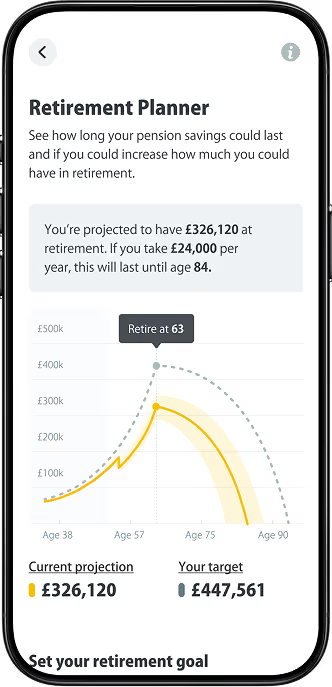
Thank you! Your submission has been received!
Oops! Something went wrong while submitting the form.

Recent articles

Put your pension
in the palm of
your hand

Combine your old pension pots into one new online plan. It takes just a few minutes to sign up.

Be pension confident!

Be pension confident!

Combine your old pension pots into one new online plan. It takes just a few minutes to sign up.
Combine your old pensions into one simple plan
Invest with one of the world’s largest money managers
Make paper-free online withdrawals from the age of 55
Pay just one simple annual fee
  • Sign up in minutes
  • Transfer your old pensions into one new online plan
  • Invest with one of the world’s largest money managers
  • Pay just one simple annual fee
Capital at risk
Button with Google Play logo and text 'Get it on Google Play' on a black background.