The Buzz.

Read the latest pension news and retirement planning tips, from our team of personal finance journalists, investment professionals and money bloggers.

The conversations we're having with our money managers
Our Chief Engagement Officer, Clare, shares some of the recent conversations we’ve been having behind the scenes with our money managers.

Over the past few months, something rather wonderful has started to happen. We’ve received lots of calls, emails, live-chats and reviews from customers asking where their pension money is invested.

Whilst we’ve always had very engaged customers, recently there’s been a real change in the type of questions and comments we see - and they’re more focused on investments, and climate change.

Some of the brilliant questions our customers are asking are:

  • ‘Why should I save into a pension if there’s no world left when I retire?’
  • ‘Am I funding my own oppression?’
  • ‘I feel uncomfortable with the voting record of the people managing my pension. What are you doing about this?’

We’ve engaged with each of these customers individually, but it’s now time to open up the wider debate and publicly share some of the conversations we’re having behind the scenes as well.

How customers’ money is invested

At PensionBee our customers’ money is invested in thousands of companies listed on global stock markets. In theory that means each customer indirectly owns shares in those companies. But in order to get economies of scale, all that money is pooled together by a money manager to passively track an index, such as the FTSE100.

These index funds aim to match the performance of all of the stocks in the index and get a return in line with the market. It’s low cost, diversified and the most common way to invest pension funds.

When a plan passively tracks an index of stocks the money manager doesn’t have the ability to add or remove certain companies. This is because the plan automatically buys all the stocks in the index, including ones that people might have strong views on, such as oil companies or tobacco firms.

One PensionBee plan that’s a bit different is our Future World Plan. Here the money manager, Legal & General, does have the ability to remove certain companies that don’t meet their environmental criteria, as they did with Exxon Mobil, who refused to engage in carbon reduction discussions.

In the case of Exxon Mobil, Legal & General sold all their shares from the Future World Plan and will use their shares from the rest of the business to vote against the reelection of the current CEO.

We agree with Legal & General ’s ‘engagement with consequences’ approach, and how they vote for change in poorly performing companies. That’s why we picked the Future World Plan.

The role of money managers

It’s clear that all money managers have a crucial role to play in tackling the climate crisis, using the collective power from all the shares they own in index funds to positively influence companies they are invested in.

They can do this through engagement or by using their voting rights as shareholders at Annual General Meetings to demand change. They can vote for climate change motions or against the reappointment of management teams who don’t commit to transition their businesses away from fossil fuels.

As a result we’ve begun to talk to our money managers (State Street Global Advisors, Legal & General, BlackRock and HSBC) about their specific engagement policies and voting records with the companies where our customers’ money is invested.

An important part of being transparent as a pension provider is holding our money managers to account. It’s also about doing the right thing by our customers.

As they manage our customers’ money, we need to be sure their views and actions are aligned with those of our customers. When it comes to the climate crisis we need to understand what they are doing to best represent the interests of both our customers and the planet.

Let’s be clear, this is a planetary issue - and not just a PensionBee one. A comfortable happy retirement also means having a sustainable planet to live on.

We’ve had a mixed response from our money managers so far, but we are using this as a starting point for discussion.

Our customers are the driving force behind this change; sharing the questions they want answered and refusing to accept weak responses. We’re proud to represent our customers.

Whilst change takes time, where a money manager will not meaningfully engage with us on these important topics and where their actions continue to be at odds with our customers’ views, after a period of consultation we will fully review the relationship.

We’ll be publishing the outcomes of our ongoing discussions with money managers and keeping customers up-to-date with our other activities in our sustainability blogs. We’ve also started to pose our customer questions to money managers in our quarterly update videos.

Not only do we want customers to know that we’re working hard on this topic behind the scenes but we invite everyone to get in touch with their ideas, comments, views and questions at engagement@pensionbee.com

What is the Backto60 judicial review of State Pension changes?
Find out why women born in the 1950s have been hit by State Pension changes, and why they’re taking legal action with the Backto60 judicial review.

Nearly 3.8 million women born in the 1950s could be affected by the results of a court hearing on 5 and 6 June 2019.

Backto60, a group campaigning on their behalf, has been granted judicial review to determine whether increases to women’s State Pension age, and the impact of those changes, amounted to age and sex discrimination.

These women were hit hard when successive governments hiked up the age when they would get their State Pension. They expected payments to start at 60 – but then the government moved the goal posts. Changes were introduced further and faster than anticipated. Worse still, many women were only notified within a year of their expected retirement age, while others didn’t receive letters at all.

This left some women with less than a year’s notice to prepare for a six-year increase in their State Pension age, missing out on up to £45,000 as it rose from 60 to 65.

How did the State Pension age change?

Until 2010, women started receiving their State Pension earlier than men, at the age of 60 rather than 65.

However, concerns about increasing life expectancy and ballooning pension costs meant politicians decided to raise State Pension age and make it the same for both men and women.

The Pensions Act 1995 proposed gradually pushing up State Pension age for women from 60 to 65 over the 10 years from April 2010 to April 2020. But then the Pensions Act 2011 accelerated the changes, so State Pension age hit 65 by November 2018.

State Pension age will continue rising to _state_pension_age by October 2020, then _pension_age_from_2028 by 2028, with plans to push it up to 68 between 2037 and 2039. You can check your own State Pension age at www.gov.uk/state-pension-age.

What went wrong?

Hundreds of thousands of women and their families have suffered financial hardship, because they weren’t given sufficient warning about the changes.

The government didn’t start writing to notify any of the women affected for nearly 14 years after the Pensions Act 1995. Many had less than a year’s notice that their State Pension age had increased by four, five or even six years. The abrupt changes left little time to make other plans, or save money to cover the gap.

All the signs of a growing scandal here. Having worked with @thisismoney on these cases, I’m increasingly convinced these are not isolated errors but rather a systematic problem with incorrect state pension forecasts https://t.co/t7b7wrYWRh

— Steve Webb (@stevewebb1) May 25, 2019

Many had already taken irrevocable decisions – such as accepting redundancy, taking early retirement or leaving jobs for caring responsibilities – based on expecting their State Pension to kick in when they reached 60.

Single, divorced and widowed women have been particularly hard hit, lacking any income from a husband or partner. The entire pension system was structured around married couples and male breadwinners, assuming that wives would benefit from their husband’s pension money.

Equalisation of the State Pension age is especially devasting for the generation of 1950s women who have already suffered from gender pay gaps, lower workplace pensions than men and the financially disastrous ‘married women’s stamp’.

These women are less likely to have had well-paid jobs and more likely to have stopped work to look after children. With less chance to build up a workplace or private pension, any changes to the State Pension are far more damaging.

How can I get involved?

If you want to take action, consider joining one of the campaign groups below.

  • Women Against State Pension Inequality (WASPI) is fighting for fairer treatment, a bridging pension and compensation for those who have suffered financial losses. WASPI is currently pursuing a complaint of maladministration with the Parliamentary Ombudsman. Visit www.waspi.co.uk for details.
  • Meanwhile BackTo60 is campaigning for all women born during the 1950s to have their financial position put back to where it would have been, had their State Pension started at the age of 60. See www.backto60.com for more information.

Check back for a further post after the hearing with tips on how women affected can cope with their State Pension delays.

Faith Archer is a Personal Finance Journalist and Money Blogger at Much More With Less.

What is a Robo-Advisor?
Discover the realities of robo-advice and weigh up some of the pros and cons.

The first robo-advisors appeared towards at the end of the 2000s. Since then, the industry has grown at an impressive pace. In fact, Statista predicts that, by 2023, the robo-advice business may be worth more than US$2,552,265m (…about £1,959,000m in today’s money).

In this article, you’ll uncover a few myths around this technology, and explore some of the pros and cons of choosing robo-advice for your pension.

Here’s what you’ll learn:

  • What’s a robo-advisor? How does it work?
  • Myth 1: Your money is managed by robots
  • Myth 2: Robo-advisors are only for people with small pension pots
  • Myth 3: Robo-advice is only for millennials and ‘tech-savvy’ people
  • Myth 4: Robo-advisors might replace human advisors one day
  • Conclusion: Are robots right for you?

What’s a ‘robo-advisor’? How does it work?

Though the software behind it all is enormously complex, the concept of robo-advice isn’t.

Simply put, the term is used to describe a range of automatic investment tools that use software (instead of human judgement) to make investment decisions.

Now to dispell a few myths…

Myth 1: Your money is managed by robots

Reality: There’s an obvious issue with the name here - robo-advisors aren’t necessarily ‘robots’. They’re software, operating with a certain amount of human oversight (depending on the provider in question).

This means that, if you visit a robo-advisory firm, you’re unlikely to see any robots - just people working at computers.

Want to see an actual pension robot in action? Take a look at Armie.

Bear in mind that Armie only speeds up your paperwork for us - he doesn’t make any investment decisions! We leave that to our money managers - more on them later.

Myth 2: Robo-advisors are only for people with small pension pots

Reality: In the earlier days, people tended to use robo-advice services purely for smaller pots (sometimes referred to as ‘micro-accounts’).

This was typically due to the cost savings, and the obvious trepidation around putting such a large sum of your retirement money under the control of a piece of software.

As the technology has evolved and people have become more comfortable with the idea, robo-advisors are taking on larger and larger pot sizes.

{{main-cta}}

Myth 3: Robo-advice is only for millennials and ‘tech-savvy’ people

Reality: As the figures show, billions of pounds in assets under management would suggest otherwise.

Today, many modern robo-advice platforms are easy to use with modern interfaces and require no more tech knowledge than the ability to log onto a website or app and choose from a few selections.

And, whilst many financial products wouldn’t describe themselves as ‘robo-advisors’, to one extent or another, many of them use the same digital decision-making technology to inform their investing strategy.

Myth 4: Robo-advisors might replace human advisers one day

Reality: OK, we’re not sure that everyone believes this one, but we’re going to put it to rest here anyway.

Despite what Silicon Valley and the ‘techno-optimists’ may tell us, automation is not the way of the future for everything.

True, robo-advice is likely to take a larger share of the pension market over the next few years (…and decades) but replacing humans completely one day? We doubt it.

There will always be people who want to work with a living, breathing human. Someone they can speak to about their investments, someone with years of experience that they can trust, and someone whose decisions are not based entirely on the variables within a piece of software.

Simply put, the robots won’t replace us any time soon. Or ever.

Conclusion: is robo-advice right for me?

Robo-advisors certainly have their place, the growth of the industry illustrates that. They’ve simplified investing and made it more accessible for many savers, but can they match the expertise and insights of the world’s biggest money managers? We’re not so sure.

Our money managers have centuries of combined experience and trillions of pounds under management - and no robo-advisor can match that yet.

The PensionBee value of innovation
Without innovation PensionBee wouldn’t exist, and it’s this value that motivates us to keep aiming for better in everything we do...

Back in January I wrote a piece about my favourite PensionBee value – love. But while that’s my favourite, it’s still only one fifth of the values that make up PensionBee, and they’re each as important as each other!

This time I’d like to talk about another of our values – innovation. In a nutshell, PensionBee wouldn’t exist without innovation. The company was borne out of our CEO Romi’s frustration at the problems she faced when trying to move her own pension, and it was that experience that inspired her to start PensionBee in order to give others the help she wished she’d had herself. She saw a system that wasn’t working for her, and she decided to create one that would.

One definition of the word innovate describes it as meaning to “make changes in something established”. When PensionBee was started, the “something established” that we were looking to make changes to was the pensions industry as a whole, and while I wouldn’t say that’s a finished job, I do believe that our innovation applies to more than just the wider industry now. In fact, in much of our innovation, we ourselves are the “something established”.

Over the three and a half years that I’ve been working at PensionBee, I’ve watched the company evolve in all areas; from our front-end product now used by thousands of customers, to the way we work internally. Importantly, we see each new change as a positive. It can be easy to rest on your laurels and remember that old saying that “if it ain’t broke, don’t fix it”. But just because something works, doesn’t mean it couldn’t work better.

One of my favourite things about the way that we innovate at PensionBee is that the desire to be better comes from all areas of the business. In our customer success team we have a monthly “BeeStorm” where the team shares the things that aren’t working for them and the improvements they think we can make. As a cycling fan, it always makes me think of Team Sky principal Dave Brailsford’s marginal gains philosophy. The smallest things, when they build up, can make the biggest difference. Whenever we introduce a new automation it makes me happy to know that every minute we save for the customer success team is another minute they can spend making sure our customers get the best service possible.

And because the entire company is encouraged to share new ideas and to highlight where we could be doing better, it helps create an environment where change isn’t seen as something to fear, but something to be excited about. Towards the end of last year we had a team discussion around the importance of feedback, and how we should always thank people – our customers and each other – for it. Even if it’s not always positive, honest feedback helps us to understand how we can improve.

Honesty also happens to be another of the PensionBee values, and will be the one I’ll be writing about next!

Making happiness a habit
Our CTO, Jonathan, writes about how we’re making happiness a habit, by prioritising employee wellbeing, at the wonderful world of PensionBee.

This article first appeared in the Spring 2019 edition of The Institute of Leadership & Management’s Edge Magazine.

It’s 1pm on a Monday and I’m stepping out for a regular one-to-one meeting with one of PensionBee’s software engineers. The opening question, “Are you happy?”, starts a conversation that is very different to the conversations I used to have with managers, revolved around performance, and opens a window onto my colleague’s thoughts and feelings and how their time working in the company fits into their life.

Our vision is to live in a world where everyone has a happy retirement, and to do this we need to make pensions simple and engaging. Pensions are not something that most people typically take an active interest in, despite the financial importance of pensions – they are often someone’s largest financial asset after their property. Pensions are typically dull, complex and provided by companies that are frustrating to deal with. The resulting disengagement means people are not actively choosing their pension provider, and when consumers don’t exercise choice there is less pressure on customer service, price and product, so they generally get a worse outcome – not exactly a recipe for a happy relationship with one of your most important financial products.

At PensionBee, I’m fortunate to be a part of a team who get out of bed every day motivated to solve this problem and help the workers of the UK take control of their long-term savings. One of our challenges is how to create an environment where everyone in the team is able and motivated to use their skills and work effectively together. To do this, we put happiness at the heart of team culture and use it as a lens for how we see our people. We believe that a happy team will lead to happy customers and happy customers will reflect back on the team in a virtuous cycle.

This means that happiness, or “Happiness!” as we call the programme, is a target that guides rather than follows more traditional people management techniques such as performance management. This seemingly unusual approach is something that we’ve come to see as a competitive advantage, leading to better workplace fit, better performance, and ultimately, more satisfied customers. In this article, I will share a few stories of what it means for PensionBee to build a culture around “Happiness!”, and how we create an environment for it to flourish.

Every new joiner to PensionBee is assigned a Happiness! Manager, who is tasked with meeting with them regularly and discussing their happiness levels. A Happiness! Manager can be different from the person taking responsibility for developing someone’s performance, as we want to make it clear that Happiness! Managers’ priority is happiness. The meetings take place every six-eight weeks and, although the conversation is deliberately open-ended, the meetings start with the simple question, “Are you happy?”. The aim is to focus on how someone is feeling, especially relative to the previous meeting, and what the company can do for them to better support their growth. Steering the conversation to look at someone’s performance is inconsistent with this, as that is instead asking what they are doing for the company.

Happiness! meetings cover a variety of topics – you might talk about adjusting someone’s working hours to give them more time with their children, how their aspirations are changing and what this means for their role, or an idea they have for improving the workplace environment. Sometimes the conversations are just a check-in that shows that someone cares and is there if they are needed. Happiness! meetings create a default of openness and honesty, which transfers well into people’s work and interactions with their teammates – if you feel comfortable to discuss any topic you are more likely to give honest feedback or collaborate across teams, all of which adds to overall productivity.

Culture in any workplace is just another word for behaviour - it’s inevitable that there will be a culture in your company, so it’s better to design it deliberately. We want the principle of Happiness! to drive group behaviour, alongside the company’s values of Simplicity, Honesty, Quality, Innovation, and Love. We use rituals to define and habitualise behaviours we believe are important. An effective method for communicating a message is to repeat it over and over again, and rituals are the behavioural equivalent.

To give an example, there is a daily “stand-up” each morning at 9:15am that the whole company participates in – we stand in a circle and set out our intention for the day, and flag if there’s anything we need help with. It’s a great way of keeping everyone connected to what others are doing and keep a spotlight on the whole team’s effect on customers. In a similar vein is the bi-weekly Show ‘n’ Tell, where anyone can present on something they have done in the last two weeks they are proud of. Questions and feedback are encouraged, and the sessions are often used to celebrate team performance or show upcoming product changes. We regularly receive feedback that these rituals show the team that we genuinely value transparency, and that we want them to feel like they can input across team boundaries, all of which increases job satisfaction.

Another contributor to happiness is the connection between your actions and your effect on customers. Customer feedback – both positive and negative – is highly visible in a channel on Slack, a messaging tool that everyone in the team uses. PensionBee customers are assigned a personal account manager from the Customer Success team when they sign up, who they know as their “BeeKeeper”, and feedback often mentions these individuals, which is fantastic for creating that feeling of a job well done.

What has been even more interesting to see is the response to negative feedback, usually triggered by a customer who feels like we have dropped the ball or failed to communicate regularly and clearly. As soon as negative feedback pops up in Slack, this lights a fire under the whole team to sort it out, and a multi-disciplinary group naturally forms to address the issue. This will usually include the customer’s BeeKeeper, someone from the product team who can help fix the problem, someone in the marketing team who will help if necessary on social media or respond to a review, and also involve compliance or technical pension experts if the issue calls for that.

Initial transparency is coupled with the delegation of responsibility for tackling customer issues to the people who have the information to deal with them best, and this allows for a rapid and effective response. It is not unusual for a customer who has left negative feedback to react positively to the group’s efforts and revise a negative review or become a strong advocate for PensionBee, further increasing the happiness felt by the people involved.

The above example is enabled by embedded use of technology – in that case, Slack being used by all team members, and integrations with external customer feedback tools. This approach is at odds with a more traditional structure of centralising feedback through specific channels, communicating issues out in regular meetings, and eventual resolution of customer problems by specifically trained staff. We believe that by encouraging a higher level of technical literacy, we can create better outcomes for team members and customers.

Technology is something that everyone is trained to work with and encouraged to think of as a mechanism for making them more productive. The media is currently hooked on the concept that AI and big data are coming to “eat all the jobs”, in the words of Marc Andreessen. For us, technology is something that is part of the reason PensionBee is able to exist at all, and we are constantly looking for ways to increase our team’s skills with technology and make sure everyone in the organisation can have high quality conversations about tech.

This approach presents a challenge to the role of the software developers at PensionBee. Part of their job is to look for ways to be tool-builders, helping people with less technical experience to get the most out of technology. If people can see that technology helps them become more effective, that will encourage them to seek more opportunities to use technology.

Moreover, we have supported members of the Customer Success team who want to move into software development to do so, as part of a general effort to transition and promote within the company. Having trained within the Customer Success function, people are highly experienced in customer needs and the company’s product, which makes them highly perceptive and valuable. An investment training them in technical skills means they are then able to bring this experience to a different area of the business, and the support they feel changing career path contributes directly to their happiness.

It’s impossible to talk about happiness without considering the role of mental health within the modern workplace, as mental health issues are on the corporate agenda more clearly than ever before. Happiness is at the heart of good mental health and a culture built around happiness ensures that the PensionBee team can adapt to changes in modern working practices and pressures. By encouraging happiness as a habit, team members are motivated, able to think freely and creatively and are a pleasure to work with – exactly the sort of foundation we need to tackle the big problems affecting the country’s long-term savers.

How to fight back against the gender pension gap
This International Women’s Day Personal Finance Journalist and Money Blogger, Faith Archer, talks about the gender pension gap and the steps women can take to fight back against financial inequality.

Women don’t just get hit by the gender pay gap – we also get walloped by the gender pension gap. After years of working for lower pay, we’re left with smaller pension pots. We’re not talking pennies either, but a great big yawning gap.

Research by PensionBee revealed a 31% difference between male and female pension pots. That’s nearly a third, and the inequality increases with age. PensionBee found that by the time women reached their 50s, men have a pension pot that’s almost twice the size, at just over £31,250 for women and nearly £53,450 for men. Yet women live longer than men, so if anything we actually need bigger pension pots to last for longer!

Writing about the gender pension gap made me cross. So for International Women’s Day, I’d encourage you to get angry about pension savings, then think about how to get even.

Women’s pension savings are hit while we’re working…

Fundamentally, if women earn less, they have less money available to pay into a pension. If you don’t have as many pounds in the first place, you can’t put as many into retirement savings.

Contributions to pensions at work are normally based on a percentage of salary. On lower pay? You’ll pay less into your pension and see smaller sums added by your employer and by tax relief. The good news about pensions is that for every £100 a basic rate taxpayer puts into a pension, the taxman will add an extra £25 on top. If you’ve been auto-enrolled into a workplace pension, then from April 2019 you’ll have to pay at least 4% of qualifying earnings into a pension, topped up by at least 3% from your employer and 1% from the tax man.

Tax relief on pensions is more attractive for higher-rate taxpayers, so women who don’t break into higher tax brackets may be less inclined to pay into a pension. Anyone lucky enough to pay higher rate tax can claim an extra _basic_rate tax relief via their tax return, or an extra _corporation_tax tax relief for additional rate taxpayers.

…and hit again if we stop

But women’s pensions don’t just get hit while we’re working. Our pension pots also get hammered when we stop. Women are more likely than men to take time off work to look after children or care for sick or ageing relatives. Our pension pots can then get slashed three ways by the ‘motherhood penalty’.

Many women stop contributions while on maternity leave, in an attempt to make ends meet. It can be hard to restart pension contributions if you don’t return to the workforce – because if you don’t have cash coming in, what can you pay into a pension? Long career gaps, with little or no pension saving for years, are a massive disadvantage for women.

Women who choose to return to work part-time get lower salaries in exchange – and so make lower pension contributions. Of the 8.4 million part-time employees in the UK, nearly 3/4 are women, according to labour market stats from the ONS, meaning women are disproportionately affected. Plus, anyone whose promotion prospects are limited by career breaks or part-time roles will then miss out on increased salaries and increased pension payments.

One spark of light is that the gender wealth gap is beginning to close at younger ages. Recent figures from the ONS showed that women aged 18-44 actually had larger estates than men of the same age. Average personal wealth was £175,200 for women compared to £152,000 for men, looking over 2014-2016. Men still had estates worth more than women for all other age groups.

Paying more into a pension early in your career, when you have any extra money, will help narrow the gender pension gap come retirement.

Fight back on the pensions front

Faced with financial inequality, it’s crucial for women to get more pounds into their pensions. Here’s my seven point action plan to narrow your own gender pension gap:

1. Grab free money

When you pay into a workplace pension, your employer has to add money on your behalf, plus you get tax relief on top. Don’t opt out of a workplace pension because retirement seems a lifetime away – it’s like turning down a pay rise.

2. Start saving early

Time is the magic weapon when it comes to pension saving, as those early payments have longer to benefit from compound interest.

3. Whack up your contributions

Stash extra cash into a pension while you can, especially if you’re ever thinking of having kids. Get a pay rise, inheritance or windfall? Bump up your pension payments.

4. Check out pension arrangements during maternity leave

Some employers will continue paying into your workplace pension while you’re on maternity leave, even after maternity pay stops. Make sure you don’t miss out!

5. Register for Child Benefit after having children

Even if you’re not entitled to payments because your partner earns over _annual_allowance a year, it’s worth doing. Otherwise, you could miss out on National Insurance credits towards a chunk of your State Pension.

6. Build pension saving into the family budget

If you’re part of a couple, and one person takes time out for caring responsibilities (man or woman!), plan how to fund their pension out of family income. Even non-taxpayers can save up to £2,880 a year into a pension and get £720 added by the tax man. Is there enough money for the earner to pay into the non-earner’s pension?

7. Make the most of your pension money

Track down pension pots from previous employers and any private pensions, then check where your money’s invested and how much it costs. If you have several years to retirement, you can afford to choose investments that take more risk in the hope of higher returns. Plus, switching to lower cost options will stop your retirement savings being eaten away by charges.

So, if you want to strike a blow for women’s equality, don’t burn your bra. Negotiate a pay rise, bump up your pension contributions and check your pension costs. Your future self will thank you, when you can afford to retire, rather than working till you drop.

Faith Archer is a Personal Finance Journalist and Money Blogger at Much More With Less.

3 key principles behind Shariah pensions that could help you to invest more responsibly
Shariah pensions could help you to invest more responsibly, regardless of faith. Here's how.

Shariah compliant pensions invest savings in accordance with Islamic principles on finance, making them suitable for anyone who wishes to invest their money in line with their faith. They could also be suitable for any savers looking to invest more responsibly, regardless of faith.

Whilst Shariah compliant pensions can seem complicated at first, they’re actually pretty straightforward. Here are three key principles of Islamic finance to help you understand more about Shariah compliant pensions and how they could work for you.

Ethical investing

Ethical investing

Islamic finance prioritises ethical investment, which means that Shariah compliant pensions will restrict or exclude investment in certain industries, which are deemed to be unethical. These industries include:

  • alcohol
  • tobacco
  • gambling
  • weapons
  • finance sector

Alongside these restrictions, some Shariah compliant pensions will allow for a small percentage of non-compliant income from large, Shariah compliant companies with many operations. PensionBee’s Shariah Plan allows for 5% of non-compliant income, which is donated to community charities, supporting positive social change and assuring investors of the fund’s commitment to ethical investing.

No interest

Islamic finance sees interest as unfair and something that can create inequalities. This is why a key principle of Islamic finance is the requirement that no interest is earned or paid, and you’ll see this reflected in Shariah compliant pensions as well. With a Shariah compliant pension, wealth is generated by profits made through trade and investment instead of interest.

Whilst this requirement may seem unconventional at first, some Shariah compliant financial products consistently outperform their expected profit rates, which means that Shariah compliant financial services may be able to balance more responsible investing and saving with a healthy return.

Transparency

Another core principle of Islamic finance is transparency in financial contracts and agreements. This means that contracts and documents must use simple language, with terms and conditions that are easy to understand. There also shouldn’t be any discrepancies within the contract that could result in later disputes.

Shariah compliant pensions offer transparency in their terms in order to encourage fairness and equality. Here at PensionBee, transparency is one of our core values so we always provide easy-to-understand information about our plans and how they work. We think transparency should be an industry standard so it makes sense to us that Shariah compliant pensions, which aim to be more responsible, are committed to transparency.

Find more info about our Shariah Plan, where you’ll also find a factsheet and a helpful video. Our Shariah Plan is managed by HSBC and State Street Global Advisors, following a Shariah compliant benchmark, and is appropriately diversified.

To learn more about Shariah investments, listen to episode 6 of our podcast, watch on YouTube or read the transcript.

Risk warning

As always with investments, your capital is at risk. The value of your investment can go down as well as up, and you may get back less than you invest. This information should not be regarded as financial advice.

What happened at the Backto60 judicial review of State Pension changes?
As we wait for a judgement, find out what took place at last month’s Backto60 judicial review, and why women born in the 1950s are seeking compensation.

Some 3.8 million women born in the 1950s must wait to find out the results of a court case about how the government delayed their State Pension for up to six years.

As described in my previous post, campaign group Back to 60 sought a judicial review of the way women’s State Pension age was increased to the same age as men.

The hearing against the Department for Work and Pensions (DWP) took place in the High Court on 5 and 6 June. The judgement is yet to be published, but here is a summary of the key arguments.

The case asks for compensation for women born between April 1950 and April 1960 on the basis of a combination of age and sex discrimination and the government’s failure to properly inform those affected.

Many of these women have suffered financial and emotional distress, after successive governments sped up the process of raising their State Pension age from 60 to as high as _state_pension_age.

Back to 60 and another campaign group, Women Against State Pension Inequality (WASPI), have long argued that many women received little or no personal notice of changes to their State Pension age, and therefore did not have time to make other plans.

In court, the DWP defended the changes as a measure designed to equalise the State Pension age between men and women, and to ensure intergenerational fairness between those receiving the State Pension, and younger taxpayers funding them.

The DWP insisted that the Government had taken “extensive” steps to notify women of the changes. The DWP also said that “personal notifications would have been difficult if not impossible prior to 2003”.

Yet the legal team for Back to 60 produced internal documents showing the DWP was aware on at least six occasions, in 1998, 2000, 2007, 2011, 2012 and 2015, that information about changes to State Pension age was not reaching the women affected.

As reported by David Hencke in the Byline Times, civil servants repeatedly warned ministers about problems ahead. The memos reveal that ministers rejected proposals to send out a mass mailing with tax paperwork in 1997. They also predicted criticism of the DWP’s failure to communicate with the women affected in 2007, and refer to ‘widespread ignorance” of the changes with only three years to go. Direct mailing only started in 2009 – just a year before the State Pension age started to go up, and 14 years after the initial legislation in 1995.

The DWP also argued that there was no duty of fairness to the women affected, no obligation to notify them, and no right to expect legal remedy for the lack of notice, as reported by The Guardian.

At heart, the case is all about money. The legal representative for the DWP said that raising pension age to _state_pension_age also aimed to “make pensions affordable…and to control government expenditure at a time of great pressure on public finances”.

The day after the judicial review hearing, the DWP released figures calculating that the net cost of reversing the changes, so State Pension age returns to 60 for women and 65 for men, adds up to a massive £215 billion.

In practice, the court case is not seeking such astronomical sums. The hearing did not ask to reverse the State Pension age changes for both men and women, but just for compensation for women born in the 1950s. But it could still cost many billions of pounds.

For now, the 1950s women, government and taxpayers must wait for the judgement to be published, to find out if any compensation will be awarded at all.

Faith Archer is a Personal Finance Journalist and Money Blogger at Much More With Less.

How do you pay off a credit card?
PensionBee customer and Founder of Mrs Mummypenny, Lynn Beattie, shares the inspirational story of how she repaid £16,000 of credit card debt in just two years.

In April 2017 I took my head out of the sand and faced my debt and emotional spending problem. I added up my four different credit card balances and worked out that I owed £16,000. A scarily high amount of debt! I had no immediate way of repaying the debt quickly.

My blog and social media business was doing okay, just about well enough to cover slightly more than minimum monthly repayments of £250. This would mean it would take 64 months, or just over five years, to repay the debt. This felt awful, too long. A sobering and depressing thought.

I came up with a plan and set my mind to paying the debt off as quickly as possible. It took two long years, but I did it! By April 2019 I was credit card debt free.

The best news folks..I am officially credit card debt FREE - 16k in two years - done….#debtfree #debtfreejourney https://t.co/0k45AIIlVR

— Mrs Mummypenny🌈 (@MrsMummypennyUK) May 1, 2019

15 tips to pay off your credit card debt as quickly as possible

  1. The first step is the hardest and the most important. You need to admit that you have a debt/spending problem and that you want to make a change. Face your fears and add up your debts. Find copies of your latest paperwork or give the card and loan companies a call for balances, interest rates or interest-free time frames.
Getting out of debt: get organised and use the Snowball System with @warrenschutecfp https://t.co/pR2XhlyZJS

— Mrs Mummypenny🌈 (@MrsMummypennyUK) February 27, 2019
  1. If your debt is unmanageable or interest payments are too high and you can’t afford the minimum monthly repayment, seek help now from a free organisation such as Step Change, Christians Against Poverty or Citizens Advice.
  2. Restructure your debt if your credit rating allows. Check your rating for free with Noddle/Credit Karma. Move any high interest rate debt to a _personal_allowance_rate deal. Regular credit card interest rate levels are around 18-_basic_rate. For every _basic_rate_personal_savings_allowance you owe, the interest charges will be £180 to £200 PER YEAR. Do what you can to minimise the interest payments.

Money Saving Expert (MSE) has a brilliant up to date tool to help you find the best credit card deals, based on your credit rating. It will be difficult to switch to _personal_allowance_rate deal if your credit rating is not good, but MSE can help with this as well with their credit card eligibility checker.

  1. Focus on your monthly spending budget. List everything you spend – from regular bills to cash purchases – onto paper or a spreadsheet or use a phone app to analyse your spending patterns. Choose whatever method you are comfortable with.
  2. Optimise every Direct Debit and monthly bill. Get the best deals for your mortgage, energy, broadband, mobile phone and TV package. Cancel all non-essential Direct Debits such as Netflix, charity donations and children’s savings contributions.
Where i'm saving money this week by switching mortgage, energy, Sky TV & contact lenses. https://t.co/TDCUH3pDoE

— Mrs Mummypenny🌈 (@MrsMummypennyUK) March 10, 2019
  1. Switch where you do your grocery shop. Whichever supermarket you choose, the food should be great quality and if you avoid the bigger chains, you can find amazing prices. And because the shops are smaller you get your shopping done quicker!
  2. Another savings strategy you could consider is having a no-spend month. Only regular bills, groceries and commuting to work are allowed. You can’t spend on anything else, so no coffees, lunches, drinks out, cinema trips, etc.
  3. Stop the takeaways or make them a treat purchase every two weeks or once a month. Home-cook instead and experiment with fake-aways.
Pressure Cooker Bolognese - A great tasting and value for money recipe - https://t.co/xp4hGxLhX7 A fab pressure cooker bolognese recipe pic.twitter.com/sMl7pOrsWE

— Mrs Mummypenny🌈 (@MrsMummypennyUK) June 13, 2018
  1. Do a no make-up spend year or a no-clothes buying year. Instead re-use all the stuff you already have at home. Or why not mend things that have holes or have ripped? Go all 1970s and put a patch over a hole rather than throwing something out!
  1. Increase your income with side hustles. Get a second job in the evenings such as cleaning, bar work, dog walking or crafting. Sell any clutter from your home that you don’t use on eBay or Facebook. Or try a car-boot sale. Give mystery shopping a try, a personal favourite of mine that earns me an extra £50 per month.
How to Make Money on eBay - Follow these simple tips - https://t.co/hvnMry5Jal

— Mrs Mummypenny🌈 (@MrsMummypennyUK) February 3, 2019
  1. Come up with a goal of when you want to pay off the debt. Be that two years, three years or five years. And be realistic with that goal and monthly repayments. But also challenge yourself. The quicker you pay off the debt, the sooner you will be free.
  2. Just go for it. Set up a monthly repayment Direct Debit amount that you can afford, just try to make it more than the minimum payment.
  3. Whenever you earn or save extra money it should go into the debt repayment. Pay off the debt with an interest charge first. Even if it’s only an extra £10 earned that month, pay it into the debt.
  4. At the same time as paying off the debt also save into an emergency fund. I did 50/50 payments until my emergency pot reached around £3,000, a number that I felt comfortable with and gave me peace of mind. Then you dip into this for real emergencies, not the credit cards. An emergency being if something breaks (washing machine, car, dishwasher) not if you fancy a holiday.
Want to know what money advice I would give to my 18 yr old self.. https://t.co/Ii6usipqrF

— Mrs Mummypenny🌈 (@MrsMummypennyUK) February 18, 2019
  1. One day in the future you will be debt free. Be prepared for the ups and downs, and for it being tough on your mental health. Accept that you’ll miss out on things like holidays with your friends or family. But it’s worth it in the long run to be free of debt. The feeling is incredible, I promise you.

Lynn Beattie is a PensionBee customer and CEO/Founder of Mrs Mummypenny, a personal finance website. She is also an ACMA management Accountant, previously working in commercial finance for Tesco, EE & HSBC. Lynn is a single mum to three boys, living in Hertfordshire, and is the author of ‘The Money Guide to Transform Your Life‘ published in September 2020.

The PensionBee value of love
Although all five of the values are incredibly important to us, I do have a personal favourite, and that’s the value of love. At PensionBee, the love value manifests itself in a number of different ways…

At PensionBee, we talk about our values a lot. We have five values, that we chose in a session nearly three years ago, with the then (much smaller!) team. The values we chose then, and still live and work by today, are honesty, innovation, love, quality and simplicity.

They’ve recently found a new home on the wall in our kitchen and they come alive in our weekly show’n’tell sessions where each presentation is introduced with the value that the presenter feels is best represented by the work they’re sharing with the team. Whenever decisions are made in the team – big or small – we ask ourselves, does this align with our values? Although all five of the values are incredibly important to us, I do have a personal favourite, and that’s the value of love. At PensionBee, the love value manifests itself in a number of different ways…

Love for our customers

Love was originally chosen as a value, because it was the word that best reflected the way we feel about our customers. All our customers are assigned a personal BeeKeeper to look after them throughout their journey with us. It was a conscious decision that was made before we even had our first customers. We wanted to make sure they never felt like a number.

Our team of BeeKeepers has grown a lot since the early days, but the one-to-one support they offer our customers has remained. When we hire into that team, we look for people that we believe will not just be able to show our customers the love they deserve but will really want to. I think they do a pretty great job of it!

Our love for our customers is also present in the way our product has evolved. We love receiving feedback! It’s always great to receive positive feedback, and to hear of the amazing things our team are doing to help our customers. But we also really value the constructive feedback, that tells us where we could be doing better or where there’s something missing that our customers really want. Our mission at PensionBee is to help people on their way towards a happy retirement and having our customers tell us how we can do that for them is something that we feel so grateful for.

Love for our team

There’s a lot of love in our team! I feel incredibly lucky to work in a team that’s full of such compassionate, supportive people, and the small things can sometimes make the biggest difference. Members of the team will announce on our Slack channel when they have a bit of spare time, so that their colleagues know they’re available to help if someone needs it.

There are also regular public displays of gratitude between employees - we’re constantly showered with chocolates from colleagues, thanking their team-mates for holding the fort while they’ve been away enjoying a holiday. We’re a team that really appreciates each other. We also, of course, have regular socials, whether it’s drinks at one of our local haunts or a ping-pong tournament in our kitchen. There are many great friendships that have been forged at PensionBee, and there’s no denying it makes coming to work even better when you come to work with friends.

Love for our community

One of my favourite ways that we show our love for the community is through our involvement in the ‘Together at Christmas’ campaign run by Better Bankside. We host a collection box in the office, where we gather items that are then donated to homeless, elderly and vulnerable people in the Southwark area. Before handing them over, we host a gift-wrapping evening, where we gather the donations into bundles and wrap them up ready for gifting. It’s a lovely, festive evening with Christmas music and high spirits all round. It’s important that we give back to our local community, and the ‘Together at Christmas’ campaign is such a worthy cause, but doing something like this also has a really positive impact on the office. The team love it and we’re already looking forward to supporting the campaign again next year – at least I know I am!

Love for the wider world

One of the earliest requests we had from our customers was for an ethical investment option. We listened, added the Future World Plan to our platform last year, and it’s proving a popular choice. As well as being what customers wanted, having an ethical option was also something that the team internally felt passionately about.

We’ve also recently added a Shariah Plan to offer an alternative ethical option – something else that our customers had asked for. Businesses are in the privileged position of being able to make a real impact on the world by the decisions they make, which is one of the reasons we’re also strong advocates for moving away from the wasteful paper-based transfer systems used by some older pension providers. We have our own company policy not to physically post anything to a customer unless they’ve explicitly requested it – and that happens rarely. We dream of a world where we can live in a paper-free office, and we’re pushing the industry to ensure that one day we’ll get there.

Great to see @pensionbee introduce this. First thing I asked about when I joined. And today I've transferred to the Future World Plan! https://t.co/UFZCqmQMBS

— richardbrophy (@richardbrophy) October 14, 2017

Change is a strong theme at PensionBee, and importantly the need not to be afraid of it. We’re constantly striving to improve the way that we do things and the experience that we give our customers. This is often achieved through innovation, which will be the next value I’ll be talking about here on the PensionBee blog – coming soon!

My week as a PensionBee BeeKeeper
Last week our CEO spent a week working as a BeeKeeper, getting to know the needs of our customers. Here are four key things she learned.

I think it’s important that CEOs spend time with their customers. At PensionBee, customers are like the North Star. We listen to their needs to deliver a pension they will love, a pension they will love to save for and, ultimately, a pension they will love to withdraw.

So what better way to stay in touch with our customers and their perspectives than to spend a week on the front line with our BeeKeepers and Nectar Collectors, resolving problems and generally being helpful?

Here are the top things I learned from my week supporting PensionBee customers.

1. Helping customers will make you happy

It may seem obvious but the reason PensionBee exists is to make pensions simple for our customers. So from explaining what we do and our plan choices, to helping a customer set up a contribution, helping customers feels good! It’s important that businesses exist for a purpose beyond profit and serving customers will quickly connect you to that purpose – while bringing a smile to your face.

2. Sometimes there are obvious things to improve

One thing that struck me is how much scope there is for improving the customer experience. I often found myself answering questions that in MY mind were obvious, but in the customer’s perception clearly required further information. Does everyone know that to generate an electronic signature, one must sign with a cursor or a finger? No, they don’t and we can make it clearer. Businesses often have blinkers on. Talking to customers helps take them off.

3. Automation has a role to play, but not everywhere

In an age where the robots are feared, it was enlightening how much our customers loved speaking with a real human. While we can automate things like livechat security screening or very basic customer support answers, we can’t automate the human touch. Customer support should be human and absolutely top class to meet customer expectations.

4. Don’t forget the bigger picture

Oftentimes all our customers needed was a little help understanding pensions. How does tax relief work? Is it different for employer contributions? These are basic things the industry takes for granted and has overcomplicated for consumers. This is why it’s so important to take a stand, to fight the fight of making pensions simple so people can look forward to a happy retirement.

At PensionBee we are proud to be doing this every single day! Thank you to our customers for letting us help.

Understanding your money personality
Money Coach and Founder of The Money Whisperer, Emma Maslin, looks at the importance of understanding your money personality.

This article was last updated on 26/01/2023

Have you ever wondered why some people get sucked into overspending whilst others manage to keep themselves in check and even save or invest their spare cash? Why some people aren’t fazed by the excess and for others it causes sleepless nights? A lot of it comes down to our underlying money personality…

How we view money is different for each of us. Its ability to enhance our lives and feeling of self-worth is something very personal. We all have a certain attitude towards money that affects how we interact with our finances. Everyone’s so-called ‘money personality’ is made up of a combination of eight different money types, some of which will be more dominant than others.

Personal Finance Expert and Founder of Mr MoneyJar; Timi Merriman-Johnson says: “When it comes to personality types, you’re not just one thing. You’ll have dominant personality types, but you’ll also grow and evolve over the course of your life.”

Some people are naturally drawn towards a desire to accumulate money; they enjoy planning and the feelings of security about the future that having savings affords. Some view money as a means to enjoy life in the here and now; they indulge in material things and experiences, often at the expense of their future self. For others, money’s a tool to facilitate making connections and building relationships, which are more important than the money itself. Others still value money as a tool to achieve the status, image and recognition they crave.

Money, money, money

Most things in life involve money; the experiences we enjoy, where and how we work, how we interact with friends, our relationships, what we choose to do with our free time, what we buy, what we wear, what we eat, how we travel.

Every single one of these opportunities that come into our world is being filtered through the lens of our unique money personality. How we maximise those opportunities requires us to draw on our strengths and identify any elements of our personality which could lead to self-sabotage.

Whilst there’s no one ‘best’ overall personality, ultimately, it’s a question of whether the mix of your individual traits is making you feel content in life. You might need to step back and look at your bigger picture life goals:

  • Do you want to be debt-free?
  • Do you want to stop always trying to ‘keep up with the Joneses’ and the anxiety it causes?
  • Do you want to stop relying on others for financial support?
  • Do you aspire to buy a home/ invest/ put your children through university?
  • Do you want to be able to retire early?
  • Do you want to stop feeling resentful because your generosity is never reciprocated or acknowledged in the way you would like?
  • Do you want to stop living above your means and start saving some money?

When you’ve answered those questions, it becomes important to acknowledge where your habits and behaviours, driven by your personality, are incompatible with achieving those goals. With awareness comes the ability to make positive changes…

Head of Content at PensionBee; Brooke Day says: “Knowing what I was saving for and that I was the one responsible for that really empowered me to make it happen.”

1. Spontaneous spending

When you have money, is your first thought what you could do with that money right now?

For those who have a tendency to spend spontaneously, and who often overspend as a consequence, frequently there are underlying emotional reasons for their spontaneity. Starting to keep a spending journal‘s a great way to monitor the feelings and reactions you have around different types of spending, and uncover some of these emotional triggers. As you keep a note of your spending, also ask yourself:

  • Is there a particular friend or group of friends which you always overspend when you are with?
  • Do you find that you shop online more when you are home alone and bored?
  • Can you not resist the sales emails when they hit your inbox?
  • Do you find it difficult to resist a splurge when your wages just hit your account?

You’ll be able to identify patterns of behaviour and make changes to avoid falling into that instinctive, habitual behaviour. Just the simple act of keeping a written diary of your spending’s often sufficient to make you question your actions, and quickly results in a reduction in the amount and frequency of spending.

Top tip: Make a list of alternative activities to shopping and spending which you can enjoy, and do them with other people to keep you accountable.

Certified Money Coach, Mentor and Founder of The Money Whisperer; Emma Maslin says: “My biggest tip for people who want that shopping hit, is to ask yourself, at that moment, what is it that you need right now? Asking that question is so valuable. There will be a need that you’re fulfilling through shopping, that shopping actually isn’t going to give you.”

2. Overgiving

Does your generosity towards others frequently leave you with feelings of frustration or resentment that your generosity isn’t always reciprocated? Do you find that your generous nature leaves you either with less for yourself, or in debt?

Draw up a list of your own needs and wants for the year ahead and make these a priority before you plan what you’re going to spend on others. Putting pen to paper and giving life to your goals for the short-term shifts your focus and allows you to create positive boundaries and balance; putting yourself first, then treating others.

Top tip: As an alternative to giving financially, look for opportunities to give your time which meet your need for acknowledgement.

3. Carefree about money

Do you not pay enough attention to the money being spent until the credit card bill hits when you get a sudden dose of reality which scares you?

Use a spending plan to give every pound of income a job; allocate all your necessary expenses, wants and needs and be clear how much you have for each. If you become tempted by the ease of spending on your credit card, use the envelope system. This involves dividing your full allowance into various categories, allocating the cash to each category and allowing yourself to only spend the money you’ve allocated for any particular category. Once it’s gone, it’s gone.

Top tip: Make it easier to pay attention to your finances by linking your bank account to a budgeting tool such as the Emma app; you get notifications when you’re spending too much in comparison to previous months and when you’re looking as if you’ll run out of money before payday.

Personal Finance Expert and Founder of Mr MoneyJar; Timi Merriman-Johnson says: “I rely on tools that can help me make good decisions. When it comes to saving, I just set up that standing order to my savings account. When it comes to budgeting, I use budgeting software which categorises my spending for me.”

4. Look at me

Do you want to stand out from the crowd? Does creating a good impression mean having the latest gadgets and clothes? Do you project an image of wealth which doesn’t necessarily match your bank balance?

Make a shopping list and stick to it. If you’re shopping for something and find it discounted, acknowledge to yourself that you don’t need to buy something else to bring the amount you’ve spent up to what you had allocated to spend.

Top tip: Shopping online can help you to avoid the impulsive spending which can result from being in an environment with sales assistants and others who you’re driven to impress.

Listen, watch on YouTube or read the transcript of episode 13 of The Pension Confident Podcast with me, Personal Finance Expert and Founder of Mr MoneyJar, Timi Merriman-Johnson and Head of Content at PensionBee, Brooke Day, as we discuss how your financial personality impacts your relationship with money.

As with any personality test and assessment tool, the underlying objective of uncovering your money personality is self-awareness, personal understanding and a sense of emotional intelligence. It helps us understand what we like, don’t like, what we are good at and where our challenges lie. To find out more about your own money personality, head here to take the money personality assessment.

Emma Maslin‘s a certified Financial Coach and Mentor, Financial Wellness Speaker and Founder of multi award-winning personal finance education website The Money Whisperer. A former Chartered Accountant, Emma believes financial health and wellbeing isn’t a luxury just for the wealthy; it’s a basic need for all of us.

How does the gig economy affect pensions?
Freelance financial journalist, Laura Miller, looks at the toll working for yourself can have on your pension, and the things the self-employed can do to get things back on track.

Go-getting hustlers are experts at juggling multiple jobs, but the 4.8 million – and rising – self-employed in the UK are the least well-prepared for retirement, and risk being left dangerously exposed to poverty in later life.

Last month the Office for National Statistics (ONS) reported that a fifth of 16 to 21-year-olds say it’s likely they’ll be self-employed at some point, and 1_personal_allowance_rate of 22 to 30-year-olds are working for themselves after leaving education.

Footloose and fancy free flexible working has lots of benefits – commute, what commute? – but can come at a price. Almost all full-time employees are auto-enrolled into a workplace pension scheme, but a huge 69% of the self-employed have no pension, research by the Association of Independent Professionals and the Self Employed (IPSE) found last summer.

A huge 69% of the self-employed have no pension

The Department for Work and Pensions (DWP) has looked at extending Auto-Enrolment to the self-employed via Self-Assessment tax returns. But IPSE’s research found this is a not hugely popular idea. The self-employed feel their income is too uncertain to commit to an automatic savings deduction.

Female entrepreneurs are most caught in the crossfire, with women in their hundreds of thousands going self-employed to split earning with childcare. Between 1984 and 2018 the ONS found female self-employment increased nearly 15_personal_allowance_rate. Since the downturn after the 2008 financial crisis it jumped from 1 million to 1.6 million.

But with average pensions already _higher_rate lower than men’s, many women are swapping saving now for poverty later. To beat the self-employed retirement trap, LEBC, a national firm of financial advisers, wants a scheme that allows employers to spend _higher_rate_personal_savings_allowance per year on financial advice for each employee as a tax-free benefit, extended to the self-employed.

But with average pensions already _higher_rate lower than men’s, many women are swapping saving now for poverty later

“Uncertain earnings make small business owners wary of locking away savings for the long term, and they also lack the security of employer funded sick pay or life assurance to fall back on,” says Jack McVite, chief executive of LEBC.

“An annual allowance to pay for advice would let them get help in building these safeguards into their lives, and provide financial resilience to enable them to save for their retirement.”

But workers setting out down the gig economy career path can’t wait for politicians to act, and should ensure they are in control of, and well prepared for, what comes with going it alone.

There are lots of pension options for the self employed, whether they’re starting from scratch with a self employed pension or consolidating old pensions with PensionBee. Rather than another expense, pension saving should be seen as an important investment in your future life.

If your income dips for a while you can push the pause button on your pension – but ideally only for as brief a time as possible. Putting away a little something is better than nothing, and every year not saving robs the ‘future you’ of the gains on your investment as well as the capital.

Putting away a little something is better than nothing

Younger entrepreneurs with time on their side have the most to gain from saving early and often, thanks to compound interest. The longer that money is invested in a pension, the more time it has to multiply investment returns, years that are hard to make up for later if you put it off.

Finances for freelancers on maternity leave
Discover the financial help available to self-employed mums, and see what steps you can take to make mat leave more affordable.

This article was last updated on 26/07/2023

According to a report by The Association of Independent Professionals and the Self-Employed, the number of freelance mums has doubled since 2008. Self-employed mums now account for one in seven of all self-employed people in the UK, with many working as highly-skilled freelancers.

There’s little wonder that self-employment’s an attractive prospect for parents. In theory, it can offer better pay, more flexible hours, and the chance to work from home. But what about taking time off to have a baby? As self-employed mums don’t receive Statutory Maternity Pay (SMP), the idea of taking maternity leave can be daunting.

Our guide will help you get to grips with the financial help that is available to self-employed mums, and run through some steps you can take to make mat leave more affordable.

Maternity pay for freelancers

While employed mums tend to be eligible for SMP, the equivalent for self-employed mums is Maternity Allowance (MA). If you’re eligible for the full amount of MA, you’ll currently receive £172.48 a week, or 9_personal_allowance_rate of your average weekly earnings (whichever is the lower amount) for 39 weeks.

To receive this, you need to have been working for at least 26 weeks in the _state_pension_age weeks before your baby’s due date, with average gross weekly earnings of at least £30 for at least 13 weeks.

If you don’t qualify for the full amount, you may be able to get a reduced amount of £27 a week instead. You can use the government’s maternity pay calculator to check what you might receive. You can also find the MA claim form on the government’s website.

Happily, MA isn’t taxable. Unhappily, there’s no equivalent for dads: self-employed dads who want to take time off to look after their baby don’t receive any government help, so generally have to rely on savings instead.

Freelancing during maternity leave

If you’re a freelancer receiving MA, you’re allowed to work (and be paid for) up to 10 “Keeping in Touch” (KIT) days while you’re on maternity leave, just like employed mums receiving SMP. This gives you the chance to stay in contact with your clients while you’re off, keep your business ticking over, and ease yourself back into work as your leave nears an end. Ten days of paid work can helpfully boost your income while you’re on maternity leave, but bear in mind that if you work more than 10 days, you’ll lose your entitlement to MA.

Things are a little different if you’re an employee who dabbles in freelance work on the side. While you’re on maternity leave from your permanent job, you can do as much self-employed work for other companies (i.e. not your regular employer) as you like without affecting your SMP.

Financial help with having a baby

As this can be a tight time financially, it’s worth making the most of the perks that are available. Just like employed mums, self-employed women are entitled to free NHS dental care and free prescriptions during pregnancy and for up to a year after the baby’s birth.

If you’re a first-time mum and you receive certain benefits, you may also be eligible for the Sure Start Maternity Grant, which is a one-off payment of _higher_rate_personal_savings_allowance towards the costs of having a child.

And don’t forget to claim Child Benefit, which is currently £24 per week for your first child and £15.90 for subsequent children. This benefit isn’t means-tested, although if you (or your partner) earn over £50,000 after tax then you have to pay a tax charge. This may mean that you don’t want to claim Child Benefit, but you should fill in the form anyway to protect your National Insurance credits and therefore your State Pension entitlement.

{{main-cta}}

Pension saving during maternity leave

Saving for your pension while you’re on maternity leave can be difficult, especially if you’re self-employed. When you stop working to look after your baby, you may not be able to maintain your usual level of pension contributions. If this is the case, remember that you can top up your pension once you’re working again so that you don’t get behind with your retirement saving.

If you don’t have a private pension, our Pensions 101 video on self-employed pensions and our self-employed pension plan can help you to start saving.

Top money management tips

Self-employed and planning a pregnancy or expecting a baby? Take these steps now to get your finances in shape.

  • Now’s the time to chase up any unpaid invoices! This will save you the hassle once you’re on maternity leave, and hopefully give your bank balance a boost before you stop working.
  • If there’s a tax return deadline looming, get your books in order as soon as possible so that you’re not hunting down receipts while caring for your newborn. Check out our self-employed tax tips.
  • Make a new household budget that takes into account your changes in income and expenditure.
  • See if you can get things like cots, clothes and toys second-hand, either from friends and family or from “nearly new” sales.
  • Hold off buying the latest gadgets and accessories until your baby arrives and you actually know what you really need.
  • Consider reusable nappies to save both the environment and your pennies!
  • Be aware of childcare options and costs so that you can make “return to work” calculations when the time comes.

Risk warning

As always with investments, your capital is at risk. The value of your investment can go down as well as up, and you may get back less than you invest. This information should not be regarded as financial advice.

How to make drawdown tax efficient
Discover how you can make drawdown tax efficient, from withdrawing a tax-free lump sum to planning your withdrawals in advance. Find out what the personal allowance is for 2018/19 and what the lifetime pension allowance is for the current tax year.

This article was last updated on 24/07/2023

As you put money into your pension your contributions receive pension tax relief, which means that you have to pay income tax when you come to withdraw it. Drawdown is one of the most effective ways to access your pension, enabling you to pay minimal tax while still allowing your savings to grow. Here are seven ways to make drawdown tax efficient and ensure you have enough savings to last well into retirement.

1. Understand the pension drawdown rules

Tax and pensions can seem complicated, but once you know the rules for using drawdown it’s pretty straightforward. Income drawdown gives you the flexibility of accessing your pension on demand, while keeping it invested until you need it. If you’ve reti red since April 2015 or are due to retire in the coming years, you’ll be eligible for flexi-access drawdown, which gives you even greater control of your savings.

Once you know the rules for using drawdown it’s pretty straightforward

However you choose to take your pension, you’ll receive an initial tax-free lump sum and any money left in your pension will be subject to income tax. It’s likely that the more money you withdraw, the more tax you’ll have to pay. Like all investments there’s risk associated with flexible drawdown and, if you withdraw too much too soon or your investments perform badly, you could end up losing your pension. Drawdown doesn’t have to be permanent so if you change your mind about it you can use your pension to buy an alternative retirement product, such as an annuity.

2. Take your lump sum

Thanks to the changes made in 2015 you’re now able to take a pension tax-free lump sum at 55. You’re allowed to take up to _corporation_tax of your pension tax-free regardless of how large your pension is or when you take it. If you make withdrawals without taking the _corporation_tax pension tax-free lump sum first, you’ll still get the income tax breaks as the first _corporation_tax of each withdrawal will be tax-free.

3. Get to grips with pension drawdown tax

You have to pay tax on pension income as it’s treated like any other earnings you’ve ever received and is effectively viewed as the salary you earn in retirement. Everyone receives tax allowances which means you can take part of your pension before paying tax.

Everyone receives tax allowances which means you can take part of your pension before paying tax

On top of the _corporation_tax tax-free lump sum, you also have a tax-free pension allowance and in the current tax year, 2023/24, you can receive up to £12,570 before pension tax is charged. After this income tax will be charged at your usual rate on each withdrawal on the taxable portion of pension, such as _basic_rate, _higher_rate and _additional_rate. Pension income is assessed with any other income you receive so if you’re still working or have another source of income, large pension withdrawals will increase the amount of tax you pay.

{{main-cta}}

4. Plan your finances around the tax year start and end

Planning ahead can help you save tax on pension payments, as you’ll have to think about when’s the best time of year to draw money from your pension and how much you should take. Being aware of when the new tax year starts and being mindful of the tax year calendar will help you plan your cash flow and aid income tax saving. It’ll also help you avoid any large withdrawals that could tip you over your current income tax rates and into an upper tax bracket.

5. Know the pension drawdown limits

In addition to the annual tax allowance for pensioners, there’s also a lifetime allowance, which determines how much pension income you can receive in retirement before the lifetime allowance tax charge kicks in. Although this only affects savers with large pots of around £1m and over, it varies depending on the annual rate set for the tax year, and it’s worth keeping in the back of your mind just in case.

The lifetime allowance is currently _lump_sum_death_benefits_allowance for the 2023/24 tax year. If you withdraw more than this from your pension you’ll have to pay extra tax. If you took your pension before 6 April 2023 a pension lump sum tax will be charged at a rate of _pension_release_tax_amount for any lump sum you take over the _lump_sum_death_benefits_allowance limit. If you took your pension after this date there’s no lifetime allowance charge. If you’re using drawdown and exceed this amount you’ll be charged an extra _corporation_tax so it’s crucial to stay below the threshold.

6. Beware of emergency tax and unauthorised withdrawals

When you take money out of your pension HMRC will deduct the income tax you owe before your pension is paid to you. It works in exactly the same way that wages are paid through PAYE. It’s likely that when you first start drawing money from your pension HMRC will place you on an emergency tax code, which will be at a higher rate.

You should contact HMRC straightaway to resolve this, and be prepared to settle any tax you’ve underpaid. Once this is done your pension provider will get an updated tax code and any future withdrawals should be charged at your usual rate. The onus will be on you to sort this out though so it’s important to act fast to avoid emergency tax on pension lump sum withdrawals.

The onus will be on you to sort this out

There are other instances where HMRC can impose a high tax and is allowed to do so if it believes you’re making unauthorised withdrawals. If you try to take money out of your pension early or through an unregulated company, HMRC can charge up to _pension_release_tax_amount tax on the amount you withdraw.

Unfortunately pension scams are increasing in sophistication so you need to be aware of anyone who contacts you out of the blue, knows sensitive information about your pension savings or promises you early access to your pension.

7. Drawdown pension providers fees

While the fees your pension provider will charge you are not directly related to the amount of tax you’ll pay, they can put a dent in your pension savings if they’re too high. Set up and administration fees are fairly standard as are costs for ongoing management. You might also be charged a fee for each withdrawal, which will need to be factored into your advance planning.

PensionBee doesn’t charge any drawdown fees, unless you decide to make a full withdrawal of your pension within a year of your first transfer. If your savings have been with PensionBee for less than a year and you want to withdraw all of your money, a full withdrawal fee of £150 applies. You’ll also be charged £150 if the value of your account is less than the £150 fee when you decide to close it.

Risk warning

As always with investments, your capital is at risk. The value of your investment can go down as well as up, and you may get back less than you invest. This information should not be regarded as financial advice.

How the stock market impacts on your pension
Learn why fluctuations in the stock market can affect the balance of your pension and find out how diversifying your investments can help reduce risk.

Unlike other types of investment and savings products such as property and ISAs, it can be hard to know where your money’s going with a pension. You don’t have the tangible bricks and mortar that you’d get with a property, and most people aren’t in the habit of checking their pension statement as they might their savings account statement. It’s no surprise then that there’s a disconnect, with savers left wondering where exactly the money they pay into their pension goes.

How a pension works

A pension fund invests your retirement savings until you want to draw your pension.

Instead of your money languishing somewhere until you reach your 50s or 60s, it’s invested in a range of different assets in the hope that you’ll get a good return on your investments by the time you come to retire. Professional money managers make all of the decisions about how a fund’s money is invested, in line with how much risk investors like you are happy to take. It may come as a surprise to learn that pension funds are among the major investors in private companies and some bigger companies too, which are listed publicly on the stock market.

How your pension’s invested

The majority of pension funds are invested in a wide range of assets to minimise your exposure to risk. These are likely to include a mixture of shares, property, bonds and cash spread across global markets, from North America to Asia Pacific.

Most of these assets are traded on stock markets so it makes sense that when the markets are strong a pension can perform well, and when the markets are weak a pension can underperform. For better or worse, any impact on your pension should be relatively low due to how your investments have been diversified and spread, but you may still notice some occasional fluctuations to your balance.

From some of the falls across the pond in February to the FTSE flying high in May, it should be fairly easy to draw a parallel between fluctuations in your pension balance and 2018’s key socio-political events.

The beauty of investing in lots of different things is that it brings diversity. The more diverse a pension fund’s investments, the more insulated your savings will be and the more opportunities they’ll have to grow. For instance, following the Brexit referendum some share prices fell, but bonds and non-sterling investments made gains, so overall many pension savers enjoyed a boost.

Another great thing about pensions is that they’re long-term investments which means short-term fluctuations are unlikely to cause any lasting damage, so you can usually wait out any downturns and look forward to the next upturn. Most downturns don’t usually last longer than a few months so you shouldn’t worry too much if you notice the stock market negatively impacting your pension.

To find out more about how your pension’s being invested, check the details in your paperwork or speak to your scheme’s administrator.

How PensionBee plans invest your money

While all of PensionBee’s pension plans are diversified, each plan invests in a different mix of assets from stocks, shares and cash to property and commodities. There are several investment location options too. Here’s how three of our plans are structured:

  • Tracker Plan

The Tracker Plan is a simple plan that invests the majority of your money in global shares, with the rest going to bonds. It’s managed by State Street Global Advisors and investments are located mostly in the UK, followed by North America, Europe (excluding the UK), Asia Pacific (excluding Japan) and Japan.

  • Tailored Plan

The Tailored Plan is our default plan and invests your money differently as you get older, moving your money to safer assets as you near retirement. It’s managed by BlackRock and is predominantly invested in global shares, with some going to bonds, property and commodities. Geographically this plan invests primarily in North America, with the rest of your investments split across a mix of territories.

  • Future World Plan

The Future World Plan is our eco-concious option, that aims to invest your money in a way that brings positive change. It’s managed by Legal & General and is invested solely in shares, predominantly in North America, followed by Europe (excluding the UK), Japan, UK and Asia Pacific (excluding Japan).

You can find out more about these pensions on our plans page, and can download a factsheet for each plan outlining its past performance.

Risk warning

As always with investments, your capital is at risk. The value of your investment can go down as well as up, and you may get back less than you invest. This information should not be regarded as financial advice.

7 retirement saving tips for the self-employed
Find out why you need to prioritise your pension if you work for yourself and follow our seven retirement saving tips for the self-employed.

One of the best things about the modern world of work is the flexibility on offer. Millions of us are taking advantage, swapping the trappings of a 9-5 for the freedom of freelance. Figures from the ONS show that the number of workers in self-employment increased sharply from 3.3m in 2001 to 4.8m in 2017, making up around _ni_rate of the British workforce. And, with the growth of the so-called ‘gig economy’ exploding in recent years, there looks set to be many more self-employed workers in the future.

But while there are many undeniable perks to self employment – such as being your own boss, choosing your own hours, projects and clients – there are also some pitfalls. Chief among them the lack of safety net in terms of job security, sick pay, holiday pay and pension provision.

Government data suggests that as many as _additional_rate of self employed workers between the ages of 35 and 55 have no private pension, compared to just 16% of employees. The fact that employees can enrol in a workplace pension scheme and self employed workers can’t is one of the key factors contributing to this divide. Without the benefits of Auto Enrolment, which compels employees and their employer to contribute towards a pension, self employed workers are missing out – to the tune of hundreds of thousands of pounds over their career.

One of the big pension companies calculated that an average 22-year-old starting a workplace pension today would be able to build around 46 years’ worth of Auto Enrolment contributions equalling as much as £447,188 by retirement.

If the government doesn’t make good on its manifesto promise of including the self-employed in its Auto Enrolment reforms, commentators are warning that the UK could face a pension crisis in future decades. But it’s not all bad news as there are lots of things self-employed workers can do to ensure they’re financially prepared for retirement. Here are seven retirement saving tips for the self-employed.

1. Calculate how much you have an how much you need

Before you do anything else you’ll need to assess your current financial situation and consider your future needs. It’s estimated most people will need about 7_personal_allowance_rate of their salary to live comfortably in retirement, but the amount you’ll require will largely depend on your circumstances and the type of lifestyle you want to lead.

When you’re deciding how much to save into your pension, you’ll need to think about how much you can afford, how long you’ve got until you retire and your desired retirement income. Our pension calculator can help you crunch the numbers by taking details of your current age, the age you’d like to retire, how much you have in savings and how much you want to earn as income each year. It’ll tell you how much you need to save each month to reach your target, and give you an accurate snapshot of what your retirement could look like.

2. Start saving sooner rather than later

The earlier you start saving into a pension, the more time your pension will have to grow. Compound interest is the interest that you earn on your pension’s interest, and if you leave your pension untouched for several decades it can turn a small savings pot into a big pension pot by the time you retire. The longer you wait to start saving, the more of your salary you’ll have to sacrifice each month to reach your goal.

3. Maximise your tax relief

To encourage workers to save into a pension the government offers generous tax breaks. You can save up to £40,000 into your pension this year and receive tax relief from HMRC. Basic rate taxpayers get a _corporation_tax tax top up, so if you pay £100 into your pension, HMRC will add £25, bringing the total contribution to _lower_earnings_limit. If you’re a higher or additional rate taxpayer you can claim further tax relief via your Self Assessment tax return.

4. If you have a limited company, get further tax breaks

If you’re a self-employed worker who’s also the director of a limited company, you can use your company to pay employer contributions into your pension. Pension contributions count as an allowable business expense, which means you can use these payments to reduce your corporation tax bill. Your company won’t pay National Insurance on these pension contributions either, so you could save additional tax when you pay money from your company into your pension.

5. Find your old pensions

7m people may have misplaced retirement savings. If this is you the governments’ Pension Tracing Service can help https://t.co/s5RQR11Tel

— Pension Geeks (@PensionGeeks) 31 May 2018

Although you’re self employed, you may have had one or two jobs earlier in your career where you could have been enrolled into a workplace pension scheme. If you think you may have started a pension there are a few things you can do to try and find it. The government’s Pension Tracing Service is a good place to start. Simply enter either the name of your pension provider or your former employer and it will try to locate the details of your workplace scheme.

Alternatively you can contact your old employer for help or ask your new pension provider for assistance. PensionBee can help you locate all of your old pensions and transfer them into a new plan when you sign up. You just need to give us some basic information like a pension number or provider name and we’ll take care of the rest.

6. Consolidate your pensions into one

There are several self-employed pension options you can choose from. A personal pension will let you make contributions on a regular or ad-hoc basis and the value at the retirement will be based on how much you’ve saved and how your money’s been invested. A SIPP (self invested personal pension) lets you invest in a wider range of assets and you can decide how your money gets invested or defer to a professional money manager. A stakeholder pension scheme has a minimum gross contribution of £20 and fees are capped at 1.5% a year, for the first 10 years.

Whichever pension option you choose, it can be a good idea to consolidate your pensions so you can keep a closer eye on how your investments are performing. By transferring all of your pensions into one modern pension, you should end up with a pension that’s well matched to the amount of risk you want to take and you should save money on management fees too.

{{main-cta}}

7. Check your State Pension entitlement

Have you thought about the lifestyle you want in retirement, and how much you might need? Check your State Pension today and find out how much you could get – and when https://t.co/Umdfxhw3vS pic.twitter.com/VS1uje92Vt

— DWP (@DWP) 25 September 2018

Thanks to rising life expectancies and an ever-increasing State Pension age, there’s no guaranteeing what today’s younger workers will receive by the time they retire. At the moment all workers need to have paid National Insurance Contributions for at least 10 years to qualify for the State Pension, and to receive the full amount of £8,546.20 a year in 2018/19, they’ll need to have paid for at least 35 years. To ensure you’re on track to receive the full amount you can view your National Insurance record online using the government’s State Pension checker.

Risk warning

As always with investments, your capital is at risk. The value of your investment can go down as well as up, and you may get back less than you invest. This information should not be regarded as financial advice.

How Open Banking can help fix the UK’s long term savings crisis
Open Banking has the potential to be hugely transformative for pensions, argues our Head of Corporate Development.

Open Banking has the potential to be hugely transformative for millions of people in the UK - in both the short and long term.

Not only do millions of us struggle to stay on top of our day to day finances, but we also have no idea if we are paying too much for regular products and services, the so-called loyalty penalty.

So the arrival of apps to help us unlock spending data, see a complete picture of our financial health, make our money work better and for longer, and empower us to make smarter financial choices, couldn’t come sooner.

But here’s a thought, if Open Banking means we no longer need to spend our time worrying about our day to day finances, does that mean we all finally have the headspace to focus on the longer term picture and our future financial self?

Well at PensionBee we think it does, in fact we think Open Banking can help us fix the UK’s long term savings crisis - without needing to find extra money from our already squeezed finances - here’s how:

  • Connect your pension to a money app that enables you to see all your balances in one place - your today money next to your tomorrow money
  • Use money app features to scan your spending for wealth hidden in bad contracts and services you are overpaying for
  • Repurpose this money to top up your pension and build the happy financial future you want and deserve!

Excluding pensions from a single view of your accounts is madness

We’ve been clear from the start: pensions need to be included in a complete picture of your financial health. Managing the day-to-day is great, but how can we see those small actions have a big positive impact in the long term?

That’s why we’ve now integrated with five Open Banking money apps and marketplaces using our Open API. So far it’s Starling Bank, Yolt, Emma, Moneyhub, Money Dashboard but we’re talking to lots more players in the ecosystem.

We are the only pension provider in the UK who allows their customers to pull their live pension balance alongside all their other balances. We’re pretty pleased to be the driving force behind rising consumer expectations that your pension is part of Open Banking, but also that we’re setting the API data standards for pension companies to integrate into the ecosystem going forward.

But how does this fix the long term savings crisis?

As a rough guide, we suggest customers need contribute roughly _ni_rate of their current salary to have a comfortable retirement. Next year AE contribution rates will rise to 8%, so we just need to make up the remaining 7% to start to address the crisis.

And where are we going to find that 7% from? Well we’re excited to see what magic Open Banking and the Government’s Smart Data Review can do on our accounts. Citizens Advice’s CMA Super-Complaint shows us that 8 / 10 people are paying a significantly higher price for remaining with their existing mobile, broadband, home insurance, mortgage or savings providers - totalling £877 a year in loyalty penalties per household.

That’s £4.1 billion a year - just from those five products - that we could all be putting into pensions instead!

And what about when you include electricity, gas, current accounts, credit cards, loans, pensions, travel, overdrafts, tv packages, gyms, plus every other regular account outgoings?

Alerts and auto-switching to better products that help you choose lower interest rates, overdraft charges or better deals will help you claw back real savings across the board.

In fact Open Banking apps will continuously scan your accounts to move you away from all high-charging, low-performing products and services, to ensure your money keeps working harder, for longer.

We’ve already seen Moneyhub enable auto-top up and sweeping rules to directly contribute into PensionBee when there’s extra money available at the end of the month.

Additionally you can set up a rule to contribute any money from an unexpected refund or saving that Moneyhub have found on your behalf, such as a rebate from your old energy supplier once you’ve switched! This how we start to fix the long term savings crisis.

We all need to understand our money better and make smarter choices in managing it.

Open Banking is here to empower us to do that, to help us use our existing money, smarter, wiser, better, and for longer - and give us the tools we need to build the happier, more resilient financial futures we all want and deserve.

Can I cash in a pension from an old employer?
Find out when you can cash in a pension from an old employer, and what you can do with a frozen pension in the meantime.

Thanks to the creation of Auto-Enrolment, which compels you and your employer to contribute to your pension, you’re guaranteed to build up several pension pots through your working life. On one hand it’s great that so many of us are saving for retirement, but on the other, it can be tricky to manage our savings when we have a trail of small pension pots in our wake. Here’s everything you need to know when deciding what to do with a pension from an old employer.

You can’t cash in your pension before your 55th birthday

If you’re younger than 55 it’s not recommended that you attempt to cash in a pension from an old employer, as you’ll have to pay a hefty tax penalty. HMRC doesn’t look too kindly on early pension withdrawal and will charge you up to _pension_release_tax_amount tax on whatever you withdraw. Because of this penalty, no reputable pension provider would let you withdraw a pension early, so if someone offers to help you unlock an old workplace pension before 55, it’s highly likely to be a pension scam. That means you could risk losing your whole pension pot, and would still have to pay _pension_release_tax_amount of its value to HMRC on top.

But you can move your pension at any age

Although you might not be able to withdraw your savings straight away, if you’re under 55, you can move a pension from an old employer at any time. Too often savers trust that their pension is looking after itself when they leave an old job, but this isn’t always the case. That’s why it’s important to check your pension balance regularly and ensure your money’s being invested in line with your expectations. It’s possible that an old pension from several years ago could be stagnating, not necessarily losing you money but not growing your retirement savings either.

If, for example, you want to take more risks and give your savings more opportunities to grow, you may need to transfer to a pension that’s more closely aligned to your investment objectives. Excessive fees can also be a big motivator! We’ve written extensively about the hidden pension fees some providers charge, and each year we call them out in our Robin Hood Index. It’s alarming to see how much of their savings people can lose when they aren’t aware of what fees they’re paying. Old pensions are frozen the moment you stop paying into them, so instead of management and policy fees coming out of new money that you’re paying in, they’re taken from your balance which can keep going down over time if you don’t keep an eye on it.

The more pensions you have the more sense it might make to move them into one so you can get an accurate picture of what your money’s doing, and avoid leaving any behind. If you think you might have already lost a pension from an old employer, you can use the government’s Pension Tracing Service to try and track it down. This pension finder is free to use and, if you know the details of your employer or the provider your company pension’s with, it should be relatively straightforward to find a pension. PensionBee can also help you move all of your old workplace pensions into a new online plan. We just need some basic information like the pension provider name and ideally the policy number.

{{main-cta}}

It might not always make sense to transfer, though

While transferring all of your old workplace pensions into a single personal pension is one of the best ways you can keep track of your retirement savings, there are some instances when it won’t make sense to move an old workplace pension. While most workplace pensions are defined contribution schemes, which are valued on how much you’ve paid in and how your investments have performed, some older ones are defined benefit schemes, which are valued based on your salary and the number of years you worked for your employer.

Defined benefit pensions can come with some special benefits that you’ll lose if you leave the pension scheme. These can include anything from a guaranteed annuity rate upon retirement to critical illness or life cover for the duration of the policy. For this reason it’s a legal requirement to seek the advice of an IFA if you’re considering transferring a defined benefit pension worth more than £30,000. If you have a public sector pension it’s unlikely you’ll be able to transfer to a new pension scheme. If you think you might have a defined benefit pension you should double check what special pension benefits it comes with by referring to your paperwork or speaking to your provider.

Cashing in your pension from 55 with PensionBee

Once you turn 55 we can help you take cash from your pension via drawdown. Our drawdown option gets activated as soon as you reach your 55th birthday and you can withdraw whatever money’s in your old workplace pensions, taking up to _corporation_tax tax-free. Withdrawals over _corporation_tax will be taxed at your marginal rate so you’ll need to consider how much you take out in one go to ensure your money lasts for the duration of your retirement.

Drawdown from PensionBee is a simple, stress-free way to take cash from your pension and you can request withdrawals from your Beehive in just a few clicks.

PensionBee does not permit unauthorised payments, before the age of 55, under any circumstances. This information should not be regarded as financial advice. As always with investments, your capital is at risk.

What is a zombie pension fund?
Find out what a zombie pension fund is and when your savings may be at risk.

News that Standard Life Aberdeen is selling its insurance business to Phoenix Group has sent shockwaves around the pensions industry, with many worrying about what will happen to these pots under the management of a company well known for its ‘zombie funds’.

If you’re one of the millions of savers who has a pension with Standard Life Aberdeen, read on to find out how you can ensure your retirement savings don’t get trapped in a zombie pension fund.

Zombie pension funds explained

A zombie pension fund is a closed or dormant fund that stops issuing new policies but typically holds on to the money invested until the existing policies mature. Critics of zombie pension funds believe that they’re unlikely to generate a good return for savers due to the lack of new money being invested and the charges they often impose.

Zombie pension funds have made the headlines before, most notably during the 2016 BHS pension scandal. When the company went into administration and its pension fund collapsed, members were put into a zombie scheme. At the same time new rules were introduced by the government’s Pension Protection Fund to ensure pensions are paid when a company goes bankrupt.

Potential zombie pensions

Your pension savings could become a zombie pension if:

  • You have a [defined benefit pension/ukpensions-explained/pension-types/what-is-a-defined-benefit-pension) or defined contribution pension
  • You think there’s a pension deficit
  • Your employer is reporting a poor performance
  • Your employer is considering a merger or acquisition
  • Your provider sells your pension to a zombie firm (similar to Standard Life Aberdeen’s deal with Phoenix Life)

How to protect yourself from a zombie pension fund

Follow these five tips to ensure your pension savings don’t get trapped in a poorly performing zombie pension fund.

1. Locate your old pensions

Finding all of your old pensions is the first step to securing your retirement fund and ensuring you’re not caught up in any zombie schemes. If you’ve had a few jobs since Auto Enrolment was first introduced in 2012, it’s likely you’ll have started several workplace pensions by now.

While there’s nothing technically wrong with having your savings spread in a range of pension funds, there’s a risk that as you get older and change jobs a few more times you might lose track of your older pensions. Plus, if you don’t know where your money’s saved, you won’t have any idea how it’s performing.

As zombie pension funds tend to occur where funds are older and closed down, leaving your money where it is until you retire might not be the most shrewd move – especially if you’re several decades away from retirement. Tracking down your old pensions and having greater oversight of your money has no downsides.

2. Combine your pensions

Once you’ve located any savings trapped in a zombie scheme it could be worth moving the pensions into one pot. This can give you more control over your savings, simplify your retirement planning and may even offer better value. It also means that any new workplace pensions you start can be paid directly into this pot, ensuring your money will always remain in one place.

If you learn that one of your old pension schemes is closing down, or an old employer or provider is being merged or selling the pension part of their business to a zombie provider, consider moving your pot. If you have a defined benefit pension, you can transfer up to £30,000 into a defined contribution pension like the ones offered by PensionBee. However, if you’d like to transfer more than £30,000 you’ll need to seek advice from a regulated financial adviser first.

{{main-cta}}

3. Monitor the performance of your pension

If you transfer all of your old pensions into one pot, you’ll be able to manage them through one central account. Depending on the provider you go with, you may still find yourself receiving paper statements which, while inconvenient, should be checked on a regular basis.

You’ll need to monitor the performance of your fund and make sure your provider is claiming things like tax relief on your contributions. You should also check what fees you’re being charged and if there are any charges above and beyond an annual management or administration fee. Old and frozen workplace pensions could be incurring charges such as inactivity fees which, if left unchecked, could be eating away at your balance.

You should check what fees you’re being charged

If you’re a PensionBee customer we’ll charge you one annual fee, which decreases the more you save. We’ll also take care of your tax relief for you and will apply for it on the 15th of each month with funds usually added to your balance by the 28th of the following month. You can also easily manage your money online through your customer dashboard which we call the BeeHive. Here you can check all of the payments in and out of your account and can also adjust your pension contribution levels.

4. Keep an eye on the business pages and our blog

Unless you have a keen interest in the financial markets and are a regular subscriber to the FT, it’s unlikely that you’ll hear about every merger and acquisition and the impact this could have on your savings.

To keep on top of what’s happening with the major lenders, insurers and pension providers it’s a good idea to get into the habit of skim reading the business pages every time you read the paper. Also, make sure you open any emails and post sent by your pension provider in a timely manner as they’ll have a duty to keep you informed of any changes that might affect your money.

The PensionBee blog is also a good source of industry news and the Pensions Explained section of our website answers some of the most commonly asked pension questions.

5. Speak to your pension provider

If you have any concerns whatsoever about your pension, you should contact your provider. They’ll be able to answer any questions and can indicate how changes may affect your savings.

If you’re already a PensionBee customer, your designated BeeKeeper will be more than happy to help or alternatively you can get in touch with the PensionBee team.

Risk warning

As always with investments, your capital is at risk. The value of your investment can go down as well as up, and you may get back less than you invest. This information should not be regarded as financial advice.

Thank you! Your submission has been received!
Oops! Something went wrong while submitting the form.
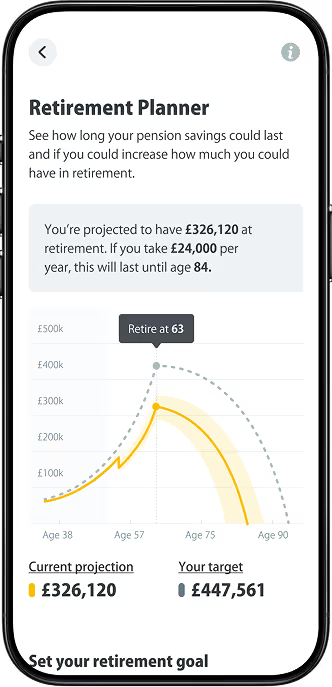
Recent articles

Put your pension
in the palm of
your hand

Combine your old pension pots into one new online plan. It takes just a few minutes to sign up.

Be pension confident!

Be pension confident!

Combine your old pension pots into one new online plan. It takes just a few minutes to sign up.
Combine your old pensions into one simple plan
Invest with one of the world’s largest money managers
Make paper-free online withdrawals from the age of 55
Pay just one simple annual fee
  • Sign up in minutes
  • Transfer your old pensions into one new online plan
  • Invest with one of the world’s largest money managers
  • Pay just one simple annual fee
Capital at risk
Button with Google Play logo and text 'Get it on Google Play' on a black background.