



State Pension forecast
A State Pension forecast can tell you what you’re projected to receive from the government when you reach State Pension age (66, rising to 67 by 2028).
You need 35 qualifying years on your National Insurance (NI) record to receive the full new State Pension. To get any State Pension at all, you need at least 10 years on your record.
In _current_tax_year_yyyy_yy, the full new State Pension pays _state_pension_weekly a week (_state_pension_annually a year).
To get a clearer picture of what you might receive, it’s worth getting a State Pension forecast from HMRC.
In this guide, find out how to check your State Pension forecast - also known as a State Pension projection - and why it could be useful.
How to check your State Pension forecast
There are three main ways to check your State Pension forecast:
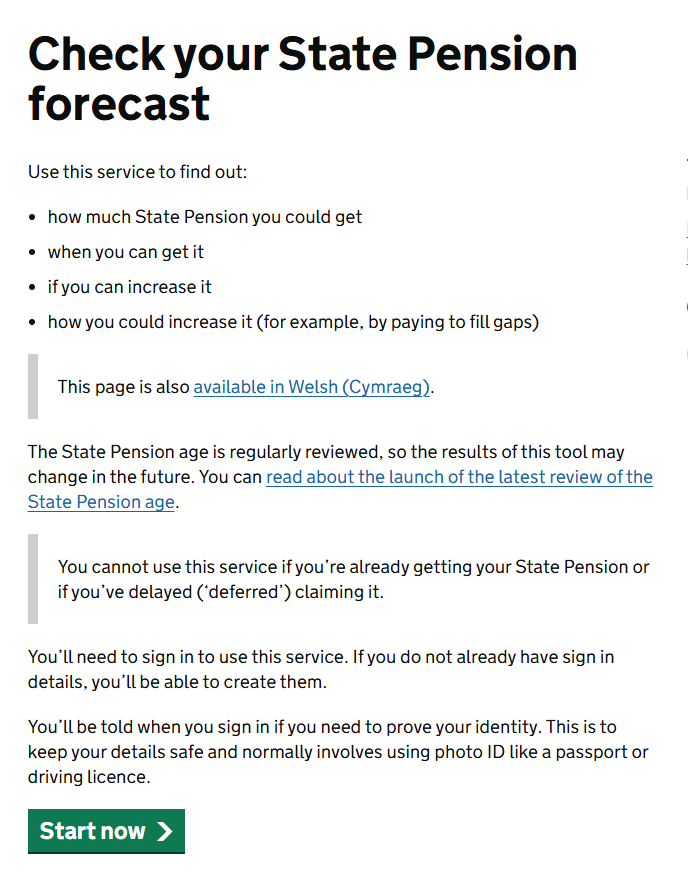
The easiest way to check your State Pension forecast is online at GOV.UK. You can also use the HMRC app.
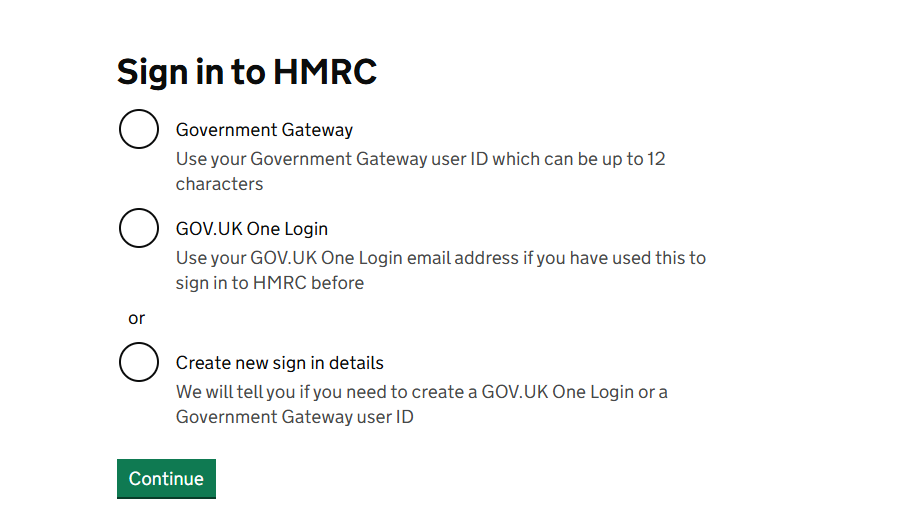
Click ‘Start now’ and sign in. You can use Government Gateway, a 12-character user ID. Or you can use GOV.UK’s One Login, which is attached to your email address - you may have one of these if you’ve signed in to HMRC before, such as for Self-Assessment.
If you don’t have either of these, you’ll need to create new sign-in details. For this, you’ll usually need photo ID, such as a passport or driving licence.
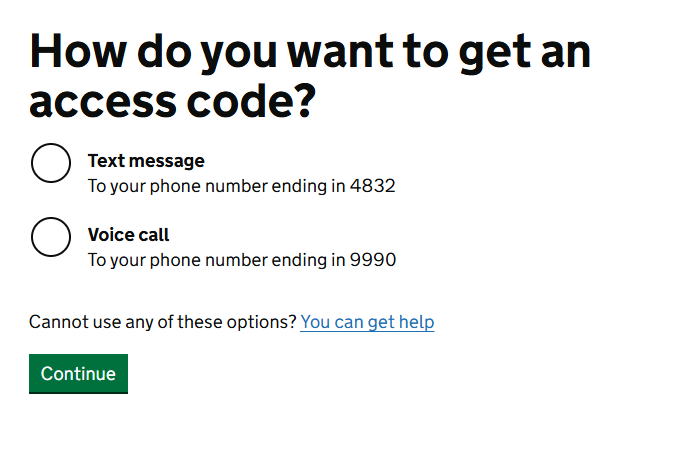
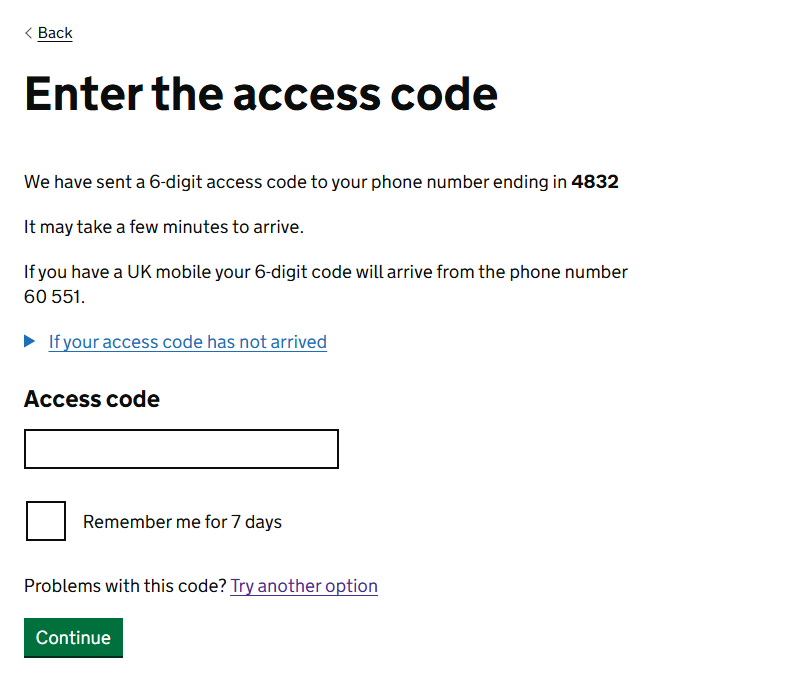
When you log in, you’ll need to complete two-factor authentication (2FA) using your phone. You can choose between receiving a text or phone call to confirm your identity.
How do I get a State Pension forecast by post?
You can get a postal forecast if you’re at least 30 days away from State Pension age (66 in 2026/27, rising to 67 by 2028).
Download and complete a BR19 form and send it by post. You can also contact the Future Pension Centre and ask for a printed copy of the form, or a different format such as large print, braille, or audio CD.
How do I get a State Pension forecast by phone?
Ask the Future Pension Centre for a forecast by phone. There are different numbers depending on whether you’re based in or outside the UK.
There are also accessibility options including Welsh language and British Sign Language services.
What does your State Pension forecast show?
Once you’ve requested your forecast, you can see:
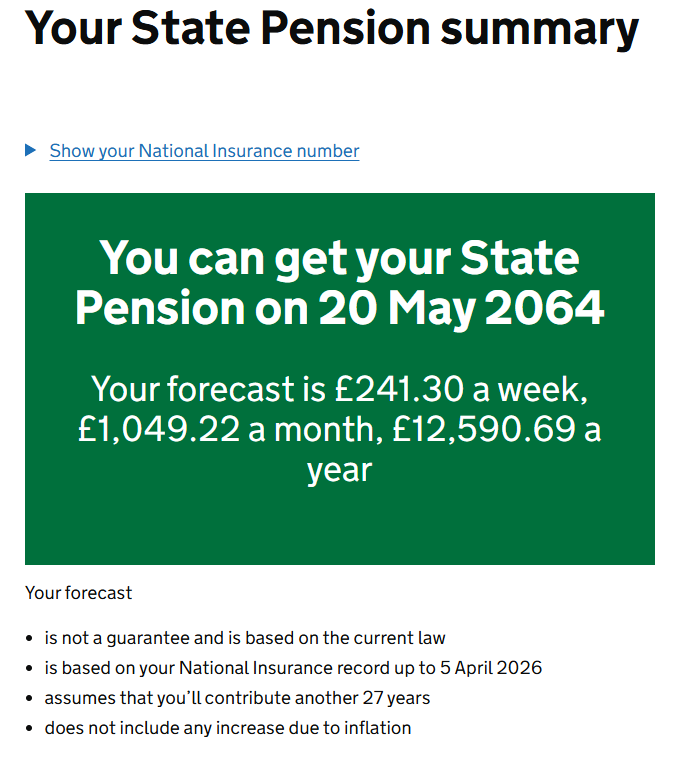
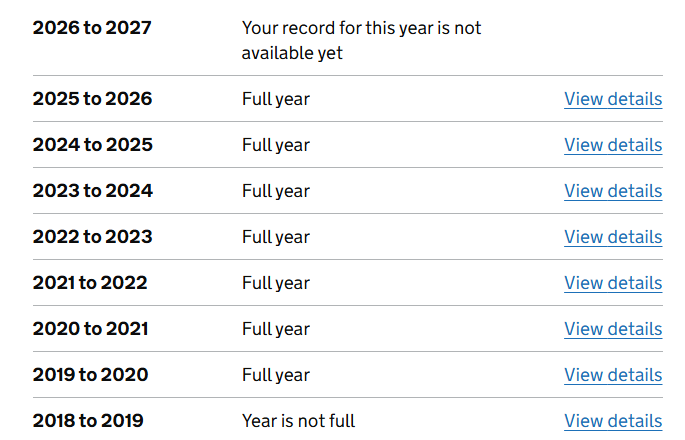
Note that any information is shown in today’s money and at today’s rate. The State Pension could increase in future.
How much is the full State Pension in _current_tax_year_yyyy_yy?
In _current_tax_year_yyyy_yy, the full new State Pension pays _state_pension_weekly a week (_state_pension_annually a year).
If you reached State Pension age before 6 April 2016, you’ll receive the basic State Pension. In _current_tax_year_yyyy_yy, this pays _basic_state_pension_weekly a week (_basic_state_pension_annually a year).
The State Pension currently rises each year under the triple lock. This sees it increase by the highest of:
How many qualifying years do you need for a full State Pension?
You need 35 qualifying years on your NI record to receive the full State Pension. You need at least 10 years to receive any State Pension at all. If you have between 10 and 35 years, you get a proportion of the full amount.
Qualifying years are mostly made up of NI contributions (NICs) from working. These are usually taken directly from your earnings if you’re employed. If you’re self-employed, you’ll have to make contributions yourself.
But you can also get them for other reasons, such as while claiming certain benefits or caring for children under 12.
It may be worth going back and checking whether you received credits you were entitled to for these reasons. It could allow you to plug gaps in your record for free.
When will I get my State Pension?
In 2026/27, the State Pension age is 66, rising to 67 by 2028. Whether you’re affected by the increase will depend on your date of birth, as shown in the table below.
A further rise to 68 is scheduled for 2044 to 2046, and the age could continue changing in future.
You’ll be able to see your State Pension age on your forecast. Or use PensionBee’s State Pension Age Calculator to check yours.
How accurate is my State Pension forecast?
A State Pension forecast is an accurate snapshot of what you’ll receive at the time of checking. However, it’s not a guarantee.
Two key things can change ahead of you claiming the State Pension.
- Your National Insurance record - you could fill gaps that increase your entitlement. On the other hand, you might have a period when you’re out of work or have earnings below the minimum threshold and don’t contribute. This could slow your progress towards having 35 qualifying years.
- The rules and State Pension age - the government could announce another increase to the State Pension age. It might also change the entitlement rules. For example, in future, you might need more qualifying years on your NI record, or there could be changes to how this is calculated.
The forecast also doesn’t account for inflation. So, what you see reflects prices now, rather than what they might be in future. That can make it harder to assess State Pension income’s spending power.
As a result, it can be sensible to check your forecast more frequently as you approach retirement.
Why is my State Pension forecast lower than the full amount?
The most common reason your forecast may be lower than the full amount is having gaps in your NI record. That might be the case if you:
- weren’t working;
- worked but earned below the threshold to pay NI;
- were self-employed with small profits;
- were living abroad; or
- weren’t working while you were caring for children, and didn’t claim the available credits to top up your record.
The other factor is if your forecast includes the Contracted Out Pension Equivalent (COPE).
This is a deduction for people who contracted out of the Additional State Pension before April 2016. That meant you paid lower NICs or some of your contributions went to your private or workplace pension.
This can lead some people who worked long careers to have less than the full amount.
You may be able to build back up to the full State Pension amount.
What if there's a shortfall in my State Pension forecast?
If your forecast reveals that you’re not currently on track to receive the full State Pension, there are a few things you could do.
Claim any National Insurance credits you’re owed
You may have been entitled to credits if you received certain benefits or cared for children, but you might not have claimed them.
It’s worth checking this first as credits are free, allowing you to close the gap at no cost.
Keep paying National Insurance
You might have a few years before your State Pension age and be happy to keep working. In that case, you could simply keep contributing towards your NI record from earnings.
You can check your forecast and see how many years short you are. Then, you’d have an idea of how much longer you’ll need to work to close the gap.
Make voluntary National Insurance contributions
You can usually make voluntary contributions for the past six tax years. This can allow you to plug recent gaps in your record.
Paying voluntary contributions isn’t necessarily the right choice for everyone. If you’re still a long way from your State Pension age and have time to complete your record, it may be better to contribute from your earnings until you retire.
It can also be worth targeting any partial years you have, where you started contributing but didn’t make enough payments for a full year. That could be cheaper to top up than buying a full year elsewhere. You’ll be able to see these years on your State Pension forecast.
Build up your personal pension
State Pension income is useful. But it’s not necessarily enough for a full retirement income, according to the Retirement Living Standards. In fact, the full new State Pension falls short of the estimate for what a single person needs per year for a minimum standard of living in later life.
That’s where topping up a personal, private, or workplace pension can be useful. You can benefit from tax relief on eligible contributions - that sees you get a tax top up on eligible contributions, effectively adding tax you’ve paid or would’ve paid into your pot. Your money will be invested to potentially grow it over time, too.
What about private pension forecasts?
With personal, workplace, or private pensions, there’s no set amount that they’ll pay you in retirement. Rather, it’s based on:
- what you (and your employer) pay in;
- what you receive in tax relief; and
- any investment returns generated.
So, there’s no definitive forecast like with the State Pension.
To see what you might have, you could use tools like PensionBee’s Pension Calculator.
Move the sliders so they reflect your age, current savings, contributions, and desired annual retirement income and age.
The Pension Calculator will then show you how much you could have by the time you retire. Plus, you can see how adjusting your contributions now could impact your pot’s size.
You can also choose whether to include the full new State Pension. So, you can see how much you’ll have in retirement between your own savings and the State Pension.
Risk warning
As with all investments, your capital is at risk. The value of your investments can go down as well as up, and you may get back less than you invest. Tax rules can change and the benefits depend on your individual circumstances. This information should not be regarded as financial advice.
Last edited: 05-10-2026