











Whether you’re dreaming of travelling the world and riding off into the sunset, or are looking forward to embracing the simple life closer to home, you’ll need to ensure you’ve got enough money saved into your pension to support yourself when you retire.
How long your pension lasts will depend on a range of factors, from your desired income to how much you’ve got saved and your life expectancy. Here’s what you’ll need to consider when doing your calculations.
Your desired retirement income
How much you need for a comfortable retirement depends on you. It comes down to your circumstances and the lifestyle you want.
Think about a drop from £50,000 a year to £12,000. That's a big change. It could feel especially hard if you're not planning to spend much less.
Pensions UK, working alongside Loughborough University, publishes Retirement Living Standards each year. These show what annual income you'd need for a minimum, moderate, or comfortable lifestyle in retirement.
It recently published its latest findings for the 2026/27 tax year. The table below shows you what income you’d need for these standards of living, depending on whether you’re a one or two-person household.
These lifestyles can look quite different in practice.
A minimum lifestyle covers the basics. It doesn't include a car, and you'd only get one week-long UK holiday a year.
A moderate lifestyle gives you more room. You'd have more to spend on food, transport, and your home, plus a two-week, three-star holiday in Europe.
A comfortable lifestyle adds financial freedom and a few extras. Think of a more luxurious hotel stay, or being able to help loved ones financially.
Keep in mind that in 2026/27, the full new State Pension pays £241.30 a week - that’s £12,547 a year. That isn’t enough to fund a minimum lifestyle for a single person.
So, not saving for retirement could leave you with a shortfall. That’s a situation that’s facing millions of people, according to Pensions UK.
How much you’ve already saved into your pension
To make sure you're on track, it helps to get a clear picture of your current pension balances and your expected retirement income.
Depending on the type of pension you have, you can check your balance by looking at your annual pension statement. Or by logging into your online pension account, if you’re a PensionBee customer. That way, you'll be able to see how much your pension is worth today and what it's expected to pay you at retirement.
If your savings are spread across several old pension pots, it may be worth bringing them together into one plan. Combining your pensions gives you a single account to manage, with a clearer view of your balance and investments.
It can also help you bring together pensions from previous employers that you've lost track of. You can learn more about finding old pensions in our blog.
Your life expectancy
Planning for retirement isn't just about how much you've saved. It's also about how long that money needs to last.
The Office for National Statistics (ONS) keeps track of this. Between 2022 and 2024, a 65-year-old in the UK could expect to live another 18 to 21 years, on average. That's roughly 18 more years for men and 21 more years for women, which puts average life expectancy in the mid-to-late 80s. And plenty of people live well beyond that.
Right now, you can access personal and workplace pensions from age 55. That's rising to 57 in April 2028. The State Pension age is also on the move, climbing from 66 to 67 by April 2028.
So if you retire at 57, your pension could need to stretch across 27 to 29 years, maybe longer. And for around the first nine years, you'll be doing it without the State Pension to help top things up.
That's a long stretch to cover on savings alone. It's why starting early, even with small amounts, tends to beat playing catch-up later on.
{{main-cta}}
Putting a pension saving plan in place
To avoid a shortfall later in life, you'll need to make sure you're saving enough for the retirement you want.
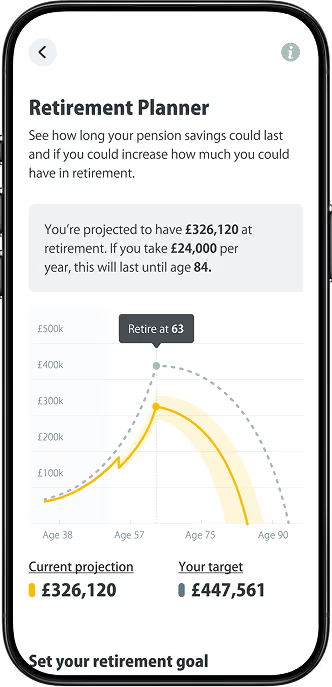
PensionBee’s Pension Calculator makes that extra easy. Just tell us how much you've saved and what you're contributing now. We'll give you an estimate of how your pension could grow and whether you may need to increase your contributions to reach your retirement goals.
Just tell us how much you've saved and what you're contributing now, and we'll give you an estimate of whether you're on track. It can also help you decide how much to pay in, by showing what increasing your contributions might mean for that estimate.
By opening a PensionBee pension you can take that first step today. Combine old pensions into one, pick a pension plan that suits you, and contribute easily online. Once you've signed up, you can manage your pension from the palm of your hand.
Find out more about PensionBee and see our range of pension plans.
Risk warning
As always with investments, with a pension your capital is at risk. The value of your investment can go down as well as up, and you may get back less than you invest. This information should not be regarded as financial advice.
Period | Market Event | FTSE World TR GBP (%) | 4Plus Plan (%) |
|---|---|---|---|
4Plus Plan’s inception – 6 Sept 2013 | QE Tapering, China Interbank Crisis and its aftermath | -5.44 | -2.41 |
3 Oct 2014 – 15 May 2015 | Oil price drop, Eurozone deflation fears & Greek election outcome | -5.87 | -1.77 |
7 Jan 2016 – 14 Mar 2016 | China’s currency policy turmoil, collapse in oil prices and weak US activity | -7.26 | -1.54 |
15 June 2016 – 30 June 2016 | BREXIT referendum | -2.05 | -1.07 |












%201.png)