


This is part of our monthly series. Catch up on last month’s summary here: What happened to global investment markets in July 2025?
Inflation and interest rates are important signs of how the economy is doing. In July, inflation rose a little; yet in August, interest rates were actually lowered. Let’s look at what this means for you and the wider economy.
‘Inflation‘ is the rise in the cost of goods and services over time. For example, if a coffee costs £3 and increases to £3.15 after one year, the annual inflation rate for that coffee is 5%. On the other hand, ‘deflation’ is when prices decrease.
The Office for National Statistics (ONS) tracks the prices of hundreds of everyday items to measure inflation over the previous 12 months. The main measure is the Consumer Prices Index (CPI). In July, the CPI showed an inflation rate of 3.8% - meaning £100 of goods and services last year would now cost around £103.80. In the UK, the economy is slowly recovering from high inflation that peaked at 11.1% in October 2022 - the highest rate for 40 years.
This brings us to ‘interest rates‘. Interest rates are typically calculated annually, but can also be paid monthly or quarterly. For example, if you have _basic_rate_personal_savings_allowance in a savings account with a fixed 2% annual interest rate, you’d earn £20 at the end of the year.
The UK’s central bank, the Bank of England, has a 2% target for inflation. When inflation is too high, it can raise the base rate - which most commercial interest rates are tied to. Higher interest rates can make borrowing more expensive (such as taking out a mortgage) and saving more rewarding (like the returns on Premium Bonds). The idea is that higher interest rates discourage spending that in turn raises inflation levels. In August, the Bank of England reduced the Bank Rate from 4._corporation_tax to 4%.
Keep reading to find out what’s the role of central banks and how interest rates impact the economy.
What happened to stock markets?
In the UK, the FTSE 250 Index fell by almost 2% in August. This brings the 2025 performance close to +5%.
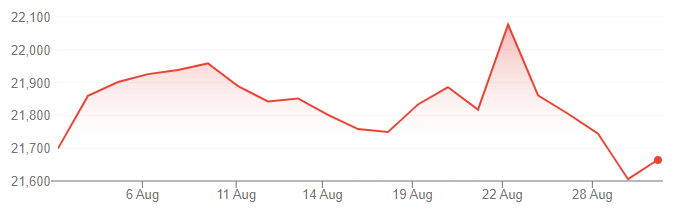
Source: Google Market Data
In Europe (excluding the UK), the EuroStoxx 50 Index rose by almost 1% in August. This brings the 2025 performance close to +9%.
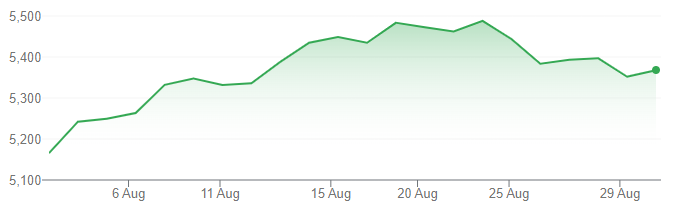
Source: Google Market Data
In North America, the S&P 500 Index rose by almost 2% in August. This brings the 2025 performance close to +1_personal_allowance_rate.
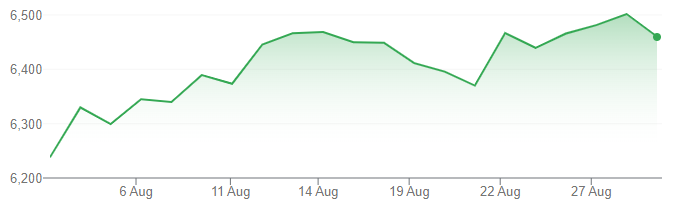
Source: Google Market Data
In Japan, the Nikkei 225 Index rose by 4% in August. This brings the 2025 performance close to +7%.

Source: Google Market Data
In the Asia Pacific (excluding Japan), the Hang Seng Index rose by over 1% in August. This brings the 2025 performance close to +_corporation_tax

Source: Google Market Data
What’s the role of central banks?
A central bank’s a government institution that manages a country’s:
- currency;
- money supply; and
- interest rates.
Since the post-pandemic supply chain shocks and escalation of Russia’s invasion of Ukraine, most of the world’s been living in a high inflation, high interest rate environment. Slowly, inflation has been stabilising. In response, many central banks have been making several interest rate cuts in the past 12 months.
The US central bank - the Federal Reserve
All eyes remain firmly fixed on the Federal Reserve, the central bank in the US. The Federal Reserve has held interest rates at 4._corporation_tax - 4.5_personal_allowance_rate since December 2024. The next interest rate decision is scheduled for 17 September, where it’s widely predicted that interest rates will be cut.
One reason investors are keeping a close eye on US interest rates is ongoing friction between President Donald Trump and Chair of the Federal Reserve, Jerome Powell. President Trump has repeatedly argued that the Federal Reserve should be more aggressive in cutting interest rates to boost growth.
On the other hand, the Federal Reserve has been cautious about acting too quickly, in an attempt to achieve a ‘soft landing’ for the US economy. There’s a possibility that tariffs may increase the cost of goods for US consumers and drive up inflation. This would make a case for maintaining interest rates to contain rising inflation.
How do US interest rates impact global investment markets?
When US rates go up, investing in US bonds looks more attractive because they pay better returns (although older bonds look less attractive now that better interest rates are available on new bonds). As a result, some investors might sell their company shares (also known as equities or stocks) or old bonds to buy new bonds. When rates go down, borrowing money gets cheaper. This can boost the value of company shares, as people go out and spend more in the economy.
What does this mean for you and your money? Well, most pensions are diversified across a range of locations and asset types. This means your retirement savings could be invested in company shares, bonds, cash, property and other assets in the region, depending on the plan you’ve chosen. Many UK pensions invest heavily in US companies because they’re some of the biggest - and in recent years most profitable - companies in the world.
Understanding global economic trends like these can help you better grasp how your investments and pension might perform over time, giving you greater confidence in your financial future.
Have a question? Get in touch!
Do you want to know more about your pension plan with PensionBee? You can check out our Plans page to learn how your money is invested in different assets and locations, or log in to your BeeHive to see your specific plan. You can always send comments and questions to our team via engagement@pensionbee.com.
Risk warning
As always with investments, your capital is at risk. The value of your investment can go down as well as up, and you may get back less than you invest. This information should not be regarded as financial advice.
Period | Market Event | FTSE World TR GBP (%) | 4Plus Plan (%) |
|---|---|---|---|
4Plus Plan’s inception – 6 Sept 2013 | QE Tapering, China Interbank Crisis and its aftermath | -5.44 | -2.41 |
3 Oct 2014 – 15 May 2015 | Oil price drop, Eurozone deflation fears & Greek election outcome | -5.87 | -1.77 |
7 Jan 2016 – 14 Mar 2016 | China’s currency policy turmoil, collapse in oil prices and weak US activity | -7.26 | -1.54 |
15 June 2016 – 30 June 2016 | BREXIT referendum | -2.05 | -1.07 |