The Buzz.
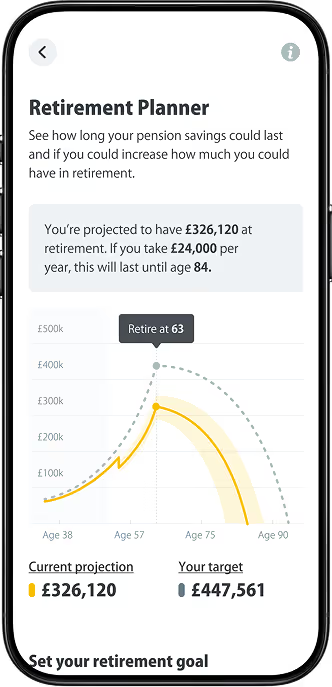
Read the latest pension news and retirement planning tips, from our team of personal finance journalists, investment professionals and money bloggers.

When is the best time to take your pension?
Timing is everything, especially with pensions. But with so many retirement choices and other considerations, figuring out the best time to begin withdrawing from your pension can be tricky.

This blog was updated on 10 June 2025.

Deciding when to take your pension is a big choice as you approach retirement. Timing is everything. It can shape your financial security and affect your daily life throughout retirement. With various types of pensions out there and plenty of factors to think about, it’s easy to feel lost. But don’t worry, we’ll guide you through your options so you can figure out the best time to access your pension.

You can typically tap into your personal or workplace pension when you reach your normal minimum pension age (NMPA). Right now, that’s 55 years old, but it’ll soon rise to 57 years old from 2028. Just remember, having access doesn’t mean you have to start using it immediately. Also, be aware that the State Pension age (currently _state_pension_age) is increasing to _pension_age_from_2028 years old by 2028.

How does retirement age impact your pension income?

The age at which you choose to retire can have a significant impact on your pension income. You essentially have two paths:

  • you can either start claiming a smaller pension sooner; or
  • wait a bit longer to receive a larger pension later on.

If you choose to retire early, you might find that your pension is smaller. This could make it harder to enjoy a comfortable lifestyle as you age. If financial difficulties arise, you may even need to go back to work, which can be challenging due to age bias.

On the flip side, if you decide to delay your retirement, you’ll be working for longer. This could impact your health and prevent you from chasing personal goals. You might miss out on important time with family or hobbies that you love.

Your retirement options explained

Let’s look at the example of Sophie, who’s 50 years old and isn’t sure when to retire. She has consolidated her old workplace pensions and now has a single retirement pot of £250,000.

The following is based on assumptions from our Pension Calculator that she:

Keep in mind that investment growth is influenced by market fluctuations. While the assumptions in this example provide a useful framework, actual returns can vary due to factors such as elections and interest rates.

While working, Sophie and her employer contribute £250 each month to her workplace pension through Auto-Enrolment. Additionally, she makes personal contributions of £200 monthly, benefiting from an extra £50 in tax relief.

Let’s explore some scenarios Sophie could consider to determine the best time to take her pension.

{{main-cta}}

Retiring at 57 years old

Sophie decides to retire at her normal minimum pension age (NMPA) of 57 years old, which is the earliest she can access her private pension savings. By that time, her pension pot could have grown to £327,000.

This could generate Sophie a pre-tax annual income of around £16,900 (or £1,408 a month) from the beginning of her retirement until she turns 100 years old. This amount includes her full new State Pension entitlement from _pension_age_from_2028 years old.

Retiring at 60 years old

Sophie could choose to work for a further three years, which could increase her pension pot by over £36,000. This decision could allow her to retire at 60 years old with a personal pension of £363,000.

This could generate Sophie a pre-tax annual income of around £19,100 (or £1,592 a month) from the beginning of her retirement until she turns 100 years old. This amount includes her full new State Pension entitlement from _pension_age_from_2028 years old.

Retiring at 64 years old

If Sophie opts to retire at 64 years old, she could enjoy a sizable pension pot worth £413,000. Simply by delaying her retirement date by seven years, she could grow her pension savings by an impressive £86,000.

This could generate Sophie a pre-tax annual income of around £22,900 (or £1,908 a month) from the beginning of her retirement until she turns 100 years old. This amount includes her full new State Pension entitlement from _pension_age_from_2028 years old.

Retiring at _pension_age_from_2028 years old

Sophie could consider delaying withdrawing from her personal pension until she reaches her State Pension age at _pension_age_from_2028 years old. By doing so, she could grow her pension pot by a staggering _lower_earnings_limit,000 - resulting in a pension pot of £452,000.

This could generate Sophie a pre-tax annual income of around £26,800 (or £2,233 a month) from the beginning of her retirement until she turns 100 years old. This amount includes her full new State Pension entitlement.

Planning is key to reaching your retirement goals

As we see in Sophie’s example, the timing of when to take your pension can significantly impact your income in retirement.

When thinking about your dream retirement, consider these important points:

  • Visualise your retirement - picture the age and lifestyle you want. Knowing how much you’ve saved in your pension is essential for figuring out when you can enjoy that dream life. This helps you see how close you are to your savings goals and what you might need to contribute to get there.
  • Consolidate your pensions - if you have several old pension pots, think about bringing them together into one easy-to-manage plan. This way, you can clearly see your total pension balance and keep track of how your investments are doing.
  • Boost your savings - consider setting up a regular contribution into your personal pension. When you make personal contributions, most basic rate taxpayers receive a _corporation_tax tax top up. This means that for every £100 you put into your pension, HMRC adds an extra £25, making it _lower_earnings_limit.

By planning ahead and understanding your options, you can set yourself on the path to achieving your retirement goals.

Summary

It’s important to remember that everyone’s situation is unique. Retirement isn’t just about numbers - it’s about creating the lifestyle you want while ensuring your pension can support you for the years ahead. If you’re unsure about your next steps, you can find a regulated Independent Financial Adviser through Unbiased.

Additionally, if you’re still feeling uncertain about your retirement plans, consider booking a free appointment with Pension Wise, a government-backed service from MoneyHelper, once you turn 50. This service is designed to help you understand your options as you approach retirement.

The best part? The appointment is completely free and impartial, giving you the chance to ask any questions you may have without any pressure. If you’re aged under 50, the MoneyHelper website provides a wealth of useful information related to pensions and broader financial matters.

Risk warning

As always with investments, your capital is at risk. The value of your investment can go down as well as up, and you may get back less than you invest. This information should not be regarded as financial advice.

What happened to pensions in February 2025?
How did the stock market perform in February 2025 and how does that impact your pension plan? Find out all this and more.

This is part of our monthly pension update series. Catch up on last month’s summary here: What happened to pensions in January 2025?

US President Donald Trump has wasted no time in making headlines since he returned to the White House on 20 January. After lifting the TikTok ban earlier this year, he turned his focus to trade, threatening substantial new tariffs on imports from Mexico, Canada, and China.

These tariffs include a _corporation_tax levy on goods from Mexico and Canada, and an additional 1_personal_allowance_rate on Chinese imports. Trump explained that these measures are part of his broader strategy to address illegal immigration and drug trafficking.

Keep reading to find out how these tariff talks unfolded and what they mean for your pension savings.

What happened to stock markets?

In the UK, the FTSE 250 Index fell by 3% in February. This brings the 2025 performance close to -1%.

FTSE 250 Index

Source: Google Market Data

In Europe (excluding the UK), the EuroStoxx 50 Index rose by over 3% in February. This brings the 2025 performance close to +12%.

EuroStoxx 50 Index

Source: Google Market Data

In North America, the S&P 500 Index fell by over 1% in February. This brings the 2025 performance close to +1%.

S&P 500 Index

Source: Google Market Data

In Japan, the Nikkei 225 Index fell by over 6% in February. This brings the 2025 performance close to -7%.

Nikkei 225 Index

Source: Google Market Data

In the Asia Pacific (excluding Japan), the Hang Seng Index rose by over 13% in February. This brings the 2025 performance close to +14%.

Hang Seng Index

Source: Google Market Data

Trump and tariffs

President Trump’s new tariffs are already having a significant impact on global markets, creating both challenges and opportunities for pension savers.

For US companies that rely on imports from Mexico, Canada, and China, these tariffs mean higher costs. This could lead to reduced profits and higher prices for consumers. This is raising concerns about the competitiveness of US businesses, particularly in manufacturing, retail and technology. Unsurprisingly, this has caused turbulence in the US stock market, with the S&P 500 Index falling in February.

The domino effect of these tariffs aren’t limited to the US. In China, companies have responded positively, with the Hang Seng Index rising sharply as investors appear confident in their ability to adjust to the new trade environment. This demonstrates how interconnected global markets are - policies introduced in one country can create risks for some, while opening up opportunities elsewhere.

For many years, the US has been the frontrunner in global stock markets, leaving other developed markets battling for second place. But 2025 may flip the script. In an unexpected twist, China and Europe have sprinted to the front, leaving the US trailing in third place. Yet, the race is far from over - being in the lead early on doesn’t guarantee who will come out on top by year’s end.

How US politics is affecting UK pensions

For pension savers, it’s important to know where your money is invested. Although most pensions are diversified across a range of countries and industries, a large share is often tied to US companies due to the country’s dominance in the global economy. As a result, recent US market volatility caused by President Trump’s tariffs may have a short-term impact on your pension’s value.

Your pension likely includes investments in regions like Europe and Asia, where markets such as the EuroStoxx 50 and Hang Seng have recently performed well, helping to offset US market volatility. While the long-term effects of the tariffs remain uncertain, it’s important to stay calm. Pensions are built for the long term and have historically balanced out after experiencing short-term market swings.

This is part of our monthly pension update series. Check out the next month’s summary here: What happened to pensions in March 2025?

Have a question? Get in touch!

Do you want to know more about your pension plan with PensionBee? You can check out our Plans page to learn how your money is invested in different assets and locations, or log in to your BeeHive to see your specific plan. You can always send comments and questions to our team via engagement@pensionbee.com.

Risk warning

As always with investments, your capital is at risk. The value of your investment can go down as well as up, and you may get back less than you invest. This information should not be regarded as financial advice.

Product spotlight - Inflation Calculator
This month we spotlight our Inflation Calculator. Over time inflation reduces the purchasing power of your pension so our Inflation Calculator could give you a better idea of how far your pension could go in retirement.

Just like the price of everyday goods, the value of your pension’s also impacted by inflation. So, whilst it’s important to grow your pension to help support you in retirement, it’s also important to know just how far your savings will go once you get there. Our Inflation Calculator helps you see how your pension could be impacted.

What is inflation?

Inflation refers to the rate at which the price of everyday goods like food and fuel increases over time. It’s important to consider because it affects the purchasing power of your money. So, an amount of money you spend in the future won’t be able to afford as much as it can today. For example, if you buy a pint of milk for £1 today and inflation jumps to 10%, next year the same pint will cost you £1.10. If the rate of inflation sticks at 10%, it’ll cost you £1.21 the year after.

When it comes to your pension, as you’re dealing with a much larger sum of money, the effect of inflation’s more noticeable. For example, imagine your pension’s worth £50,000 today. To keep up with inflation and maintain the same purchasing power in 10 years, with an assumed inflation rate of 2.5% per year, you’d need to have £64,004.23 in your pot. Over those 10 years, you’d need to either contribute or have an investment growth of £14,004.23 to have the same purchasing power as today.

Knowing how inflation could impact the value of your pension at retirement will help you see if you need to make adjustments - like increasing your contributions - which could help your pension outpace inflation. That’s where our Inflation Calculator could help you.

How to use the Inflation Calculator

You’ll only need a few basic pieces of information including:

  • the current value of your pension pot;
  • your age now and the age you intend to retire; and
  • the rate of inflation you want to see the impact of.

You can optionally add the total value of your current annual contributions.

If you need to know the current rate of inflation, you can always find it on our How does inflation affect pensions? blog under the heading ‘How inflation affects the value of goods over time’. We update this every month in line with the latest monthly figure given by the Office for National Statistics (ONS).

{{main-cta}}

How the Inflation Calculator works

Once you’ve entered your details you’ll see the graph to the right update automatically with several helpful bits of information.

Projected pension pot value

You’ll see how much your pension could be worth by your retirement age in the green box. This is made up of the total value of your pensions, an assumed rate of 5% growth from your pension’s investment and any annual contributions you make.

Inflation Calculator image 1

Pension value in today’s money

Importantly, the calculator will show how much your pension will be worth by your retirement age in today’s money. For example, you’re aged 30 (in 2025) with a retirement age of 68. If you have a pension pot of £50,000 with 5% investment growth and no annual contributions then your pension pot will have £247,613 in 2063. However, with an assumed inflation rate of £2.5% then it’ll only have the purchasing power of £98,489 in today’s money.

Side-by-side: your pension’s value and its purchasing power

Move up and down the graph to see the value of your pension and its equivalent purchasing power in today’s money over various points in time between now and your retirement age.

Inflatio Calculator image 2

Underneath the graph, there are a few examples of everyday goods like a litre of petrol and a pint of milk. By adjusting your retirement age and the inflation scale, you can see how much these could be worth by the time you retire.

Inflation Calculator image 3

How the Inflation Calculator can help you

Tools like our Pension Calculator will show you how much your pension could be worth by the time you retire. But it’s important to know what that may be able to afford you in retirement. The Inflation Calculator provides a better understanding of your pension’s purchasing power at retirement. This can help you make adjustments to things like your pension contributions to make up for any impact inflation will have. The calculator will tell you how much extra your pension will need to make up the difference.

How much will you need in retirement?

The answer will be different for everyone. It all depends on the kind of lifestyle you might hope to live in retirement. Things like travelling more or moving house may all factor into your decision. You may even have to consider the cost of looking after a loved one. The Pensions and Lifetime Savings Association’s (PLSA) Retirement Living Standards provide a helpful guide to how much your retirement might cost at three different levels; minimum, moderate and comfortable. Our retirement hub provides lots of resources to help you prepare for life in retirement.

Future product news

Keep your eye out for our next product blog or catch up on previous posts. We’re looking forward to spotlighting more of our handy features and free financial tools plus we’ve got lots of great new updates in the works we’re looking forward to bringing you. Once released, we’ll let you know what they are and how they can help you save for a happy retirement.

Risk warning

As always with investments, your capital is at risk. The value of your investment can go down as well as up, and you may get back less than you invest. This information should not be regarded as financial advice.

Why the Magnificent Seven matters for pension savers
Find out how seven leading US companies, known as the Magnificent Seven, are influencing the global stock market - and your pension.

The term ‘Magnificent Seven‘ refers to a group of seven leading technology companies in the US, recognised for their innovation and strong performance. Coined by Bank of America in 2023, the name draws inspiration from the heroic characters of the classic 1960s Western action film of the same name. These companies have played a significant role in driving market growth in recent history.

Collectively, the Magnificent Seven holds massive influence over major US stock markets - including the Nasdaq Composite Index and the S&P 500 Index. By the end of 2024, their combined ‘market capitalisation’ (which is the number of company shares issued multiplied by the current share price) stood at an impressive $17.6 trillion.

These companies are at the forefront of revolutionising a range of technologies including:

The advancements in these sectors extend their impact far beyond technology, affecting numerous other market areas as well. As such, the Magnificent Seven are some of the most widely discussed company shares (or stocks).

Meet the Magnificent Seven

The Magnificent Seven comprises of the following companies:

Alphabet is Google’s parent company. It’s a major player in online advertising and search engines. In recent years it has branched out into cloud computing and AI.

Amazon started as an online bookstore but has changed the way we shop. Its cloud service, Amazon Web Services (AWS), now holds over a third of the cloud market.

Apple is the biggest company in the world. It leads in consumer electronics with products like iPhones and Macs. Apple’s also working on AI tools which can help with writing, editing and creating images.

Meta owns popular social media platforms like Facebook, Instagram and WhatsApp. The company invests a lot in virtual reality through its Meta Quest headsets and focuses on developing the ‘metaverse’ - a new way for people to interact online.

Microsoft remains a leader in software and cloud services. It’s also making strides in AI with projects like OpenAI and CoPilot, which assist users in various tasks.

NVIDIA creates graphics processing units (GPUs) and software tools for developers. It also produces chips for AI, mobile devices, plus the automotive industry.

Tesla is the top company for electric vehicles (EVs). It’s expanding into energy storage and solar technology.

The importance of the Magnificent Seven for investors

Each company leads its field and develops solutions that could have significant implications across industries like healthcare, education, and finance. For example, NVIDIA’s GPUs might power the AI revolution in the automotive and medical sectors.

With their substantial ‘market caps’ (short for market capitalisations) and extensive reach, they have the power to influence the broader stock market. These companies could offer investors an element of confidence given their dominance in the market.

Despite their massive size, these companies still possess a huge growth potential as they continue to innovate and expand into new markets. NVIDIA is advancing in AI, while Tesla persists in its commitment to EVs and clean energy.

The Magnificent Seven and UK pensions

Most pension funds are diversified across various locations and asset types. This means your retirement savings may be invested in a mix of company shares, bonds, cash, and property - depending on your chosen plan.

This strategy, known as diversification, helps reduce risk. By investing in various areas, if one company or industry performs poorly, it won’t have a major impact on your overall savings.

The main goal of pension investing is to achieve positive returns over the long term so that savers can look forward to a comfortable retirement. This is why many UK pensions invest heavily in US companies, particularly the Magnificent Seven.

How the Magnificent Seven is performing in 2025 (so far)

While the Magnificent Seven continues to dominate US stock markets, they face several challenges that could impact their performance. The competition within the AI and technology sectors is intensifying. Here are three hurdles the Magnificent Seven are facing:

1. Changing valuations

In January 2025, a new China-based generative AI chatbot called DeepSeek emerged, posing a significant challenge to established competitors like ChatGPT. DeepSeek offers similar capabilities at a much lower cost. Its AI model, known as R1, was developed in just two months for under $6 million. Whereas OpenAI’s model took considerably longer and cost a staggering $600 million to train.

This potential for more affordable AI solutions triggered a tech sell-off in US markets. Notably, NVIDIA’s share price saw a _ni_rate decline year to date. This situation has raised questions among investors regarding the Magnificent Seven’s high valuations after years of rapid growth. Are we nearing a tech bubble burst?

2. Increased regulation and competition

Governments worldwide are increasing regulations on big tech. This is due to concerns about privacy and market dominance. Additionally, new competitors are emerging in AI, semiconductors, and cloud computing. They aim to challenge established companies and capture market share.

3. The Trump administration’s tariffs

Returning US president Donald Trump’s tariffs could also impact the sector. These tariffs are essentially taxes on imported goods. The Trump administration has already imposed tariffs on goods imported from China, Canada, and Mexico.

The tariffs have already spooked the markets, with the share prices of Apple and Tesla the most affected out of the Magnificent Seven. Apple has a huge manufacturing base in China and now faces _basic_rate tariffs on all the products it creates there.

What steps should pension savers take?

When you’re younger, you can usually take more risks with your pension because there’s plenty of time to ride out multiple cycles of market volatility. Remember, investing is a long-term game where values may go up as well as down. Investing primarily in company shares can help maximise growth through compounding - where your returns generate even more returns over time.

As retirement approaches, usually from around 50 years old, it might be a good idea to think about reducing your risk. This can mean moving some of your investments into safer options like bonds or cash. This process, called de-risking, helps protect your savings from market fluctuations, ensuring they’re ready when you need them.

PensionBee offers two default plans depending on your age:

  • under 50s can save in the Global Leaders Plan, designed for the ‘accumulation’ (or growth) years; and
  • over 50s can save in the 4Plus Plan, designed for the ‘decumulation’ (or withdrawal) years.

If your investments align with your retirement timeline, you can remain steady during market ups and downs. Market downturns can actually benefit your long-term pension savings, as they allow regular investors to buy shares at lower prices. While history suggests that downturns are often followed by growth, past performance doesn’t guarantee future results. Staying focused on your long-term goals will help you navigate the market’s fluctuations with confidence.

Emma Lunn is a multi-award winning Freelance Journalist. She’s written about personal finance for 20 years, with a career spanning several recessions and their consequences. Her work has appeared in The Guardian, The Mirror, The Telegraph and MoneyWeek. Emma enjoys helping people learn to manage their money well, in both the short and long term.

Risk warning

As always with investments, your capital is at risk. The value of your investment can go down as well as up, and you may get back less than you invest. This information should not be regarded as financial advice.

How to teach kids about money
How to teach your kids about money to set them on the right path.

This article was last updated on 06/04/2025

Kids are curious. Most parents will be all too familiar with a steady stream of daily discoveries. While keeping the world magical may seem the right move on some topics (Father Christmas for example), actually an honest approach to money can work wonders for them.

Why is teaching kids about money important?

Knowing where money comes from, how much to save and spend, and some basic maths! Learning to be financially literate early on can create a lasting effect on their future finances. These skills are invaluable to all of us.

Here are some tips to teach your kids about these topics.

Teaching the basics of money

There are three basic principles of day-to-day money management to teach your children: earning, saving, spending. In that specific order. More specifically, learning to live within your means, measuring what you can afford to save, as well as what you can comfortably spend each month.

1. Learning about earning

By teaching them about how work creates income, your children may value hard work more. Telling them that ‘money doesn’t grow on trees’ doesn’t build understanding. But being honest, and showing them how your payslip supports essentials in life like the following, can:

  • council tax;
  • groceries;
  • household bills;
  • insurance; and
  • mortgage, or rent.

Leading by example is an important part of parenting. So why not let your kids watch you pay the bills? Even if they’re only peeking over your shoulder, exposure to healthy habits can rub off on them and help them understand how income and expenses are connected.

Tip: pocket money for chores

Money is earnt (most of the time). You can give your children the toys they want, or you can ask them to work towards them. Take the ‘I’ll pay half, if you pay half’ approach. How can they pay their own way? Through chores of course, and pocket money in return.

2. Saving for happily-ever-afters

Concepts like ‘actions have consequences’ are often interpreted as negative by children. Refreshingly, saving is different. The act of saving money often has very positive consequences for them - through delayed gratification.

Tip: choosing their own goals

To save money effectively it helps to have an objective. Kids are familiar with wishes from fairy tales, so explain that saving money moves them closer to achieving those dreams. Disneyland could be out of reach for an average seven year old, but these ideas aren’t:

  • concert tickets, or music subscriptions;
  • extra accessories for their bedroom;
  • games, or a game console to start with; and
  • toys to play with, or a bike to ride.

See, there are tons of achievable goals your children can reach for themselves. In saving for their own future they’re making a small step towards financial independence.

3. Avoid sloppy spending

After earning and saving a portion, you’re left with the spending money. So the next lesson is moderation. Children can be impulsive and impulse buys are always a slippery slope. Teaching your children to consider purchases carefully could help them buy better. Some good buys for kids are:

  • big books (filled with big words!);
  • colouring in books;
  • durable bags and shoes;
  • games everyone can play together; and
  • kid-friendly technology.

Odds are ‘buy cheap, buy twice’ is hard when kids are constantly growing out of everything. Spending is essential. But weighing up the cost against its lifetime some items are best bought cheaper (clothes) and others can be considered an investment (consoles).

Tip: spending they can see

Kids ought to know their spending history to make connections between how buying affects their bank balance. Products like Starling Kite (a debit card designed for kids) gives parents control limits and visibility, which may teach kids skills like accountability and budgeting.

{{main-cta}}

Different lessons for different ages

From teaching toddlers to teaching teenagers, there are different methods of educating your children about money dependent on their age. And each child is unique. Finding new and fun ways to make money interesting for your child is important.

Counting with children

Young children are tactile. They learn through touch first so showing them coins and other objects to begin making connections with the cost of things. You can create games about the process of buying and selling, like playing shopkeeper, to engage them.

Preparing preteens

Around this age they’re keen on being independent. Helping them understand how money is managed, through a mixture of leading by example and giving them experience. Rewarding them gradually as they take on more responsibility is a great introduction to money.

Teaching teenagers

Money is a topic most teenagers are actually interested in. Allowing them to earn their own money (through pocket money) enables them to try prioritising their spending habits. Whether it’s saving up for big-budget purchases or splashing out on smaller items.

A financial education for life

Children are given a financial education in secondary school in England, and primary school in Northern Ireland, Scotland and Wales. But between schools the level of this learning can vary. Research suggests only four-in-ten children report receiving financial education.

Outside of school you, as their parent, can provide them with information about managing money. Supporting their financial education through showing them what positive habits look like, from saving for their first home to building a million pound pension.

Risk warning

As always with investments, your capital is at risk. The value of your investment can go down as well as up, and you may get back less than you invest. This information should not be regarded as financial advice.

How much income do you need in retirement?
Thinking about how much income you might need in retirement? Here's what to know.

This article was last updated on 06/04/2025

Perhaps, like me, you’re pretty clueless about how much income you’ll actually need, at the point when you finally quit work and skip off into the sunset. According to the Pensions and Lifetime Savings Association (PLSA), 77% of savers don’t know how much they will need in retirement and only 16% of savers can give a figure.

Weighing up income in retirement

The rule of thumb for income in retirement always used to be two thirds of your income while working. This assumes you’ll have cleared your mortgage and can ditch work-related expenses, from commuting costs to a uniform. But I’m freelance, so my income has its ups and downs, making it harder to calculate how much I might need based on my current earnings.

Plus, I find it tricky to grasp how much less I’ll need in future, after (fingers crossed) the kids have left home and university, versus how much more I might want to spend, with time to enjoy hobbies and holidays.

Thanks to Auto-Enrolment, more of us are stashing cash in pensions than ever before. I think pensions are a good thing, as I’m particularly keen to grab the free money on top, in tax relief and any employer contributions, should you qualify. But I’m finding that without knowing how much income I’m aiming for in retirement, it’s tricky to plan how much I need to pay into my pension beforehand.

Check out the Retirement Living Standards

Thankfully, if you want an idea of what life in retirement might cost, you can check out the Retirement Living Standards from the PLSA. These put a price tag on retirement at three different levels - minimum, moderate and comfortable – depending on whether you’re single, or in a couple. You can also see how much more you might need when living in London, rather than elsewhere.

The living standards are described as:

  • minimum, which covers all your needs, with some left over for fun;
  • moderate, which offers more financial security and flexibility; and
  • comfortable, which includes more financial freedom and some luxuries.

Sadly, none are described as ‘Go crazy partying on a yacht’, so maybe I’ll have to pencil in a Lottery win for that. So – drum roll please – according to the Retirement Living Standards, if you’re single and living outside London, you’ll need £13,400 a year at a minimum, £31,700 a year for a moderate lifestyle and £43,900 a year to be comfortable.

Some caveats: the living standards were last updated in 2024. They assume people are living mortgage and rent free, so you’ll need to add on housing costs if you’re still likely to have them. Plus, they ignore care costs, which can be stratospheric in later life.

What’s interesting is looking at the picture painted at each of these income levels, the kind of life you’d lead. Sure, you won’t exactly duplicate the living patterns, and you’re unlikely to have exactly the same income. But it provides a starting point: would I be happy with that? Would I want more than this?

{{main-cta}}

Minimum for basics

At £13,400 a year for one person (£21,600 for a couple), the minimum living standard is set just a tad above the current full new State Pension, which for _current_tax_year_yyyy_yy is _state_pension_weekly a week, or _state_pension_annually a year. I tried living on just the State Pension for a week last year. It wasn’t fun.

As the minimum living standard describes, you’d cover your essential bills but with little left over. You can wave goodbye to a car and eating out more than once a month. Forget foreign holidays – the budget only stretches to one week away in the UK each year. Keen to redecorate now you’re spending more time at home? You’d be reliant on your DIY skills, as there’s no budget to pay someone else to help. This worries me as my own DIY skills are non-existent.

Moderate for more flexibility

Life is looking up for those on the moderate living standard, which promises more financial security and flexibility. The £31,700 a year for one person, or £43,900 for a couple, brings the chance to eat out once a month. A three-year old car, can be replaced every 7 years. It allows a fortnight long 3* all inclusive holiday in the Med and a long weekend break in the UK. The budget for clothing and shoes shoots up, and suddenly you can afford £30 a pop on birthday presents, rather than £20 each at the minimum living standard. You can even afford some help with maintenance and decorating each year. (What a relief)!

Comfortable for some luxuries

Stretch to £43,900 a year for one, or £60,600 for two, and now we’re talking. The luxuries listed at a comfortable living standard include a fortnight long 4* holiday in the Med with spending money and 3 long weekend breaks in the UK. The food budget is £230 a month, the spending on clothes and footwear up to £1,500, and you’re up to a generous £50 each for birthday presents. You can even replace your car every 5 years and your kitchen and bathroom every 10 to 15 years. More importantly, you have enough cash to be more spontaneous, rather than being forced to plan for every penny.

Working out how much to save

Fair to say I’d prefer my retirement to be on the comfortable side, rather than struggling to make ends meet on minimum income. At least now I have a better sense of the chunky sums needed in future, I can work out how much I need to put in my pension right now to get there.

PensionBee has a handy Pension Calculator on its website and app. I can put in my current age, when I’d like to retire, how much I’ve saved so far and how much income I’d like to have, and then play around with how much I need to contribute every month for my pension to last until I hit 100 years of age. You can even choose whether or not to include the State Pension, if you’re suspicious it might not be around by the time you retire.

Luckily I’ve been paying into a pension for a long time (because: old) so have a decent amount stashed away. If I keep up my contributions, I may yet be able to sail off into the sunset on something a bit better than a pedalo.

Faith Archer is a Personal Finance Journalist and Money Blogger at Much More With Less.

Risk warning

As always with investments, your capital is at risk. The value of your investment can go down as well as up, and you may get back less than you invest. This information should not be regarded as financial advice.

Do you know what pension plan you’re in?
If you have a pension, chances are you're invested in a default pension fund. But it's worth checking if that's the best place for your money.

If you have a workplace or personal pension, chances are you’re invested in a default pension fund. But it’s worth checking if that’s the best place for your money, and that the plan fits with your values and retirement goals.

What’s a default pension fund?

Under Auto-Enrolment (provided you’re eligible) your employer is legally required to sign you up for a pension. This is unless you actively choose to opt out. If you qualify for Auto-Enrolment, you’ll likely be automatically put into one of the pension scheme operator’s default funds. If you aren’t part of a workplace scheme, and instead have a personal or private pension, then your provider is required by the Financial Conduct Authority (FCA) to offer a default option.

Depending on your pension scheme, there could be different default options for different age groups. Historically, most default options were ‘lifestyle funds’ - this is where the investments are adjusted as you age.

The default fund could also be based on your target retirement age, also known as a target date fund. This is where your investments are gradually transferred into less risky options as you approach retirement, to reduce the potential for big losses just before you stop working.

The good news is that if you’re invested in a default fund your money actually gets invested without waiting around for you to choose a specific fund. This includes your pension contributions plus tax relief and contributions from your employer. The default arrangements may also have relatively low fees, and always under 0.75%, which is the Department for Work and Pensions (DWP) charge cap for the default arrangement in workplace schemes.

PensionBee has two default pension funds for different age groups - the Global Leaders Plan and the 4Plus Plan. When signing up, if you don’t choose a specific plan, you’ll be invested in one of these based on your age. If you’re under 50 and are still saving for retirement, you’ll be invested in the Global Leaders Plan. This is a predominantly equity based plan to focus on growth in your accumulation years.

If you’re 50 or over when you sign up, you’ll be invested in the 4Plus Plan. In this plan, your money is invested in a range of assets and is actively managed by experts as you approach retirement. This is a medium risk plan which is suitable for anyone who is considering accessing their pension in the near to medium term.

Is the default pension fund right for you?

More than nine-in-ten members of workplace pensions are invested in the default fund offered by their pension scheme. But just because so many people end up in the default option, doesn’t mean it’s right for you and your financial future. The default arrangements will have been chosen to meet the needs of the average scheme member – which might not match your own.

There could be a multitude of reasons why your pension scheme’s default fund might not suit your specific circumstances, and you might want to seek an alternative. Most providers offer alternative investment funds, for example PensionBee have a range of plans in addition to their default options. Here are five things to consider if you’re wondering whether to switch pension funds.

1. Do you want to take on more risk?

If you’re young, with multiple decades to go until retirement, you might prefer to take greater risks with your money, in the hope of higher returns. The default fund may just be too cautious for your needs and retirement goals. This is the case for some target date funds, which begin the de-risking process thirty years away from retirement, so starting from age 35. If you’re wondering about the risk profile of your pension plan, you can usually check the fact sheet or online dashboard to find out.

If you’re a PensionBee customer, this information is on the website under ‘Our pension plans‘. Or if you’re using the app, you can find it under ‘Account’ and then ‘Plan information’.

2. When are you intending to retire?

Typically, default schemes target a retirement age of or around State Pension age - currently _state_pension_age and rising to _pension_age_from_2028 in 2028. Because of this, they’ll reduce risk even further as you creep closer.

By lowering the amount invested in company shares (known as equities) and increasing the amount invested in bonds, your balance will be more stable as you stop working. Bonds are loans from a company or the government which is paid back with interest over a period of time. They’re typically seen as lower risk. Whereas company shares represent units of ownership in a company - by investing you’re taking on the risk of a decline in share prices as well as the opportunity of an increase in share prices. This brings more volatility to your balance.

But what if you’re thinking about retiring at a different age? If you retire earlier, you might also want to reduce risk earlier. If you’re planning on working for longer and delaying retirement, you might prefer your money to stay invested for longer too. With more time for it to benefit from compound interest and potential investment growth.

{{main-cta}}

3. Do you have other sources of income?

You might also want to keep a decent stake in equities if you’re less reliant on this particular pension. For example you might be a higher earner, or have steady income from other sources, such as ISAs, rental property or defined benefit pensions elsewhere.

4. How will you use your pension to provide an income?

In order to choose the right investments to make while you’re still working, you’ll need to consider what you want to do with your pension in retirement. Before the rules changed in 2015, most people used their pension pot to buy an annuity, which pays out a guaranteed income for the rest of your life, or for a specified period.

More recently, sales of annuities saw a chunky increase as annuity rates rose - this meant people were getting more for their money. According to the Financial Conduct Authority (FCA), sales of annuities were up from 59,163 in _tax_year_minus_three to 82,061 in 2023/24. Stripping risk out of your pension makes a lot of sense if you’re intending to use it to buy an annuity on a specific date.

But nowadays pension drawdown is a more popular option. This is where your pension pot remains invested, and you make withdrawals as and when needed. Nearly 280,000 pension savers opted for drawdown in 2023/24, up 28% from the year before, according to the FCA.

If you’re intending to use drawdown, you might not want to remove all chances of growth by the day you retire, if the bulk of your money might stay invested for several decades more.

5. Where is your money invested?

You might find that you’re looking for a pension fund that’s aligned to your values. The default pension fund isn’t likely to be as specialised in its investments as a Shariah-compliant pension or socially responsible pension for example.

If you’re keen to invest in line with your values, there are options out there. PensionBee offers both a Shariah Plan - for those that want to invest according to their faith - and a Climate Plan - which invests in companies that are actively reducing their carbon emissions.

At the very least, it’s worth reviewing what pension plan you’re in - whether it’s the default fund or otherwise. Make sure the investment option suits your goals, values and circumstances - and consider switching if not. If you’re unsure about investment options and risk, consider getting guidance or advice from a qualified Independent Financial Adviser (IFA). Your workplace pension scheme may well offer a range of other funds, and moving your money could be as simple as asking the pension provider.

Faith Archer is a Personal Finance Journalist and Money Blogger at Much More With Less. Check out Faith’s YouTube series about retirement planning.

Risk warning

As always with investments, your capital is at risk. The value of your investment can go down as well as up, and you may get back less than you invest. This information should not be regarded as financial advice.

What happened to pensions in May 2025?
How did the stock market perform in May 2025 and how does that impact your pension plan? Find out all this and more.

This is part of our monthly pension update series. Catch up on last month’s summary here: What happened to pensions in April 2025?

US President Trump has stolen the spotlight on the world stage with his bold “America First” approach to foreign policy and trade negotiations. In this ongoing theatre of geopolitics, each tariff and concession feels like a carefully choreographed act. By quoting sky high tariff figures, he’s been able to negotiate with world leaders to accept more favourable trade deals for the US.

While successful with some countries, it’s backfired with others. China responded with reciprocal tariffs of their own, escalating trade tensions. This peaked with US tariffs on Chinese imports of 1_additional_rate and Chinese tariffs on US goods of 1_corporation_tax. The public outcry from businesses reliant on international trade was loud enough to call both world leaders back to the negotiating table. On 14 May, a 90-day tariff pause was agreed (set to expire on 12 August) with the initial tariff rates put back in place.

One casualty of President Trump’s aggressive negotiation tactics is tech giant Apple. Around 9_personal_allowance_rate of Apple’s iPhones are assembled in China. If there were triple digit tariffs applied on Chinese goods, this could double the cost of an iPhone for US consumers. In response, Apple has committed to moving more of its manufacturing to India over the coming years.

A big diplomatic breakthrough occurred in May with the UK-US trade deal. After intensive negotiations, the UK Prime Minister Sir Keir Starmer and President Trump were able to arrive at a mutually beneficial agreement for both countries. This settled elements of economic uncertainty brought about by President Trump’s various attacks on foreign export industries.

Keep reading to find out how the UK-US trade relationship shifted in May and what it could mean for your pension.

What happened to stock markets?

In the UK, the FTSE 250 Index rose by almost 6% in May. This brings the 2025 performance close to +2%.

FTSE 250 Index

Source: Google Market Data

In Europe (excluding the UK), the EuroStoxx 50 Index rose by 4% in May. This brings the 2025 performance close to +1_personal_allowance_rate.

EuroStoxx 50 Index

Source: Google Market Data

In North America, the S&P 500 Index rose by over 6% in May. This brings the 2025 performance close to +1%.

S&P 500 Index

Source: Google Market Data

In Japan, the Nikkei 225 Index rose by over 5% in May. This brings the 2025 performance close to -4.8%.

Nikkei 225 Index

Source: Google Market Data

In the Asia Pacific (excluding Japan), the Hang Seng Index rose by over 5% in May. This brings the 2025 performance close to +16%.

Hang Seng Index

Source: Google Market Data

The art of the UK-US trade deal

The trade relationship between the UK and the US has been under intense scrutiny in recent months, with May proving to be a turning point. Traditionally, the US has enjoyed a ‘trade surplus’ with the UK. This means the US exports goods and services of higher value than those they import from the UK. As a result, the UK is a valuable trading partner for the US economy.

When President Trump made his ‘Liberation Day’ announcement on 2 April, the UK was given the lowest tariff rate of 1_personal_allowance_rate. On the surface, this looked like a win. But the reality of tariffs is that the businesses affected will likely pass the costs to consumers. This would lead to higher costs for UK consumers of US goods and services, which could cause the UK’s rate of inflation to increase.

The next challenge to UK-US trade relations came when President Trump announced a _corporation_tax tariff on British car exports and steel products. The US remains the largest export market for British cars and the second-largest for its steel. Prime Minister Starmer chose not to retaliate to this development and instead kept trade discussions friendly.

On 5 May, President Trump announced a 10_personal_allowance_rate tariff on movies made in foreign countries. This became the final straw for Prime Minister Starmer. Increasingly Hollywood blockbusters such as the latest Mission Impossible film and Netflix hits like the Bridgerton series have been filmed in the UK. This is in part due to the UK’s lower production costs when compared to the US.

On 8 May, the UK and US reached a trade agreement. Under the deal, the US agreed to remove tariffs on British airplane parts and metals up to a certain limit. Also lowering tariffs on 100,000 British cars from _corporation_tax to 1_personal_allowance_rate. In return, the UK agreed to get rid of tariffs on American ethanol. In addition to increasing its beef imports from the US, raising the limit from 1,000 metric tons to 13,000 metric tons.

However, the UK will continue to ban hormone-treated US beef and charge a 1_personal_allowance_rate tariff on US cars, along with retaining its digital services tax. In the end, reactions have been mixed from both sides of the Atlantic Ocean. Some critics have pointed fingers at President Trump for not supporting the US car industry. While others have questioned whether Prime Minister Starmer did enough during negotiations.

What does a UK-US trade deal mean for my pension?

Think of publicly listed companies as plants in a garden. They can thrive when all the elements they need to grow are readily available. For businesses this could be low taxes and high consumer spending. This creates increased profits that can be reinvested to support future growth.

If the economic environment becomes harsh - through increased competition or economic uncertainty - these companies may struggle. Smaller startups, like young saplings, are especially vulnerable and may not survive tough conditions.

Through your pension, you’re likely invested in both US and UK publicly listed companies. This is called diversification and, just as a well-tended garden, features a variety of plants that can weather different seasons, your investments are spread across multiple companies and geographies.

If the UK-US trade deal creates a favourable environment for businesses, it can lead to higher share prices for those companies. When you invest in companies that see their share prices grow, you’ll benefit from that growth in your pension.

Remember, politics is short-term and investing is long-term. With diversification, your pension can flourish in the long-term as the growth of some investments can balance out the losses of others.

This is part of our ongoing monthly investment market update series. Check out the next month’s summary here: What happened to global investment markets in June 2025?

Have a question? Get in touch!

Do you want to know more about your pension plan with PensionBee? You can check out our Plans page to learn how your money is invested in different assets and locations, or log in to your BeeHive to see your specific plan. You can always send comments and questions to our team via engagement@pensionbee.com.

Risk warning

As always with investments, your capital is at risk. The value of your investment can go down as well as up, and you may get back less than you invest. This information should not be regarded as financial advice.

How to change career at 50
Pursuing a new line of work is becoming more possible for more people and could be one of the most rewarding things you do. Learn about some of the considerations you might need to make if you're looking to switch things up in your work life.

For many, turning 50 brings a moment of reflection in both their personal and working life. For those still working, it might be a point for considering whether now is the right time for a change of career. With increased life expectancies and many planning to continue working for as much as another two or so decades, changing careers isn’t the radical change it once was. Here are a few considerations to approach a career change at 50 and why it might be the perfect time to pivot.

Is changing careers at 50 right for you?

Whilst you may be considering a career change, there are a few things to think about before you start.

Consider the way you want to work

Do you want to continue in full-time employment or move to part-time? Do you want to work for yourself? How about working from home or moving to hybrid working?

Your financial situation

If your next move means you could earn less, will you still be able to afford what you need? Especially if you have family or other dependents, like elderly relatives, who count on you for support?

Re-training

Will you need to earn a qualification? If you do, will you be able to afford any costs involved or take time away from your current job to re-train?

{{main-cta}}

How to start changing careers

Your passions and values

Some people may know what career they want to move into next, whilst others simply have a desire to do something different. If you’re not sure about your next move, you may want to explore your hobbies and passions and see if they can be made into a new career. There may be job opportunities related to a hobby that didn’t exist not so long ago.

Not that it’s mutually exclusive to your passions, but considering your values can also inform your next career move. Something like creativity may be important to you, or wanting a better work-home life balance.

Take stock of your transferable skills

Changing careers doesn’t have to mean starting from scratch. You may have many skills that easily transfer to other industries. It’s worth reflecting on what you do and have done in the past. You may have developed skills you didn’t start your career with, which you could now pursue.

It could be helpful to list out:

  • tasks or projects you most enjoy being involved with;
  • your hard skills, like specific technical abilities and knowledge and your soft skills, like communication, teamwork and adaptability; and
  • any feedback or compliments you’ve received at work.

Once you’ve done that, you could match those to roles or industries where they’re particularly desirable. The National Careers Service Skills Assessment can help you identify your skills and what you can do with them.

Retraining or upskilling

Not all career changes require retraining. However, depending on your new direction, you may need to invest in some learning and development or gain a new qualification. There are many options to develop new skills and knowledge such as:

  • Online platforms - there are many distance learning courses available at both traditional universities and online education platforms. These could give you the best flexibility for learning and accreditation.
  • Apprenticeships - far from being exclusive to those starting out their careers, there are many adult apprenticeships on offer. The Apprenticeship Guide is a good place to explore what’s available.
  • Volunteering - this can be a great way to gain exposure to the kind of role or industry you’d like to move into, but without such a financial commitment.
  • Formal qualification or training - you could look into a part-time course, allowing you to earn a qualification over a longer period of time.

Career coaching and mentoring

A career coach can help you define and develop your goals and skills. This could help you focus on the practical steps to move forward. A career coaching service is one you typically pay for in return for advice.

Rework your CV

When changing careers, highlight your transferable skills and any relevant achievements on your CV. A skills-based CV may be most helpful in your job applications as it emphasises skills over your career history. Making what you could bring to a role clearer to prospective employers.

Tap into your network

You may have built quite an expansive network of personal and professional contacts who will, in turn, have their own connections.

Create or update your LinkedIn profile to highlight the skills you want to promote and what you could bring to your next role. It’s also a great place to reach out to people in roles you’re interested in.

Sometimes a single conversation can lead to a job lead, training opportunity, or fresh perspective.

Summary

Stepping into the relative unknown can feel daunting, but an exciting prospect at the same time. Whether your motivation includes pursuing a lifelong passion, looking for a better work-life balance or escaping burnout, a new career can be deeply rewarding.

Thankfully, there are more ways to transition careers than ever, alongside more ways to get guidance and support in making that transition. At 50, a career change isn’t about putting your past career behind you; it’s about building on it.

Resources

Risk warning

As always with investments, your capital is at risk. The value of your investment can go down as well as up, and you may get back less than you invest. This information should not be regarded as financial advice.

Can you afford to have a baby?
When you’re figuring out whether you can afford to have a baby, there are lots of factors to take into account. Our guide should help you work through the finances.

This article was last updated on 24/07/2025

The costs that come with having a baby can seem overwhelming. Baby stuff’s expensive, pay for parental leave’s limited and UK childcare’s costly.

Some parents say that you can never truly prepare for how much a baby will cost. You may be considering just taking the plunge and starting your family. But it’s still a good idea to work through the financials first and see how everything may add up. Read on for what to consider to give yourself a head start.

How much paid parental leave can you get?

Maternity pay

Statutory Maternity Leave consists of up to 52 weeks if you’re employed in the UK. Statutory Maternity Pay lasts for 39 weeks which usually starts at the beginning of maternity leave. The amounts available are:

  • 90% of the mother’s average weekly pay (before tax) for the first six weeks; and
  • the lower of £187.18 or 90% of the mother’s average weekly pay (before tax) for the next 33 weeks.

This’ll apply as long as the employee has worked for 26 weeks or more for an employer by the time they’re 15 weeks from their due date. This is only the legal minimum though, and many employers offer more generous maternity pay packages.

At PensionBee our Parental Leave Policy applies to anyone taking on parental responsibilities and aims to address challenges that all new parents face, while fully supporting them throughout their journey.

Maternity allowance if you’re self-employed

For those not entitled to Statutory Maternity Pay, for example anyone who’s self-employed, there’s the option of applying for Maternity Allowance. Those who qualify will get the lower of £187.18 or 90% of their average weekly earnings for 39 weeks. Unlike with Statutory Maternity Pay, the last 13 weeks of maternity leave will be unpaid under Maternity Allowance. To receive the full amount, and applicant must:

  • have been registered with HMRC for at least 26 weeks in the 66 weeks before their due date; and
  • have paid National Insurance contributions for at least 13 of those 66 weeks.

Paternity pay

Paternity Leave is available to fathers who:

  • earn at least £125 per week (before tax);
  • have been continuously employed for at least 26 weeks by the 15th week before the due date, or by the date they’re matched with a child when adopting; and
  • are employed up to the date of birth.

Statutory Paternity Pay’s the lower of £187.18 or 90% of a father’s weekly pay and is paid for one or two weeks.

Shared Parental Leave

Alternatively, parents who meet the required criteria can divide the time taken off between them in what’s known as Shared Parental Leave. Up to 50 weeks of leave can be shared along with 37 weeks of Statutory Shared Parental Pay. The amount available is again the lower of £184.03 or 90% of a person’s average weekly earnings. Use the government’s parental leave calculator to check what your household could receive.

Adoption pay

Those adopting are entitled to Statutory Adoption Leave of 52 weeks. Only one person can take this, so it’s useful to explore some of the other options at the same time, if adopting as a couple. As an alternative, those who adopt may also be eligible for Shared Parental Leave. Like Statutory Maternity Pay, Statutory Adoption Pay’s paid over 39 weeks and is made up of:

  • 90% of the adopter’s average weekly pay (before tax) for the first six weeks; and
  • the lower of £187.18 or 90% of the adopter’s average weekly pay (before tax) for the next 33 weeks.

Adopters can also take paid time off work to attend up to five adoption appointments.

Other maternity entitlements

Pregnant women are entitled to take paid time off work for antenatal appointments. Free NHS dental care and free prescriptions are also provided during pregnancy and for 12 months after the baby’s born. Plus, those who receive certain benefits can get the Sure Start Maternity Grant, which is a one-off £500 payment.

Child Benefit

Once your baby’s born you can claim Child Benefit of £26.05 per week if it’s your first child. You’ll receive an extra £17.25 per child on top of that if you go on to have more children. However, if you or your partner earn more than £60,000 per year, you’ll face a tax charge. You may want to check how much tax you’ll pay before you make a claim. If you’re over the earnings threshold it’s possible to register for Child Benefit and decline the payments. This can help you stay on target to receive your full State Pension as you’ll receive National Insurance credits when you claim for any children under 12. This can be handy if you take a period of time away from work or if you don’t earn enough to pay National Insurance contributions.

How much will baby stuff cost?

Studies suggest that, on average, you’re likely to spend over £600 in just the first month of your baby’s life. Therefore, you’ll need some cash to prepare for your new arrival. Purchases range from big things like a pram and a cot, to smaller things like nappies, blankets and babygrows.

However, you can really cut down these costs and prepare for your baby on a shoestring if necessary. Many newborn items are only used for a very short amount of time. Getting second-hand items from places like NCT nearly-new sales and friends and family can be a good option.

Check out our article on financial planning for your first baby for more tips. Our Milestone Moments video series provides easily digestable content for some of life’s big stages, including How to financially prepare for starting a family.

{{main-cta}}

Returning to work or paying for childcare

It can be tricky to manage on statutory pay and it doesn’t last forever, so what do you do after that? Many parents face the difficult decision of whether to both return to work and fork out on childcare, or for one parent to stay at home - sacrificing one of your incomes in the process.

The cost of full-time childcare

The typical weekly cost of childcare for a child under two ranges from £238.95 per week in England to £290.06 per week in Wales! It’s worth exploring the help that’s available from the government and from employers. You may be entitled to 15-30 hours of free childcare per week depending on the age of your children. Check gov.uk to find out your eligibility.

The cost of staying at home

Once you’ve been out of work it can be difficult to re-enter the workforce. The income hit could be long-term as well as short-term. It’s still more likely to be the mother that stays at home to take care of children during the early years. Our research on the gender pension gap shows that, on average, men’s pension pots are 37% larger than women’s. Time taken off to look after children’s one of the key reasons for this.

Staying in work without paying for full-time childcare

You may be able to find a way to keep working but avoid paying full-time childcare costs. All employees have the legal right to request flexible working. This could mean working from home, job sharing, working part-time or flexitime. Alternatively, maybe you’re in a position to ask your family to help with childcare.

Getting in good financial shape to have a baby

If you’re thinking about having a baby, it’s a good idea to sit down and make a budget so that you’ve got a clear picture of your income and outgoings. You can then figure out if and where you can trim your spending to make room in your finances.

Having a target amount of money that you pay into a savings account monthly may also be helpful. Even if you’re not thinking of having a child just yet, saving up now could be very helpful when the time comes.

Although it’s useful to think through the financial implications of having a baby, try not to let money worries overwhelm you. Remember that most people feel like they can’t afford to have a child, but also that most parents find a way to make it work when their child arrives.

Thinking about starting a family? Listen to episode 19 of The Pension Confident Podcast. Our guests discuss preparing to have kids, childcare costs and more. You can also watch the episode on YouTube or read the full transcript.

Risk warning

As always with investments, your capital is at risk. The value of your investment can go down as well as up, and you may get back less than you invest. This information should not be regarded as financial advice.

Are high charges eroding the value of your pension?
Not all pensions are equal and high charges can eat into your pot. Read on to find out more about pension charges.

Pensions are one of the smartest ways to save for retirement. Not only do they help fund your future once you stop working, but they also come with valuable tax relief that can boost your savings.

But not all pensions are equal. High charges can eat into your pot so you could end up retiring with less, even if you’ve contributed the same as someone else.

What are pension charges?

At PensionBee, we have a simple fee structure and we’ll halve the fee on the portion of your savings over £100,000. Our one simple annual management fee is between 0.50% and 0.95%, depending on your plan.

However, other pension providers may charge for their service in lots of ways. And when there are multiple pension fees, it can be difficult to know exactly what your pension costs you each year (let alone over its lifetime). Providers could be charging all sorts of different pension fees, including:

  • fund fees;
  • management fees;
  • service fees;
  • contribution fees;
  • investment fees;
  • platform fees;
  • inactivity fees;
  • *exit fees; and
  • admin fees.

*If your pension has been with us for less than a year and you wish to withdraw in full, then a full withdrawal fee of £150 will be applied. This includes if the value of your account is less than £150 at the point of withdrawal.

How much do pension providers charge?

To find out what fees you’re paying on your pension check your annual statement, online account, or the fund factsheet from your provider. If it’s not clear, you can contact your provider directly and ask for a breakdown.

We weren’t able to find a reputable study comparing the total of all fees charged by pension providers in the UK. But you can find out more about PensionBee plan charges on our dedicated fees page.

Higher fees don’t guarantee higher returns

When it comes to regular purchases - like a car, for example - it’s common for a more expensive product to perform better than a less expensive one.

But when it comes to investments, a pension with higher fees won’t necessarily lead to better performing investments.

{{main-cta}}

How much could pension charges erode the value of your pension?

Let’s ignore fees for a moment and look at how pensions grow over time:

  1. you invest money into a pension fund;
  2. the fund invests your money in the stock market (for example);
  3. if the value of those investments grows, combined with tax relief and compound interest, so does your pension; and
  4. you could retire with a pension that’s worth more than the money you invested.

Now let’s add in pension charges:

  1. the value of your pension grows by 5% in a year (from £100,000 to £105,000);
  2. the fund charges a 1% fee (£1,050) on the value of your pension; and
  3. overall, your pension (now £103,950) grew by just 3.95%.

The impact of different pension charges

A difference of just 0.50% might not sound like much, but as you’ll see in the example below, it can reduce the pension value significantly.

Let’s imagine that four people paid £100 into their pensions every month from the age of 25, and their pensions grew an average of 5% per year until they retired at 65.

  • With an annual charge of 0.50% - person A would retire with £134,115
  • With an annual charge of 1.00% - person B would retire with £118,196
  • With an annual charge of 1.50% - person C would retire with £104,466
  • With an annual charge of 2.00% - person D would retire with £73,443

Calculated using the Regular Investment Calculator at thecalculatorsite.com

What can you do?

To avoid high charges eroding the value of your pension, you’ll want to consider pensions that charge lower fees. But be weary. Pension fees aren’t the only consideration when choosing a pension for your needs.

Here are a few ways you can make sure you’re not paying over the odds.

1. Check your current pension

Depending on your provider, you’ll receive an annual pension statement at the very least. You may be able to check your statement online.

On it, you’ll want to identify which fees you’re paying. Many providers charge more than one fee, so read through it carefully.

Look out for exit fees. And if you’re unsure, call your provider to check. If you’re in a workplace pension you can also speak to the HR team at your current or previous employer for more information.

Once you know what you’re currently paying, you’ll be able to compare it against other providers.

If you’re a PensionBee customer, you can find your annual statement(s) in your online account - your ‘BeeHive’ - under ‘Account’ and ‘Resources’.

2. Choose the right pension for you

It’s easy to compare pension plans these days, as most are available online. As well as comparing pension charges, you’ll want to consider:

  • who the pension is designed for;
  • where it’s invested ;
  • the pension plan’s risk level;
  • whether you can manage your account online; and
  • the provider’s customer ratings.

If you’re not sure how to choose a pension, read our guide.

3. Combine your old pensions into one

Research by the Centre for Economics and Business Research, on behalf of PensionBee showed that nearly one-in-five UK adults feel certain they have lost or probably lost a pension pot. That’s around 8.8 million people missing out on savings or working longer to achieve a comfortable retirement.

It might’ve been a while since you set some of your old pensions up - maybe you’ve had a few different jobs for example. Check their charges and consider combining them into a new plan with lower pension charges.

With PensionBee, you can combine your old pensions into a single easy-to-manage plan in a few steps.

Risk warning

As always with investments, your capital is at risk. The value of your investment can go down as well as up, and you may get back less than you invest. This information should not be regarded as financial advice.

Switching plans in volatile markets - what you need to know
Key considerations for switching plans during periods of market volatility.

When markets are volatile, it can be tempting to want to take action. However, trying to time the market could have negative long-term consequences for your pension. Knowing how long it takes to switch pension plans, and what affects balance fluctuations during volatile markets, can help you make a more informed choice.

Please note that all figures and data presented in this blog are theoretical for educational purposes and they should not be considered financial advice. PensionBee is not liable for any personal investment decisions made based on this content.

Switching plans during market uncertainty affects your pension balance

Pension funds are made up of units, and when you contribute to the fund, you’re essentially buying more units at the next available Net Asset Value (‘NAV’) per unit. This price reflects the value of the fund’s underlying assets and is calculated daily. As a result, the NAV fluctuates in response to changes in market conditions.

During volatile periods, your pension’s daily value can fluctuate significantly. Before you decide to switch plans, it’s important to understand how this may affect your pension balance in the long term.

1. Daily price swings affect your pension value and sale price

Daily market swings can cause the NAV to rise or fall sharply. If your plan switch happens during a market dip, the price used to sell your units might reflect a temporary low. This means you could sell your units at a lower price, also known as selling at a loss.

Imagine you have a pension fund with 1,000 units, and you want to switch plans. To do this, you need to sell your current units before purchasing new ones in the new fund. However, the total selling price will vary depending on the day you sell the units because the NAV changes daily.

For example, on 10 June, the NAV was £1, so you’d receive a total of £1,000 when you sell your units. On 11 June, the NAV increased to £1.50, meaning you’d receive £1,500 for the same 1,000 units.

This highlights the importance of the selling price when making your plan switch. The NAV difference will tend to be greater during volatile times due to larger daily price fluctuations.

2. Being out of the market during a switch impacts long-term investment goals

The switching process can take around 12 working days to complete, on average. During this transition, your funds will be temporarily out of the market, meaning they’re not invested in any assets, but held in cash. While this may seem like a brief period, in times of uncertainty, this can be a critical factor in your long-term investment objective.

This is ‘out of market risk’. Being out of the market can have a compounding impact on your pension balance because pension investments rely on consistent market exposure to grow over time. But when you’re out of the market, you may miss the potential growth opportunity, especially if the market moves sharply upwards thereafter.

The risk is further compounded by attempts to time the market. Understanding why trying to predict market movements may lead to missed opportunities is key to protecting your balance during volatile times.

Timing the market is impossible: The worst trading days are often followed by the best

You might wonder, when is the best time to switch plans during market uncertainty?

The simple answer: trying to time the market can backfire, as it could lead you to missing strong market rebounds that often follow downturns.

Historically, the best and worst trading days in stock markets tend to occur close together, especially during volatile periods.

The graph above shows the daily closing prices of the S&P 500 Total Return Index (the largest US stock index) from 2004-2023. Over the past 20 years, six of the seven best trading days followed the worst days. Seven of the 10 best days occurred within two weeks of the 10 worst days during that period.

The cost of missing the market’s best days for pension investors

Pensions are a long-term investment, spanning from five to over 50 years. To achieve consistent growth, staying fully invested throughout your working life is key. Staying in the market means you’re more likely to benefit from rebounds and long-term upward trends. Both of which significantly influence overall returns. On the other hand, switching when the market is volatile could mean missing out on the market’s best days, leading to a substantial reduction in long-term gains.

The above bar chart shows the impact of missing the best trading days in the S&P 500 over the past 20 years on the growth of a £10,000 original investment.

An investor who remained fully invested during this period would have earned £75,007 with an annual compound return of 10.60%. However:

  • missing the 10 best trading days would’ve reduced that return by c.54%;
  • missing the 20 best days would’ve reduced it by c.73%; and
  • missing the 30 best days would’ve reduced it by c.82%.

This highlights the risk of attempting to time the market during times of volatility and, therefore, missing out on rebound opportunities. Even missing out on a few top days can drastically reduce long-term returns.

Data source: J.P. Morgan Asset Management, as of 28/02/2025. Based on S&P 500 Total Return Index (incl. dividends). Please note that an individual can’t invest in an index directly, and past performance does not guarantee future returns. Capital is at risk.

Pensions are long-term investments, and market volatility is a normal part of investing. While it can feel unsettling, historical trends suggest markets often balance out over time.

The most important takeaway is staying invested. Attempting to time the market by switching plans during volatile periods risks missing crucial rebound opportunities, which can drastically reduce your long-term returns. Being out of the market means you may miss potential growth.

To navigate this, regular contributions and starting early give investments more time to recover. Understanding volatility and focusing on your long-term investment strategy can help protect your pension.

Have a question? Get in touch!

Do you want to know more about your pension plan with PensionBee? Learn more about the top 10 holdings in your pension fund on our blog, which is regularly updated. You can also look at our Plans page to learn how your money is invested in different assets and locations, or log in to your BeeHive to see your specific plan. You can always send comments and questions to our team via engagement@pensionbee.com.

Risk warning

As always with investments, your capital is at risk. The value of your investment can go down as well as up, and you may get back less than you invest. This information should not be regarded as financial advice.

9 ways to make the most of your pension
Saving for a comfortable retirement can be tough at the best of times, so read our tips and tricks to grow your pension pot.

Saving for a comfortable retirement can be tough even at the best of times. So making the most of every tip and trick to grow your pot matters. Here’s nine of the best.

1. Start saving now

The younger you start a pension, the more time it has to grow. Auto-Enrolment applies to workers aged 22 or over, but younger people earning _lower_earnings or more can opt in and benefit from extra money from their employer. With 40 years of saving and investing to play with, young people can afford to take more investment risks as they should balance out over time. Savers who start early will also benefit from greater rewards helping to grow their pension pot in the long-term.

2. Avoid high fees

Keeping the fees and charges you pay low means keeping more of your pension – 1% a year may not sound like a lot but over 40 years that could mean tens of thousands of pounds less for you to spend in retirement. When stock markets fall, poor investment returns are compounded by high charges, meaning it will take your nest egg longer to recover. Check your fees on your pension statement and shop around for a cheaper deal.

At PensionBee, we charge a simple annual fee to manage your pension depending on how much you’ve saved.

3. Think about combining your pension pots

Combining your pensions with a company like PensionBee means only paying one set of charges, and likely more compound growth over time. Put simply, compound interest works like this. You have some money. You save or invest it to earn a rate of interest. This interest is added back to the principal sum, making it bigger. You keep the new total – the starting amount plus the interest – invested or saved. You earn interest on that – more, in fact, because you are earning it on the new total. So your pot gets even bigger.

And this happens the next time, and the next time, and the next. That’s the power of compounding. The bigger your pot to start with, the more compound growth works in your favour over time. Some pensions have valuable benefits you may want to keep though so check your pension before making any decisions.

{{main-cta}}

4. Watch out, women - don’t miss out on pension contributions

Time off or working part-time to raise a family or care for elderly relatives, as well as lower pay, mean that on average women have pensions more than a third smaller than men. To help combat this, women planning to have a child should stay in their workplace pension scheme while on maternity or adoption leave. Those not working can still put £3,600 a year into a pension, and if you can’t afford to keep up the contributions yourself perhaps an earning partner can contribute instead. It’s also crucial to claim Child Benefit (even if you waive it as a higher earner) for the National Insurance Credit that goes towards the State Pension. Check when you may be eligible to claim the State Pension and use our ‘Pre-State Pension Gap’ Calculator to see how much income you may need depending on how early you want to retire.

5. Increase your pension contributions with inflation

When you get a pay rise consider increasing your pension contributions by the same amount, if you can. Most of us only get fairly modest pay rises these days in line with inflation so you may not miss it if you squirrel it away into your pension instead. Remember, you were able to live fine on your wages before the raise and consider how over a 40-year career this could really add up.

6. The self-employed still need to save for retirement

With often volatile incomes, the self-employed are traditionally quite bad at saving for retirement. However, now with PensionBee it’s possible to start a new pension for free with no minimum contribution amounts. Starting one as soon as you begin making a profit means getting tax relief to help it grow. And you can also pause contributions through periods of lower income.

7. Check your State Pension entitlement

How much State Pension you get is based on your National Insurance Contribution record. If you’ve had periods not working during your career, your National Insurance record may be incomplete. However, you can ‘buy’ up to 10 years to compensate. One full year’s National Insurance entitlement costs £17.75 per week (£923 per year) for the _current_tax_year_yyyy_yy tax year, and you typically get back much more in return. Check how much State Pension you could get on the gov.uk website.

8. Contribute more in the 10 years before retirement

Stuff as much as you can into your pension in your 50s – these should be your peak earning years so it’s important to make the most of them and put away as much as you can into your retirement pot to benefit both from the tax relief and your employer’s contributions. ‘Carry forward’ rules also let you fill up any unused annual pension allowances from the previous three years – again useful when you begin earning more late in your career.

9. You may be eligible for carer’s credits

You could get Carer’s Credit if you’re caring for someone for at least 20 hours a week. It’s a National Insurance Credit that helps with gaps in your National Insurance record, which as mentioned earlier, affects your State Pension entitlement. Your income, savings or investments won’t affect eligibility for Carer’s Credit. Check if you’re able to get Carer’s Credit on the gov.uk website.

Laura Miller is a freelance financial journalist.

Risk warning: As always with investments, your capital is at risk. The value of your investment can go down as well as up, and you may get back less than you invest. This information should not be regarded as financial advice.

What happened to pensions in December 2024?
How did the stock market perform in December 2024 and how does that impact your pension plan? Find out all this and more.

This is part of our monthly pension update series. Catch up on last month’s summary here: What happened to pensions in November 2024?

Looking back on 2024, we can see it’s been a transformative year for global finance, and your investments. This period has been shaped by important political events, economic changes, and technological advancements that have affected your pension investments. Central banks have been driving down inflation, while the causes of inflation, like supply chain disruptions and heightened demand during the pandemic, have moved further into the rearview mirror.

With nearly half of the world’s population engaging in crucial elections, the political landscape has been dynamic and unpredictable. Increased geopolitical tensions have highlighted the fragility of peace and how conflicts can significantly affect markets and inflation.

Despite these challenges, signs of a global economic recovery have emerged. Inflation has begun to decline and interest rates are showing signs of stabilisation. Meanwhile, the growth of artificial intelligence (AI) has created new investment opportunities, presenting both potential benefits and challenges for investors.

Keep reading to find out how global stock markets performed in 2024 and what investors can hope for as we begin 2025.

What happened to stock markets?

In the UK, the FTSE 250 Index fell by almost 1% in December. This brings the 2024 performance close to +5%.

FTSE 250 Index

Source: Google Market Data

In Europe (excluding the UK), the EuroStoxx 50 Index rose by almost 2% in December. This brings the 2024 performance close to +8%.

EuroStoxx 50 Index

Source: Google Market Data

In North America, the S&P 500 Index fell by almost 3% in December. This brings the 2024 performance close to +23%.

S&P 500 Index

Source: Google Market Data

In Japan, the Nikkei 225 Index rose by over 4% in December. This brings the 2024 performance close to +_corporation_tax_small_profits.

Nikkei 225 Index

Source: Google Market Data

In the Asia Pacific (excluding Japan), the Hang Seng Index rose by over 3% in December. This brings the 2024 performance close to +18%.

Hang Seng Index

Source: Google Market Data

How did the investment landscape shift in 2024?

Falling inflation and interest rates

In 2024, inflation rates around the world generally fell, as many countries moved towards a more stable economic situation after years of uncertainty. Major economies like the Eurozone and the United States reported inflation rates between 2.2% and 2.7%, which led central banks to rethink their financial strategies.

As a result, several central banks (including the European Central Bank and the Federal Reserve) started to lower interest rates due to the easing of inflation. The European Central Bank set its deposit rates at 3%, while the Federal Reserve reduced its rate range to 4._corporation_tax - 4.5%. This approach aimed to encourage economic growth while keeping inflation in check.

In the UK, inflation also showed improvement, with the 2% Bank of England target achieved in May, only for inflation to creep up to 2.6% by November. Even so, this indicated a more stable economy compared to earlier years. The Bank of England responded by cutting interest rates twice, first to 5% in August and then to 4.75% in November, maintaining this lower rate through the end of the year.

Risk of ‘Magnificent Seven’ dominance

In 2024, a key trend was the increasing influence of the ‘Magnificent Seven‘, a group of leading US tech companies. These firms, including NVIDIA, saw impressive growth, with some stocks rising by about 6_personal_allowance_rate in the first half of the year. But this has raised concerns among investors because these seven companies now make up nearly 35% of the S&P 500 index.

This heavy reliance on just a few stocks could be risky if their performance starts to decline. The excitement around AI might be exaggerated, which could lead to disappointments in company earnings. Recent market changes have shown this risk, as worries about a potential recession and concerns over spending on AI technologies have caused fluctuations in stock prices.

What does this mean for pensions?

As we move into 2025, the current economic outlook could signal a positive year for defined contribution pensions. With the prospect of a soft landing and declining inflation, there’s potential for improved financial stability, which may benefit pension funds. A more stable economy can lead to better investment returns for pension schemes, helping to boost the potential income of future retirees.

Lower interest rates from central banks may also affect pension plans, particularly those that promise a fixed retirement income (such as a defined benefit scheme). If the economy continues to recover and grow, these pension schemes will find it easier to meet their funding obligations. This means they’ll have enough money available to pay eligible retirees. Overall, the investment landscape in 2024 suggests a cautious optimism for the future.

This is part of our monthly pension update series. Check out the next month’s summary here: What happened to pensions in January 2025?

Have a question? Get in touch!

Do you want to know more about your pension plan with PensionBee? You can check out our Plans page to learn how your money is invested in different assets and locations, or log in to your BeeHive to see your specific plan. You can always send comments and questions to our team via engagement@pensionbee.com.

Risk warning

As always with investments, your capital is at risk. The value of your investment can go down as well as up, and you may get back less than you invest. This information should not be regarded as financial advice.

3 reasons to think about where your pension’s invested
For most of us, a pension may be the biggest investment we hold in our lifetimes. And yet, so many of us have little engagement with that money. Here are three reasons to think about where your pension's invested today.

For most of us, a pension may be the biggest investment we hold in our lifetimes. And yet, so many of us have little engagement with that money. Research by the Pensions and Lifetime Savings Association (PLSA) found that although 82% of pension savers understand that their pension’s invested, only 26% know what it’s invested in.

But what if we did take an interest in our pension and where it’s invested now? We could make a difference not only to our own future, but to the planet and society too. Here are three reasons to think about where your pension’s invested today.

1. You can invest in line with your ethical values

For many of us, our pension fund invests money on our behalf, whether that’s via a workplace or a personal pension. This investment has an impact in the wider world - for good or for bad.

Your money may be invested in companies that are causing harm, supply chains that are unsustainable, and industries that are driving climate change. Usually, pension fund managers primarily consider two things when deciding where to invest - risk and return. But there’s a third, equally important factor - responsibility.

If you looked into where your pension’s invested, you might find it doesn’t align with your life choices and personal values. The campaign Make My Money Matter found that 68% of UK pension holders want their investments to consider people and the planet alongside profit. But you can only align your pension with your principles if you look at where it’s invested in the first place.

PensionBee’s Climate Plan invests in companies at the forefront of the transition to a low carbon economy while their specialist Shariah Plan is Shariah-compliant. This means it only invests in companies that comply with Islamic finance principles and excludes alcohol, tobacco and weapons companies.

When you know where and what your money is invested in, you can choose to use the power of your pension to invest in line with your values.

{{main-cta}}

2. You can cut your carbon footprint

An increasing number of us are making more sustainable lifestyle choices to cut our carbon footprint - the total amount of carbon dioxide (CO2) emissions caused by an activity or product over its life cycle. You might be going veggie, giving up flying or switching energy providers in a bid to cut yours. But according to Make My Money Matter, ‘greening’ your pension is 21x more powerful at fighting climate change than all these efforts combined.

In the UK alone, £3 trillion is invested in pensions. That’s almost the same as the entire country’s GDP - which is the total value of goods and services they produce.

This means our retirement savings have tremendous power, and how that power’s used is up to us. Currently, UK pension schemes are estimated to invest £88 billion into the fossil fuel industry. That’s an average of £3,096 per pension saver.

All this means that by taking control of your pension, and using it to invest in companies that are better for the planet, you can cut your personal carbon footprint.

3. You could benefit from greater financial returns

Choosing to invest your pension for good isn’t pure altruism. It can also be a logical financial strategy. The latest Good Investment Review shows that actively managed sustainable funds have performed comparatively well to their traditional peers in recent years, despite difficult market conditions. While companies that do harm to the environment face a future of increasing consumer criticism, government regulation and financial penalties.

Analysts are optimistic that sustainable funds are in a good position for strong returns over the long term. However, bear in mind that as with all investments, sustainable funds are subject to changes in market conditions so their value may go down as well as up.

How to find out where your pension’s invested

Looking into your pension and changing it for the better might seem daunting, but it needn’t be. Just a few years ago, there were very few sustainable pension options on the market. So even if you passed the first hurdle of thinking about where your pension is in the first place, it was difficult to do anything about it.

Thankfully, all that’s changing. As consumer demand has grown for pensions that help solve the world’s problems, rather than contribute to them, so have the plans on offer. It’s easier than ever to take control of your pension and move it to a plan you can be proud of.

PensionBee’s Climate Plan was created in direct response to customer feedback. Their customers told them they wanted to send a strong message to polluters and so, the new plan excludes fossil fuel producers while also investing in companies that are better prepared for the low carbon shift.

If you’re a PensionBee customer, you can see exactly where your pension’s invested. Whatever PensionBee plan you’re in, you can see the top 10 holdings. And if you decide to switch plans, it couldn’t be easier to do. You just need to head to your online account - your BeeHive. If you’re in the app, head to ‘Account’ and tap ‘Switch Plans’. If you’re logged in via desktop, click through to your ‘Account’ in the top navigation, select ‘My Plan’ and scroll down until you see ‘Switch Plan’. From there, you can view the curated range of PensionBee plans.

Your pension is your money and you’re saving towards the future you want. Knowing where it’s invested means you can plan for your retirement more intentionally. Plus you have a say in the kind of world you want to retire into.

Listen to episode 36 of The Pension Confident Podcast and hear from our panel of expert financial guests as they discuss whether your pension is funding climate change and the impact of switching investment plans. You can also read the transcript.

Lori Campbell is a Freelance Journalist specialising in sustainable finance and investing. She’s the Editor of ethical personal finance website Good With Money. Lori was previously a Senior News Reporter at the Sunday Mirror.

Risk warning

As always with investments, your capital is at risk. The value of your investment can go down as well as up, and you may get back less than you invest. This information should not be regarded as financial advice.

How to make financial resolutions and stick to them
If you’re hoping to boost your money management skills this year, here’s how to create financial resolutions you can actually stick to.

39% of Brits vowed to make finances their priority in 2024. Paying off-debt was among the top goals, while others prioritised building a healthy savings account or boosting their investment portfolio.

Whatever your goals for the new year, let’s face it - keeping financial resolutions is no walk in the park, which explains why only 11% of us stick to them all year. If you’re hoping to boost your money management skills this year, here’s how to create financial resolutions you can actually stick to.

Why financial resolutions matter

Starting the year with clear financial goals provides a roadmap that helps us swap that ‘where did it all go?’ panic for a plan to spend smarter and save faster. Here are some practical steps to guide you towards a financially healthy 2025.

Step 1: Reflect on your current financial situation

Take stock of your income, expenses, debt, savings, and any investments you may have. This will give you a baseline to start setting realistic resolutions. Below are a few things to consider.

  • List your monthly income - include your primary income such as your salary or weekly pay plus any side hustles, or passive income streams.
  • Track your expenses - use a budgeting app or spreadsheet to record every pound you spend. Group expenses into categories like your rent/mortgage, utilities, groceries, dining out, and subscriptions.
  • Assess your debt - write down all outstanding debts, including credit cards, student loans, and any other liabilities.
  • Evaluate your savings and investments - review your current savings, including pensions, and any other investments.

Step 2: Set SMART financial goals

Vague resolutions like ‘save more money’ or ‘reduce debt’ can be challenging to stick to. Without a defined direction to follow, you could be more likely to fall at the first hurdle. Instead, model your goals against the SMART framework.

  • Specific - instead of ‘save money’, specify an amount, like ‘save _starting_rates_for_savings_income this year’.
  • Measurable - set a way to track progress. For example, saving £417 per month will get you to _starting_rates_for_savings_income in a year.
  • Achievable - set realistic goals that match your financial capacity and lifestyle.
  • Relevant - ensure your goals align with your long-term plans, like paying off debt if you want to start saving more into your pension each month.
  • Time-bound - set a deadline, such as achieving your goal by the end of the year or in six month’s time.

{{main-cta}}

Step 3: Prioritise your goals

If you’ve got a list as long as your arm, it’s time to prioritise. It’s easier to achieve a few focused goals than to juggle multiple at once. You want your goals to be sustainable so consider the below.

  • Categorise urgency - for instance, paying off high-interest debt might take priority over saving for a holiday.
  • Define your goals - short-term goals might be paying off credit card debt, while long-term goals could include retirement planning.
  • Focus on one at a time - while you may work on multiple goals, it’s often easier to put most of your effort into one primary resolution at a time.

Step 4: Create a realistic budget

You might find it harder to stick to a budget that’s too restrictive. But the 50/30/20 rule provides a realistic budget while accounting for your hobbies and social life too.

  • 5_personal_allowance_rate for the essentials - these are necessary expenses that we simply can’t avoid, like rent or mortgage payments, utility bills and groceries.
  • 3_personal_allowance_rate for the fun stuff - these are non-essential expenses that make life a little sweeter. Whether it’s dining out with friends, travelling to new places, or indulging in a hobby, we all have wants that deserve to be prioritised.
  • _basic_rate for savings, investments and debt repayment - dedicate a chunk of money for savings, investments and/or paying off debt. This could include anything from savings for a house deposit, adding a little extra to your pension or making other long-term investments.

Step 5: Track your progress

Tracking your progress is crucial for getting those bursts of motivation along the way, as well as some perspective when things aren’t working. Keep on track by considering the below methods.

  • Monthly check-ins - whether you’ve set weekly, monthly, or quarterly goals, consider setting some time aside every month to measure your progress.
  • Tracking tools - many budgeting, banking and pension apps allow you to set goals and monitor progress, helping you stay accountable and on track. If you’re a PensionBee customer, you can use your Retirement Planner in your online account, your BeeHive, or our Pension Calculator which is available via our website.
  • Celebrating milestones - congratulate yourself when you hit specific targets, like paying off a credit card or reaching a savings goal. They deserve a healthy dose of acknowledgment!

Step 6: Prepare for setbacks and adjust as necessary

No plan is perfect, and setbacks (like when the washing machine packs in) are inevitable. The trick is to stay calm and adjust if needed. Make sure you’re staying flexible with these final tips.

  • Build a buffer - set aside a bit each month for an emergency fund to handle unexpected expenses.
  • Revisit your goals - life can throw a spanner in the works. If you need to adjust your goals, do it without guilt – just don’t abandon them entirely.
  • Remember your ‘why’ - remember why you’re setting these goals, whether for security, financial freedom, or a bit of peace of mind.
  • Evaluate successes and challenges - identify areas where you succeeded and pinpoint what hindered your progress – whether it’s allocating too much to your disposable monthly income or not contributing enough to your pension.
  • Refine your goals - use what you’ve learned the previous month to set smarter, more achievable approaches the following month.

Start planning today

With the start of a new year, there’s no time like the present to kick off those financial resolutions. Be wary that waiting for the ‘perfect moment’ can sometimes mean it never feels like the right time. Consider using this month to muster up a plan. And remember that sticking to financial resolutions requires dedication and commitment. So grab a notebook, make a cuppa, and jot down your first money goal you want to achieve in 2025.

Maria is a Freelance Editor and Writer who previously worked as Global Editor at Female Invest. Her writing focuses on gender equality in finance. She’s also written for a variety of other publications including Harper’s Bazaar, The Telegraph, inews, Metro, Glamour and more.

Risk warning

As always with investments, your capital is at risk. The value of your investment can go down as well as up, and you may get back less than you invest. This information should not be regarded as financial advice.

January 2025 product spotlight
This month we explore how our Pension Calculator can help you financially plan and adjust for life in retirement. Get a clearer picture of how much your pension could be worth and how long it could last in retirement.

Financially planning for retirement can often seem daunting, but our Pension Calculator simplifies the process. Learn how it can give you a clearer picture of what your pension could be worth by the time you retire and whether your current pension savings are on track to meet your financial retirement goals.

Pension Calculator

The Pension Calculator considers a number of factors to estimate how much income you might receive when you retire. These include:

  • your planned retirement age;
  • how much annual income you’d like to receive;
  • the current value of your pension savings;
  • your pension contributions; and
  • an assumed inflation rate of 2.5%.

Once you learn how much you’re on track to receive at retirement it becomes easier to see whether you want to make any changes. For example, you may decide to increase your monthly contributions now to help you retire earlier. Adjusting the calculator’s sliders will show how much income you’re on track to receive relative to what you hope to receive.

{{main-cta}}

What information will I need to use the Pension Calculator?

To use our Pension Calculator you’ll need to enter:

  1. your current age;
  2. your planned retirement age;
  3. the current value of your pension savings: the total amount you’ve already saved across all your pension pots;
  4. desired annual retirement income;
  5. personal monthly contributions: how much you plan or are currently contributing to your pension each month until you reach your desired retirement age; and if you’re employed, add how much your employer pays into your pension each month.

How the Pension Calculator works

Pension Calculator image 1

What the graph shows

As you enter and adjust your figures the target and project income lines will automatically update.

Target and projected income

The grey dotted line shows your target retirement income based on:

  • your desired retirement income;
  • an average life expectancy of 100 years; and
  • a growth rate of 4% before inflation during your retirement.

The solid yellow line shows how much in total income you’re projected to have based on the combined value of your pension pots, contributions, the age you wish to retire and an inflation rate of 2.5%.

You’ll also notice a yellow area around your projection lines. This represents the high growth (assuming 8% growth) or low growth (assuming 3% growth) potential of your investment. This provides an idea of how much higher or lower your pension’s value could be relative to your projected retirement income if these assumptions hold true.

Pension Calculator image 2

Assumptions the Pension Calculator makes

There are a few things that could impact your pension’s value and how long it’ll last like the rate of inflation and how long you live. To generate your projected income our Pension Calculator makes a few assumptions. These include:

  • an average life expectancy of 100 years;
  • an inflation rate of 2.5% per year;
  • a growth rate of 4% before inflation;
  • a management fee of 0.7% taken from your pension each year; and
  • when using the personal monthly or one-off contribution sliders, your projection will include the _corporation_tax tax top up from HMRC.

How the Pension Calculator can help you

Identifying shortfalls

If you find a gap between your projected and desired income you can try adjusting your target retirement income or increasing your retirement age to see how those could make up any difference.

Monitor progress

If there’s a change in your circumstances you can reflect those on the calculator to see how it might impact your potential income. For example, if you’re able to make a personal one-off contribution or your employer’s increased their monthly contributions to your pension, simply adjust the sliders alongside the others to see how these change what you may receive.

Setting savings goals

Understanding your projected income can help set savings targets so you can budget your finances to help you reach your desired retirement income.

Combine with our other calculators

We have a range of calculators each designed to help you manage a different aspect of financial planning for retirement. Using these together can help you prepare for your future. For example, once you know how much income you may need in retirement you pop that figure into our Inflation Calculator. This’ll show you the impact inflation may have on how much your projected pension could be worth in the future.

How much do you need in retirement?

To get the most out of the calculator it’s helpful to have an idea of how much you may need in retirement. However, working out what that should be can be challenging. Thankfully, the Pensions and Lifetime Savings Association (PLSA) offer a helpful guide in the form of their Retirement Living Standards. This helps you understand how much you may need based on three living standards. You can also read more about those and other retirement planning information on our retirement hub.

Future product news

Keep your eye out for our next product blog or catch up on previous posts. We’re looking forward to spotlighting more of our handy features and free financial tools plus we’ve got lots of great new updates in the works we’re looking forward to bringing you. Once released, we’ll let you know what they are and how they can help you save for a happy retirement.

Risk warning

As always with investments, your capital is at risk. The value of your investment can go down as well as up, and you may get back less than you invest. This information should not be regarded as financial advice.

Flexible retirement tips
Flexible retirement is when employees and the self-employed start pension drawdown while continuing to work. But is it a good idea? These tips may be able to help you decide.

This article was last updated on 05/02/2025

Just like in yoga, finding the right balance requires a little flexibility. When it’s time to start drawing an income from your pension, having options is essential. Fortunately, savers now have much more choice than they used to. Pension legislation offers a flexible ‘pick and mix’ method for withdrawing funds from defined contribution pensions.

You don’t even have to stop working! Flexible retirement, or ‘phased retirement’, lets employees and the self-employed draw from their pension while continuing to work. 

There are various ways you could do this. For example, you could reduce your hours with your current employer, moving from full-time to part-time. Or, you might move into freelance or consultancy work, giving you control over exactly how much work you do, and when.

You could even switch to an entirely new career that better suits the lifestyle you want. 

Whatever you choose to do, this approach could allow you to:

  • earn extra income alongside your regular salary;
  • supplement your income while reducing your hours;
  • continue contributing to your pension while you work; and
  • defer your State Pension, increasing its payout for later.

Is flexible retirement a good idea? Keep reading to find out about your withdrawal options, tax implications of each, and the questions you should ask yourself.

Before you begin: what type of pension do you have?

This blog focuses on defined contribution pensions. In this type of pension, the value is determined by what’s paid in, including:

  • your own contributions;
  • employer and any third-party contributions; 
  • tax relief; and
  • any investment returns generated.

Most modern workplace schemes are this type, as are the majority of private and personal pensions.

Alternatively, you may have a defined benefit pension. These provide a guaranteed income for life, with the amount you receive determined by factors such as:

  • your salary while working for your employer, often at the end of your service or as an average throughout your career;
  • your length of service; 
  • how much you pay in; and
  • a calculation called the ‘accrual rate’.

Defined benefit pensions are now far rarer in private companies. That said, many civil service and local government schemes are this type.

Visit our pension types page to help you work out what kind of pension you have.

How can I take money from my pension?

The introduction of ‘pension freedoms’ reforms

In the past, if you retired with a defined contribution pension, you usually had two options to take an income. You could use it to buy a pension annuity - a product that guarantees you an income for the rest of your life. Or, you could put it into ‘capped drawdown’ where the annual income amounts were capped at a set level.

Since the introduction of the ‘pension freedoms‘ in 2015, savers aged 55 and over (rising to 57 from 2028) have more choice on how to take an income from their defined contribution pension. 

From this point, you could access your fund in various ways - more on this later!

One of the biggest changes is the ability to access the first 25% of your fund tax-free from this age. You can now take the first 25% of your savings (totalled across all your pensions) without paying tax. You can draw this: 

  • as a single lump sum;
  • as multiple lump sums taken over time; or
  • gradually, with each withdrawal being 25% tax-free and 75% taxable.

This 25% is also capped by the lump sum allowance. In 2025/26, this is up to £268,275. The remaining 75% of your fund is taxable, with the rate depending on your total taxable income in that tax year.

Defined benefit pensions already provide an income based on your salary and length of service. So, the pension freedoms aren’t designed for savers in these schemes. In fact, if you have a defined benefit pension that’s worth over £30,000, you must consult with an Independent Financial Adviser (IFA) before trying to move it.

That’s because you need to understand the special or safeguarded benefits you might be giving up, such as a protected retirement age.

Your withdrawal options under pension freedoms

If you have a defined contribution pension, you have several options for accessing your savings when you reach 55 (57 from 2028). Let’s explore the three main ways you can withdraw your money.

1. Flexi-access drawdown

Flexi-access drawdown lets you access your pension savings whenever you need to. Meanwhile, your remaining funds stay invested in a way that’s specially designed to provide an ongoing retirement income.

Additionally, you can place funds into drawdown in phases, allowing you to flexibly manage your retirement income.

2. Annuities

A pension annuity is a financial product that pays you a guaranteed income for a fixed period or for the rest of your life. When you retire, you can choose to use some or all of your pension savings to buy an annuity.

3. Lump sum payment

A lump sum payment is a withdrawal from your pension. You can take lump sums of any size up to the value of your pension. Bear in mind that they may count towards your taxable income, and so taking large lump sums could incur a notable Income Tax bill.

As referenced above, the first 25% of your pension can be withdrawn tax-free, but you’ll need to pay tax on any further withdrawals. 

You could pay less tax if you use your 25% tax-free sum on regular withdrawals throughout retirement, instead of taking it as a single lump sum.

What do I need to check before withdrawing?

Pension providers all have slightly different rules about accessing your pension.  Depending on your provider, this could affect your flexible retirement options.

Check your pension policy to find out:

  • the pension drawdown options they offer;
  • the age you can start drawing down from your pension;
  • whether you need to have paid into the pension for a qualifying number of years;
  • if there’s a minimum or maximum amount you can withdraw while working; and
  • whether there’s a limit to the number of times you can change your flexible working arrangements while withdrawing from your pension.

There can be penalties for breaking the terms of your pension arrangement. It’s worth checking your options with your provider first.

Has my employer agreed to my reduced hours?

If you plan on reducing your working hours and making up the difference with pension income, your employer will need to approve this first. They may need to adjust their own plans to accommodate your new schedule.

If you work for a larger company, they’re likely more familiar with such requests. It’s a good idea to check your firm’s flexible working policy and speak to the HR team for advice before talking to your manager.

Remember, any employee has the right to request flexible working from the first day of employment. 

If you work at a smaller company, consider discussing your plans with a trusted friend, family member, or colleague first. They could help you to refine your approach and address any concerns.

Can I afford to flexibly retire?

When thinking about the kind of retirement lifestyle you’d like, you’ll need to make sure your pension pot is big enough to last. Retirement may be a lifestyle choice, but financing it is more of a maths equation.

It’s hard to predict how much you’ll need in your pension to enjoy a comfortable retirement since everyone’s circumstances are different. The average 65-year-old can expect to live for another 20 years, according to the latest government data, but many people live much longer.

In June 2025, Pensions UK released an update to its Retirement Living Standards. These standards illustrate what kind of lifestyle we can expect at retirement at three different income levels.

This shows that single retirees would need:

  • £13,400 a year for a minimum lifestyle;
  • £31,700 a year for a moderate lifestyle; and
  • £43,900 a year for a comfortable lifestyle.

Note: these figures assume you own your home with no mortgage. They don’t account for mortgage, rent, or care costs.

You might not have enough in your pension to fully retire from age 65. But you may be tempted to draw down smaller amounts earlier to enjoy a flexible retirement. However, by choosing to flexibly withdraw at an earlier age, you may need to postpone the age at which you fully retire.

To give you an idea, imagine that you:

  • are 65;
  • have pension savings of £250,000 and took 25% tax-free at 55; 
  • receive the full new State Pension; and
  • plan to take an annual income of £23,000 from your pot. 

Source: Figures calculated using the PensionBee Pension Calculator.

In this case, your savings will last around 19 years. But, you might choose to save or invest your income during your flexible retirement instead of spending it.

Keep in mind that inflation can erode the real value of your savings over time, and the investment returns on your pension may differ from those of non-pension investments. You could also continue contributing to your pension - but you’ll need to be careful of any tax implications. More on this later!

Tax implications of taking your pension

How much tax will I pay?

When you reach 55 (57 from 2028) and start to withdraw from your pension, you can take the first 25% tax-free (whether as a lump sum or in stages). However, the remaining amount will be taxed as income, which could push you into a higher tax bracket.

Example 1 (before adding pension income)

  • you earn £30,000 from your job;
  • your total earnings are £30,000;
  • this classes you as a basic rate taxpayer; and
  • you’d pay £3,486 in Income Tax.

Example 2 (after adding pension income)

  • you earn £30,000 from your job;
  • you draw down £30,000 from the taxable portion of your pension;
  • your total earnings are £60,000;
  • this classes you as a higher rate taxpayer; and
  • you’d pay £11,432 in Income Tax.

Source: Figures calculated using the MoneySavingExpert Income Tax Calculator. Please note that the net tax you’ll pay depends on your personal tax code, which can differ from one person to another.

You might find it useful to withdraw a smaller amount now and save the rest for later when you’re fully retired. This way, you can manage your tax liability more effectively.

However, be cautious about taking a larger lump sum all at once, as this could result in more tax than you expect. Providers will apply an emergency tax rate to your first income withdrawal, which may lead to a higher tax charge than you’ve prepared for.

Tax risks of contributing and withdrawing

Each tax year, you can tax-efficiently save up to a certain threshold (known as your ‘annual allowance‘) into your pension. In 2025/26, the standard annual allowance for most people is £60,000. 

All contributions count towards your annual allowance. This includes personal contributions and those from your employer or another third party.

It also includes tax relief on personal and third-party (excluding employer) contributions. You can receive tax relief on the higher of £3,600 or 100% of your relevant UK earnings each tax year.

For the highest earners the annual allowance may be less depending on your adjusted income. This is known as the ‘tapered annual allowance‘.

If you exceed the limit, you may have to pay tax on any amount over the contribution limit. This is called an ‘annual allowance charge’, and it’d need to be reported on your Self-Assessment tax return. It’ll be payable at your highest rate of Income Tax, and added to your overall tax liability due when tax is calculated.

Alternatively, you may be able to ask your pension provider to pay the charge from your pension benefits. This is known as Scheme Pays, and you’d need to discuss it with your provider as soon as possible, as there can be strict deadlines. In some situations, you may be able to reduce the charge by bringing forward some of your annual allowance from previous years.

You can carry forward unused annual allowances from the three previous tax years, starting with the earliest tax year. You’ll need to have been a member of a pension for the previous tax years and your carry forward can’t exceed your gross earnings for the tax year in which the contributions over the annual allowance have been paid.

Why does this matter if I’m withdrawing money?

Another bit of legislation from the pension freedoms was the money purchase annual allowance (MPAA). Once you begin accessing the taxable portion of your defined contribution pension starting from 55 (57 from 2028), your annual allowance is permanently reduced to £10,000 a year (2025/26).

The MPAA is designed to help prevent ‘tax recycling’, where a saver could take their tax-free cash and put it back into their pension - receiving further tax relief.

Example: If you’re contributing £1,000 a month to your pension, then flexibly retire in May, you’ll need to reduce your monthly pension contributions for that tax year (and ongoing tax years) to ensure you don’t incur a tax charge.

You could reduce your risk of triggering the MPAA by:

  • only taking a tax-free cash payment from your pension after 55 (57 from 2028); or
  • taking income from a long-term annuity which doesn’t reduce.

Is it worth consolidating my pensions?

Consolidating your pensions can make managing your retirement savings simpler and more efficient. By combining your pots into one, you’ll:

  • have a clearer view of your total savings, which can help with planning and decision-making;
  • potentially save money if you’re paying fees across different providers; and
  • reduce paperwork and have fewer statements to manage.

How to consolidate your pensions

PensionBee makes this straightforward by handling the transfers for you, even if you don’t have all the details of your old pensions to hand. Plus, once you sign up, your online account (the ‘BeeHive’) allows you to easily track and manage your savings in one place.

However, before consolidating, it’s important to check if any of your pensions come with valuable benefits or guarantees that you would lose by transferring. If you’re unsure, consider getting advice from a qualified IFA.

Feeling unsure? Book a free Pension Wise appointment

Finally, if you still feel uncertain about your retirement plans, consider booking a free appointment with Pension Wise. Provided by MoneyHelper, this government service is designed to help you understand your options with a defined contribution pension as you approach retirement. 

The best part? The appointment is completely free and impartial, giving you the chance to ask any questions you may have without any pressure. You can also find more useful information related to pensions and broader financial matters on the MoneyHelper website.

You can usually only arrange a Pension Wise appointment if you’re under 50, although you may be able to over 50 in certain circumstances.

Summary

Planning for retirement can feel overwhelming. But with the right information and a clear understanding of your options, you can make confident decisions about your future. Whether you’re considering flexible retirement, exploring your withdrawal options from 55 (57 from 2028), or thinking about consolidating your pensions, it’s important to weigh the financial and tax implications carefully.

Remember, retirement isn’t just about numbers - it’s about creating the lifestyle you want while being sure your pension can support you for the years ahead. If you’re unsure about your next steps, don’t hesitate to speak to a professional for guidance. A free Pension Wise appointment or resources from MoneyHelper can provide valuable, impartial advice to help you navigate your retirement journey with ease.

Risk warning

As always with investments, your capital is at risk. The value of your investment can go down as well as up, and you may get back less than you invest. This information should not be regarded as financial advice.

What are the best mobile apps to save you money?
In a world where every penny counts, mobile apps can be your ultimate sidekick for saving money. Read our list of a few apps that can help you save a penny or two.

In a world where every penny counts, mobile apps can be your ultimate sidekick for saving money. There’s no shortage of apps available to help you cut down on bills, find the best deals, and manage your money. Here are a few apps that can help you save a penny or two.

Emma

Emma is a personal finance money management tool. It helps you find and track your subscriptions, bills and expenses. Like other apps on this list, Emma connects to your bank accounts through Open banking enabling it to identify and track your spending habits. You can see all your accounts in Emma giving you an easy overview of them in one place.

Key money-saving features:

  • Helpful alerts and reminders - if a bill you’re paying’s going up and you could find it cheaper elsewhere, you’ll be notified.
  • Subscriptions list - so you can actively see where your money is going e.g. broadband and energy.
  • Clear upcoming payments - to make budgeting your bills and expenses easier.

Why we like it

Makes identifying unused or little-used subscriptions easy as well as tracking spending habits to find areas to save money.

Visit Emma.

Snoop

Like a personal money detective, Snoop can track your spending and look for ways you can save money and set budgets, putting you in control of your finances. The clever tech behind Snoop will identify unused subscriptions so you can decide if they’re still worth paying for and alert you to new deals like better offers on broadband, insurance and energy.

Key money-saving features:

  • Analyses your spending - tracks recurring payments, highlights where you’re overspending and recommends ways you can save.
  • Personalised tips - offers money-saving tips and deal alerts bespoke to you.
  • Compare your spending - helpful features show your activity month-over-month.

Why we like it

It feels like having a savvy friend who always knows where to find the best deals. Does more of the leg work for you in spotting cost-cutting opportunities you otherwise might miss.

Visit Snoop.

Moneybox

Moneybox combines savings and investment accounts, tools and financial education to help you take control of your finances without being overwhelmed by complexity.

Key money-saving features:

  • Automatic round-ups - helping you save your spare change.
  • A wide range of financial products - including savings, investments, ISAs, mortgages and personal pensions.
  • Goal-based savings - set savings goals within the app, and Moneybox will provide tools to help you stay on track.
  • Savings boost tools - “Payday Boost” lets you transfer extra money into savings on a fixed day you choose each month, helping you develop good savings habits.

Why we like it

Offers a wide variety of financial tools, savings and investment accounts and financial education. It’s also good for setting personalised savings goals.

Visit Moneybox.

Plum

Plum uses the power of AI to help you save without having to even think about it. It offers micro-investing that analyses your spending, rounds up your purchases to the nearest pound and automatically transfers small amounts into a savings pot. You can also use it to invest in stocks or get reminders to switch utility providers. It’s gradually expanded its range of financial products over time, currently offering savings accounts, a Cash ISA, pension and investments.

Key money-saving features:

  • Automatic savings - set up rules so Plum sets aside a portion of your money.
  • Round-up investments - invest your spare change from everyday purchases.
  • Helpful insights - budget tracking and spending insights help you manage finances more effectively.
  • An expanded financial range - help users identify and switch to cheaper providers for utilities, insurance, and more.

Why we like it

It takes the hassle out of saving. It’s like an AI-powered financial assistant.

Visit Plum.

Airtime Rewards

Airtime Rewards helps you save money on your mobile phone bill. The app links to your debit or credit card and then gives cashback on purchases you make from the platform’s retail partners. That cashback gets automatically deducted from your mobile phone bill helping to reduce your monthly costs.

Key money-saving features:

Cashback - applied directly to your phone bill with seamless payment card integration. Retail partners - a range of over 200 brands to shop and earn cashback towards your phone bill.

Why we like it

  • Helps you save money on an expense many people pay for every month anyway.

Visit Airtime Rewards.

VoucherCodes

A great app for deal hunters. VoucherCodes provides exclusive discount codes for major UK retailers and restaurants. It also offers access to student deals, dining offers, and free delivery codes.

Key money-saving features:

  • Exclusive vouchers - discount codes and cashback deals with popular retailers and restaurants.

Why we like it

  • It makes finding a money-saving bargain simple and convenient.

Visit VoucherCodes.

Raisin

Raisin acts as a savings marketplace where you can explore a variety of competitive savings products offered by partner banks. Raisin isn’t a bank itself but simplifies the process of finding, comparing, and managing savings accounts and connects to banks to help you get the best returns.

Key money-saving features:

  • Finds and shares savings accounts - so you don’t have to do all the shopping around for the best rates.
  • Helpful tools - automatically reinvests funds upon account maturity.

Why we like it

It takes more of the manual work out of finding and comparing savings accounts and the features they offer. Plus you can sometimes find offers exclusive to the platform.

Visit Raisin.

Sprive

A smart mortgage assistant that helps homeowners manage and pay off their mortgages faster. Sprive automates making overpayments on a mortgage without interfering with a user’s regular budget or financial commitments.

Key money-saving features:

  • Automatic mortgage overpayments - Sprive analyses your spending habits and identifies any extra money that can be put towards your mortgage.
  • Mortgage progress tracking - provides a clear view of your mortgage balance, interest saved, and how overpayments are reducing the term of your loan.
  • Integrates with UK mortgage lenders - so you can make automatic and direct mortgage payments.

Why we like it

Offers an automated, low-maintenance approach to mortgage repayments. Users can reap the benefits of paying off their mortgage early without requiring extensive financial knowledge or extra effort.

Visit Sprive.

OLIO

The OLIO app focuses on reducing food and household item waste. It connects users to neighbours and local businesses to share their extra items for free or at a low cost.

Key money-saving features:

  • Localised lists - shares free food and items near you.
  • ‘Borrow’ section - helps find items you can return to their owners after you’ve used them.
  • Become a ‘Food Waste Hero’ - and you can keep 1_personal_allowance_rate of the food you collect from businesses before sharing the rest with the community.

Why we like it

Helps you save money on everyday items whilst building community and living more sustainably.

Visit Olio.

From budgeting to cashback, we hope you’ll discover some apps that’ll help make saving money easier whether you’re trying to reduce bills, avoid overspending, or score some freebies.

Risk warning

As always with investments, your capital is at risk. The value of your investment can go down as well as up, and you may get back less than you invest. This information should not be regarded as financial advice.

What happened to pensions in January 2025?
How did the stock market perform in January 2025 and how does that impact your pension plan? Find out all this and more.

This is part of our monthly pension update series. Catch up on last month’s summary here: What happened to pensions in December 2024?

China recently launched DeepSeek, a powerful Artificial Intelligence (AI) model. It’s sparked a lot of discussion about the global technology landscape, with the growing competition between the United States and China coming into sharp focus.

DeepSeek’s advanced abilities have raised questions about the potential for China to challenge the US’s long-standing dominance in the technology sector. This shift would have important implications for international relations, economic competition, and the future of technological innovation.

Keep reading to find out how global stock markets performed in January 2025 and how advancements in AI could impact pensions.

What happened to stock markets?

In the UK, the FTSE 250 Index rose by almost 2% in January.

FTSE 250 Index

Source: Google Market Data

In Europe (excluding the UK), the EuroStoxx 50 Index rose by 8% in January.

EuroStoxx 50 Index

Source: Google Market Data

In North America, the S&P 500 Index rose by almost 3% in January.

S&P 500 Index

Source: Google Market Data

In Japan, the Nikkei 225 Index fell by almost -1% in January.

Nikkei 225 Index

Source: Google Market Data

In the Asia Pacific (excluding Japan), the Hang Seng Index rose by almost 1% in January.

Hang Seng Index

Source: Google Market Data

What does DeepSeek have to do with UK pensions?

Innovations like DeepSeek could drive advancements in technology and productivity across the world. As companies adopt more efficient AI tools, they may become more profitable, which could have a positive impact on global stock market performance.

Pension funds often contain a mix of asset types, from bonds to company shares (also known as equities). You probably own a tiny percentage of many of the world’s largest and most successful companies. This includes the big players in the technology sector - known as the ‘Magnificent Seven‘. These company shares are known as holdings within your pension plan. So this boost could lead to better returns for pension savers.

The competitive advantage gained by Chinese firms could also challenge the rest of the world to innovate and improve their own technological capabilities. It could lead to improved products and services, which would positively affect the global economy. This would be good news for pension savers, as a strong global economy often means you may see gains.

But, there are also some risks to advancements in AI. If the US continues to force restrictions on China, it could create a ripple effect, and impact global supply chains and market stability. This uncertainty could lead to volatility in financial markets, which can affect the value of investments. Market volatility is a normal part of investing but can feel scary. Historically, stock markets balance out over time, although this isn’t guaranteed. Regular contributions and saving as soon as possible gives you more time for things to balance out and offer better returns.

The developments around DeepSeek may seem far from our daily concerns. However, the way markets are interwoven across the world means that staying informed is essential. As most UK pensions link to other countries’ economies through investment, it means that anything impacting those markets, such as developing technologies, can affect the value of the holdings in your pension fund.

Appreciating this link and making sure you’re up to date is key to help you better understand your pension balance.

This is part of our monthly pension update series. Check out the next month’s summary here: What happened to pensions in February 2025?

Have a question? Get in touch!

Do you want to know more about your pension plan with PensionBee? You can check out our Plans page to learn how your money is invested in different assets and locations, or log in to your BeeHive to see your specific plan. You can always send comments and questions to our team via engagement@pensionbee.com.

Risk warning

As always with investments, your capital is at risk. The value of your investment can go down as well as up, and you may get back less than you invest. This information should not be regarded as financial advice.

Thank you! Your submission has been received!
Oops! Something went wrong while submitting the form.

Recent articles

Put your pension
in the palm of
your hand

Combine your old pension pots into one new online plan. It takes just a few minutes to sign up.

Be pension confident!

Be pension confident!

Combine your old pension pots into one new online plan. It takes just a few minutes to sign up.
Combine your old pensions into one simple plan
Invest with one of the world’s largest money managers
Make paper-free online withdrawals from the age of 55
Pay just one simple annual fee
  • Sign up in minutes
  • Transfer your old pensions into one new online plan
  • Invest with one of the world’s largest money managers
  • Pay just one simple annual fee
Capital at risk
Button with Google Play logo and text 'Get it on Google Play' on a black background.