The Buzz.

Read the latest pension news and retirement planning tips, from our team of personal finance journalists, investment professionals and money bloggers.

5 tips for parents paying for university
Find out how much uni really costs when you add up tuition, and the price of student accommodation, and read our top tips for parents paying for university.

If you’ve got kids approaching university age, you might be feeling the pressure of the rising costs ahead. From tuition fees and student accommodation to everyday expenses like course books and nights out - it can all add up quickly.

Whether your child is just a few years away from starting university or preparing to begin this autumn, there are always practical steps you can take to save money and manage your finances more effectively.

How much does university cost?

To help cover the costs of going to university the government provides two loans to students; the Tuition Fee Loan and the Maintenance Loan.

The Tuition Fee Loan works by paying the cost of your child’s tuition directly to the university. Maintenance Loans are means-tested, and to apply you’ll have to provide details of your household income. They’re designed for covering living expenses when your child’s at university and are paid directly into their bank account at the start of each term.

Even though tuition fees often grab the headlines, it’s the living costs that most students actually struggle with. A new report from the Higher Education Policy Institute found that students need £61,000 to have a minimum socially acceptable standard of living over a three-year degree. But for students in England, the maximum Maintenance Loan amount would only cover around half of that.

Here’s a recap of the Tuition Fee and Maintenance Loan available to UK students.

Tuition Fee Loan

Almost all UK students are eligible for a Tuition Fee Loan. The amount is paid directly to their university, without ever touching the student’s bank account.

There are two factors that determine tuition fees: where the student’s from and where the student’s studying. For most UK students, it’ll cost £9,535 a year (_current_tax_year_yyyy_yy).

  • Students from England and Wales - a tuition fee cap of £9,535 a year (_current_tax_year_yyyy_yy) applies for full-time courses in the UK.
  • Students from Northern Ireland - the same £9,535 a year (_current_tax_year_yyyy_yy) tuition fee cap applies for full-time courses in most of the UK, with a discounted rate of £4,855 if studying in Northern Ireland.
  • Students from Scotland - again, the £9,535 a year (_current_tax_year_yyyy_yy) tuition fee cap applies for full-time courses in most of the UK, with free tuition available if studying in Scotland.

While tuition fees can be covered upfront by the government’s Tuition Fee Loan, students will still need money for accommodation and day-to-day living costs.

Maintenance Loan

The Maintenance Loan can feel a bit more complex, but it’s an important part of helping students cover their living costs while at university.

Simply put, the higher the household income, the smaller the Maintenance Loan tends to be. As it’s expected that parents may cover some of the living expenses.

Students from England can receive a Maintenance Loan (that’s repayable) through the student finance system. Like most of the UK, the amount available depends on two factors: the student’s living situation while studying and the household income of their non-university residence.

For the _current_tax_year_yyyy_yy academic year, students from England can receive:

  • between £3,907 and £8,877 if living with parents;
  • between £4,915 and £10,544 if living away from home but outside of London; and
  • between £6,853 and £13,762 if living away from home and in London.

Students from Wales can receive a combination of a Maintenance Loan and Grant from the Welsh government. The amount of money given is the same for all students. The difference is how much is covered by the Grant and the Loan, which is determined by the exact household income of the student.

For the _current_tax_year_yyyy_yy academic year, students from Wales can receive:

  • up to £10,480 if living with parents;
  • up to £12,345 if living away from home but outside of London; and
  • up to £15,415 if living away from home and in London.

Students from Northern Ireland can receive a combination of a Maintenance Loan and Grant. Students with household incomes of £41,540 or more become ineligible for the Grant portion of student finance. The variations between the minimum and maximum amounts are determined by the exact household income of the student.

For the _current_tax_year_yyyy_yy academic year, students from Northern Ireland can receive:

  • between £4,726 and £7,925 if living with parents;
  • between £6,099 and £9,757 if living away from home but outside of London; and
  • between £8,543 and £13,016 if living away from home and in London.

Students from Scotland can receive a combination of a Maintenance Loan and Bursary. Students with household incomes of £34,000 or more become ineligible for the Bursary portion of student finance. Unlike the rest of the UK, the Scottish system doesn’t distinguish different living situations. It also uses banded household income to calculate Maintenance Loan amounts.

For the _current_tax_year_yyyy_yy academic year, students from Scotland can receive:

  • between £8,400 and £11,400.

How to pay for university

As a parent, your support can make a big difference in helping your child manage these costs and build good money habits. Here are five essential tips to guide you in supporting your student through this important chapter.

1. Start saving early

Engineering Manager at PensionBee, Stewart Tywnham says: “We saved for both our eldest, basically from when they were born. We were putting something like £25 a month into an ISA, the price of a takeaway pizza.”

Starting a university fund for your children when they’re a young age will help take the sting out of the cost of sending them to uni when the time comes. A Junior ISA is a tax-free way to put money aside for your child’s future and grandparents can contribute too. You can save up to £9,000 a year (_current_tax_year_yyyy_yy) and your child won’t be able to access the money until they turn 18.

If you don’t want to go down the ISA route, you could always put a portion of what you’d spend on each birthday and Christmas present aside, or save a portion of your salary each month, the same way you’d set aside money for your pension. If you get into the habit of doing it, you might not even notice that the money’s missing at the end of the month.

2. Explore university financial support

Each university will have a range of support services available to new students including bursaries and scholarships. These cash awards aren’t just reserved for students from low socio-economic backgrounds and, depending on the university, you can find funding for disabled students and those from rural communities, for example. Whatever your circumstances, it’s worth doing some research.

3. Understand government loans and grants

Founder at Pennies to Pounds, Kia Commodore says: “I think I’m close to £90,000 [in debt]. Because I did a four-year degree and I had a lot in Maintenance Loan. It’s a big chunk of money.”

It’s important to fully understand how student loans and grants work before your child starts university. Loans don’t need to be repaid until your child is earning over a certain threshold and repayments are generally based on income rather than the amount borrowed. Grants, on the other hand, are non-repayable and can significantly reduce the financial burden.

4. Encourage part-time work

A great way to teach your children the value of money is to make them earn it. Whether that’s by doing jobs around the house in exchange for pocket money from a young age, or allowing them to get a Saturday job while still studying. This can give them a taste of the independence that’s to come. Plus, work experience can help them get that first job while studying at university.

5. Budget as a family

Communications Director at Save the Student, Tom Allingham says: “5_personal_allowance_rate of students said that their parents contribute to them. Of those that do, they’re receiving an average of £171 a month.”

Having open conversations about money as a family can make a huge difference. Sit down together to create a realistic budget that covers essentials like rent, food, travel, and study materials. Encourage your child to track their spending and adjust the budget as needed. This not only helps prevent overspending but also teaches valuable money management skills that will benefit them long after university.

Don’t forget your own finances

Research from Save the Student found that parents typically give their children while studying around £170 per month. But before committing to making regular contributions to support your child through higher education, it’s essential to have a financial health check first.

Two major financial commitments to consider are your mortgage and pension.

So, if you’re still catching up on your pension or managing mortgage payments, it might be wiser to focus on strengthening your own financial foundation before contributing to your child’s finances.

It’s also important to consider how long this financial support will be needed. Many assume student courses last three years, but some degrees, such as medicine or architecture, require a longer commitment. Planning for the duration of support helps families prepare better and avoid surprises down the road.

Summary

Supporting your child through university doesn’t have to be overwhelming. With a little planning and clear communication, you can help them navigate this new chapter confidently. Here are five helpful tips to keep in mind as you support your student.

  • Start saving early - put aside money regularly, whether through a Junior ISA, gifts, or monthly savings, so funds grow steadily over time.
  • Explore university financial support - explore bursaries, scholarships, and hardship funds that your child may be eligible for beyond just income-based options.
  • Understand government loans and grants - know how Tuition Fee Loans and means-tested Maintenance Loans work, and use tools like the student finance calculator to plan effectively.
  • Encourage part-time work - support your child in finding part-time or summer jobs to help cover expenses and develop financial independence.
  • Budget as a family - create a shared budget, cut unnecessary spending, and use money-saving apps to prepare everyone for managing university finances.

Listen to episode 42 of The Pension Confident Podcast where our expert guests debate whether parents should pay for their children to go to university. You can also read the full transcript.

Risk warning

As always with investments, your capital is at risk. The value of your investment can go down as well as up, and you may get back less than you invest. This information should not be regarded as financial advice.

3 lessons we can learn from a recovering market
Find out what’s causing the small falls and increases that may have affected your pension balance in recent months. Learn why they’re nothing to worry about in the long-term and how to find out how your pension’s invested.

Not so long ago, pensions savers across the UK were worried about falls in their investments. At the time, volatile markets were having a knock-on effect on pensions and savers were worried their balances would continue falling.

The good news is that the markets have recovered, with the FTSE 100 hitting record highs last week and trading at levels not seen since before the 2008 financial crisis.

Pension savings are bouncing back and you might have seen a small rise in your balance since then.

While we can all breathe a little easier for now, it’s important to remind ourselves that downturns in the market are perfectly normal, and to be expected.

The bad news is there’s going to be another downturn at some point in the not too distant future. And that’s not pessimism talking, it’s simply the way financial markets work. Market prices fluctuate and can move suddenly with little or no warning, but we’re prepared for it.

Right now, inflation has fallen and there’s still uncertainty in the market. The US and China have been threatening an all-out trade war for weeks, and renewed political tensions in Italy have sparked fresh fears for the future of the eurozone. Confidence is fading and the international markets are already beginning to react.

Here are three things to bear in mind the next time your pension value goes down.

Pension fluctuations are normal

One of the key causes of market change is political turbulence, and unfortunately there’s been a lot going on so far in 2018. From talk of nuclear wars and a lack of definitive Brexit decisions, through to not knowing what the US president will do from one day to the next, people are apprehensive.

It’s a mixture of factors like these that can have an impact on the value of stocks and currencies, which are just two of the asset classes pensions are typically invested in. Most downturns don’t usually last longer than a few months so there’s no need to worry.

Diversification protects your pension savings

When you invest money with PensionBee, we spread it in a mixture of stocks, shares, cash, property and even commodities, depending on which of our plans you’ve chosen. Investments are made in multiple locations around the world meaning that if any one market performs badly, there will be others in the mix with the potential to generate profits.

This diversification helps to protect your savings against dramatic fluctuations and gives them more opportunities to grow. For example, while some assets may decrease in value in the UK, values of other assets in Japan, Europe and North America may increase.

If you’d like to have a closer look at how your pension’s being invested, check our plans page and download the relevant factsheet for more information. While past performance is not indicative of future performance, you’ll be able to see all of the historic ups and downs and the impact they’ve had on the overall performance to date.

There’s no need to panic the next time your pension goes down

As long-term savers we have to take the rough with the smooth, and sit tight during the lows. Short-term fluctuations are unlikely to cause any lasting damage, especially if you’re several years away from retiring. It’s worth remembering though, that there are no certainties when you make any investment and there’s always a risk that you could get back less than you’ve invested.

The best thing to do is keep an eye on the business headlines and check the balance in your BeeHive regularly. Always let us know if you have any concerns and don’t hesitate to contact your BeeKeeper if you have questions.

7 steps to taking early retirement
Thinking about taking early retirement? Our step-by-step guide has tips on increasing your pension contributions and reducing fees. Learn how to find your old pensions and combine them so you can better plan for the future.

Everyone fantasises about quitting their job and retiring early, but few can make their dreams a reality. If you’re serious about cashing out on your career, you’ll need to put a savings plan in place, and soon. Here are seven things you can do now to put your finances in the best possible position for the future.

How to retire early

1. Calculate how much you’ll need to save

An online pension calculator can help you figure out how much you’ll need to save to be able to retire at a specific age. If you want to retire at 60, for example, with a retirement income of £30,000 a year, all you need to do is input these details into the calculator, along with your current age and savings total.

It will calculate how much you’ll need to save between now and 60 to reach your £30k target. If the results aren’t what you were hoping for and the amount you’d need to save each month is too high, try inputting a slightly higher retirement age to see what’s achievable.

2. Increase your pension contributions

Once you’ve identified how much you’ll need to save each month, it’s likely you’ll need to increase your pension contributions. It’s easy to adjust the amount you pay into your workplace scheme or personal pension, and you should pay in as much as you can afford to sacrifice from your salary.

You should pay in as much as you can afford to sacrifice

If you’re serious about retiring early you’ll need to budget and tighten the purse strings in order to resist excess spending. There’s a range of money saving apps that can help you get your finances under control so any spare money can go into your pension.

While short term cash injections can really help your pension grow, it’s worth remembering that higher regular contributions will have the most significant impact.

3. Increase your employer’s pension contributions

If you have a workplace pension, it could be possible to increase the amount your employer pays in by fully embracing Auto-Enrolment. From 6 April 2018 it will be a legal requirement for your employer to make a minimum contribution of 2% of your annual salary through Auto-Enrolment. Depending on the nature of your workplace scheme, it may be possible for your employer to match your contributions to a set amount. If contribution matching is on offer, increasing the amount you save into your pension will help unlock higher contributions from your employer.

Having a workplace pension means that when you pay in, your boss pays in too. As Fred says, it's a win-win https://t.co/F7sbflMfbc pic.twitter.com/g3DJiND7sX

— DWP (@DWP) March 3, 2018

If it’s not possible to increase your employer’s contributions in your current workplace, it might be a good opportunity to shop around and see what other employers are offering. While changing your job won’t always be possible in the short-term, increasing your salary and pension contributions is a great way to help you get closer to your retirement savings goal, faster.

4. Find your old pensions

No matter how short your career, it’s likely you’ll have had more than one employer, which means more than one workplace pension. If you can’t remember where the old ones are or how much they’re worth, you’ll need to track them down.

The government’s Pension Tracing Service lets you enter some basic details about your old employer to help locate the contact details of the pension provider. You’ll have to contact them individually to find out how much your pots are worth and to update your contact details.

It’s much better to have sight of how your money’s performing

Whatever you do, don’t fall into the trap of thinking that you’ll be pleasantly surprised the longer you leave your pots to grow, as this isn’t always the case. It’s much better to have sight of how your money’s performing so you can make informed decisions on how to manage it.

5. Check how much you’re paying in fees

The more old pensions you have, the more you could be paying in fees so it’s a good idea to check your statements regularly. While fees will vary from provider to provider, you can expect to pay an annual management fee for each one as a minimum.

Less standard is an inactivity fee which is charged when you don’t make any payments into your pension over a set timeframe. This means that you could be being penalised for not making regular contributions, and your pensions could be shrinking without your knowledge. In the worst case scenario, fees like these might leave you with with nothing at all…

Travesty of the vanishing pension https://t.co/nCKazpEa1g via @thisismoney

— Philipcrawford (@Philipc37782932) September 21, 2016

Elsewhere, when you close each of your old pensions you may face an exit fee - typically charged to cover the administration costs for closing your account. In contrast, there’s no exit fee if you leave PensionBee at any point. Plus there’s also a 30-day cancellation policy, which means we will return your pensions to your old providers (assuming they are also willing to take them back) free of charge if you cancel your PensionBee plan within 30 days of opening it.

6. Transfer your old pensions into one pot

To avoid having lots of pensions with different providers, it’s possible to transfer all of your old pensions into one. PensionBee can help you track down and combine all of your old pensions and consolidate them into one simple plan.

{{main-cta}}

From here you’ll be able to track the performance of your money much more easily and will only have one fair fee to pay. It won’t always makes sense to transfer them all into one plan - particularly if you have a defined benefit pension or two - but it can make sense if you’ve gots lots of disparate defined contribution pots, being eaten away by hefty fees and poor performance.

7. Make sure you’ll qualify for the full State Pension

While your State Pension will be off limits until you reach the State Pension age (66 for men and women by the end of 2020, rising to 67 by 2028), you’ll want to make sure that you receive the maximum amount when the time comes.

To qualify for a full State Pension you’ll need to have been working and paying your National Insurance for at least 35 years or have a good reason why not, in which case you’ll qualify for credits.

How much could you get? Find out more about your State Pension today https://t.co/jNnawlldMx pic.twitter.com/Xr7892ypaQ

— DWP (@DWP) March 7, 2018

Most people will automatically meet the requirements, but it’s sensible to double check your State Pension eligibility well in advance of your retirement. If you haven’t paid enough, you can top up with voluntary National Insurance Contributions. Plus National Insurance credits can be claimed for periods of unemployment, sickness or parental and care leave.

Can I retire early?

Once you’ve started digging into your savings and have a clearer understanding of your pension you’ll be able to decide if you really are in a position to retire early. The longer you leave it before you start investigating, the more you’ll likely need to save each month to get yourself back on track.

But what if you are on track? what’s the earliest age you can start accessing your pension?

Early pension release

While the age at which you get your State Pension is non-negotiable, it’s possible to access your workplace or personal pension earlier. The law changed in 2015 so that those who’ve reached their 55th birthday can take greater control of their savings and access their pension.

You’ll be able to withdraw a portion or all of your funds via drawdown and can use your money to purchase an annuity, or spend as you see fit. No matter how big your pot or what you decide to do with it, you can take the first 25% as a tax-free lump sum. If you’re under 55 you won’t be able to access your pension.

Beware of early pension release scams

Unfortunately there are several early pension release scams targeting those approaching retirement so if you’re contacted by a company out of the blue, claiming they can help you access your pension even earlier than 55, it’s unlikely to be trustworthy.

Don’t give out any personal details about your pension and don’t be fooled by a good sales patter or slick website. You can check the Financial Conduct Authority register to see if a company’s regulated and there’s also an Financial Conduct Authority warning list which gives details of unregulated companies you should avoid.

Are you on target to retire early? Tell us your tips in the comments!

Risk warning

As always with investments, your capital is at risk. The value of your investment can go down as well as up, and you may get back less than you invest. This information should not be regarded as financial advice.

4 tips on managing money in a marriage
Read our tips on how to manage your money after you get married. From joint bank accounts and financial independence to prioritising your pension and end of life planning, there’s lots you can do to co-manage your money.

For richer or for poorer, when you get married you’re in it for the long-haul! What’s yours is theirs and what’s theirs is yours, and money is just one of the things that’s included into the bargain.

But what happens if one of you is a conscientious saver and the other has very different ideas when it comes to managing the finances? Or what if your earnings are on opposite ends of the pay scale? Here are our top tips for managing money in a marriage, and maintaining marital bliss until death do you part.

1. Be transparent about your earnings and goals

With the average cost of a wedding estimated to be around £27,000, it stands to reason that married couples should already know a thing or two about each other’s finances. Or so you’d think! 2017 research found that almost half of Brits have no idea how much their partner earns, or whether they have debts.

Almost half of Brits have no idea how much their partner earns

In true British fashion it seems that we’d rather discuss sex and embarrassing health problems publically than talk about our finances in private. Much like in other areas of your marriage, it’s important to be honest and open about money – from how much you earn to your preferred way of managing it.

If you earn a similar amount it can be relatively straightforward, but where you don’t, lying about it or covering it up can lead to serious trust issues and even debts. Being fully transparent about how much money you have and what you’d like to do with it will ensure you and your partner are on the same page from the very beginning and can work out the best approach to managing your money together.

2. Don’t feel like you have to share everything

Sharing is caring, but you don’t have to share absolutely everything with your husband or wife. While pooling your finances can absolutely simplify the day to day running of your home it’s important not to lose the independence that comes with managing your own money.

Have some pocket money that isn’t under the microscope

If setting up a joint bank account seems easier than keeping tabs of who’s turn it is or who spent what, be sure to set clear boundaries for its use. Being equals means you should each pay a similar amount into the joint account, whether that’s a financial value or portion of salary.

Elsewhere, agree what the money can be spent on in advance – whether it’s groceries, holidays or petrol – this will avoid arguments about how much each of you is spending.

Keeping a portion of your earnings for yourself is just good sense when you consider that money matters are one of the biggest causes of stress and conflict among married couples and are often cited as a main reason for the dreaded ‘d’ word (d-i-v-o-r-c-e).

This way you can spend some of your money on the things you enjoy without it having a negative impact on your shared plans and life goals. So whether you enjoy splurging on clothes or showering your loved one with lavish gifts and surprises, you’ll have some pocket money that isn’t under the microscope.

Carrie Bradshaw quote

3. Think selfishly when it comes to building your pension

Whatever else you have going on in your life money-wise, it’s important to save for your retirement. Shared property and investments are all well and good, but you’ll want to ensure that you have enough money to live independently in later life, should you need to.

You can use a pension calculator to help you figure out how much you should be saving each month. Simply enter your current age, the age you’d like to retire, how much you have in savings and, most importantly, your retirement goal. Your goal is the target amount of money you’d like to receive as an annual income in retirement.

Aside from the peace of mind that comes with pension saving, there are several other benefits, including tax relief from the government and contributions from your employer, that can help your money grow.

Once you get to grips with your pension you should encourage your spouse to do the same. That way you can ensure you’re able to live the same quality of life in retirement, and will both have the option of accessing your savings from age 55 and over.

The full State Pension pays just £159.55 a week, and the age at which you can start withdrawing it is rising. It’ll be 65 for men and women by the end of the year, increasing to 66 by 2020. It’s highly unlikely you’ll be able to live on this alone, so the earlier you both start saving whatever you can afford, the better.

{{main-cta}}

4. Plan for the end of the road

Our own mortality is a sad thing to consider, especially when it comes to imaging life without our partner or leaving them behind. But as it’s highly unlikely that you and your partner will pass away at exactly the same moment, you need to give some thought to what happens to your shared and individual finances when one of you dies.

Writing a will is the first step, and it’s a lot easier than you may think. While everything should automatically go to your spouse, it’ll help remove the avoidance of doubt. A will is where you can legally state what you’d like to happen to your estate once you pass away, and can help ensure your loved one inherits your money, property and belongings.

It’s possible to decide what happens to the rest of your pension

Being co-signatories on any properties you own is good practice as is naming your partner as the beneficiary of any insurance policies taken out in your name. One example is death in service benefit usually arranged by your employer.

For instance, if you die while employed, a death in service benefit pays a tax-free sum of money from your pension to the person(s) you choose.

It’s possible to decide what happens to the rest of your pension in death too, however your options will depend on how old you are when you die, what type of pension you have and whether you start drawing money out of it before you die. If you’re a PensionBee customer and you’re keen to set up beneficiaries, you can do so in the Account section of your BeeHive.

In some scenarios your entire pension can be passed to your beneficiaries tax-free, and in others your partner may need to pay inheritance tax. Annuities are a little more complicated so it’s important to consider all of your options carefully.

Following these four simple tips should help achieve a rich marriage, free from financial worry.

What are your top tips for managing money in a marriage? Tell us in the comments below.

What happens to your pension during maternity leave?
Find out what happens to your pension contributions when you take maternity leave. Learn when your employer is obliged to pay into your pension and what you can do to make up for any missed contributions when you take time out to have a baby.

This article was last updated on 26/07/2023

If you’re planning to take time out of work to have a baby, chances are your pension isn’t high on your list of immediate priorities. Yet just as preparing for sleepless nights and the emotional rollercoaster of being a new parent is essential, so too is ensuring your finances are in order.

In addition to your maternity pay, it’s important to factor pension contributions into your financial planning for a baby. Here’s everything you need to know about what happens to your pay and pension during maternity leave.

How does maternity leave work?

Since April 2015 parents are allowed to share up to 12-months of leave following the birth of a child. That means a full year of maternity or paternity leave, or a combination of the two which is usually called Shared Parental Leave and can last for up to 50 weeks. It’s not compulsory to take a full year off, however it is your legal right, should you wish to.

Typically maternity leave‘s split into two parts; Ordinary Maternity Leave and Additional Maternity Leave. Ordinary Maternity Leave covers the first 26 weeks of your leave and if you go back to work during this period you can return to the exact same job you had before leaving to have a baby.

Additional Maternity Leave covers the last 26 weeks and your rights change slightly during this time. If you go back to work during this period you can return to the same job, but only if it’s available. If it isn’t your employer has to offer you a similar job with the exact same pay and conditions.

Maternity pay

How much maternity pay you’ll receive will vary from employer to employer, however you’re guaranteed to receive 39 weeks’ pay at the statutory minimum or above.

With Statutory Maternity Pay (SMP) for the 2023/24 tax year, you’ll receive 9_personal_allowance_rate of your average weekly salary for the first six weeks then either £172.48 or 9_personal_allowance_rate of your average weekly salary for 33 weeks (depending on which is the lowest). If you decide to take a year’s maternity leave and claim SMP, the last 13 weeks will be unpaid. Note that Statutory Maternity Pay payments will be taxed and National Insurance will be deducted.

A person earning the average weekly UK salary of £571 would receive £513.90 for the first six weeks, then £172.48 for the following 33 weeks.

To qualify for SMP you’ll need to earn at least £123 a week and have worked for your employer for 26 weeks when you reach the 15th week before your due date. If you earn less than £123 a week or are self-employed you may be entitled to Maternity Allowance.

Maternity rights

During your time away from work you’re allowed to benefit from all the things you usually would such as paid holiday, employee protection from unfair dismissal, employee benefits and employer pension contributions.

Pensions and maternity leave

If you’re eligible to receive maternity pay during your leave you’ll also continue receiving regular pension contributions from your employer. Due to Auto-Enrolment, all employers have to enrol their staff into a company pension scheme and contribute at least 3% of their annual salary to the pension in 2023/24.

Maternity rights state that those on maternity leave must receive the same benefits as they would if they were at work, which includes pension contributions. You won’t need to do anything as your employer will make these payments automatically, however you must ensure you remain in your pension scheme, continue with your payments and don’t opt-out.

{{main-cta}}

Pension contributions during maternity leave

If you receive SMP, your employer has to keep paying into your pension for at least 39 weeks and possibly longer, depending on what’s agreed in your contract. Payments will usually be based on the salary you received before you went on maternity leave, and if you’re in a pension scheme where your employer matches your contributions, they’ll also be matched to the level of contributions you made before your leave began.

The contributions you make to your pension during maternity leave will be based on your actual earnings during this period which may be lower than your usual payments. That means your contribution level may fall over the duration of your maternity leave, if you don’t increase your payments.

Unless your contract states otherwise, your employer won’t have to make a contribution to your pension during the period of your maternity leave where you’re not being paid, such as the last 13 weeks if you receive SMP. This period is considered as unpaid leave and you may want to make extra contributions to cover it when your leave ends and you go back to earning your full salary.

Topping up your pension after maternity leave

When you return to work after maternity leave you may want to consider topping up your pension. You can contribute up to _annual_allowance to your pension each year so if you haven’t used this allowance during your maternity leave, you may want to make up for any personal or employer contributions that reduced towards the end of your leave.

Topping up your pension will ensure your savings aren’t adversely affected by any time taken out to raise children and can help keep your savings on track for retirement. This is especially important the more children, and therefore the more breaks, you have throughout your career.

It’s a good idea to review your pension every so often and see how your savings are performing. If you have several workplace pensions, PensionBee can help you move them into one simple plan that you can manage online. Find out more about how PensionBee works and sign up today.

Risk warning

As always with investments, your capital is at risk. The value of your investment can go down as well as up, and you may get back less than you invest. This information should not be regarded as financial advice.

The PensionBee app is out!
It’s official, we’ve launched the PensionBee app! Our Product Manager, Martin, talks about how we built the app, and the important part our customers played in getting it off the ground. He also looks ahead to what’s coming up in the next release.

The PensionBee office was abuzz with excitement last week as we clicked the final ‘submit’ button to get our freshly minted app into the Apple App and Google Play Stores.

Customers can now access their real time pension balance with PensionBee, without needing to log into the BeeHive through a web browser.

It’s just another step in our goal to enable people to take control of their pensions, simply.

How did we get here?

It was a bit of a learning curve for our team, many of whom had not been involved with native app development before. Here at PensionBee though, we believe in developing all our developers so they can get involved in any type of tech work that’s needed, so we reached out and found support from the team at Built.ie to upskill our development team to be ready to take on the world of app building!

You asked, we listened

There’s no point making something no one’s going to use, so when we started hearing the refrain of ‘where’s the PensionBee app?’ and ‘I can’t find you in the App Store’, we thought ‘hey, maybe we should look into making a mobile app!’. It was heartwarming to see ‘PensionBee app’ getting searched for a lot – long before we decided to create an app.

We engaged with our PensionBee community to sign up testers whom we owe a huge thank you to, and about 1,574 builds later (each tiny change, from line spacing to the ‘forgot password’ button requires a new ‘build’), we finally got to a point where we were happy to release to the general public.

{{main-cta}}

What’s next?

Now that the PensionBee app is released, we won’t stop there of course. Over the coming months we’ll be building out new features such as:

  • Transfer tracker

This will essentially mirror the visibility customers have in the current BeeHive, allowing them to keep on top of where in the process a pension sits.

In addition to the ability to keep track of transfers, we want to enable push notifications, so that your dedicated BeeKeeper can let you know what’s happening or request actions from you without needing to email.

  • Contributions

The key to a healthy pension is making contributions over the course of the investment, so we want to make this as easy as possible, including the ability to make additional contributions with just a few clicks in the app.

  • Analytics

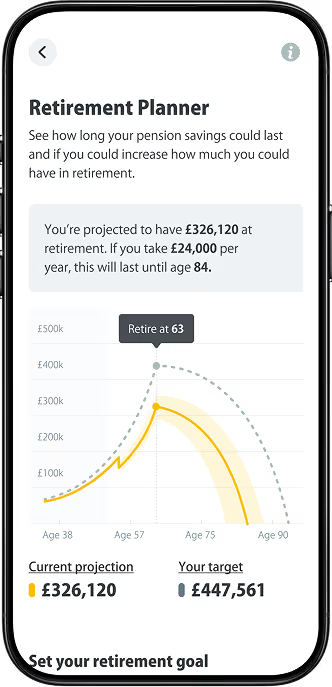
Making contributions to help your pot grow is great, but how do you know how much to put in? What can you expect to see in retirement?

Our analytics capability will build on our currently available pension calculator to enable you to make an informed decision on how to manage your pension.

As always with anything PensionBee, we’re happy to listen to feedback, so feel free to drop us a note by emailing me at martin@pensionbee.com!

How to sell inherited property
Find out everything you need to know about selling an inherited property. From finding the deceased’s will to applying for probate and managing their estate. Learn what inheritance tax is and who pays it, and how Capital Gains Tax is calculated.

This article was last updated on 24/06/2024

When a person dies it usually falls to their close friends or relatives to manage their estate. In order for them to make decisions about the deceased’s property, money and possessions they’ll need legal permission, which can either be expressed by the deceased in their will or granted by the Probate Registry.

If you’re expecting to inherit a property and want to sell it, there are a few things you’ll need to bear in mind. Depending on how much the property is worth and your relationship to the deceased, you may need to pay Inheritance Tax (IHT) on the property. Plus, what you do with the property before you sell it will affect how much capital gains tax (CGT) you’ll have to pay. Here are three things you’ll need to do to sell an inherited property.

1. Find a will

In order to confirm who stands to inherit the deceased’s estate, you’ll need to find their will. This legal document will outline how they’d like to split their assets and should also name an executor, who is the person they trust to manage their estate and carry out their wishes.

Wills can be found in a wide variety of places so it’s a good idea to check the obvious ones first. In most cases a copy of a will is stored in a safe place within the home such as a filing cabinet, lockable drawers or inside a safe.

Another option is to contact the deceased’s solicitor as it’s possible that they either worked on the will with your loved one or are storing it for them. If the will was created a long time ago, and you find that the solicitor is no longer in business, you can contact the Solicitors Regulation Authority for help. It could also be worth contacting their bank as, like the solicitor, it’s possible they may have a copy of the will on file.

If you can’t find a will by exploring any of these avenues you can contact your local Probate Registry or search the government’s probate database, which stores a public record of wills for people who died from 1858 onwards.

2. Apply for probate

Probate Registries are branches of the court that can help you get legal permission to carry out your role as the executor of a will. If there isn’t a will you’ll need to apply for a ‘grant of representation’, or ‘probate’ at your local Probate Registry.

A ‘grant of representation’ is also known as ‘probate’, and is a document that’ll give you the legal authority to act on behalf of the deceased. Once you have this you’ll be able to access their bank accounts, investments and tax affairs. After their debts have been settled you’ll be able to distribute their estate to the next of kin or those named in the will.

If you live in England and Wales you can make an application yourself on gov.uk, or alternatively you can go through a solicitor. If you live in Scotland, you’ll need to apply for ‘confirmation’ or a ‘grant of probate’ if you live in Northern Ireland.

When you may not need to apply for probate

There are some instances where you don’t need to apply for a grant of representation or probate. If the deceased has a spouse or civil partner and assets in the estate are jointly owned, no action will need to be taken. This typically applies where the surviving partner is named on assets such as a mortgage deed or bank account records. A grant of representation or probate isn’t usually required if the deceased’s estate doesn’t include property, land or shares and investments.

Get a house valuation for probate

As part of your application for a grant of representation or probate, you’ll need to find out the value of the deceased’s estate. To do this you’ll need to get access to their financial paperwork and contact banks and financial institutions to find out how much money they have in bank accounts, pension funds and investments.

Their home and any other properties they own also have to be valued, even if the beneficiaries aren’t planning to sell. The value you report to HMRC should be consistent with the amount the property could sell for if it was put on the open market on the ‘date of transfer’, which is usually the date the deceased passed away.

The process of valuing an estate can take six to nine months, possibly longer, so you should be mindful of what the deadlines are for reporting the value of the estate to HMRC and paying any inheritance tax that becomes due.

3. Pay Inheritance Tax (IHT) on property

IHT is a one-time tax that’s due on the total value of someone’s estate when they die. The amount of IHT collected by HMRC will vary depending on the total value of the estate and who inherits it.

IHT is charged at a rate of _higher_rate on any proportion of the estate that goes over the current _iht_threshold threshold. This is usually referred to as the ‘nil-rate band’. Everyone can pass on _iht_threshold of assets before their beneficiaries will need to pay IHT, but if the deceased was married or in a civil partnership, their partner can inherit any of their unused allowance which means they could receive up to £650,000 worth of assets.

If the deceased’s assets aren’t worth more than _iht_threshold, IHT won’t be charged. And, if the deceased leaves everything to their spouse or civil partner, IHT won’t be applicable, even if the estate is worth more than _iht_threshold. The same rules also apply if the estate is left to a charity.

Specifically where property is concerned, direct descendants of the deceased will see their tax-free threshold increase to $450,000. That means children, grandchildren, great-grandchildren, stepchildren, adopted and foster children can all inherit property without having to pay any IHT up to £450,000.

However, other relatives such as siblings, nieces and nephews, and other parties named in a will, are required to pay IHT on any amount over the _iht_threshold threshold. Visit the gov.uk website to find out more about the IHT rates and how you can calculate how much tax is due.

Check the capital gains tax on the inherited property

Capital gains tax (CGT) is a tax that’s charged on the profit you make when you sell an asset that’s increased in value. You pay tax on the amount of money you’ve gained, rather than the whole amount.

CGT is sometimes applicable if you go on to sell part of an inherited estate. For example, if as a beneficiary, you were to sell a property and its value has increased since you inherited it, you might need to pay CGT on the profit you make.

If you were to live in the inherited property and use it as your home before you decided to sell it, you’d automatically qualify for private residence relief, which means your property sale would be exempt from CGT.

On the other hand, if you were to sell the property without ever living in it as your main residence, you’d need to pay CGT. Everyone has a capital gains tax-free allowance of £3,000 per year (2024/25) before tax is charged and you might be able to reduce your bill further.

You’d be able to deduct some of your costs such as those associated with selling the property, legal fees and any expenses you were to incur improving the value of the property, for example if you decided to install a brand new kitchen or bathroom. You can find out more about how CGT works and if you need to pay it on the gov.uk website.

Risk warning

As always with investments, your capital is at risk. The value of your investment can go down as well as up, and you may get back less than you invest. This information should not be regarded as financial advice.

4 pension scams to watch out for
Find out what the four most common pension scams are and how they could affect you. Learn what warning signs you should watch out for, what you can do to protect your pension savings and who to contact if you are a victim of pension fraud.

Pension scams come in many shapes and sizes, all promising to convert your hard earned pension savings into cash before retirement. While HMRC is taking steps to deter scammers, thousands of people are affected each year, with 1 in 10 over 55s fearing they’ve been targeted by a pension scam since 2015.

Citizens Advice found that 10.9m consumers received unsolicited contact about their pension in the year following the 2015 pension freedoms, with as many as eight scam calls being received every second.

It’s likely pensions will continue to be an attractive target for fraudsters as the life savings of just one person can run into hundreds of thousands of pounds. That’s why it’s more important than ever to know the warning signs to watch out for and the steps you can take to protect yourself from a pension scam.

1. Pension liberation scams

Once you reach the minimum age of 55 you can access the money in your pension however you want. If you try to withdraw your pension any earlier you’ll have to pay a high tax bill, unless you can prove that you meet certain criteria such as a medical condition preventing you from working, or being medically advised that you have less than 12 months to live.

For most people this won’t apply and you won’t be eligible for early pension release, but pension liberation scammers will try to convince you that you can get access to your pension before 55 anyway. They’ll sometimes offer you cash incentives and might refer to it as a ‘pension loan’ or ‘saving advance’.

While it may be tempting to take up an offer like this, you should avoid anything related to pension liberation as it’s likely that you’re being asked to transfer your money into an unregulated scheme. You could end up losing your whole pension to a bad investment or fraud.

Many people who fall victim to pension liberation scams aren’t aware of the tax implications of withdrawing their savings early. If you access your pension before 55, HMRC will view this as an unauthorised payment and you’ll have to pay 55% tax on your withdrawal. Even if you lose your pension to a scam, HMRC will still charge you so you could end up losing 155% of your pension’s value (100% lost by the scam, 55% by the tax charge to HMRC).

2. Cold calling pension scams

Pension cold calling ban could be in force by June https://t.co/T91tdjup8Q #pensions #scams

— Pension Geeks (@PensionGeeks) 7 March 2018

Cold calling pension scams occur when someone contacts you out of the blue and tries to get you to move your pension savings into another investment. The scammer might offer a last-minute opportunity to invest in a luxury property development or an overseas deal and will say anything they can to get you to send them your pension.

Scammers might pressure you into making a fast decision and it’s not unheard of for documents to be couriered over for a signature straightaway. Cold calling pension scams don’t just happen on the phone, they can happen at every point of contact including text message, email, post and in person.

{{main-cta}}

3. DWP scams

A common way for scammers to get in touch is via post, sending fraudulent letters from trusted companies such as banks and government bodies like HMRC or the Department for Work and Pensions (DWP). They’ll either ask you to provide updated bank details along with other personal information, or they’ll tell you that they’ve updated their bank details and you should arrange for all of your payments to go to the new account.

Last autumn Middlesbrough residents received official looking letters claiming to be from the DWP, asking them to confirm their bank details. The letters were found to be fraudulent after a resident googled the phone number on the letter.

4. Annuity scams

An annuity is a product that you can buy with your pension to guarantee an income for the rest of your life. Scammers often target those looking to buy an annuity and try to convince them to buy products at an inflated cost or that aren’t suitable for their financial circumstances.

They may target older savers who have poor health or who are losing their memory, and are therefore more vulnerable. Sometimes annuity scammers might promise a cash incentive or signing bonus to try and convince you to sign. They might also claim that the deal is only valid for one day.

How to protect yourself from a pension scam

Pension scams are becoming increasingly sophisticated and it can sometimes be hard to spot one until it’s too late. Here are six things you can do to protect your pension savings.

Keep your pension details to yourself

Whether you’re approached by phone call, text message, email or letter, don’t share any details about your pension with anyone you don’t know. Even if they appear to know specific details about your pension, don’t drop your guard.

Cold calls and text messages are common pension scam tactics. Find out more https://t.co/9extvy48pn #scamaware pic.twitter.com/BoYevjnd6u

— DWP (@DWP) 5 July 2016

If a friend or family member asks you about your pension, you can relax a little bit but it’s never a good idea to share sensitive information or passwords with anyone.

Don’t be fooled by clever use of language

Some pension scammers will use phrases like ‘pension liberation’, ‘saving advance’, ‘pension loan’, and ‘cashback’ to trick you. ‘Legal loopholes’ are often cited as a way to get access to your pension before 55, but no such thing exists. You should also be mindful of anyone offering a ‘free pension review’ or someone who neglects to mention how much it will cost to withdraw your pension.

Avoid anything that sounds too good to be true

Can you spot pension scams? Most can detect 'too good to be true' offers - but may miss the 'clone' menace https://t.co/WqAEXYxBaB #scams

— Pension Geeks (@PensionGeeks) 21 February 2018

Whether you’re the one looking for help and advice or are contacted out of the blue, you should avoid any firm who offers cash incentives or tax-free access to your pension. Never click on links to websites and social media profiles offering easy access to your pension savings without checking their credentials.

Always read the small print and ensure there are no hidden fees or clauses that will cost you more money in the long run. In general, if the sales pitch seems too good to be true, it’s probably a scam.

Contact your pension provider

If you’re unsure about something that someone’s telling you about your pension, always contact your pension provider and ask for confirmation. Depending on what it is that you’ve been told, your pension provider should be best placed to provide you with more information. You should also let your pension provider know if someone has contacted you out of the blue, but knows sensitive information about your pension savings.

Check the Financial Conduct Authority register

Don’t fall prey to pension scams – follow the link to get advice and stay #scamaware https://t.co/m1yLqXoKj4 pic.twitter.com/ctVuZmA9QY

— DWP (@DWP) 6 July 2016

If anyone offers you financial advice or claims they can help you with your pension, it’s a good idea to check the Financial Conduct Authority register and confirm that they’re authorised to provide financial advice. It’s not a good sign if you can’t find them on the register, but you may want to also check the Financial Conduct Authority Warning List which highlights firms you should avoid.

Report any concerns to the Financial Conduct Authority and Action Fraud

If you’ve been approached about early pension release out of the blue, and the firm isn’t on the Financial Conduct Authority register, you should report it so the Financial Conduct Authority can investigate. You can report anything suspicious by calling the consumer helpline on 0800 111 6768 or via the Financial Conduct Authority website.

If you’ve already agreed to something that you’re having second thoughts about, contact your pension provider straight away. If your savings are still in your account they may be able to prevent any pending transfers from going ahead. You should also call Action Fraud on 0300 123 2040 or visit the Action Fraud website to report the crime.

What does the average pension look like for women over 50?
PensionBee customer and Founder of Mrs Mummypenny, Lynn Beattie, attempts to answer the question.

How do you feel about your financial future? My thoughts have changed significantly over time and vary depending on my life stage. I thought it would be interesting to speak to a few of my friends aged over 50 to understand their thoughts, provisions and views towards their financial future and how they are providing for themselves.

Pension gap research

Firstly a few stats. PensionBee recently completed some research on the pension gap. You might have heard this term in the media and not paid much attention, but it’s pretty shocking. The average UK pension pot for a man is £23,416 and the average for a woman is £16,083 – a significant 31% difference.

The geographic gap is even starker in certain areas of the country, with women in the North East facing a 5_personal_allowance_rate gap and women in Northern Ireland struggling with a pension that’s 76% smaller. Greater London, as maybe expected, fairs better with a gap of 27%. Take a look at how your region compares on the pension landscape microsite.

The gap worsens beyond the age of 50

The research highlights a huge problem here; women are far less prepared financially for older age than men. Even more shocking is an analysis of pension gaps and age, which worsens as women get older. Women over 50 experience a gap of almost 5_personal_allowance_rate, with men at an average pot of £53,400 and women at £31,300*.

Why do women have less in their pension pots?

Of course, women have babies, which can affect our finances in a big way. I know I stopped my pension contributions during all three of my maternity leaves to maximise my earnings in that financially difficult time. Many women take a career break for several years to bring up their children. These women may then struggle with a return to work and/or take lower paid jobs to work around their children’s school hours. These factors inevitably affect our earning potential and pension contributions during our 30s and 40s, meaning that the pot in our 50s and beyond is much less.

I know I stopped my pension contributions during all three of my maternity leaves

Many women realise that a return to the corporate world is a huge challenge after children, hands up Lynn! I tried it for one year after my maternity leave with my third child Jack. I couldn’t hack it. Commuting four days a week, working 12-hour days and not seeing my three boys was tough. I negotiated redundancy one year after my return to work. My pot stood at £43,000 at that point of leaving and is now growing nicely with PensionBee. Since then my pension pot hasn’t been added to.

Real-life examples of women in their 50s

I wanted to speak to a cross section of my friends in their 50s to explore how they are doing with their pension and financial planning for retirement. I asked them all the same five questions and their responses were very different and very interesting.

  • Are you employed/self-employed? Do you have a pension pot, and how much is in it?
  • What is your savings/investment/pension strategy for retirement?
  • At what age do you plan to retire?
  • How do you feel about your pension and do you have enough money for retirement?
  • If you don’t think you have enough saved, what are your plans to address this?

M - Executive Director (aged 51)

M has a current pot of £87,000 and currently contributes 12%, plus her employer matches 1_personal_allowance_rate. M had children early in life and started her corporate career in her 40s. Her intention is to keep going with pension contributions increasing them by 1% each year.

She plans to have a phased retirement by reducing her hours upon reaching 60, health dependant. M feels like she doesn’t have enough in her pot, but realises she still has time to build it up. M has an ISA as extra savings and expects to receive some inheritance to boost her pot.

Helena - self-employed yoga instructor (aged 51)

Helena and her partner are both self-employed and neither has a pension. They do own a property in London, which has equity of around £250,000 and is increasing in value each year.

Helena loves her job and sees no need to retire at any point really

Helena loves her job and sees no need to retire at any point really. She takes time when needed and trusts that the rest is looked after. She’s one of the healthiest, zen people I know and doesn’t stress about money – it comes and goes. She finds it when she must, and it flows in and out. She has no worries about the future as she has no idea what that holds.

Justina - self-employed business owner (aged 50)

Justina runs her own business and has done for ten years, for which time she has been self-employed. She doesn’t have a pension pot. Her financial provisions include property and developing her business model. The property plan includes selling property when the time is right, downsizing and living off the capital. She is currently exploring options with a financial planner.

Justina has created a global franchise model around her business. The plan is that through ongoing franchises across the world and the royalty fees they pay, she will be able to draw passive income for years to come.

She will carry on working for as long as she can. She feels comfortable with property investment, as she will have a substantial amount left if she sells, even after paying off the mortgage. The business aspect is a bit riskier as you never can be sure of outcomes, but fingers crossed it will work out the way she intends.

Justina and her partner have some investments in other companies, which will also provide good revenue if and when they sell (that is their exit strategy). She is comfortable that this is enough provision for retirement.

D - self-employed accountant (aged 56)

D was employed for most of her adult life by the same employer and has a pension pot of £650,000. She is now a self-employed accountant. She is intending to manage her pension fund in a tax efficient way by drawing down on annual allowances, and plans to retire at 65.

She recognises that her current pension pot value is good and given current market conditions should provide a good standard of living. D’s concerns for retirement include the cost of being cared for in old age. She believes that her pension provisions and the equity in her home will provide enough cover for this.

Summary

Those are four very different provisions for the future. Each woman has a provision of money set aside but each is very different. All are suitable for their life position, employment status and intended expenses in retirement - there is no one-size-fits-all number. Everyone has a different intention and view of retirement, so think hard on this as you save.

There is no one-size-fits-all number

These provisions will all be on top of the State Pension currently set at £164.35 per week. For impartial advice for the over 50s check out Pension Wise and have a read about what I did with my pensions moving them all over to PensionBee, turning frozen pots from two employers into a fully accessible and trackable pot, currently worth £48,000.

How does your pension situtation compare? Let me know in the comments section at the bottom of the page, or tell me on Twitter, Facebook or Instagram.

Lynn Beattie is a PensionBee customer and CEO/Founder of Mrs Mummypenny, a personal finance website. She is also an ACMA management Accountant, previously working in commercial finance for Tesco, EE & HSBC. Lynn is a single mum to three boys, living in Hertfordshire, and is the author of ‘The Money Guide to Transform Your Life‘ published in September 2020.

*Source: PensionBee, based on a sample of 5,098 savers

Risk warning

As always with investments, your capital is at risk. The value of your investment can go down as well as up, and you may get back less than you invest. This information should not be regarded as financial advice.

9 free things to do in the summer holidays
PensionBee customer and Founder of Mrs Mummypenny, Lynn Beattie, shares her favourite ideas to help you get through the school holidays without spending a penny.

The summer holidays can be expensive. I have six weeks looming ahead with three boys who need constant distraction and amusement. Holiday clubs, days out, extra food and the moanings of ‘I’m bored’, all have financial consequences. Put very simply, we cannot afford to shell out the estimated £133 per week to keep the children amused.

Here’s a list of the best ideas to get you through the school holidays without spending a penny.

1. A countryside walk

We all live close to nature, even if you live in the middle of a city. Go to the woods and create houses from trees and branches or find some green space and explore. My family lives near fields of wheat and corn and I love to walk around the edges of the fields spotting wildlife and flowers, and looking for grass snakes.

I like to write a list of 20 flowers, trees, animals and birds that the children need to search for whilst we’re out for the walk. The winner with the most things ticked gets to choose dinner or a film to watch when they get home.

Before you set off to explore, put a big bottle of water in your rucksack and fruit and energy snacks for when the kids start moaning that they’ve walked too far.

2. Geocaching

An extension to the country walk is the treasure hunting excitement of Geocaching. Check out this website for a great explanation of what you have to do. I’ve just done a quick search and there are 10 treasure spots within one mile of my house alone! I can see how recently they’ve been visited and how easy they are to find.

You’ll need to take some treasure with you to replace the treasure that you find. I am sure your kids can find a toy or gift that you no longer need to put in the treasure chest.

3. Visit a free museum

So many museums are free, from the huge Science Museum or Natural History Museum in London to the smaller places more local to you. We love RAF Hendon. Money Saving Expert has a fab list of free museums where you search by location. In Eastern England, particularly Cambridge, we have the choice of around 10 free museums to visit and then another 20 in London. Top of our list to visit this year is the Bank of England museum where you get to learn about money and hold a gold bar.

4. Go to a splash park

We love a splash park in this household. Luckily, we’re surrounded by them in lots of parks, so I’m guessing it’s the same for you as well, wherever you’re reading this post. We have them in St. Albans, Stevenage, Letchworth and Royston. All very near to where we live. Just take a couple of towels and your packed lunch, and you’re good to go.

5. Do a park assault course

Check out your local park’s assault course or exercise course. Our most local big park is Fairlands Park in Stevenage, which has a course of apparatus running through the fields and trees. The boys can do pole climbs, monkey bars and chin-ups. They like to compete and have me take videos of their chin-up records!

6. Free community activities

Check out the free classes at your local church, library or children’s centre. All these organisations offer freebie activities. There will be play in the park, messy play and rhyme time. Ask around in local Facebook groups or Google your local children’s centre.

7. Plan your summer with Clubcard vouchers

The boys are very keen to go to Legoland this summer. We’ve been before, and it’s amazing, especially for three boys who all adore Lego. Alas, I’m not paying full or even half price for tickets as it’s so expensive. For one adult and three boys it’s £188 for us to go with advanced booking. Yikes!

I tend to save them up, so I have a bigger chunk of vouchers to use each summer

Instead I will use my Clubcard vouchers and get four tickets from there. The tickets will cost just £63 in Clubcard vouchers. I tend to save them up, so I have a bigger chunk of vouchers to use each summer. I’m going to ensure I bring plenty of drinks, a packed lunch and snacks as we’ll be avoiding the shops! Look at your Clubcard account for lots more days out ideas.

8. Fruit picking

July-August is a great time to hit the berry farms and go fruit picking. Near me I have them all; strawberries, raspberries, gooseberries, even the blackberries are starting to ripen. And, of course, you don’t have to pay for what you eat! I have a few places I know where we can go proper freebie blackberry picking or foraging so we’re going to do that. Make sure you know what a blackberry is and don’t go picking them near a road or below a metre in height (where animals might have had a call of nature).

9. Recycling box creativity

There are loads of things to do in the summer holidays at home too… you don’t have to go out all the time! I always have a craft box suitable for any given moment of inspiration. Whenever I get stuff from goodie bags or packaging it all goes into the craft box. I just let the boys go wild with creativity. There are tons of amazing printables and card models online that you could find. Only today I’ve been printing out Incredibles colouring-in pictures for some amusement whilst mummy gets a bit of work done.

Lynn Beattie is a PensionBee customer and CEO/Founder of Mrs Mummypenny, a personal finance website. She is also an ACMA management Accountant, previously working in commercial finance for Tesco, EE & HSBC. Lynn is a single mum to three boys, living in Hertfordshire, and is the author of ‘The Money Guide to Transform Your Life‘ published in September 2020.

5 retirement mistakes to avoid
Here are five of the most common mistakes to avoid in retirement. Find out the risks of withdrawing too much from your pension too early, and the benefits of keeping your pension invested with drawdown.

Now that you’re retired, you can finally reap the benefits of saving into a pension your whole life. Without a boss to worry about or any rules to follow, you can enjoy the retirement you’ve always imagined for yourself. But, before you get carried away and risk undoing decades of hard work, there are a few things to bear in mind. Here are five of the most common mistakes to avoid in retirement.

1. Taking too much of your pension too soon

Even if you only have a modest pension pot, gaining access to it can feel like winning the lottery. Pensions are often out of sight, out of mind so when you’ve suddenly got thousands of pounds to your name, it can be easy to withdraw more than you actually need.

There’s a reason why the age you’re able to access you private pensions is set to rise to 57 in 2028. People are living longer and savings accessed in our 50s may need to last us into our 80s – and perhaps beyond. Taking your pension early or withdrawing too much too soon can have a dramatic impact on your overall pension pot size and how long it will last. And, once you’ve withdrawn all of your pension there’s no getting it back.

2. Not understanding how pension tax works

As per the new rules introduced in 2015, you can take up to 25% of your pension as a tax-free lump sum from the age of 55. Another option is to take the first 25% of each withdrawal tax-free. Whichever method you choose, only the first 25% is tax-free and you’ll need to pay pension tax on everything else.

All of the pension money you receive is treated like income and HMRC will charge you income tax at your usual rate of 20%, 40% or 45%, depending on how much you withdraw. You’ll get a tax-free allowance of £11,850 (for 2018/19) before tax is charged.

The more money you withdraw from your pension in any given tax year, the more tax you’ll have to pay. For this reason it’s important to be mindful of the pension tax rates and income tax thresholds, and consider spreading your withdrawals if you don’t need money urgently.

Pension tax isn’t optional or something you can sort out later. Instead it’s automatically deducted by your pension provider before each withdrawal is paid to you in the same way income tax is deducted from salaries by employers using PAYE. You’ll find more information about how pension tax is calculated on your pension statement.

3. Maintaining an expensive lifestyle you can’t afford

Just because you’re retired doesn’t mean you can’t have fun! But without the option of picking up overtime or pulling in extra cash another way, chances are the money you have now is going to be all you’ve got.

Getting to know your pension and its limitations is an important part of retirement planning. Before you withdraw pension lump sums and take risks with your savings, you need to figure out how much you can afford to withdraw each year to ensure you have enough to last for the rest of your life.

If your old salary far exceeds your retirement income you’ll need to make some adjustments – and soon. It’ll be impossible to maintain the same standard of living you had before, unless you’ve reached another financial milestone, such as paying off your mortgage, or will be reducing your overheads in some way.

You need to be realistic about what you can afford and what you’re prepared to sacrifice to ensure you don’t get left short in later life.

4. Forgetting about old pensions

Although you’ve already started drawing your pension, it’s possible that there could still be an old workplace pension that you’ve forgotten about somewhere. The days of a job for life are long gone and it’s likely that you’ll have had a few jobs throughout your career and could have easily lost track of a pension along the way.

In retirement every little helps, so if you think there’s some money that you could be missing out on it’s worth trying to find it. The government’s Pension Tracing Service can help you find an old pension, provided you remember either who the pension provider is or the name of your employer at the time. Should you choose to combine your pensions with PensionBee we can also find those old pensions for you - all we need is some basic info like a pension number or a provider name.

{{main-cta}}

5. Being resigned to your financial fate

While it can be hard to dramatically improve your financial position in retirement, there’s usually something you can change – especially if you’re unhappy. No matter how far into retirement you are it’s important to check your pension statements regularly to see how your money’s being managed. If you find that you’re being charged high fees for the service you’re getting or don’t think your funds are being managed well, it’s quite straightforward to change pension provider.

Elsewhere, drawdown is one of the most flexible ways of taking your pension and also allows your money to stay invested until you need it.

This can be a great way to boost your pension pot when you’ve already retired, although investing your savings later in life does come with risks.

A key benefit of flexi-access drawdown is that you can always change your mind if you feel it’s not delivering the returns you were expecting or are concerned about the size of your pension pot. In contrast, when you decide to purchase an annuity with your pension you’ll be making a commitment that can’t be undone. That’s why it’s important to research the best annuity rates and consider all of your pension options before going down this route.

There are a number of pension providers that can help you regain control of your pension. PensionBee, for example, makes it easy to transfer your pension and can help you find any old pensions you might have lost. Managing your pension can be simple too, with an online pension dashboard and app, which lets you see your balance in just a few clicks.

Are you in retirement? What mistakes would you tell other retirees to avoid? Tell us in the comments.

Risk warning

As always with investments, your capital is at risk. The value of your investment can go down as well as up, and you may get back less than you invest. This information should not be regarded as financial advice.

4 signs you could be heading for a retirement shortfall
Running out of money in retirement is becoming a very real risk for many. Here's four signs that suggest you could be heading for a retirement savings shortfall.

In times gone by previous generations could look forward to their retirement, living out their golden years without financial burden. Nowadays the pension landscape is a lot more complicated and financial security in later life isn’t guaranteed.

To prevent a retirement savings shortfall it’s time to get serious about your pension - whatever your age. Here are four of the most common mistakes you should avoid.

Your current contributions aren’t big enough

Thanks to auto-enrolment British employers have to place all eligible staff in a workplace pension scheme and contribute a minimum amount by law. Typically, contributions will be matched by your employer to a certain percentage and then it’s up to you, the employee, to contribute above and beyond.

Several factors can influence the level of contributions needed to reach your retirement savings goal, chief among them how much time you have until retirement. For instance, retirement saving research from consumer brand Which? found that a couple hoping to secure an annual income of £26,000 in retirement would need to save just £194 per month in their 20s, £253 in their 30s, £351 in their 40s and £591 in their 50s. The longer you leave it before you start saving, the more you’ll have to save each month.

Our pension calculator can also help you find out how much you should be saving. Simply set yourself a retirement goal based on your desired income for each year of your retirement, input your current age and the age at which you hope to retire, plus details of any savings you may have. It’ll then tell you how much you’ll need to contribute each month to make your goal a reality. While the results might not be what you were hoping for, it’s better to identify a retirement savings shortfall sooner rather than later, and while you still have time to rectify it.

To ensure you’re saving enough, it’s a good idea to check what your contribution level is, and increase it to as much as you can afford. Most workplace schemes can be adjusted easily so if your circumstances change and you need to reduce your payments, you can do so with minimum fuss. Whatever you do, make sure you’re paying in enough to get the maximum amount from your employer.

You haven’t paid enough National Insurance

When it comes to the State Pension, most people know that it may not be enough for them to live on, yet few know that the full amount isn’t always guaranteed. For in order to qualify for your full basic State Pension you’ll need to have paid National Insurance, or received credits, for 30 years or more.

National Insurance credits also count towards the 30 years

If you’ve worked for most of your life chances are you’ll have paid National Insurance for more than 30 years and will automatically meet the requirements, but if in doubt you should always check. On gov.uk you can find out how much State Pension you’re eligible for, when you can claim it and what you can do to increase the amount.

If you find that you have gaps in your National Insurance record, you can top them up with voluntary National Insurance contributions. National Insurance credits also count towards the 30 years and can be claimed for periods of unemployment, sickness or for time taken out of work as a parent or carer.

{{main-cta}}

You’re paying hidden charges

All pensions come with charges, yet while you can expect fees to vary from provider to provider, transparency around each charge isn’t always the same. It’s a good idea to thoroughly read your paperwork, looking out for the charges that are to be expected, and those that may be buried in the small print.

The most common pension charge is an annual management fee which covers any admin costs your provider incurs looking after your fund. Exit fees are also applied on some older plans, and are charged the moment you withdraw or transfer your pension savings. Staggeringly some are as high as 77.60%, as our most recent Robin Hood Index revealed.

Less familiar are contribution charges and inactivity fees – the very definition of “damned if you do, damned if you don’t”. If your pension provider applies a contribution charge, it means they’ll take a percentage every time you add to your pension. While this is a fee that’s becoming less common, over time it could have a big impact on the size of your pot, if you make regular contributions.

Inactivity fees are charged when you don’t make any payments into your pension in a given time period so it’s especially important to look out for such charges on old pensions. Service fees, policy fees and underlying fund fees are often defined as management fees to cover the cost of administration, despite being charged in addition to an annual management fee.

Several cases have hit the headlines where small pension pots have been wiped out, thanks to ongoing charges. An engineering machinist from Rotherham lost an entire £1,300 pension pot after being charged six different fees.

While a young technology executive was told he’d have to pay an exit fee of £14,000 to move his pension. As of 31 March 2017 the government has imposed a 1% cap on early exit charges, but so far this only applies to people aged 55 and over.

To avoid falling victim to hidden charges it’s crucial to check statements regularly and keep track of old pensions. At PensionBee We only charge one annual fee across each of our plans, ranging from 0.5-0.95%. Plus, once your pension grows larger than £100,000 your fee will start decreasing - we’ll halve the fee on the portion of your savings over this amount.

You don’t know what your old pensions are worth

With the concept of a job for life disappearing faster than you can say “LinkedIn recruiter”, it’s now considered the norm to change jobs several times in your career. Whether you move on in search of better opportunities, career progression, job satisfaction or that all important pay rise – it’s important to keep sight of the benefits you clocked up in each role.

But what about your really old pensions? With the best will in the world it can be a challenge to manage multiple pensions, and with the passing of time it’s not uncommon to lose track. To find out the details of old pensions you can use the government’s Pension Tracing Service which uses the details you provide to find the names and contact details of your pension providers.

If you’re happy to put in the legwork you can trace previous pensions yourself by contacting former employers to request the details of the plans they have in place, before contacting each provider. Depending on the restrictions of each pension scheme you may be able to transfer some pots into your current workplace pension or a private pension, within a set period of time.

One of the most straightforward options is to combine all of your pensions into one with the help of a specialist pension service that can easily consolidate them on your behalf. At PensionBee we can transfer all of your old pensions into one simple plan. This will make them more manageable, but could help to reduce your fees too. We just need a few simple details, like your old provider name, policy number and National Insurance number. The more details you have like this, the better, as it makes locating and consolidating all your old pensions much simpler. Get started today.

Are there any other signs should savers look out for? Tell us your thoughts in the comments section below.

Risk warning The information in this article should not be regarded as financial advice.

What is the average pension pot at 50?
In or nearing your 50s? Find out whether you're on track for a comfortable retirement.

This article was last updated on 20/07/2023

They say 50 is the new 40, and you’re only as old as you feel. Take Noel Gallagher for instance – he’s in his 50s now and he’s still throwing parties that are ‘better then Glastonbury’.

As dull as it sounds though, it’s also an age when you’ve got to start thinking about your pension sensibly. Your 50s are a crucial decade when it comes to your retirement, especially if you haven’t started thinking about it already.

So, where you should be by now? And how can you fix things if you’ve fallen behind?

The average pension pot at 50

Research from insurance company LV= found that Brits aged 45-54 have an average pension pot worth £71,342. Our own, recent study of nearly 200,000 PensionBee customers, showed that males and females over 50 had an average pension pot of £43,954 and £23,962, respectively.

To put this into some context, a recent study by Which? suggests that a combined pot of £115,000 would give a couple a comfortable retirement if you opt to withdraw from your pension via drawdown. *Drawdown figures are based on a saver withdrawing all their money over 20 years from age 65, and assume investment growth at 3%, inflation at 1% and charges of 0.75%

So, what can you do to get your pension on track?

Firstly, consider finding and combining

A good place to start is to find out what you have hidden away. Almost half of those over the age of 50 admit they don’t know the value of their pension, thanks in part to the patchwork of old workplace pensions that they’ve left unclaimed.

Collating all of these old pensions and putting them into a single pot is an easy antidote to this, as it’ll clarify your pension position and make monitoring the performance of your funds a lot more straightforward.

We can do this for you at PensionBee - on average, it takes up to 12 weeks to locate and transfer your old pensions - or alternatively you can use the government’s free Pension Tracing Service to track down those old pensions. Discover more about finding and transferring pensions in our dedicated section.

To put this into some context, a recent study by Which? suggests that a combined pot of £115,000 would give a couple a comfortable retirement if you opt to withdraw from your pension via drawdown. *Drawdown figures are based on a saver withdrawing all their money over 20 years from age 65, and assume investment growth at 3%, inflation at 1% and charges of 0.75%

So, what can you do to get your pension on track?

Firstly, consider finding and combining

A good place to start is to find out what you have hidden away. Almost half of those over the age of 50 admit they don’t know the value of their pension, thanks in part to the patchwork of old workplace pensions that they’ve left unclaimed.

Collating all of these old pensions and putting them into a single pot is an easy antidote to this, as it’ll clarify your pension position and make monitoring the performance of your funds a lot more straightforward.

We can do this for you at PensionBee - on average, it takes up to 12 weeks to locate and transfer your old pensions - or alternatively you can use the government’s free Pension Tracing Service to track down those old pensions. Discover more about finding and transferring pensions in our dedicated section.

{{main-cta}}

Secondly, put a saving plan in place

Once you’re clearer on your pension position, it’s time to start to thinking about the future.

A smart place is to start is our pension calculator, as this can help you determine how much you’ll need to save between now and retirement. Simply set yourself a retirement goal based on the income you’d like to receive and the age you’d like to start receiving it. Then input your current age, and details of any pensions and savings already in place, to discover how much you’ll need to contribute each month to reach your target.

Thirdly, stay positive

If the size of your pension isn’t quite where you’d like it to be there’s still time to make a positive impact. No matter what your age, it’s never too late to come up with a plan and start saving – even if you were to start saving from ground zero aged 50. It’ll take a bit more effort, but it’s by no means impossible!

Above all else don’t panic, as it’s suprising what’s possible. Start by seeing how some small switches could make help you put an extra _higher_rate_personal_savings_allowance a month in your pension, and make you sure you avoid missing out on ways to boost your State Pension.

Risk warning

As always with investments, your capital is at risk. The value of your investment can go down as well as up, and you may get back less than you invest. This information should not be regarded as financial advice.

How much does a financial adviser cost and do I need one?
Discover the costs that come with hiring a financial adviser, learn about the different types of financial advisers, and find out if you need one for your pension.

Making confident decisions about your pension and investments is never easy. Yet with more freedom and choice than ever before there’s a lot of pressure to get it right. As you near retirement understanding your options becomes increasingly important, for the decisions you make now will have a lasting impact on your finances.

If you find getting to grips with your pension a struggle, independent advice could help ensure your pension is setup in a way that’s easy to manage and achieves your retirement goals. Yet when you consider the costs involved, is it worth seeing a financial adviser, or could you do some of the work yourself?

What is a financial adviser?

An independent financial adviser (IFA), is authorised by the Financial Conduct Authority (FCA), to offer impartial advice. An adviser will ask you a series of questions to find out your financial health, knowledge of the pension landscape, retirement goals and attitude to risk. This will help them provide specialist pension advice on the full range of products on the market, and recommend the best options to suit your needs.

An IFA can help you calculate when you can afford to retire and recommend the best way to access your pension funds. And, if you have several workplace pensions, they may recommend consolidating your pensions into one single plan.

{{main-cta}}

Things to consider when seeking financial advice

  • Average cost of a financial adviser

Independent financial adviser fees will vary depending on the advice you need, and how you choose to pay for it. The majority of advisers will offer you a free consultation, but if you decide to meet again the cost can be as high as _higher_rate_personal_savings_allowance for an initial review.

There are three ways to pay for financial advice. You can pay a fixed fee for a specific service, such as purchasing an annuity, or you can pay an hourly rate. Hourly rates range from £75 an hour to £350, with an average of £150 an hour.

Hourly rates range from £75 an hour to £350, with an average of £150 an hour

If you’d like an adviser to help you manage your investments on an ongoing basis, they may charge a percentage of assets rather than a fixed amount. This means they can command a percentage of your portfolio’s total value, anywhere from 0.5% to 5%.

If you’re looking for high level advice on managing your money more efficiently, and have a healthy pension, it’s unlikely that paying a percentage of assets will be cost-effective. Before you retain the services of a financial adviser you should ask for a written breakdown of their fees and find out what’s included in the costs. You may find that the cost of financial advice changes based on where you’re located in the UK.

  • Restricted advice

Some financial advisers will only offer solutions based on certain products or specific providers, which makes them restricted in the advice they can give you. A financial adviser has to inform you whether they are independent or restricted so you should always ask.

In order to receive advice that’s genuinely best suited to your personal circumstances you should always seek the help of an independent adviser.

The benefits of financial advice

  • Receive a personal recommendation

One of the best things about independent financial advice is the personal recommendation you’ll receive. An IFA will be able to offer guidance on how you can convert your pension pot into a sustainable retirement income, and how best to manage your money moving forward. If you have several pensions an adviser can help you streamline your funds by unlocking old pensions on your behalf.

  • Learn how to protect your retirement funds

If you’re the first to admit that you don’t know a thing about your pension, an independent financial adviser can help you understand the basics. They can educate you about all of the products across the pension landscape and explain the different types of funds, and the risks involved to ensure you don’t make costly mistakes.

  • Get your pensions back on track

If you have pensions here, there and everywhere and find them hard to manage – an IFA can help you get them back on track. They can breakdown how much you’re spending in fees and will recommend measures and products to help you better manage your money.

Do I need a financial adviser for my pension?

While there are many advantages to enlisting the help of an IFA, paying for advice isn’t always going to be worth it. If you have straightforward needs it’s possible to do some pension planning on your own.

If you’re unsure how much you should be saving for retirement, for example, our pension calculator can give you a good indication. Elsewhere, our Pensions Explained centre will help you find out everything you need to know about paying into a pension, taking a pension and all the pension rules and legislation - plus anything else in-between! What’s more, the money you save in adviser fees can go straight into your pension fund.

The money you save in adviser fees can go straight into your pension fund

When you sign up to a PensionBee plan we’ll help unite all of your old pensions into one manageable pot and will take care of the transfers for you. It’s easy to manage your money and measure your progress against your goals through our online dashboard.

In some more complicated circumstances financial advice is recommended. If you’d like to mix your pension options and get an annuity and adjustable income, for example, guidance is advised.

You’ll be required by law to seek advice if you have a ‘final salary’ or defined benefit pension worth more than £30,000 and want to transfer it to a defined contribution pension scheme.

How to choose a financial adviser

If you decide that you’d like to speak to a financial adviser there are several online directories that can help you find professional advice. If an adviser is regulated by the Financial Conduct Authority it will be included on its free register of authorised individuals, firms and bodies.

The Money Advice Service has a similar directory for those seeking independent pensions advice.

Have you used a financial adviser? How did you find the experience? Tell us in the comments section at the bottom of the page 👇

What is the cost of transferring pension funds?
Find out the cost of transferring a pension and the things you’ll need to consider before moving your savings. Find out how PensionBee works and why our transfers are free.

This article was last updated on 07/02/2024

If you’ve had more than one job in recent years it’s likely you’ll have more than one pension to your name, and the longer you have left in your career, the more workplace pensions you’ll accumulate in the future thanks to Auto Enrolment.

Over time, managing lots of pensions can get messy and it can be easy to lose track of your savings. Maintaining multiple pension pots could also become costly if you’re paying several high fees.

If you’re thinking about transferring your old workplace and personal pensions into one plan there are a few things you’ll need to consider first, from transfer charges and exit fees to the special features and benefits you might lose. Here’s a breakdown of the things you should consider and what you can do to avoid paying for a pension transfer.

Common reasons to transfer a pension

Depending on how many pensions you have, how they’re performing and how much you’re paying in fees, it might make sense for you to consolidate your pensions into one. In fact, there’s a range of circumstances where you might want to consider transferring your pensions including:

  • Your current pension provider’s no longer offering the type of pension option you want to use to access your savings in retirement
  • Your current pension isn’t being invested in line with your expectations and you want to take more/ less risks and earn a higher income
  • You’re moving abroad and want to take your pension with you
  • You want to have just one pension to manage
  • You want to pay just one fee, which will hopefully be cheaper than the multiple fees you’re paying now.

{{main-cta}}

When to transfer a pension

Transferring your pension is an option that’s open to everyone and you don’t necessarily need to have a ‘good’ reason, provided you’ve done your research and are confident you’ll be financially better off with a new provider. You can transfer your pension at any age, no matter how close you are to retirement, although if you’re nearing retirement you’ll want to make sure your savings are invested in a plan with less risk.

The majority of newer workplace and personal pensions are defined contribution pensions, which have a value based on how much you’ve contributed and how your investments have performed. If you have one of these pensions it’ll be relatively straightforward to transfer.

However, if you have a defined benefit pension you should approach any potential transfer with caution until you’ve assessed what benefits you could lose by exiting your current scheme. You can find out what type of pension you have and what benefits it comes with by checking your pension paperwork, such as an annual pension statement, or by contacting your provider directly.

When not to transfer a pension

If you’re part of an older pension scheme, known as a defined benefit or ‘final salary’ pension, a transfer might not always be the best option. Defined benefit pensions have a value based on your salary and the number of years you worked for your employer, and can often come with special benefits that you could lose if you leave the pension scheme.

Special benefits could include a guaranteed annuity rate upon retirement, regardless of the market rate at the time, and other perks that you may not want to forfeit. To ensure you weigh up your options carefully it’s a legal requirement for savers with defined benefit pension pots worth more than £30,000 to speak to an independent financial advisor before moving their pensions. If you have a public sector pension you probably won’t be able to transfer this type of pension, although you can stop paying into it and start a new one separately.

Pension transfer charges

The amount you’re charged for transferring your pension can vary from provider to provider and from scheme to scheme, so it’s important to find out how much you’ll be charged and understand the impact this will have on the size of your pension.

Pension transfer charges usually come in the form of an exit fee. This is where your current pension provider charges you a fee to release your money, and it’s usually deduced from the balance of your pension. Exit fees can either be charged as a flat fee or as a percentage of your savings, which means the larger your pension, the more you’ll have to pay. Where a percentage is charged it can be as much as 1_personal_allowance_rate.

Transferring your pension’s free with PensionBee

If you decide to transfer your pensions with PensionBee, we won’t charge you a thing. You’ll get your own personal BeeKeeper who will then guide you through the transfer process, from start to finish.

All we’ll need is a few details about your pension history to get started, such as a pension number or provider name. And, if we find any pensions where your current provider charges an exit fee of more than £10, we’ll check with you before going ahead with the transfer.

It can take just two to three weeks for us to receive your pension money and we’ll always attempt to use electronic transfer technology to send and receive it safely and efficiently. Once we’ve received your pensions we’ll charge just one annual management fee, which is taken directly from your pension pot. There are no hidden transfer fees, or any other kind of fees, and the more you save with PensionBee, the less you’ll pay.

Risk warning

As always with investments, your capital is at risk. The value of your investment can go down as well as up, and you may get back less than you invest. This information should not be regarded as financial advice.

You should always thoroughly research any new providers you’re consider joining to ensure they are fully regulated. You can check the Financial Conduct Authority register to confirm that they’re authorised to manage your money and you can also check the FCA Warning List which highlights companies known for pension scams.

How much is my pension worth?
Read our top tips for finding out how much your pension is worth and ensuring you’re on track for a comfortable retirement.

All through our lives we’re taught to spend sensibly and put money aside for a rainy day. Whether that’s saving into a piggy bank as kids, or our pensions as we get older, eventually there comes a time to count the pennies and see how much we’ve got saved.

It doesn’t matter if you’ve just started a pension, are close to retiring, or are somewhere in between, it’s important to keep an eye on your pension and check your balance regularly. Unlike a piggy bank where what you put inside stays there until you break it open, a pension balance can go down as well as up, depending on the type of pension you have, how much you’ve saved and how your investments have performed.

Here are our top tips for finding out how much your pension pot is worth and ensuring you’re on track for a comfortable retirement.

Check your pension statement

The easiest way to find out how much your pension is worth is to check your pension statements. Whatever type of pensions you have, you’ll receive an annual pension statement from your provider. In it they’ll tell you how much your pension is currently worth and what it’s expected to pay out at your retirement date. It’ll also tell you which type of pension you have.

Most personal, workplace and private pensions are defined contribution, which means you’re mainly responsible for contributing to your pension and it’s value when you retire will be based on how much money you’ve paid in, how your money’s been invested and how those investments have performed. If you’ve got a defined contribution pension, your statement will explain how your pension’s been invested in the past year and how it’s performed.

The other type of pension is defined benefit and its value is based on your salary and how long you’ve worked for your employer. If you have one of these pensions you might have heard it being called a ‘final salary’ pension, and your statement will tell you if there’s anything else included with it. Sometimes defined benefit pensions can come with additional benefits, such as a guaranteed annuity rate or life insurance.

Of course, to be able to check your pension statements, you’ll need to make sure your pension providers have your current address details. Depending on who your pension provider is and how old-fashioned they are, you might be able to check your pension contributions and balances online.

{{main-cta}}

Check your National Insurance record

If you’ve worked in the UK for a certain number of years you’ll also be eligible to receive State Pension. The amount you’ll get is based on how much National Insurance you’ve paid during your working life. To qualify for the new State Pension you’ll need to have paid National Insurance contributions for at least 10 years, and to claim the full State Pension amount of £164.35 per week (2018/19), it’s 35 years.

To find out how much State Pension you’re on track to receive you can use the government’s State Pension forecasting tool which you can find on the gov.uk website. It’ll calculate how much National Insurance you’ve already paid and how many years you have left until you reach State Pension age. From there you’ll be able to get a State Pension forecast and find out what you’re eligible for and how you can increase it if it turns out that you haven’t paid enough National Insurance. If you’re due to retire soon you can contact the Future Pension Centre and request a full State Pension statement.

Check for any lost pensions

The more pensions you have, the harder it can be to keep track so, even if you think you’re on top of everything, it won’t hurt to use a pension finder. The government has a free tool called the Pension Tracing Service which is a searchable database of pension provider contact details.

You can also contact your old employers to find out information about any pension scheme that was in place when you worked for the company, and then contact the pension providers directly to find out if you were a member of their schemes.

There are also some pension companies who’ll be able to help you locate an old pension, especially if you plan to transfer the balance to them. This can be more straightforward if you’re already planning to transfer your pensions or have several old pensions that you’ve lost track of.

Consider joining the UK’s most-loved pension company

If you’re having trouble managing several pensions, all with different providers, it might make sense to consolidate them into one. That way you’ll have a unified view of your savings, and just one pension balance to manage going forward. That means only one pension provider to deal with and potentially lower fees too.

Before you move your savings, you’ll need to make sure there aren’t any restrictions on your pensions, or special benefits that you could lose if you have a defined benefit pension, for example. Also, if you do have a defined benefit pension pot and it’s worth £30,000 or more, you’ll need to seek advice from an independent financial advisor.

If you do decide to open a PensionBee pension we can help you combine all of your old pensions into a new online plan. You just need to provide the pension provider name and policy number (if you have it to hand). You’ll get a personal BeeKeeper to guide you through the transfer process.

With PensionBee you’ll get an online pension that you can manage anytime and from anywhere, through your favourite device. You’ll be able to see a list of recent transactions and a performance graph showing how your pension investments have performed over time. Existing customers can download our app in the iTunes and Google Play stores, and use it to access their real time pension balance with PensionBee.

How long will my pension last?
Find out how the PensionBee pension calculator can help you determine how long your pension will last, and what you’ll need to consider.

Whether you’re dreaming of travelling the world and riding off into the sunset, or are looking forward to embracing the simple life closer to home, you’ll need to ensure you’ve got enough money saved into your pension to support yourself when you retire.

How long your pension lasts will depend on a range of factors, from your desired income to how much you’ve got saved and your life expectancy. Here’s what you’ll need to consider when doing your calculations.

Your desired retirement income

The amount of money you need to have a comfortable retirement will very much depend on your personal circumstances and the standard of living you’d like to have. If, for example, you currently earn £50,000 a year, it would be quite a shock to the system to drop down to _money_purchase_annual_allowance a year in retirement – especially if you don’t intend to adjust your lifestyle or reduce your outgoings.

Earlier this year Which? conducted a study and found that the average couple needs just £18,000 between them to live for a year. This amount covers the bare essentials like food, accommodation and transport and would be just about doable if both parties were receiving the new State Pension amount of £8,546.20 each a year.

A slightly more comfortable retirement, that includes modest luxuries like European holidays, would require £26,000. A luxurious retirement, with long-haul holidays and a brand new car every five years, would cost a couple £39,000 a year.

How much you’ve already saved into your pension

To ensure you’re saving enough money to comfortably support yourself for your whole retirement you’ll need to have a good understanding of your current pension balances and your expected retirement income.

Depending on the type of pension you have, you can check your balance by looking at your annual pension statement, or by logging into your online pension account. With either option you’ll be able to find out how much your pension is worth today and how much you can expect it to pay out at your expected retirement date.

If you have your retirement savings spread across multiple pensions, you may want to consider transferring them into one. That way you’ll have just one pension to manage and will always be able to get a clear view of not only your balance, but how your investments are performing. When you transfer your pensions into one you can also go through the steps of looking for any old pensions you might have forgotten about. This can help ensure that any pensions you’ve previously started with an old employer are brought together and can’t be misplaced or lost in future.

Your life expectancy

Last year research from the Office for National Statistics (ONS), found that an average 65-year-old could be expected to live for another 22.8 years, giving them an average life expectancy of approximately 87 years. At the moment you can start withdrawing your personal-types/what-is-a-private-pension) from the [age of 55](/pensions-expl, workplace and private pensions, although this is expected to rise to 57 by 2028. The current State Pension age is _state_pension_age, although this is rising too and will be _pension_age_from_2028 by 2028.

If you decide to stop working and cash in your personal, workplace and private pensions at 55, by the ONS’ calculations, the average person would need to have enough money saved to last them 33 years. In this scenario, your State Pension wouldn’t kick in for at least 10 years after that so you wouldn’t be able to rely on that topping up your income straightaway.

It might sound obvious, but 33 years is a long time to live off your retirement savings, if you don’t plan to have any other income from property or a part-time job, for example. This is why it’s crucial to start thinking about the kind of retirement you want to have from a young age, at a stage in your life when you can feasibly save a little bit of money often, rather than having to sacrifice more of your wages later on.

{{main-cta}}

Putting a pension saving plan in place

To prevent a shortfall in later life you’ll need to ensure you’re saving enough money for your retirement. A pension calculator can help you work out how long your average pension pot will last and how much more you’ll need to save in order to achieve your desired income for the duration of your retirement.

To use the PensionBee retirement calculator, just tell us the amount of money you’ve saved so far and your level of contributions, and we’ll show you whether you’re on track to save enough to reach your desired retirement income, or whether you’ll need to increase your contributions. Our pension pot calculator can also help you decide how much money to pay into your pension moving forwards by showing you the impact that increasing your contributions could have on your retirement income.

When you sign up to PensionBee we’ll help you take control of your pension saving, giving you access to your online pension 24/7. You can adjust your contributions and see how your pension’s performing in just a few clicks. Existing customers can download our app in the iTunes and Google Play stores, and use it to access their real time pension balance with PensionBee.

Risk warning

As always with investments, with a pension your capital is at risk. The value of your investment can go down as well as up, and you may get back less than you invest. This information should not be regarded as financial advice.

PensionBee’s take on the Pensions Dashboards Feasibility Study
Last week saw the long-awaited Pensions Dashboards feasibility study finally being published by the Department of Work and Pensions. This is a huge step forward.

Last week saw the long-awaited Pensions Dashboards feasibility study finally being published by the Department of Work and Pensions. This is a huge step forward and one that reflects the perseverance of a forward-thinking Pensions Minister like Guy Opperman.

While the study has many positives, there are also some critical flaws in the proposed implementation. This is the first in a series of three PensionBee blog articles that will address our main concerns in the study as it stands. Specifically, I will be writing about the unnecessary delays to commercial dashboards; Jonathan Lister Parsons, Chief Technology Officer, will be writing about the proposed technological infrastructure and Clare Reilly, Head of Corporate Development, will be writing about governance.

Our feedback is informed from our own experience in helping thousands of customers to find and combine their pensions (effectively providing dashboard functionality to the market) as well as our market-leading position in integrating with five open banking applications and thereby setting the standard for “open pensions”. Since our inception, we have focused on delivering the best possible outcomes for consumers and we believe pension dashboards, if done correctly, can make a real difference.

So let’s start with the unnecessary delay to commercial dashboards.

Laying out the government’s approach

The government is on board to create multiple dashboards, noting that “the Department recognises the potential for industry (for example, financial services including pension providers, and new FinTech providers) to find new ways of engaging and supporting individuals, in a way that a single, non-commercial dashboard may not.” The report goes on to say that “in order to harness innovation and maximise consumer engagement, an open standards approach that allows for multiple dashboards is the right way forward.”

However, DWP also notes that “the evidence would suggest that starting with a single, non-commercial dashboard, hosted by the Single Financial Guidance Body (SFGB), is likely to reduce the potential for confusion and help to establish consumer trust”.

I will now explore the three reasons why this approach is suboptimal and actually undermines the government’s objectives to 1) obtain sufficient data coverage 2) meet the 2019 deadline 3) protect consumers and 4) ultimately help consumers engage with their pensions.

A voluntary initiative needs a commercial incentive

Because “there is absolutely nothing going on in government”, as DWP often tell us, the Department has taken the decision to get going with the Pensions Dashboards on a voluntary basis rather than by compulsion, which would require legislation. This means that providers are expected to pay for the Pensions Dashboards and provide their data out of the goodness of their hearts. Undoubtedly some will, because it’s the right thing to do, but many won’t without the opportunity to benefit commercially.

Pensions Dashboards will create winners and losers: the winners will benefit from increased pension consolidation into their products. The losers will face an exodus. If we want to start with a voluntary initiative, then there needs to be a quid pro quo for those who provide their data to also reap the commercial benefit of data sharing. So far, no major provider has put its hand up to voluntary data provision. If there is no commercial benefit, the voluntary group is likely to be too small to matter.

Delays, delays and more delays

It has been argued that the phased approach - because it seems smaller in scope - will enable the industry to release a working concept by 2019. After all, how hard could it be to launch a single dashboard? The answer is: pretty hard. Because this dashboard will be the “official version”, it will inevitably become bogged down in all of the questions that have plagued the Pensions Dashboards project and that still remain unresolved, such as: how many providers are enough? what is the minimum viable product? Answering these questions to the satisfaction of the industry (or at least the initial group of voluntary data givers who will have diverse interests) will take time and there is a substantial risk that nothing gets out the door.

It is unclear to me if anyone has actually done the math on what it would take to get a voluntary Pensions Dashboards shipped from a timing perspective. The SFGB will begin work in January 2019. If it begins working on the dashboard immediately, we would expect it to have a governance committee in place at the earliest by April 2019. The committee would then need to design the standards, which would realistically take at least another 8 months. Only once the standards are in place will the voluntary data givers truly be able to prepare to give data (cleansing, validation, opening APIs, testing) - this will take at least 12 months...so that brings us to 2021. Maybe. Then we would need to do consumer testing and answer all of the difficult questions above.

If it were made clear that commercial dashboards could launch at any time, there would be an incentive for providers to push the project forward and sufficient tension for the “official version” to get on with it or risk being left behind.

No such thing as private data on a public dashboard

I disagree that commercial dashboards will necessarily endanger consumer interests. After all, it is proposed that commercial dashboards are regulated entities that would presumably require authorisation and supervision.

The consumer ultimately owns the data on the dashboard. And therefore the consumer has the right to share this data with whomever they wish. In the period between when the “official version” is live and the first regulated commercial dashboard is available, anyone who can convince the consumer to give them access to the data will be able to get their hands on the consumer’s “official dashboard” data. The lowest form of technology to do this with is a screenshot, but we expect many scraping services to pop up. The DWP has said that “commercial dashboards should not be available to users until the appropriate regulatory framework is in place”, but it is unclear what mechanisms will prevent rogue dashboards from appearing in the period between when the “official version” is launched and commercial dashboards are formally regulated. The feasibility study has said that “information and functionality will be covered by existing regulation”, so why not lead with this approach? To protect consumers, we should make it clear that only regulated entities can operate dashboards and should be allowed to access a consumer’s data at any time; alternatively we could find ourselves confronted with the data scandal of our time.

Consumer engagement: a distant fantasy?

Ultimately delaying commercial dashboards means delaying the full potential of consumer engagement with their pensions. It is expected that the “official Pensions Dashboards” will not (and could not) meet the diverse requirements of 15 million pension owners. The official dashboard will primarily be used as a tool to find old pensions and only the commercial sector can truly deliver the innovation consumers need and deserve in pensions, such as saving round-ups, dynamic outcome calculators and asset aggregation. These are the tools that are needed to get consumers to understand their pensions more and ultimately to save. Attempting to delay commercial dashboards means we would delay - or even fail to deliver - all the good things dashboards are expected to do.

It has been argued that the phased approach will make at least one dashboard more deliverable by 2019. However, in the next post by Jonathan Lister Parsons, Chief Technology Officer of PensionBee, we will discuss why an open standards technological infrastructure would be the optimal approach to allow commercial dashboards to launch at the same time as an “official dashboard”.

A love letter to the PensionBee team
Our CEO Romi reflects on 2018 and picks out some of the highlights of the year.

Dear PensionBee team,

As I reflect on a phenomenal 2018, in which PensionBee grew its customer base over 3x to c.30,000, it seems there is no better way to reflect on the last 12 months than to spend some time thanking you for all your hard work.

Jonathan, I’ll start with you. Since embarking on this journey 4 years ago, you have been the technological backbone of PensionBee and so much more. 2018 was no exception as you did a remarkable job transforming our pension system on Salesforce, launching our native app and putting us at the forefront of the open pension revolution. Thank you tech team, for the unending drive to be the best, for the late nights, early mornings and everything in between that made sure our customers got the best from PensionBee’s product.

Jasper, I’ll turn to you next. I know you still feel like we’re sitting in that bathtub when you look around our now small office and see we’ve grown to 40. Like you, I sometimes look back at the pictures from day 1 in our little room and I must admit — it is PensionBee fashion to grow so quickly you are busting at the seams! 2018 has been your year. As CMO, you have led our marketing and product strategy to become the UK’s most loved pension brand. The marketing and product team has been a powerhouse of customer activity, taking feedback and insights straight from those who matter most — our customers — and translating it into their pension experience. Thank you for the unrelenting focus on what our customers want.

Clare, it’s been a whirlwind 2018 for you. You’ve launched 5 (!) open banking partnerships, expanded the B2B line with me and of course fought the battle we all wake up for in the morning: to make pensions better for consumers. I’m confident that we will get a pension switch guarantee, public information of switching times and the right kind of pension dashboard. And we will have led on those movements thanks to you.

Tess, you are PensionBee’s moral compass and chief culture carrier (or Chief Christmas Officer, as you were recently known!). You took on the huge challenge of running PensionBee operations during an unprecedented period of change and growth. The operations team has adapted to everything thrown your way, making sure our BeeKeepers and Nectar Collectors are well-equipped to give our customers the PensionBee love. Because you know that’s what it’s all about. You are building the next set of PensionBee leaders and a prime example is Emily, our very new Head of Talent. Emily, you have made our unique way of hiring into the A-team of BeeKeepers and Nectar Collectors — our Program — the foundation of great customer service. I’m excited about where you will take this next as we build out the kind of company and culture that reflects our values of honesty, innovation, love, quality and simplicity.

And last but most certainly not least, our A-team of BeeKeepers and Nectar Collectors. Every time I read one of your inspiring Trustpilot reviews I am reminded of the extraordinary lengths you go through to make sure our customers can enjoy PensionBee, whether they are finally taking control of their pensions by combining them, topping up as they look forward to a good retirement or drawing down so they can enjoy the fruits of their hard work.

Yes, 2018 is a year of thanks and it is a year we will look back on fondly as we face the challenges of 2019, whether those are market headwinds, the sheer impact of tripling in size (again!) or the most important challenge of all: staying true to ourselves and our mission of making pensions simple and engaging for all.

Here’s to 2019!

What is the average pension income for a couple?
Discover what the average pension income is for a couple and how much you and your partner will need to save for a comfortable retirement. Find out what you can do to increase the size of your pension and learn how to plan for your retirement.

Figuring out how much you and your partner will need for a comfortable income in retirement can be tricky. It’ll depend on several factors like how much income you’re used to, when you intend to retire and the lifestyle you hope to lead.

Data from the Department for Work and Pensions analysed earlier this year showed that the average UK retired couple has a weekly income of £576 or £29,952 a year, while one-fifth have a higher than average weekly income of £936 or £48,_pension_age_from_20282 a year.

The average UK retired couple has a weekly income of £576

A 2018 study by Which? found that the average retired couple needs just £18,000 a year to pay for their essentials such as food, transport and housing costs. This amount rises to £26,000 if you’d like a more comfortable retirement, which includes occasional European holidays and other luxuries. If you want to take long-haul holidays and buy a new car every five years, you’ll need around £39,000 a year.

According to Which? you’d need to have a defined contribution pot worth £210,000 and the State Pension to generate a retirement income of £26,000 a year. Here are three simple ways you can increase the size of your pension to bring it in line with the average pot size for a couple and beyond.

1. Set a retirement goal

If you’re unsure of how much you should be saving for retirement our pension calculator can tell you. If you’d like to aim for a joint annual retirement income of £26,000 with your partner, simply halve that amount and input it as your retirement goal, along with your age and the age at which you’d like to retire. You can also enter how much you’ve already got saved and how much you’re currently paying into your pension.

Our calculator will tell you how much you’ll need to save each month, and for how long, to reach this goal. You can then set the same goal for your partner and adjust as necessary based on their age and savings total. If you find that you’ll each have to save a large amount each month to reach your target, adjust the settings until you get to a more manageable amount. It may be the case that you’ll have to delay your retirement slightly in order to achieve the retirement income you want.

2. Pay into your pension

While you may intend to share your pension income with your partner in retirement, you’ll need to concentrate on building your own pension while you’re still working and generating an income. Not only can this help avoid a pension savings gap between you and your partner in future, it can also help ensure you have enough saved to look after yourself should your plans or circumstances change in later life.

Knowing how much to save into a pension is one of the biggest challenges people face when planning their retirement. The amount you save will be dependent on your individual circumstances and how much you can afford, but once you’ve set yourself a retirement goal, it’ll be much easier to see how the contributions you make each month can quickly add up.

The more you pay into your pension the more tax relief you’ll get from the government as for every £100 you pay into your pension, HMRC effectively adds £25 in the form of a tax top up. You can currently save up to 10_personal_allowance_rate of your salary (up to £40,000) into your pension and benefit from tax relief.

From 6 April the total min contribution to workplace pensions will rise from 2% to 5% https://t.co/i3nZLZ3BpW #autoenrolment #pensions

— Pension Geeks (@PensionGeeks) 3 April 2018

If you’re paying into a workplace pension, your employer has to pay in too under the rules of Auto-Enrolment. The minimum employer contribution level is currently set at 2% of your annual earnings, as long as you’re contributing at least 3%, however this is set to increase to 3% for your employer and 5% for you within the next year.

If you have several old pensions you may want to consolidate them into a single pension plan so you can manage all of your savings in one place. This can give you a better overview of how your investments are performing and give you peace of mind that you’re on the right track to meet your goal.

{{main-cta}}

3. Check your National Insurance record

While you shouldn’t rely on the State Pensionto fund your retirement, it can be useful for supplementing your income. It’s worth remembering that your State Pension entitlement is based on your National Insurance record and how many years’ contributions you’ve made, and only you will be able to influence this. If you haven’t already retired, you’ll need at least 35 years’ of qualifying National Insurance contributions to receive the full State Pension of £164.35 a week or £8,546.20 a year.

Your State Pension entitlement is based on your National Insurance record

If you’ve taken time out of your career to care for your family or as a result of illness, you may be able to claim National Insurance Credits. It’s worth checking your National Insurance record sooner rather than later to ensure you and your partner are on track to receive the full amount, in order to boost your retirement income.

Risk warning

As always with investments, your capital is at risk. The value of your investment can go down as well as up, and you may get back less than you invest. This information should not be regarded as financial advice.

Thank you! Your submission has been received!
Oops! Something went wrong while submitting the form.

Recent articles

Put your pension
in the palm of
your hand

Combine your old pension pots into one new online plan. It takes just a few minutes to sign up.

Be pension confident!

Be pension confident!

Combine your old pension pots into one new online plan. It takes just a few minutes to sign up.
Combine your old pensions into one simple plan
Invest with one of the world’s largest money managers
Make paper-free online withdrawals from the age of 55
Pay just one simple annual fee
  • Sign up in minutes
  • Transfer your old pensions into one new online plan
  • Invest with one of the world’s largest money managers
  • Pay just one simple annual fee
Capital at risk
Button with Google Play logo and text 'Get it on Google Play' on a black background.